Water application · Laboratories
Dissolved CO2 sensor for water research: the CO2-100 electrode on conditioned samples and side streams
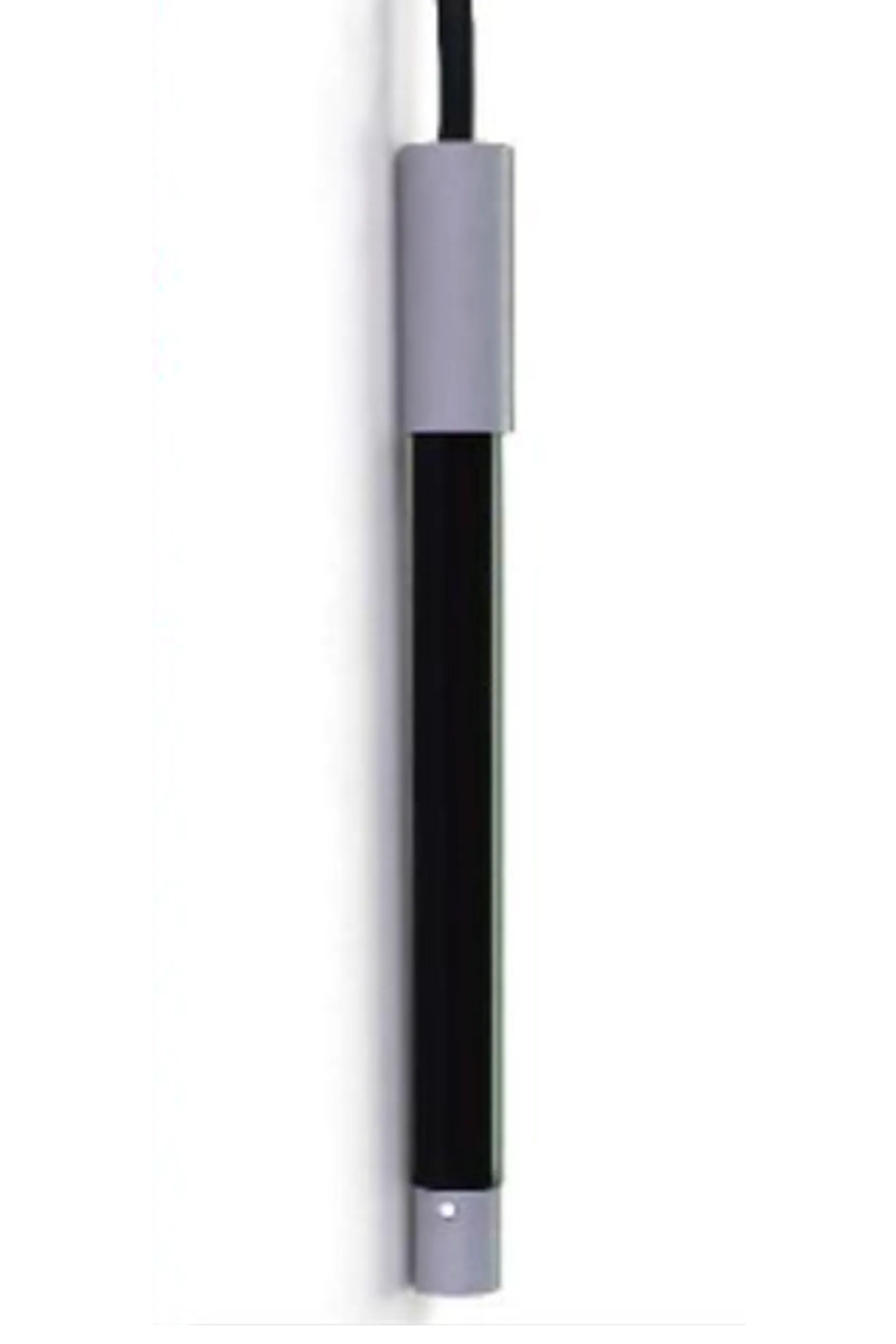
The Agrinovo CO2-100 is a gas-sensing electrode that reports dissolved CO2 from 0.2 to 2200 ppm, with temperature, over RS485 Modbus RTU. Its datasheet requires the sample at pH 4.8 to 5.2, so a laboratory uses it on water that is already in that window, or on a drawn sample or side stream buffered into it, where the reading follows the inorganic carbon the sample carried, expressed as CO2.
At a glance
- Sample condition
- pH 4.8 to 5.2 at the electrode for valid readings
- Measurement range
- 0.2 to 2200 ppm CO2, configurable to 20000 ppm, resolution 0.01 ppm
- Accuracy
- ±5% FS, with automatic (NTC10K) or manual temperature compensation
- Interface
- RS485 Modbus RTU, 32-bit float registers, 9 to 27 V DC supply
Carbon dioxide in water is awkward to measure because it will not stay put. It escapes to the air when a sample is poured, and it converts to bicarbonate and back as the pH moves. A laboratory that wants a CO2 number therefore has to decide two things before buying a sensor: which carbon pool it wants to know, and under what chemical conditions the sensor can deliver it. For the CO2-100 the second answer is printed on the datasheet as a working pH range of 4.8 to 5.2. The experimental setup follows from that line.
How a gas-sensing CO2 electrode works
A gas-sensing electrode keeps the sample on one side of a gas-permeable membrane and a thin layer of inner solution on the other. Harvey’s analytical chemistry text describes the CO2 version: dissolved CO2 crosses the membrane, reacts with water in the inner solution to form bicarbonate and hydronium ions, and a pH-sensing element behind the membrane registers the change. The membrane passes the gas and holds back the non-volatile part of the sample matrix. The same text notes that the inner solution changes with use, which is why electrodes of this kind are recalibrated and serviced periodically.
The CO2-100 packages that electrode with an NTC10K thermistor, an isolated supply and an RS485 Modbus interface in a PPS body 30 mm in diameter and 220 mm long, threaded 3/4 inch NPT at the front and back.
What the CO2-100 reports
Three 32-bit float values come back from one Modbus request: the CO2 concentration in ppm, the electrode signal in mV, and the temperature in °C.
| Parameter | CO2-100 |
|---|---|
| CO2 range | 0.2 to 2200 ppm (configurable to 20000 ppm) |
| Resolution | 0.01 ppm |
| Accuracy | ±5% FS |
| Working pH range | 4.8 to 5.2 |
| Temperature range | -10 to 110 °C |
| Temperature accuracy | ±0.5 °C |
| Temperature compensation | Automatic (NTC10K) or manual |
| Supply voltage | 9 to 27 V DC, 0.5 W or less |
| Isolation | 2500 Vrms |
| Housing | PPS, NPT 3/4 inch front and back thread, Ø30 mm, 220 mm length |
The pH 4.8 to 5.2 window
Dissolved inorganic carbon exists as dissolved CO2, bicarbonate and carbonate, and the pH sets the split between them. Middelburg and co-authors describe the system with three measurable parameters, pH, dissolved inorganic carbon and the partial pressure of CO2, of which any two define the rest. Only the dissolved gas crosses the electrode membrane. Holding the sample at a fixed acidic pH pins the split, so the electrode sees a stable and known share of the carbon.
ASTM D513 builds a standard method on the same principle. Its Test Method A uses a gas sensing electrode for total or dissolved carbon dioxide, a quantity the standard defines to include CO2, carbonic acid, bicarbonate ion and carbonate ion, over 2 to 800 mg/L in natural waters and brines.
For the experiment this gives two cases:
- The water is already at pH 4.8 to 5.2. The reading is the dissolved CO2 of the water as sampled.
- The water is buffered into the window. Acidifying moves bicarbonate and carbonate toward CO2, so the reading follows the inorganic carbon the sample carried, expressed as CO2. Free CO2 at the original pH is calculated from that figure with the pH and temperature recorded before conditioning.
Write down which case applies in the methods section, with the buffer and the mixing ratio.
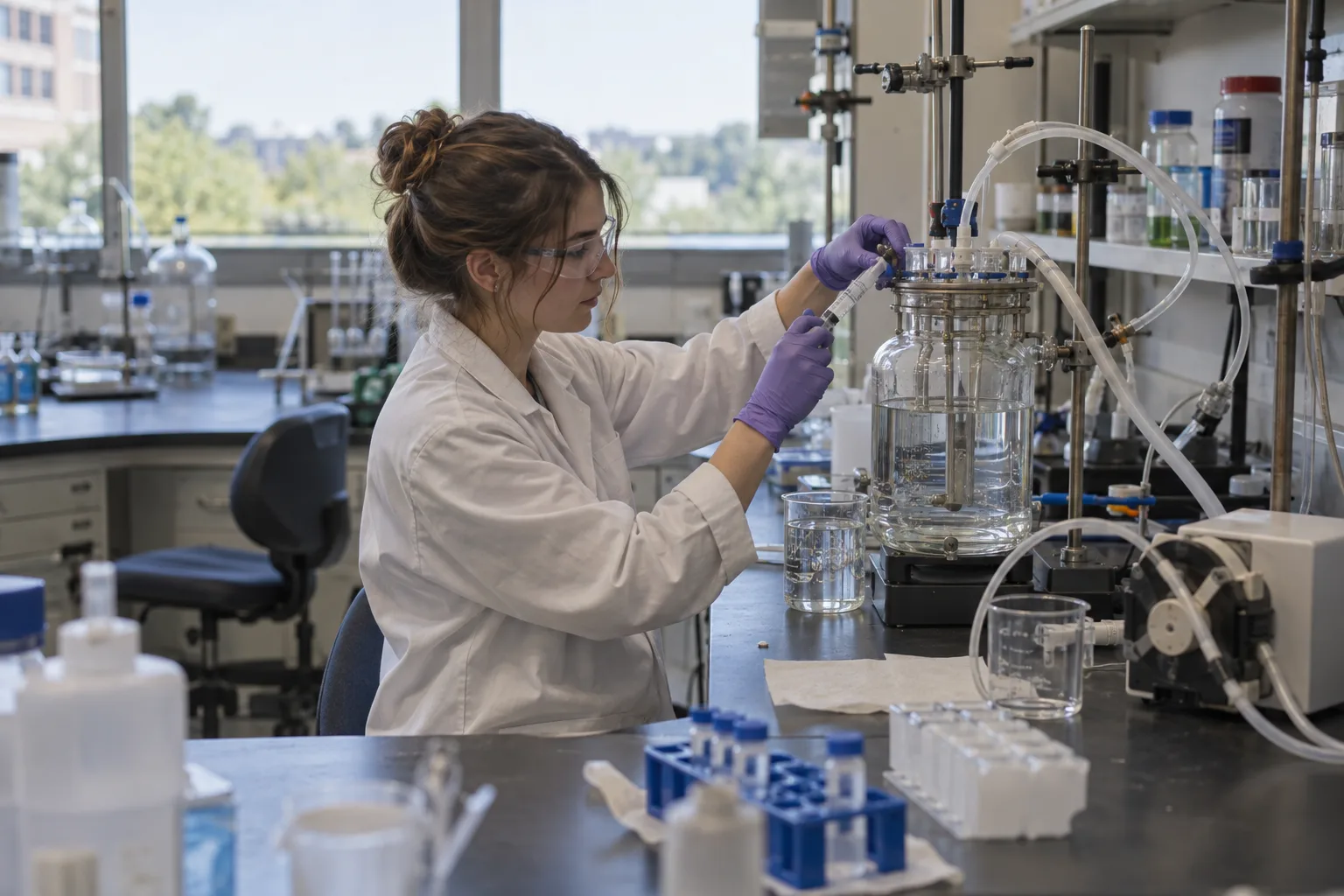
Running a conditioned sample
Drawn samples
- Draw the sample into a syringe or a bottle filled from the bottom, with no headspace. The ASTM standard warns that loss of CO2 disturbs the carbonate equilibrium.
- Add an acid buffer in a fixed volume ratio that brings the mixture to pH 4.8 to 5.2. Find the ratio once for each water type by titrating a spare sample against a pH probe.
- Transfer to a closed measuring cell with the electrode tip immersed and stir gently. The datasheet asks you to avoid air bubbles and high-flow zones at the tip.
- Record the CO2 value, the electrode mV and the temperature once the mV signal is steady.
- Multiply by the dilution factor from the buffer addition.
A side stream from a reactor or tank
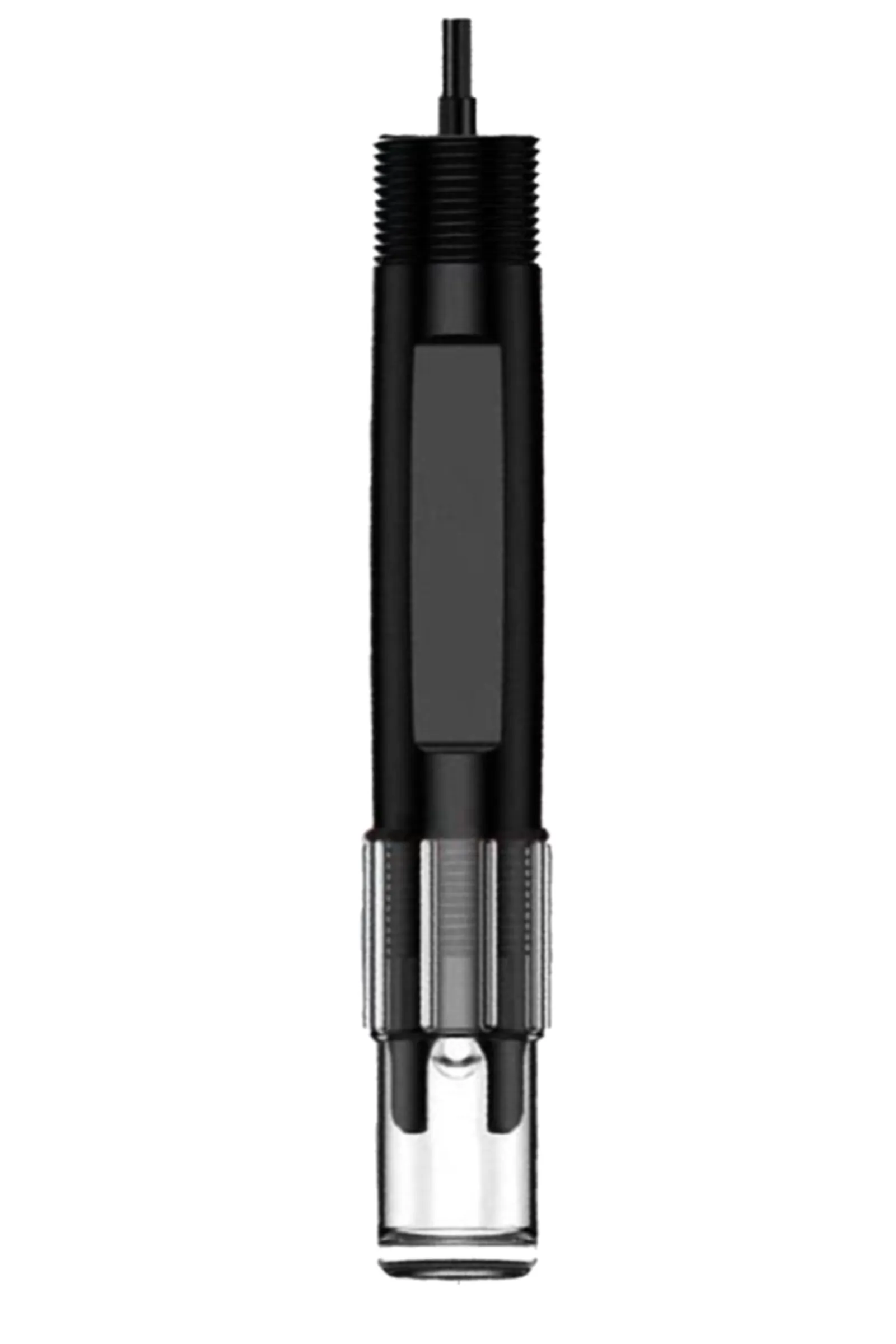
For a time series, bleed a small flow from the vessel with a peristaltic pump, dose the buffer through a mixing tee with a second pump channel, and pass the mixture through a flow cell holding the CO2-100. The 3/4 inch thread seats the probe in a standard tee or cell. A PH-100 pH probe in the same line confirms that the stream stays inside the window, and it shares the RS485 bus under its own Modbus address. Send the conditioned stream to waste, since it now carries buffer.
Keep the line between vessel and cell short and gas-tight, hold the flow low and steady, and log the two pump rates so the dilution factor is on record.
Where research groups use it
Carbon capture and mineralization experiments
The USGS describes carbon mineralization as CO2 reacting with rocks rich in magnesium, calcium and iron to form solid carbonate minerals, with basalt, peridotite and serpentinite as the candidate formations. Bench experiments that react rock or industrial residues with CO2-charged water follow the carbon left in solution over time. Samples drawn from the reactor and conditioned give that series directly, and the configurable upper range of 20000 ppm leaves room for carbonated solutions.
Bioreactors and fermentation side streams
Cells release CO2 into the broth, and the broth pH decides how much of it stays as dissolved gas. A cell-free side stream from a filtration loop, conditioned and passed through the flow cell, gives an inorganic carbon series that can be set against the off-gas analysis for a carbon balance.
Aquaculture and hydroponics research
In recirculating aquaculture the usual field method for dissolved CO2 is titration. Pfeiffer, Summerfelt and Watten compared it with headspace, calculated and probe methods at 8 to 50 mg/L CO2 and found titration unsuitable for marine systems because dissolved solids and minerals interfere. Culture water is held near neutral, so with the CO2-100 it is run as a conditioned sample, and free CO2 is calculated with the tank pH. Trials on degassing columns, stocking density or CO2 enrichment of nutrient solutions use the same arrangement. The ASTM standard gives a sense of scale: surface waters usually hold under 10 mg/L of CO2, and deep groundwater may hold several hundred.
Calibration
The probe stores up to five calibration points and recognises standards of 0.1, 1, 10, 100 and 1000 ppm. With the electrode in a standard, write the standard’s code to register 0x0043 (for example 0x0008 for 10 ppm) and poll that register: 1 means in progress, 0 means accepted, 3 means the signal was unstable or out of range after 180 seconds, and 4 means electrode performance is outside the allowed range. Writing 0x7FFF clears all points. Register 0x001C returns the electrode efficiency, between 70 and 130 percent, which is a useful number to log at every calibration.
Pick the points that bracket the concentrations you expect, and take the standards through the same buffer, mixing ratio and temperature as the samples so the electrode meets the same matrix in both.
Reading it from your own hardware
- Wiring: red to 9 to 27 V DC, black to ground, yellow to RS485-A, white to RS485-B.
- Serial: Modbus RTU, 9600 bps by default, 8 data bits, no parity, 1 stop bit, address 0x01. Baud rates from 1200 to 19200 and addresses 1 to 247 are supported.
- Request:
01 03 00 00 00 0A C5 CDreads 10 registers from 0x0000. - Decoding: each value is an IEEE-754 float across two registers, with the high word in the second register. CO2 is at 0x0000, the electrode signal at 0x0002 and temperature at 0x0008.
An Arduino or ESP32 needs an RS485 transceiver and a supply inside the probe’s voltage range. A PC reads it through a USB to RS485 adapter from Python or any Modbus master program. The CO2-100 developer page has the register map, a float decoding example and the calibration commands.
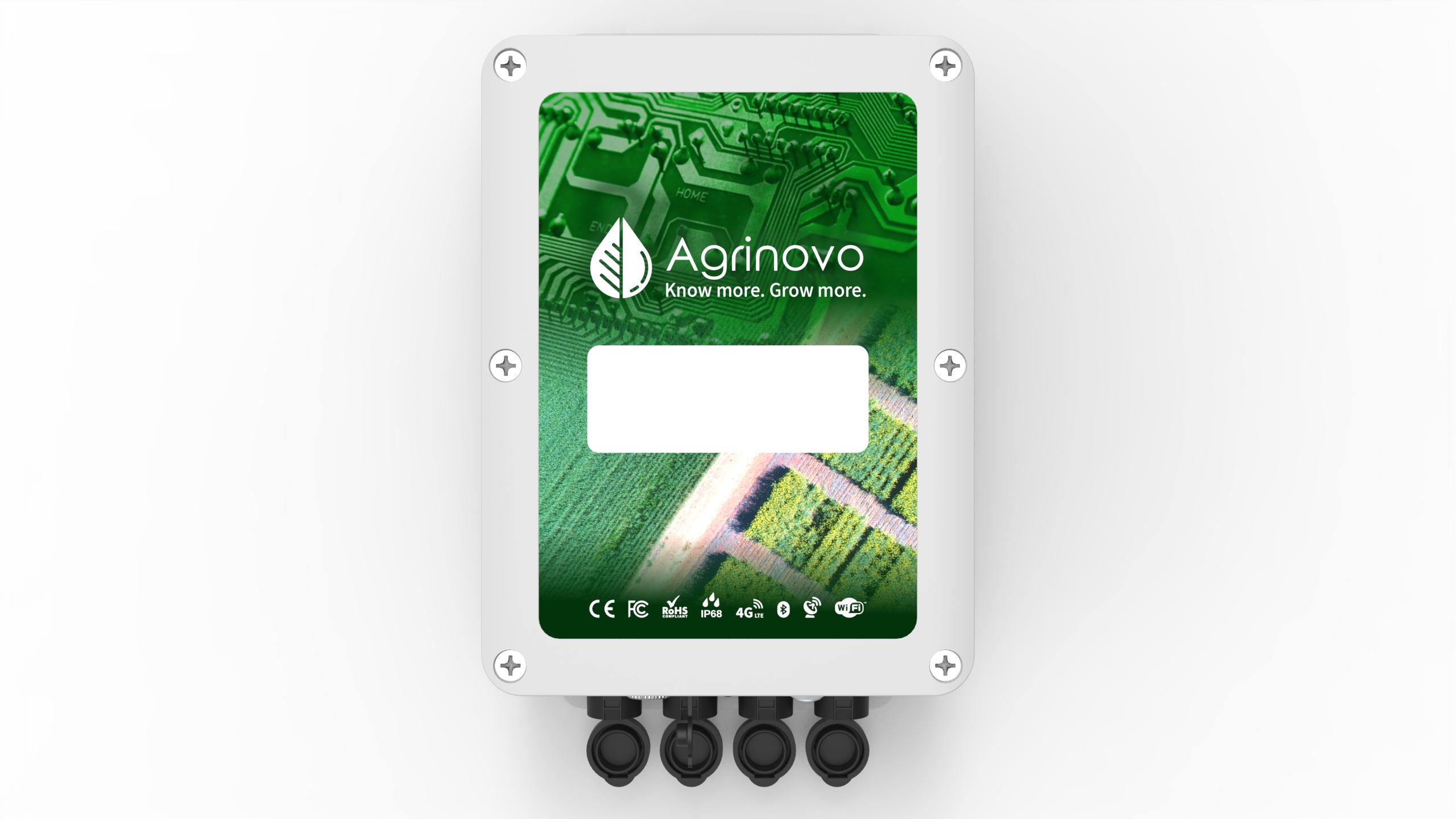
Groups that want the data in the cloud without building a logger connect the probe to an Omni Genesis controller. A port set to RS485 Modbus RTU powers the probe from its switched 12 V supply and reads it on the interval set in the dashboard, and the controller stores readings locally and syncs them over 4G-LTE or Wi-Fi. Readings are then available through the API. Quotes, purchase orders and citation details are on the research purchasing page.
Agrinovo hardware for this application
Every item links to its product page with the datasheet. Specifications on those pages come from the manufacturer documents, not from this article.
Frequently asked questions
What sample pH does the CO2-100 need?
How do I measure dissolved CO2 in a neutral reactor, fish tank or nutrient solution with the CO2-100?
What does the reading mean on a conditioned sample?
What range and accuracy does the CO2-100 have?
Can I read the CO2-100 from an Arduino, an ESP32, a PLC or a PC?
How is the CO2-100 calibrated?
Sources
The agronomy on this page comes from the publications below. Where a number is not on this list, we left it out.
- ASTM D513-16: Standard Test Methods for Total and Dissolved Carbon Dioxide in Water, ASTM International
- Analytical Chemistry 2.1, section 11.2: Potentiometric Methods (gas-sensing electrodes), David Harvey, DePauw University, via LibreTexts
- Ocean Alkalinity, Buffering and Biogeochemical Processes (Reviews of Geophysics, 2020), J.J. Middelburg, K. Soetaert and M. Hagens, Utrecht University and NIOZ
- Carbon Mineralization, U.S. Geological Survey, Geology, Energy and Minerals Science Center
- Comparative performance of CO2 measuring methods: marine aquaculture recirculation system application (Aquacultural Engineering, 2011), T.J. Pfeiffer, S.T. Summerfelt and B.J. Watten, publication record at the U.S. Geological Survey
Other applications
Orchards & plantations
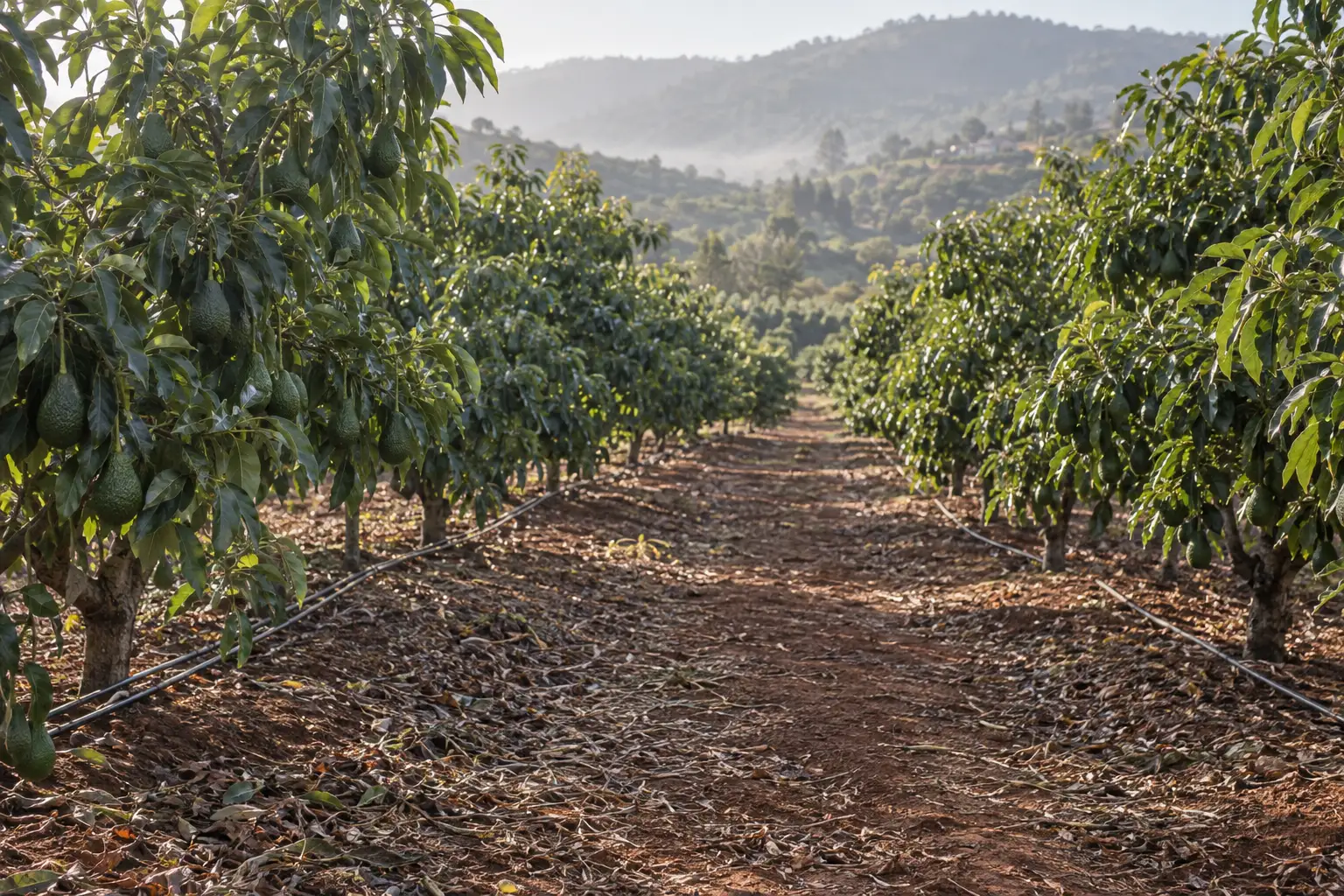
Avocado orchards
Which sensors an avocado orchard needs and where to put them: tensiometers and Watermark probes at 20 and 45 cm, irrigation triggers by soil type, EC of the irrigation water, and the Agrinovo hardware that reads them remotely.
Orchards & plantations
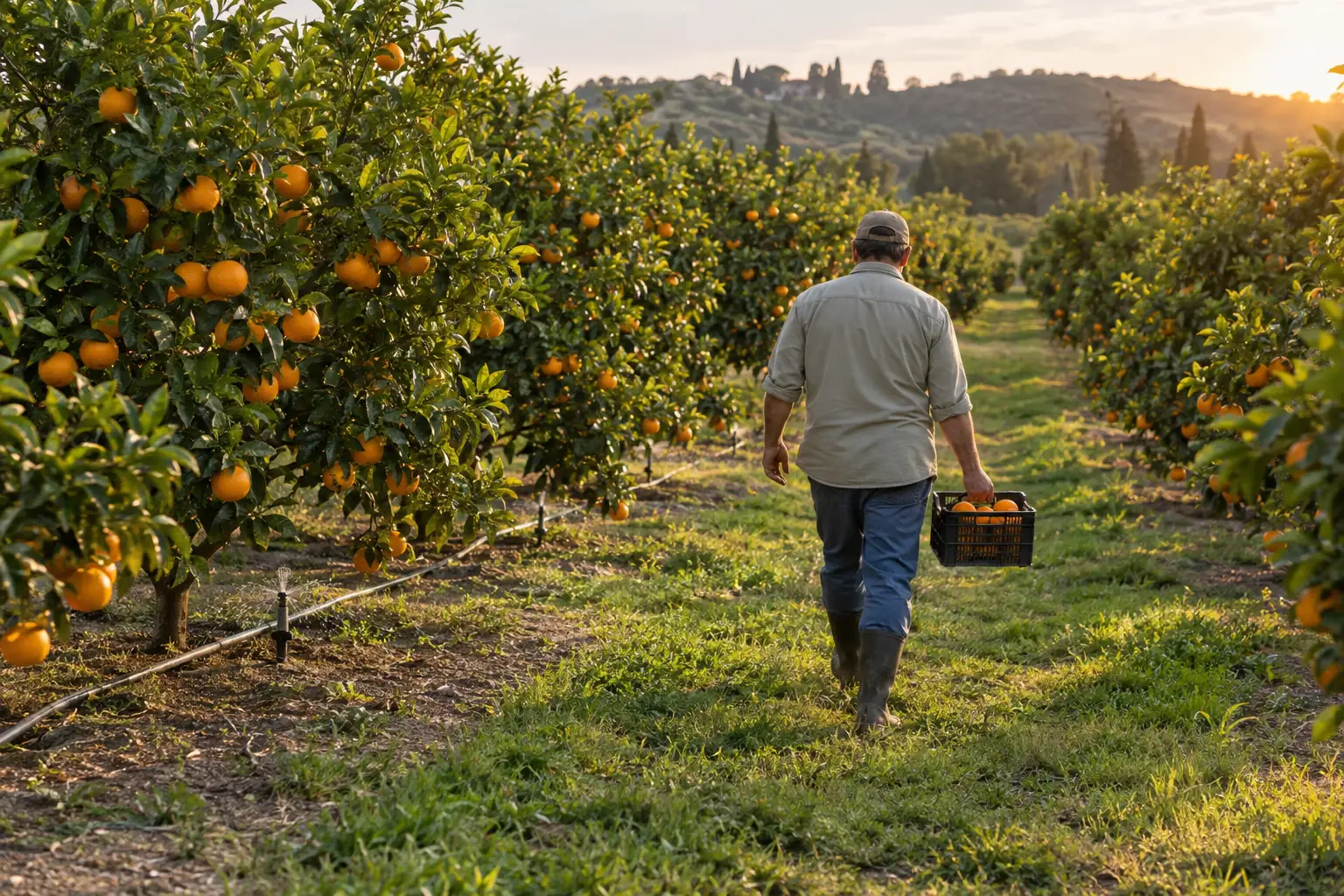
Citrus orchards
Which sensors a citrus grove needs and where they go: two soil water sensors in the top 30 cm at the dripline, depletion and tension triggers, irrigation water EC against rootstock chloride limits, and the Agrinovo hardware.
Orchards & plantations
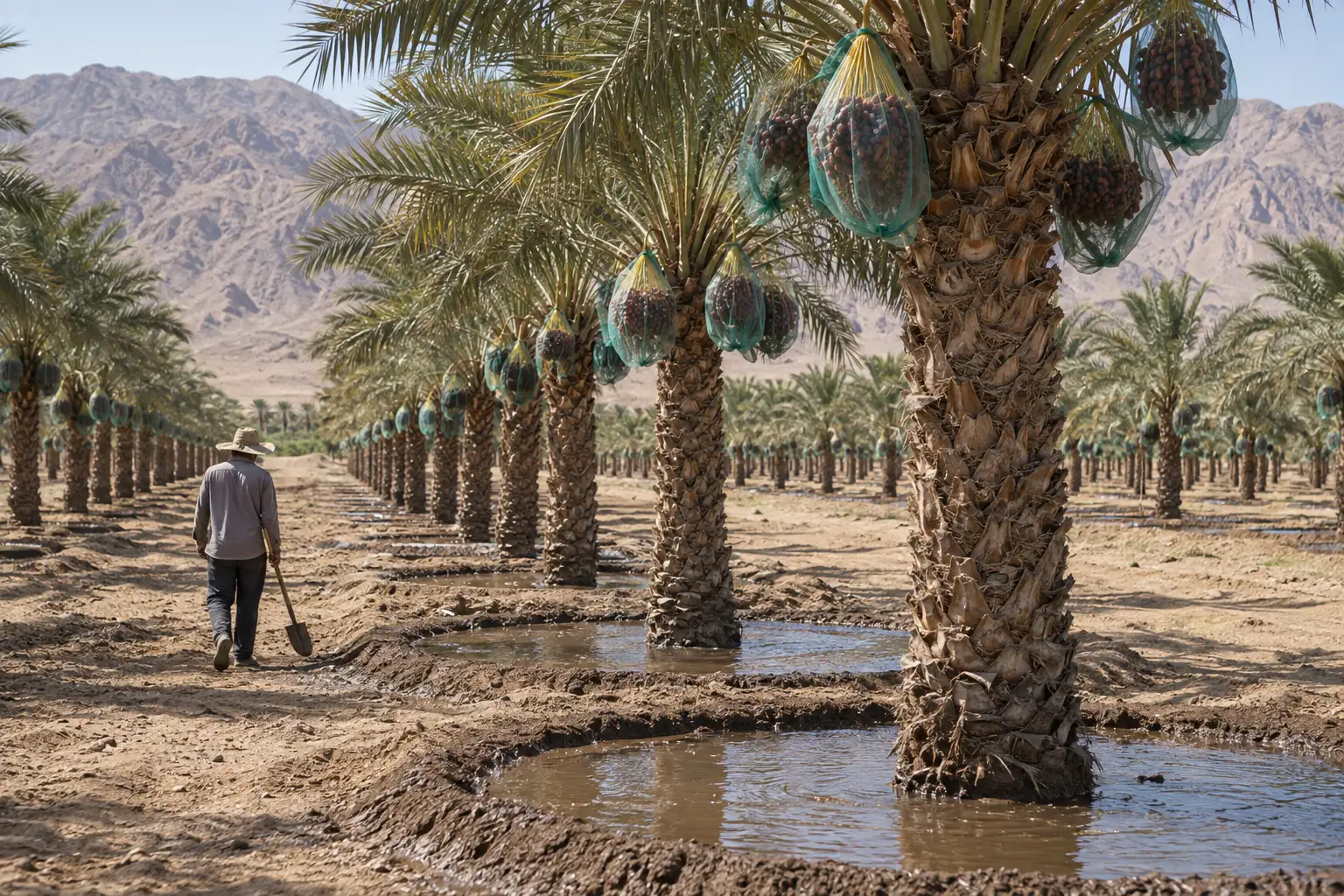
Date palm plantations
Which sensors a date palm plantation needs: tensiometers and Watermark sensors from 30 to 120 cm where the palm draws its water, EC of the irrigation water, and the Agrinovo hardware that reports them over cellular.
Tell us about your plot
Soil type, crop, irrigation method and what you want to see from your phone. We reply with a sensor list and a layout, not a brochure.