IoT Aquaculture Monitoring System
Optimize your aquaculture operation with precise, real-time water quality monitoring. Track dissolved oxygen, temperature, pH, and water conditions to ensure healthy fish and maximum productivity.
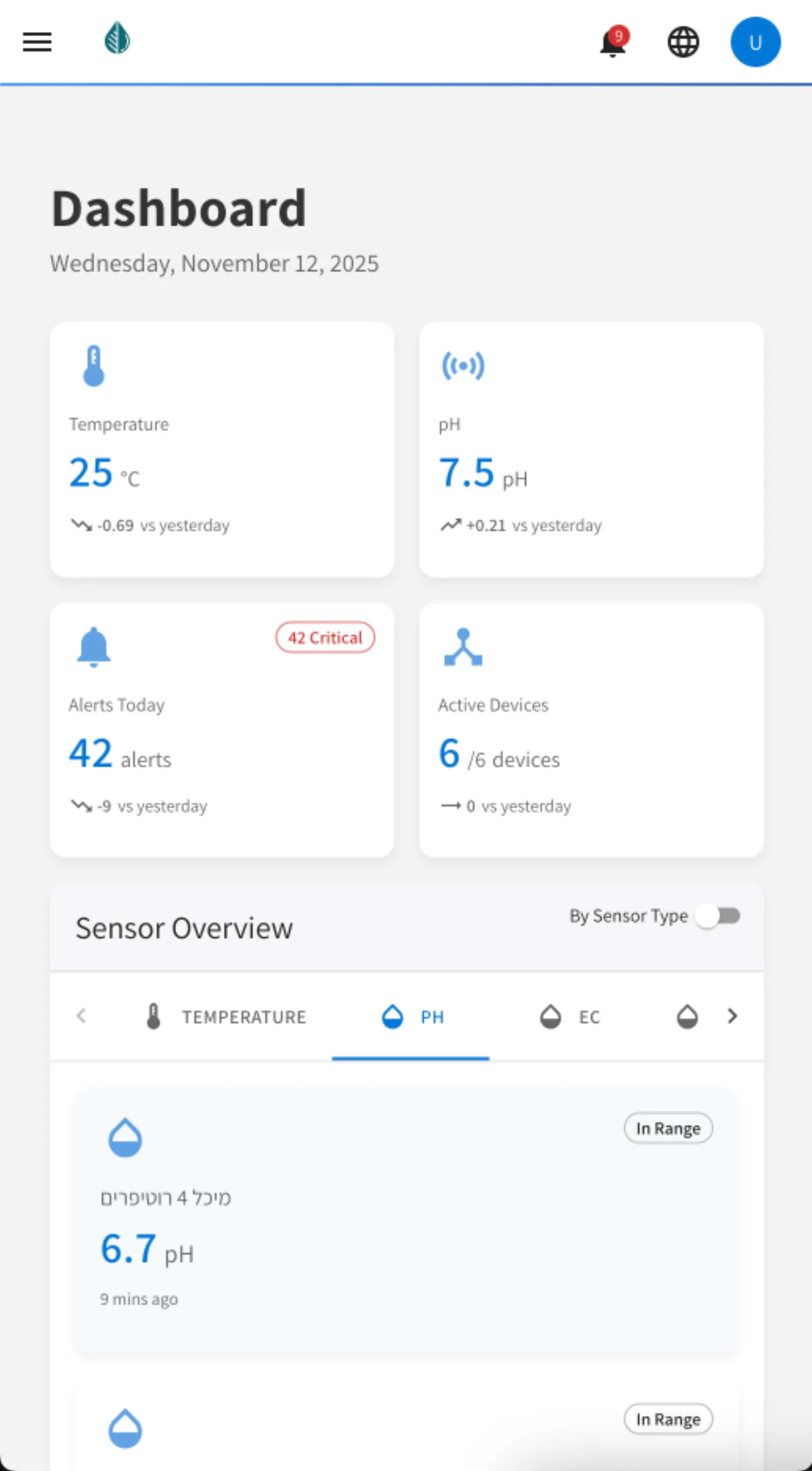
Dive Into Smart Aquaculture
Advanced water monitoring technology designed specifically for fish farming operations
Fish Health Optimization
Monitor critical parameters like dissolved oxygen and temperature to maintain optimal conditions for fish growth and health. Early detection prevents costly die-offs.
Water Quality Management
Comprehensive monitoring of pH, turbidity, and chemical levels ensures optimal water conditions. Track water clarity with the TUR-110 turbidity sensor, SS-130 suspended solids sensor, and MLSS-110 sludge concentration sensor for complete water quality insights. Automated alerts help you respond quickly to changes.
Continuous Monitoring
Round-the-clock surveillance of your aquaculture systems with instant notifications for any parameter that falls outside optimal ranges.
Data-Driven Decisions
Historical data analysis and predictive insights help you optimize feeding schedules, stocking density, and harvest timing for maximum profitability.
Complete Water Quality Intelligence
Our comprehensive monitoring system tracks all critical water parameters
Dissolved Oxygen
Critical oxygen levels monitoring to ensure fish health and prevent die-offs.
pH Levels
Monitor water acidity to maintain optimal conditions for fish growth.
Temperature
Precise water temperature monitoring for optimal fish metabolism and growth.
Water Quality
Comprehensive turbidity, conductivity, and chemical parameter monitoring.
Built for Every Aquaculture Operation
Our water monitoring solutions adapt to any aquatic farming environment
Pond Fish Farming
Monitor large-scale outdoor ponds for tilapia, catfish, and carp. Track dissolved oxygen stratification and temperature layers to optimize aeration.
RAS Systems
Recirculating aquaculture systems require precise monitoring. Control biofilter efficiency, ammonia levels, and water quality in closed-loop tanks.
Marine Cage Farming
Ocean and coastal cage systems for salmon, sea bass, and shrimp. Monitor salinity, dissolved oxygen, and environmental conditions in open water.
Hatcheries
Sensitive larvae and fry require precise water conditions. Monitor temperature stability, pH, and dissolved oxygen for maximum survival rates.
Common Aquaculture Challenges We Solve
Traditional aquaculture relies on manual testing and reactive management. By the time problems are detected, fish may already be stressed or dying.
Dissolved Oxygen Crashes
Overnight DO drops can kill entire stocks before morning checks
Ammonia Spikes
Toxic ammonia buildup causes gill damage and mortality
Temperature Fluctuations
Rapid temperature changes stress fish and reduce growth rates
Disease Outbreaks
Poor water quality creates conditions for pathogen growth
Real-Time Monitoring Changes Everything
Instant DO Alerts
Get notified immediately when oxygen drops below safe levels
Predictive Analytics
AI predicts problems before they occur based on trends
Historical Insights
Learn from past data to optimize future production cycles
Automated Response
Trigger aerators, alarms, or other systems automatically
From Water to Wisdom
Three simple steps to transform your aquaculture operation with intelligent monitoring
Deploy Water Sensors
Strategic placement of marine-grade sensors throughout your ponds, tanks, or cage systems for comprehensive water quality monitoring.
Continuous Data Stream
Real-time collection of dissolved oxygen, temperature, pH, and water quality parameters transmitted at your chosen interval to our secure platform.
Intelligent Insights
AI-powered analytics provide actionable recommendations for feeding, aeration, and harvesting decisions to maximize fish health and profits.
Technical Specifications
Marine-grade sensors designed for aquaculture environments
System Features
- Dissolved Oxygen: 0-20 mg/L with ±0.1 mg/L accuracy
- Temperature: -5°C to 50°C with ±0.1°C precision
- pH: 0-14 with ±0.1 precision
- Turbidity, conductivity, and ammonia monitoring
- Supports any other available sensors from our products catalog
- Wireless connectivity (cellular 4G, LoRaWAN-ready)
- 3+ year battery life
- IP68 waterproof rating
Cloud Capabilities
- Real-time data monitoring and visualization
- Data export (CSV, Excel, PDF)
- RESTful API for system integration
- Real-time alerts and notifications (Email, SMS, Push)
- Smart analytics and predictive insights
- Historical data analysis and reporting
- Multi-user access with role management
Building an Aquaculture Monitoring System: Components and Sensor Selection
An aquaculture monitoring system is a connected stack of in-water sensors, a field controller, cellular connectivity, and a cloud platform. The right configuration depends on what you grow, the water type, and the size of your operation. Below is the structure of a working system and how to size it for your farm.
Core Sensors Every Aquaculture Monitoring System Needs
Five parameters cover the failure modes that kill stock fastest. A monitoring system that misses any one of these is incomplete:
- Dissolved oxygen (DO): the single highest-priority sensor. Fluorescent (optical) DO probes like the DO-100 do not need membrane replacements and hold calibration much longer than galvanic alternatives. For full saltwater, the titanium DO-110 handles 0-60 ppt salinity without corrosion.
- pH: directly controls ammonia toxicity. The PH-100 is a digital RS485 probe with automatic temperature compensation; the PH-10 is the analog inline equivalent for legacy systems.
- Electrical conductivity (EC) and salinity: EC-100 (K=1.0) for freshwater, EC-120 (K=0.45) for brackish and marine. Cell constant must match your salinity range or readings are inaccurate, regardless of how good the probe is.
- Temperature: integrated into every modern digital DO and pH probe with automatic compensation. Standalone temperature probes are useful for vertical profiling.
- ORP (oxidation-reduction potential): the early warning signal for water quality drift. Healthy aquaculture water reads 200-400 mV. The ORP-100 (digital) and ORP-10 (analog) cover both control architectures.
Operations running ozone treatment add the O3-100 dissolved ozone sensor at the contact chamber outlet. Intensive RAS systems add ammonia (NH3-100) and nitrite (NO2-100) ion-selective probes for biofilter monitoring.
Controller Selection by Operation Type
The controller reads your sensors over RS485, SDI-12, or analog, and pushes data to the cloud. Match the controller to your sensor count and your environment:
- Single freshwater pond, 3-4 sensors: the Omni Genesis (4 ports) handles a complete DO, pH, EC, ORP loop with solar-friendly low power draw (under 30 microamps in sleep).
- Marine cage or saltwater pond, 5-6 sensors: the Omni Exodus (6 ports) uses marine-grade connectors that survive salt spray, where standard connectors corrode within months.
- Pilot or single-sensor deployment: the Omni Genesis Lite (1 port) is the entry point for proving the concept on one critical pond before scaling.
All three accept 6-32V DC solar input and support RS485 Modbus, SDI-12, I2C, and analog inputs natively. Open protocols matter: vendor lock-in to proprietary sensor formats is the most expensive long-term mistake an aquaculture operation can make.
Connectivity for Pond Operations at Scale
Most aquaculture operations are not next to Wi-Fi. Three connectivity patterns cover the realistic deployment scenarios:
- Direct 4G/LTE per controller: the proven default for pond and cage operations. Each controller carries its own cellular link, so a single site or a multi-pond layout stays online without shared infrastructure. Tested cellular coverage at the actual sensor location is non-negotiable; "there is signal at the farmhouse" does not equal signal 600 meters out.
- Wi-Fi or mesh: reasonable for indoor RAS facilities and small farms within range of an existing network. Range is the limit, not bandwidth.
- Modular LoRaWAN option: the Genesis controller is LoRaWAN-ready, so a future low-power radio add-on can let multiple controllers share a single 4G gateway across 2-10 km. Cellular remains the connectivity that ships and is tested today.
Aquaculture Monitoring System for RAS, Pond, Marine Cage, and Hatchery Operations
The same hardware stack covers very different operation types. The differences are in placement, redundancy, and which advanced sensors get added:
- Recirculating aquaculture systems (RAS): add ammonia and nitrite probes for biofilter monitoring. Place sensors at multiple points (sump, biofilter outlet, fish tank return) to track the nitrogen cycle. Add ORP at the fish tank as a hard safety cutoff for any ozone subsystem. The RAS water quality monitoring guide walks through the full sensor map.
- Pond fish farming (tilapia, catfish, carp): single sensor station per pond under 0.5 hectares, two stations per larger pond (one near inlet, one near drain). Place DO probes at 60-80% water depth where fish concentrate. Cover all five core parameters; ORP is especially valuable for catching the slow water-quality decline that precedes a die-off.
- Marine cage farming (salmon, sea bass): titanium-bodied DO and high-salinity EC are non-negotiable. Add a current/temperature profile if you operate in stratified water. Plan for sensor replacement on a 12-18 month cycle; even titanium needs maintenance in full seawater.
- Shrimp ponds (vannamei, monodon): ammonia is the parameter that causes the most chronic production losses. Add the NH3-100 probe alongside DO, pH, EC-120, and ORP. The shrimp farm water quality guide covers stage-by-stage parameter targets.
- Hatcheries: larvae are far more sensitive than adults. Tighter alert thresholds, faster polling intervals, and often pH plus DO at multiple depths in the same tank. Hatchery operations also tend to need integration with feeding and aeration controls, so API access on the cloud platform matters more than for grow-out.
Sizing and System Layout
The most common sizing mistake is buying exactly the number of sensor ports needed today. Add at least one spare port for the sensor you will inevitably want next year. The most common installation mistake is placing all the sensors at the easiest-to-reach point rather than at points that represent the actual stock conditions. Both mistakes are free to avoid in the planning stage and expensive to fix once deployed.
For complete sensor selection guidance with specific product comparisons, see the aquaculture monitoring system buyer's guide. For sensor protocol selection (RS485 vs SDI-12 vs analog) on mixed-vendor systems, the sensor protocols guide covers the trade-offs.
Aquaculture Monitoring Questions, Answered
Straight answers on water quality parameters, sensors, and remote monitoring for fish and shrimp farms
What water quality parameters does an aquaculture monitoring system track?
How does IoT monitoring reduce fish mortality in aquaculture?
What is the ideal dissolved oxygen level for fish farming?
How much does an aquaculture monitoring system cost?
Can aquaculture sensors work in saltwater and freshwater?
Which remote monitoring platforms work with large-scale pond equipment and sensors?
Aquaculture Monitoring Guides
In-depth resources to help you build and optimize your water quality monitoring system
Monitoring System Buyer's Guide 2026
Compare sensors, controllers, and IoT platforms for fish farming. What features matter most and how to avoid costly mistakes.
Water Quality Monitoring: Complete Guide
Master DO, pH, ORP, EC, and ammonia sensors. Learn which parameters matter most and how to prevent costly fish losses.
Choosing a Dissolved Oxygen Sensor
Compare fluorescent vs galvanic technology, freshwater vs saltwater materials, and what specs actually matter for fish farming.
RAS Water Quality Monitoring
Which sensors are critical for recirculating aquaculture systems, optimal parameter ranges, and how to prevent system crashes.
Shrimp Farm Monitoring Guide
Optimal parameter ranges for Vannamei and Monodon, sensor selection, and disease prevention through continuous monitoring.
IoT vs Manual Testing: ROI Analysis
Real numbers on labor savings, fish mortality reduction, and payback periods comparing continuous IoT monitoring to manual water testing.
Dissolved Ozone Monitoring Guide
How to measure dissolved ozone in water treatment and aquaculture. Sensor technologies, placement strategies, and IoT integration.
ORP Control for Ozonation in RAS
How to use ORP sensors to control ozone dosing in recirculating aquaculture systems. Safe setpoints by species and automation guide.
Ammonia, Nitrite and Nitrate Sensors: Which to Buy
The nitrogen trio as a buying decision: which probes each system type needs, ISE vs test kits, and what the controller does with the readings.
Shrimp Farm Monitoring System
What goes into a shrimp farm monitoring system: which sensors to deploy, where to place them, the alert thresholds that matter, and how to scale across ponds.
RAS Monitoring System
The DO, pH, ammonia, and ORP sensors a recirculating loop needs, where each one goes, and the alarms that catch a biofilter problem before fish do.
Tilapia Farm Water Quality Monitoring
Which parameters matter for tilapia in ponds, cages, and tanks, the sensors to use, where to place them, and the alerts that protect a crop.
Ready to Optimize Your Aquaculture?
Join leading aquaculture operations using IoT monitoring to improve fish health, increase survival rates, and maximize profitability.
Technical capabilities
The facts an integration plan needs. Full measurement range and accuracy specifications are on every product page and datasheet.
Sensor protocols
- RS-485 Modbus RTU
- SDI-12
- I2C
- Analog
- 1-Wire
Connectivity
- 4G LTE cellular (optional)
- Wi-Fi
- Bluetooth
Power and enclosure
- Solar powered
- Battery operated, deep-sleep cycle
- IP65 rated controllers
Data and integration
- Cloud dashboard with real-time alerts
- Configurable reporting intervals
- REST API access