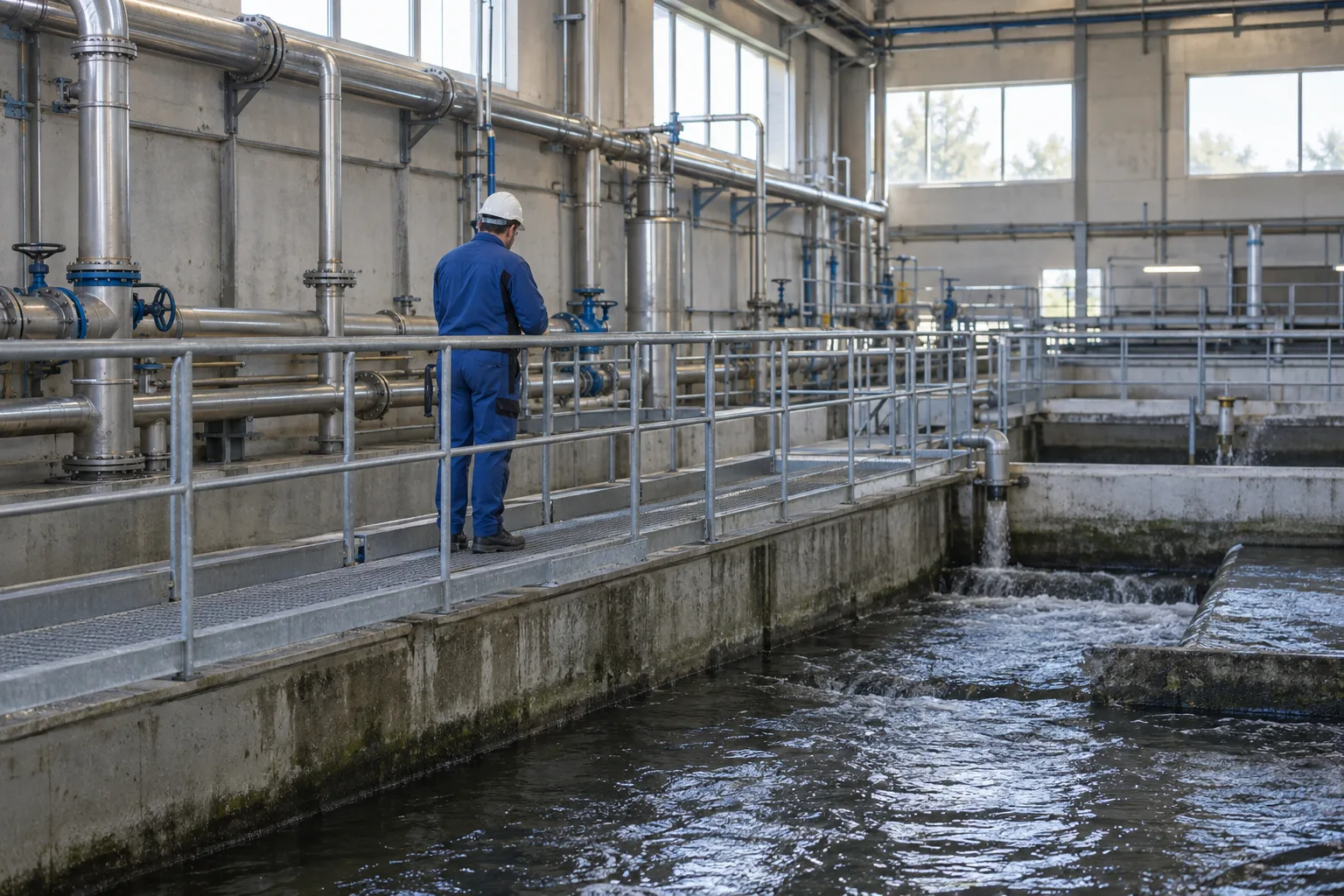
Search for an RS485 pH sensor and most of what comes back is aimed at hobby projects and lab benches. A probe that has to sit in a tank or a pipe for months, next to pumps and dosing equipment, and report to a controller without anyone standing over it, is a different instrument. This guide covers what separates the two and how to choose among process pH probes.
Process probe or lab electrode
A lab electrode is designed to be dipped, read and put back in its storage cap. A process probe is designed to stay in the water. Four things follow from that:
- Sealed for immersion. A process probe is rated for continuous submersion. The PH-110 is IP68.
- A threaded body. It mounts in a pipe tee, a tank wall or an immersion holder. The PH-110 has a 3/4 inch NPT thread.
- Electronics in the probe. The signal from a pH electrode is tiny and does not travel well over a long cable. A process probe converts it inside the body and sends a robust signal out.
- Calibration without removing the cable. The probe is calibrated in place, from the controller side.
If the probe you are comparing lacks these, it is a bench instrument, whatever the listing says.
Output: RS485 Modbus, analog, or both
This is the first real decision, and it is decided by what the probe connects to.
RS485 Modbus RTU sends the finished pH value as digital data. Several probes share one two-wire bus, each with its own address. Distance has little effect on the value, and calibration commands travel over the same line. The PH-100 is an RS485 probe: 9600 bps by default, address 1 out of the box, configurable from 1 to 254. If the terms are new, our guide to sensor protocols explains RS485, Modbus and analog signaling.
Analog output suits equipment that expects a current or a voltage: a PLC analog card, a chart recorder, a dosing controller. Each probe needs its own input, and the receiving end has to scale the signal back into pH.
Both outputs remove the decision. The PH-110 provides RS485 Modbus together with 4-20 mA and 0-2 V, 0-5 V or 0-10 V. A dosing controller can take the analog signal while a monitoring system reads the same probe over Modbus, and a probe bought for one installation still fits the next.
Isolation and electrical noise
A pH electrode works at very high impedance. The PH-110 datasheet lists 100 MΩ. A signal that weak is easily disturbed, and a process tank is an electrically noisy place: pump motors, solenoid valves, dosing pumps and variable speed drives all leak small currents into the water.
Without isolation, those currents find a path through the probe and the reading jumps whenever equipment switches. That is why a pH value can look steady on the bench and unstable in the tank. The PH-110 uses four-layer isolation with internal filtering for this reason. If the probe will share a tank with pumps or dosing equipment, treat isolation as a requirement.
Range, accuracy and temperature
The numbers on a pH datasheet matter less than buyers expect, with one exception.
- Range and accuracy. The PH-100 and PH-110 both measure 0 to 14.00 pH at 0.01 pH resolution and ±0.02 pH accuracy, with stability of 0.02 pH or better over 24 hours. For process control and water quality work that is ample. Fouling and calibration drift will move the reading more than the stated accuracy does.
- Operating temperature is the exception. The PH-100 is specified for 0 to 60°C and the PH-110 for 0 to 70°C. Water outside that band needs a probe built for it, such as the PH-G10 high temperature probe.
- Power. Both run from 12 to 24 V DC and draw 0.5 W or less, which suits solar and battery powered installations.
Calibration and upkeep
Every pH probe drifts, because the glass ages and the reference slowly changes. What you are choosing is how awkward calibration will be over the life of the probe.
The PH-100 and PH-110 use three-point calibration with standard buffers at pH 4.00, 6.86 and 9.18. Each point is stored by a Modbus command, so calibration is done from the controller with the probe sitting in the buffer. Nothing needs to be opened.
How often depends on the water. Clean water holds a calibration for weeks. Wastewater, nutrient solutions and anything that coats the glass shorten the interval. Check against a buffer on a fixed schedule, note the drift, and let that set the interval.
Day to day, the datasheet advice is short: rinse with distilled water, keep air bubbles off the tip, never touch the glass with anything sharp, and do not connect or disconnect the probe while it is powered.
Which probe for which job
| Probe | Output | Built for |
|---|---|---|
| PH-100 | RS485 Modbus | Continuous monitoring where the controller reads Modbus: irrigation, hydroponics, aquaculture, wastewater |
| PH-110 | RS485 Modbus plus analog | Industrial installations near pumps and dosing equipment, or where a PLC needs 4-20 mA |
| PH-10 | Analog | In-line electrode for use with an existing transmitter |
| PH-G10 | Analog | High temperature process water |
| PH-T10 | Analog | Flue gas desulfurization scrubbers |
Most monitoring projects come down to the first two. Pick the PH-100 when everything downstream speaks Modbus. Pick the PH-110 when an analog signal is needed, or when the probe will live beside electrical equipment.
Connecting to a controller
An RS485 pH probe connects straight to an Omni Genesis controller, which reads it over Modbus and sends the data over cellular (4G LTE) to the cloud. The same controller takes other RS485 sensors alongside it, and pH is rarely measured alone: conductivity and ORP usually sit in the same tank. Our guides to choosing an EC probe and selecting an ORP probe cover those two.
Conclusion
Choosing an industrial pH probe is mostly a matter of answering three questions in order. What does it connect to, which settles RS485, analog or both. What else is in the tank, which settles isolation. How hot is the water, which settles the temperature variant. Accuracy figures come after all three.
To get a recommendation for your installation, contact us with the water type, the temperature and what the probe needs to connect to.