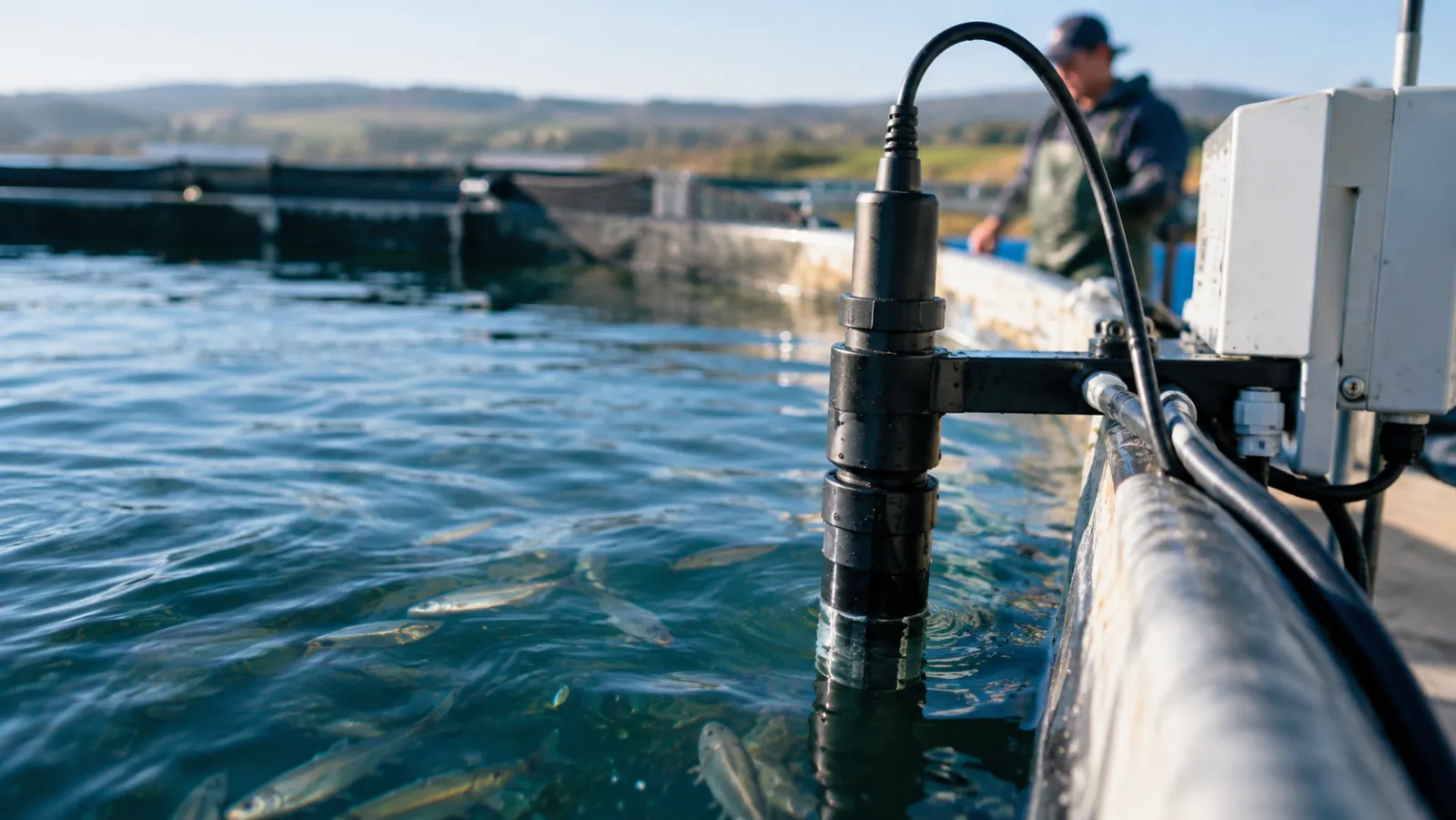
ORP is one of the most useful measurements in water treatment and one of the most misread. It is simple to install, responds in seconds, and drives a dosing loop better than almost anything else available. It also does not measure what most people think it measures, and choosing a probe without understanding that leads to a sensor that technically works and practically disappoints.
What ORP is, in one paragraph
Oxidation reduction potential is a voltage. A measuring electrode, usually platinum, sits in the water alongside a reference electrode, and the potential between them reflects the net tendency of everything dissolved in that water to give up or accept electrons. The result is reported in millivolts, positive for oxidising conditions, negative for reducing.
What it is not is a concentration. An ORP probe cannot tell you how much ozone or chlorine is present. It tells you how oxidising the water currently is, which is the combined result of the disinfectant, the organic load consuming it, the pH, and the temperature. Treat it as a state variable rather than an assay and it becomes extremely useful. Treat it as a residual measurement and it will mislead you.
The three classes of probe, and when each fits
In-line analog. A raw millivolt output into an analog input. The ORP-10 sits here, covering the full practical span at -2000 to +2000 mV with optional temperature compensation. Analog is the right choice when the cable run is short and the electrical environment is quiet. Its weakness is that a millivolt signal is a small signal, and every metre of cable near a pump or a variable frequency drive is an opportunity to pick up noise.
Digital RS485. Conversion happens at the probe head and the value travels as data rather than as a voltage. The ORP-100 covers -1999 to +1999 mV with automatic temperature compensation. This is the sensible default for anything crossing a plant room, sharing a trench with power, or running tens of metres back to a controller. It also means several probes can share one bus back to a single controller.
Industrial. Where the fluid or the mounting is hostile. The ORP-110 uses a PTFE body with four-layer isolation, RS485 Modbus output, a three quarter inch NPT thread on both ends so it mounts directly into a tee or a bypass loop, and single-point offset calibration. The NPT-both-ends detail matters more than it sounds: it is the difference between a probe you can service without cutting pipework and one you cannot.
Installation decides the reading
More ORP deployments are ruined by mounting than by probe choice.
Keep flow past the junction. A probe in a dead leg reads the dead leg, not the process. In a bypass loop, size it so water actually moves. In a tank, put the probe where circulation reaches it rather than in the quietest corner.
Keep the junction wet. An ORP reference that dries out is often permanently damaged, not merely unresponsive. This is the most common way probes die during a shutdown, and it is entirely avoidable.
Mount so you can remove it. Every ORP probe needs cleaning and periodic standardisation. If servicing means draining a line, servicing will not happen, and an unserviced ORP probe is worse than none because it reads low and confidently.
Watch the temperature. ORP is temperature dependent. Automatic compensation, as on the ORP-100, removes one variable from a reading you are already asking to do a lot of work.
The failure mode worth designing against
An ORP probe fails downward. A fouled reference or a coated platinum surface reads lower than reality, and low ORP means “not enough oxidant” to any control loop watching it. So the classic incident is not a probe that stops working. It is a probe that quietly drifts low while the controller dutifully increases dosing to compensate, until somebody notices the water is far more aggressive than intended.
Two defences, and both are simple. Put a hard ceiling on dose rate independent of the ORP loop, so a wrong reading cannot become an unbounded response. And check against a redox standard on a schedule, because a drifting probe is only detectable against something that does not drift.
This is also the argument for reading ORP alongside pH rather than alone. Because the two are linked, an ORP shift with a simultaneous pH shift is usually chemistry, while an ORP shift with steady pH is usually the probe. A pH probe on the same bus turns an ambiguous reading into a diagnosable one.
Getting the data somewhere useful
RS485 Modbus probes share a bus, so a cluster of measurements does not need a cluster of controllers. The Omni Genesis has four modular ports where each port takes any supported protocol, so ORP, pH and temperature can arrive on one unit and report over cellular without depending on a site network.
The reason that matters for ORP specifically is the drift problem above. A probe checked monthly and read continuously gives you a trend, and a trend is what separates “the water changed” from “the probe changed”. A logbook of spot readings does not.
If you are running ORP for ozone or chlorine control in a recirculating system, our guide to ORP control and ozonation in RAS covers the control strategy rather than the hardware, and the dissolved ozone monitoring guide covers the case for measuring residual directly alongside it.
Not sure which of the three fits your installation? Tell us the cable run, the mounting and what the water carries, and we will tell you. Get in touch, or see the full range on the aquaculture monitoring page.