Crop · Orchards & plantations
Citrus orchard sensors: soil water in the top 30 cm, irrigation water EC and chloride
Most citrus roots that matter for irrigation sit in the top 30 cm of soil, and on Florida sands, Israeli coastal soils and Mexican lemon groves alike that layer holds little water, so the schedule has to follow measured soil water rather than the calendar. Agrinovo sets up two soil water sensors in that layer at the dripline of each block, a conductivity probe on the irrigation line, and a cellular controller that reads them all.
At a glance
- Active root zone
- Top 30 cm in Florida guidance; about 30 cm for HLB-affected trees on ridge and flatwoods
- Sensor position
- At the dripline, inside the emitter wet pattern, at least two sensors in the top 30 cm
- Allowable depletion
- 25 to 33% of available water from February to June, up to 50 to 66% in the rainy season (Florida)
- Tension trigger
- Italian lemon in Tamaulipas yielded best when irrigated at 30 kPa measured at 30 cm
- Water salinity
- Orange keeps full yield up to an irrigation water EC of 1.1 dS/m
- Chloride in water
- 6.7 to 16.6 meq/L before leaf injury, depending on rootstock
Citrus is grown on some of the least forgiving soils in irrigated agriculture. The Florida ridge and flatwoods are sands that hold a fraction of an inch of available water per foot. Israeli groves include the sandy and hamra soils of the Sharon, with groves irrigated from desalinated water and others from treated wastewater. In central Tamaulipas, Mexico, only 62.4 percent of the citrus area is irrigated at all, from wells, and the lemon grove in the trial cited below was watered with moderately saline, low sodium water (class C3S1). In all three, the tree’s working roots are shallow, the reservoir they draw from is small, and the irrigation water carries salts that some rootstocks tolerate and others do not. That combination decides what to measure: soil water in the shallow root layer, and the conductivity of the water that refills it.
What a citrus tree needs from the soil
The University of Florida citrus production guide is blunt about the soil side. Field capacity on Florida sands is reached at about 10 centibars, and between field capacity and the wilting point there is only a few percent of soil volume: the guide assumes 8 to 12 percent water at field capacity and 2 to 3 percent at wilting. Central Ridge soils hold about 0.3 to 0.7 inches of available water per foot of depth (roughly 25 to 58 mm per metre), flatwoods soils 0.3 to 1.2 inches per foot. A tree drawing on a 30 cm root zone in those soils empties it in days, not weeks.
The tree also does not wait for the reservoir to run dry before it slows down. The same guide reports that healthy citrus takes up less than half as much water once available soil water falls to about 50 percent. Water stress at the wrong time costs fruit: in Florida the driest months, February to May, coincide with leaf expansion, flowering, fruit set and the start of fruit enlargement. That is why the guide sets a tighter limit in spring than in the rainy season.
Citrus greening (HLB) has made the root zone shallower still. Trees affected by HLB lose foliage and root mass, and the current Florida guidance assumes a root depth of only about one foot on both ridge and flatwoods. It also reports that spreading the same weekly volume over more, shorter irrigations improves water uptake in HLB-affected trees: three hours a week given as 30 minutes a day on five days rather than in one or two long sets. A schedule that fine needs a measurement that responds daily.
Salinity is the third constraint, and here the rootstock matters as much as the scion. The FAO guidelines on water quality give orange full yield up to an irrigation water conductivity of 1.1 dS/m, 90 percent at 1.6 and 75 percent at 2.2 dS/m. Those figures assume a rootstock that does not accumulate sodium and chloride quickly. Where chloride dominates, the FAO table of rootstock tolerance applies instead, and the spread is wide: Cleopatra mandarin and Rangpur lime tolerate about two and a half times the chloride that trifoliate orange and the citranges do.
What to measure and where
Soil water in the shallow root layer
The Florida guidance gives four rules for sensor placement, and they transfer well to other regions: know the soil’s water holding capacity and the root depth; place sensors where most roots are, which is the top 12 inches (about 30 cm); put them at the dripline, inside the wet pattern of the microsprinkler or dripper and no more than a foot in from the canopy; and use at least two sensors in that top layer, plus stations in more than one place in the grove.
A practical station is one sensor at about 15 cm and one at about 30 cm, beside a typical tree in each irrigation block. The shallow one shows the daily drawdown and decides when to start. The deeper one shows whether the set reached the bottom of the root zone. On sands, a deep reading that drops to field capacity right after every irrigation means the set is pushing water and fertilizer below the roots.
Triggers: depletion on sand, tension on heavier soil
Florida schedules by allowable depletion. Before HLB the guide recommended keeping depletion within 25 to 33 percent of available water from February to June and allowing 50 to 66 percent once the rains started; its current text frames the range as one quarter to two thirds depending on the time of year. With a reservoir of a few tenths of an inch, that turns into short, frequent sets, and a sensor reading at the same hour every day is the simplest way to see where in the band the block is.
On loam and clay, tension is the more direct trigger. A trial in a seven-year-old Italian lemon grove at Güemez, Tamaulipas, compared starting irrigation at 30, 50 and 70 kPa measured at 30 cm against the growers’ usual practice of irrigating when the leaves began to fold. In the second harvest every tension treatment beat the grower schedule, and the 30 kPa treatment gave the highest yield, 43.93 t/ha against 25.6 t/ha, while applying less total water than the 50 and 70 kPa treatments, through more frequent, smaller irrigations. The paper cites a general working range of 20 to 60 kPa for citrus tensiometers.
In Israel, the Ministry of Agriculture extension recommendations start the season with a physical check: irrigation begins when the top 25 cm of soil is dry. A shallow sensor at that depth replaces the soil auger with a daily reading. The same recommendations then set the dose from Penman-Monteith evaporation, with crop coefficients for mature groves in the Sharon rising from about 0.45 to 0.50 in May to 0.60 to 0.65 in July. The sensors are what tell you whether that coefficient suits your soil.
Irrigation water EC and chloride
Conductivity is a property of the water source, and the source changes: a well over a dry season, a blend with treated wastewater, a reservoir that concentrates by evaporation. A conductivity probe on the irrigation line shows that change the day it happens, and the FAO thresholds above give the number to compare it with.
Chloride is not measured directly by an EC probe, so the EC trend is the trigger for a lab test rather than a replacement for one. The FAO rootstock table gives the chloride that irrigation water can carry before leaf injury, assuming surface irrigation and a leaching fraction of 15 to 20 percent:
| Rootstock group (FAO table) | Chloride in irrigation water | Approximate mg/L |
|---|---|---|
| Cleopatra mandarin, Rangpur lime, Sunki mandarin | 16.6 meq/L | about 590 |
| Sour orange, rough lemon, Sampson tangelo | 10.0 meq/L | about 355 |
| Trifoliate orange, Troyer and other citranges, citrumelo 4475, sweet orange | 6.7 meq/L | about 240 |
The same table warns that overhead sprinklers that wet the leaves can cause leaf burn at concentrations far below these. Water quality in Israel adds its own case: the extension recommendations note that groves on desalinated water, especially on the sandy and hamra soils of the Sharon and particularly lemons on Volkamer rootstock, need attention to magnesium, and that treated wastewater often supplies the phosphorus and potassium a grove needs, which changes the fertigation plan. An EC record of the water actually applied makes both easier to manage.
Agrinovo hardware for a citrus block
The measurements above are modules on one controller, chosen per block:
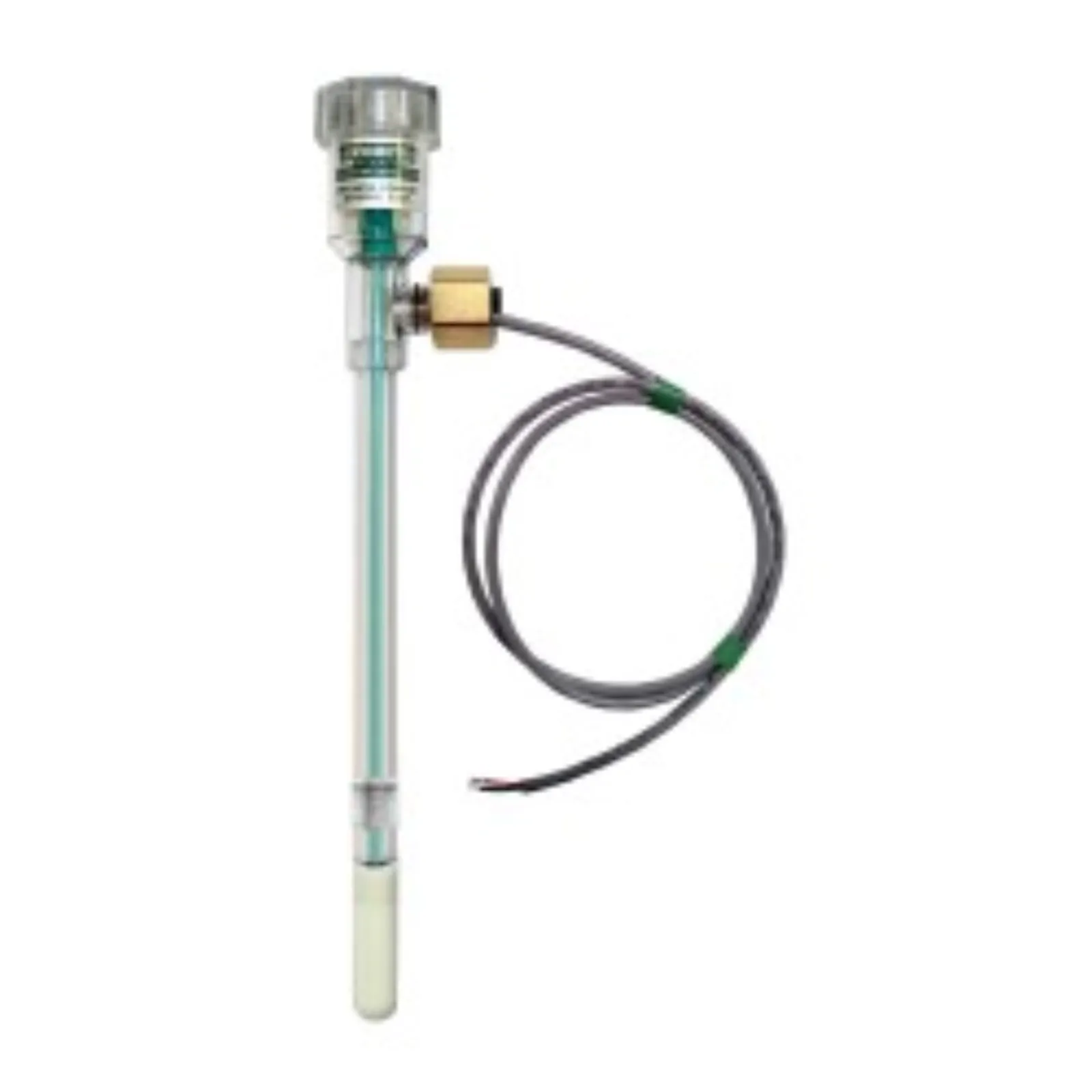
- Irrometer LT tensiometer (0 to 40 cb) for sandy soils, where field capacity sits near 10 cb and the useful band is narrow. It is made for coarse and sandy soils.
- Irrometer SR tensiometer (0 to 100 cb) for loam and clay groves, where triggers of 30 to 60 kPa sit inside its range. Both come in 15 and 30 cm lengths for the two station depths, and read into the controller as analog inputs with the manufacturer’s voltage transducer.
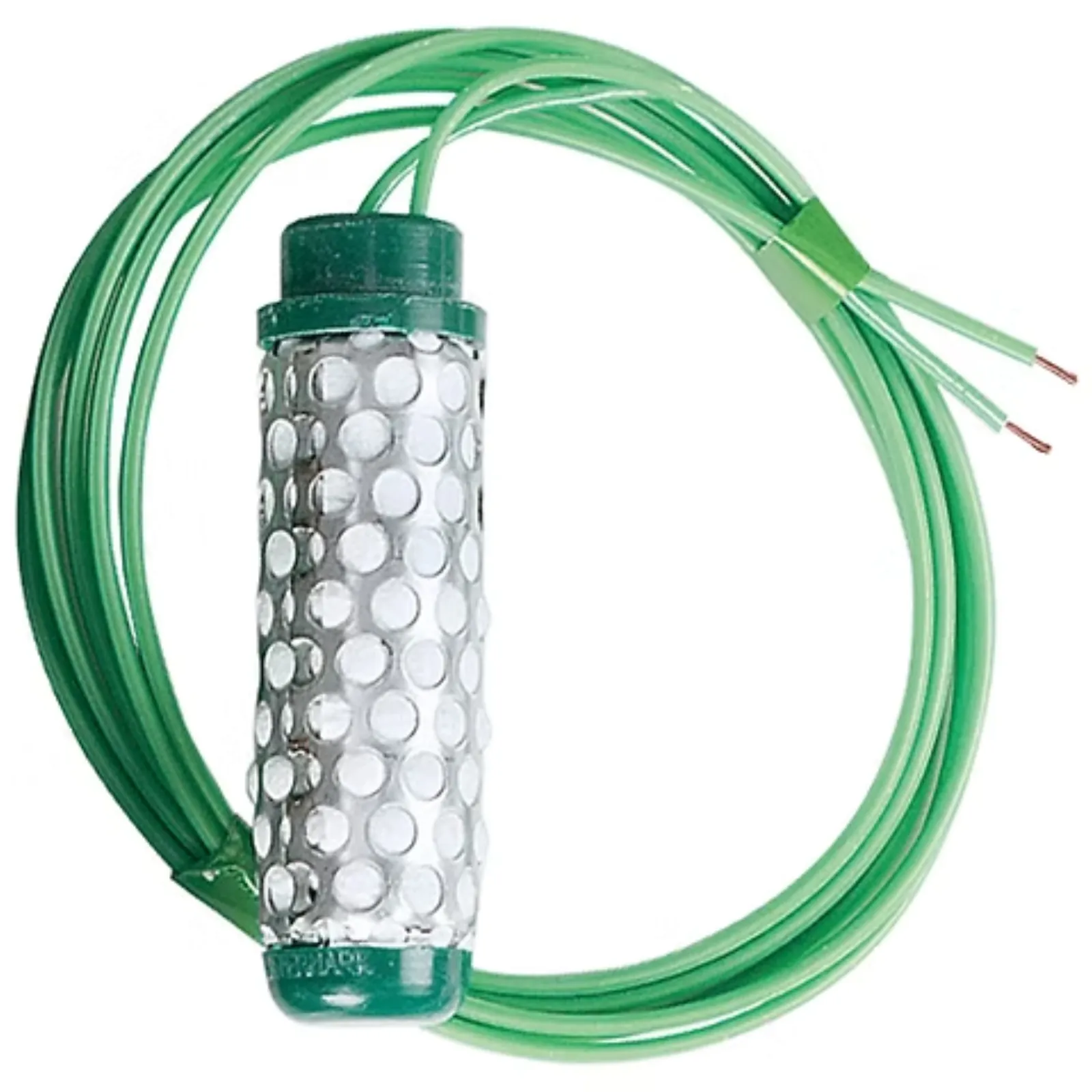
- Watermark 200SS (0 to 200 cb) where a buried sensor that needs no refilling suits better, for stations that are rarely visited.
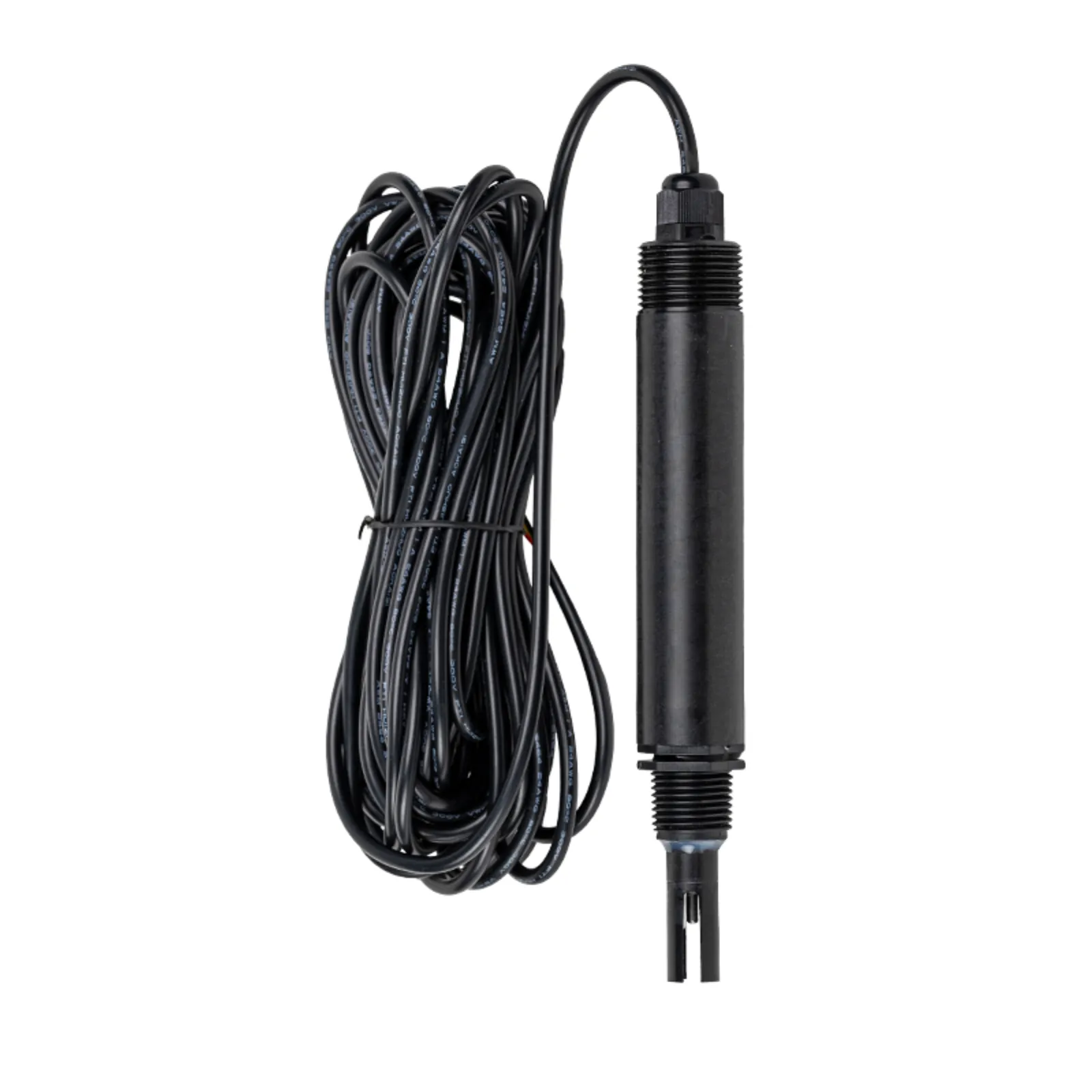
- EC-100 conductivity probe on the irrigation line, RS485 Modbus, with automatic temperature compensation. With its standard cell it reads well above any water a citrus grove can use.
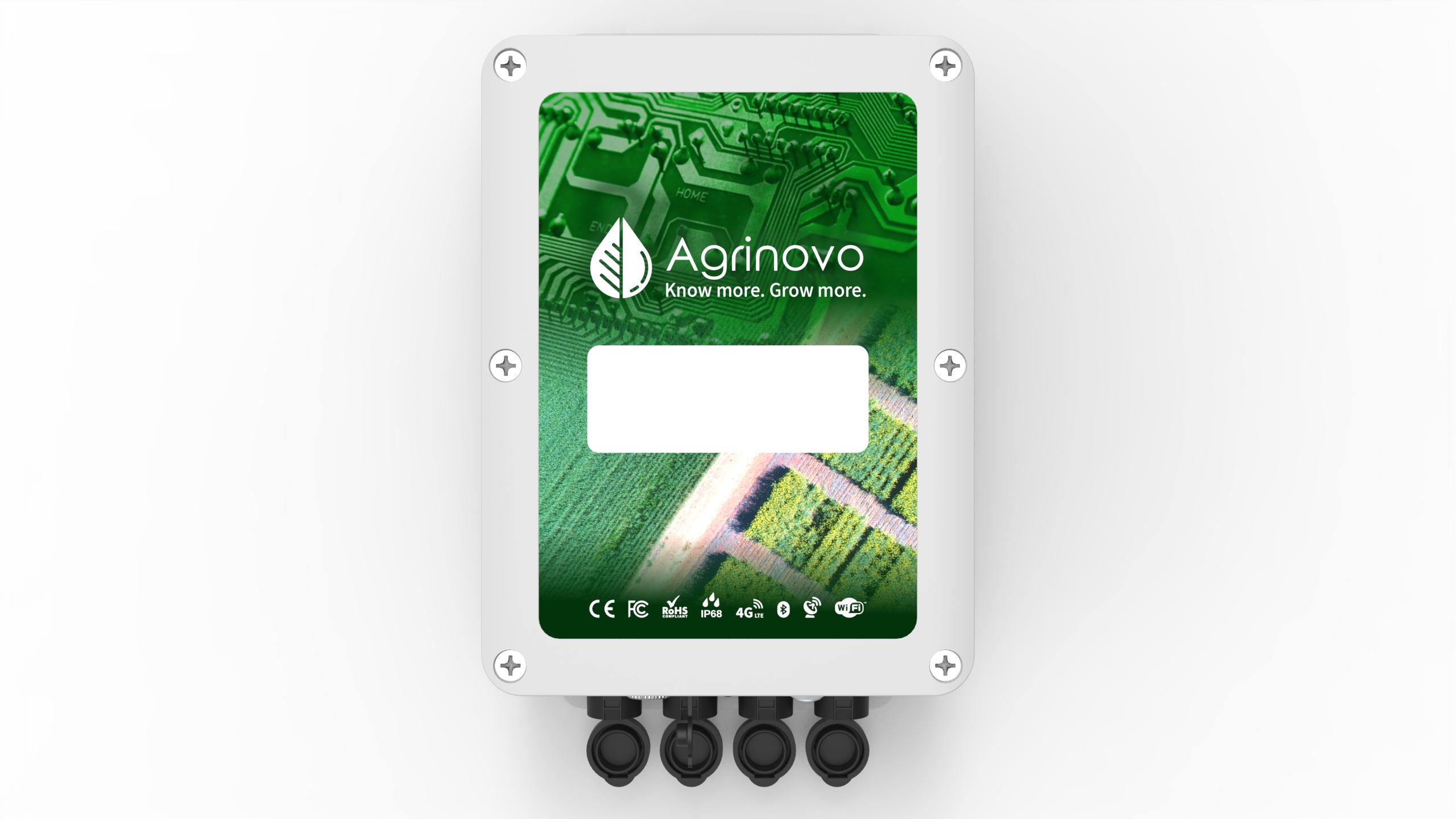
- Omni Genesis controller, reporting over 4G-LTE by default, powering the sensors and reading analog and RS485 inputs on the same unit. Each reading gets its own minimum, maximum and allowed time out of range, and users on the account get an app notification when a block crosses its trigger.
The result is one chart per block with shallow and deep soil water and the EC of the water going in, on the same time axis.
Using the readings through the season
A reading taken at the same time every day gives a drying curve per block, and its slope is the grove’s water use. In Florida spring, the curve shows how many days a block can go before it crosses the 25 to 33 percent depletion limit, and that number replaces the calendar. In an Israeli summer, the curve tests whether the July coefficient is too high or too low for a given soil. In a Mexican lemon grove, the shallow tension reading is the trigger itself.
After each irrigation, the time the deeper sensor takes to respond tells you whether the set was long enough. A deep sensor that never responds means the set is too short; one that goes straight to field capacity on sand means water and fertilizer are leaving the root zone. Split sets, as the HLB guidance recommends, show up as small daily steps on the shallow curve instead of a single large jump.
The sensors do not replace two things: a soil survey that tells you how much water each block can hold, and a periodic lab analysis of the irrigation water for chloride and sodium, which the EC line tells you when to repeat.
Agrinovo hardware for this application
Every item links to its product page with the datasheet. Specifications on those pages come from the manufacturer documents, not from this article.
Frequently asked questions
How deep should soil moisture sensors go in a citrus grove?
Where in the grove should the sensors be installed?
At what tension should citrus be irrigated?
How salty can citrus irrigation water be?
Can one Agrinovo controller read the soil sensors and the water EC probe together?
Sources
The agronomy on this page comes from the publications below. Where a number is not on this list, we left it out.
- 2026-2029 Florida Citrus Production Guide: Irrigation Management of Citrus Trees (CG093), D.M. Kadyampakeni, K.T. Morgan, M. Zekri, A.W. Schumann and others, UF/IFAS Extension
- Water Quality for Agriculture, FAO Irrigation and Drainage Paper 29 Rev. 1, Table 4: crop salt tolerance, R.S. Ayers and D.W. Westcot, Food and Agriculture Organization of the United Nations
- Water Quality for Agriculture, FAO Irrigation and Drainage Paper 29 Rev. 1, Table 14: chloride tolerance of fruit crop rootstocks, R.S. Ayers and D.W. Westcot, Food and Agriculture Organization of the United Nations
- Tensión de humedad del suelo y rendimiento de fruto en limón italiano (Rev. Fitotec. Mex. 30(3), 2007), A. Zermeño-González, M.A. García-Delgado, B.I. Castro-Meza and H. Rodríguez-Rodríguez, Universidad Autónoma Agraria Antonio Narro and Universidad Autónoma de Tamaulipas
- Citrus irrigation and fertilization recommendations, May to July 2016 (Hebrew), Yoram Eisenstadt, Field Service, Extension Service, Israel Ministry of Agriculture
Other applications
Orchards & plantations
Avocado orchards
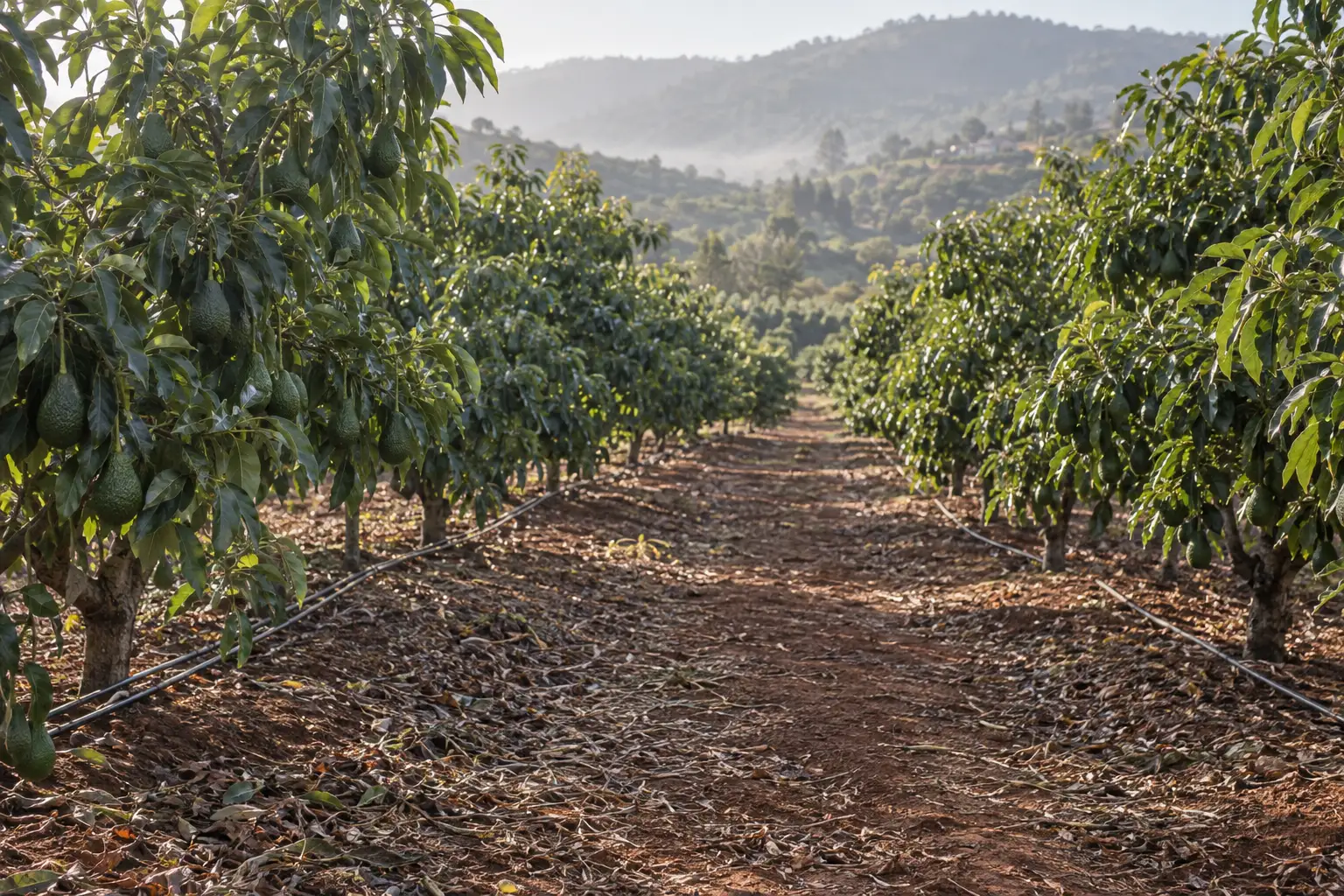
Which sensors an avocado orchard needs and where to put them: tensiometers and Watermark probes at 20 and 45 cm, irrigation triggers by soil type, EC of the irrigation water, and the Agrinovo hardware that reads them remotely.
Orchards & plantations
Date palm plantations
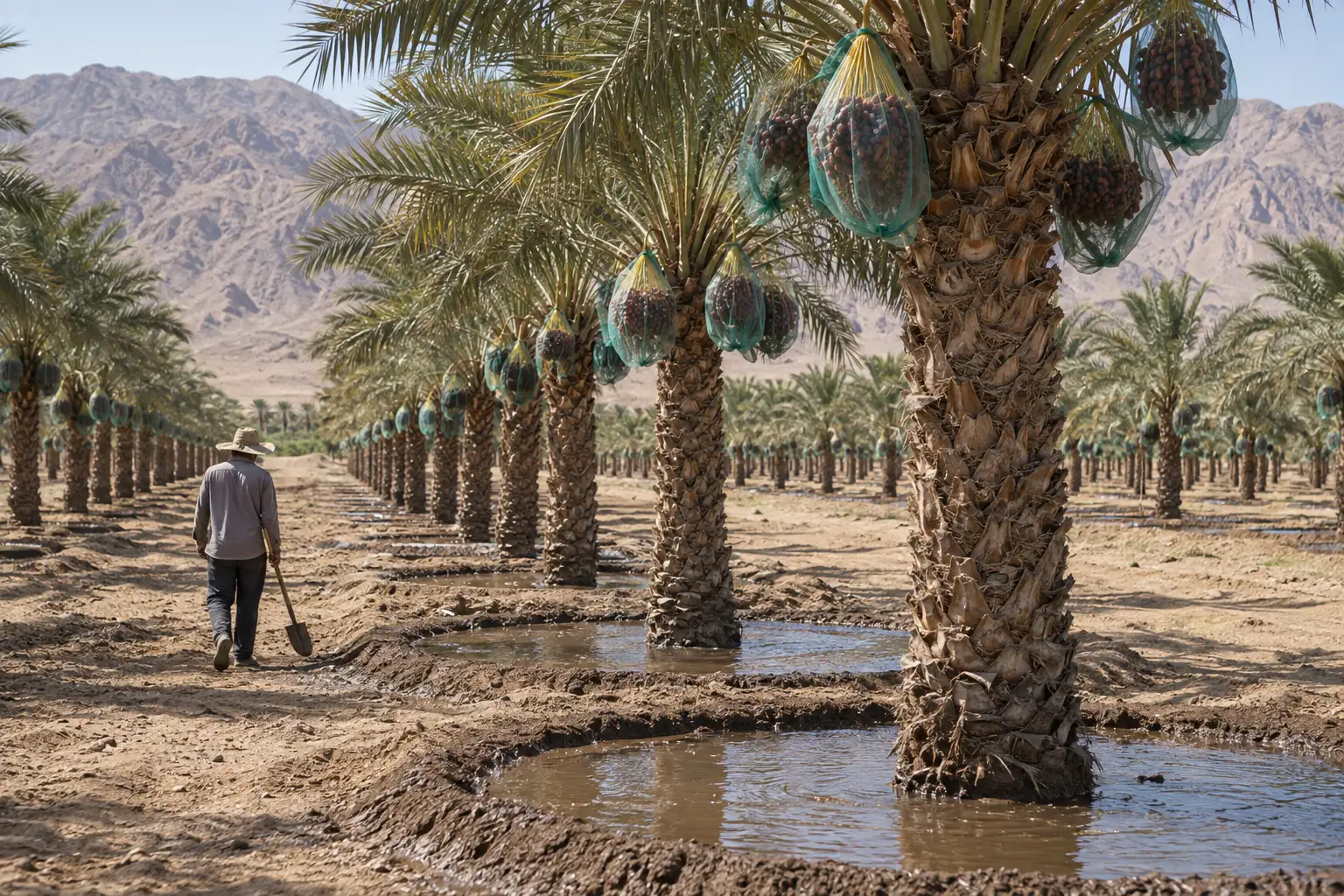
Which sensors a date palm plantation needs: tensiometers and Watermark sensors from 30 to 120 cm where the palm draws its water, EC of the irrigation water, and the Agrinovo hardware that reports them over cellular.
Orchards & plantations
Olive orchards
Which sensors schedule irrigation in an olive grove: tensiometers and Watermark probes at 30 and 60 cm, triggers from field trials, deficit by stage, water EC.
Tell us about your plot
Soil type, crop, irrigation method and what you want to see from your phone. We reply with a sensor list and a layout, not a brochure.