RS-485 Modbus sensors for OEMs and system integrators
Agrinovo water quality, gas and climate probes speak Modbus RTU over RS-485, and each datasheet publishes the full register map with example frames. Wire them into your PLC, data logger, controller or product, or run them on the Omni Genesis controller with no code at all.
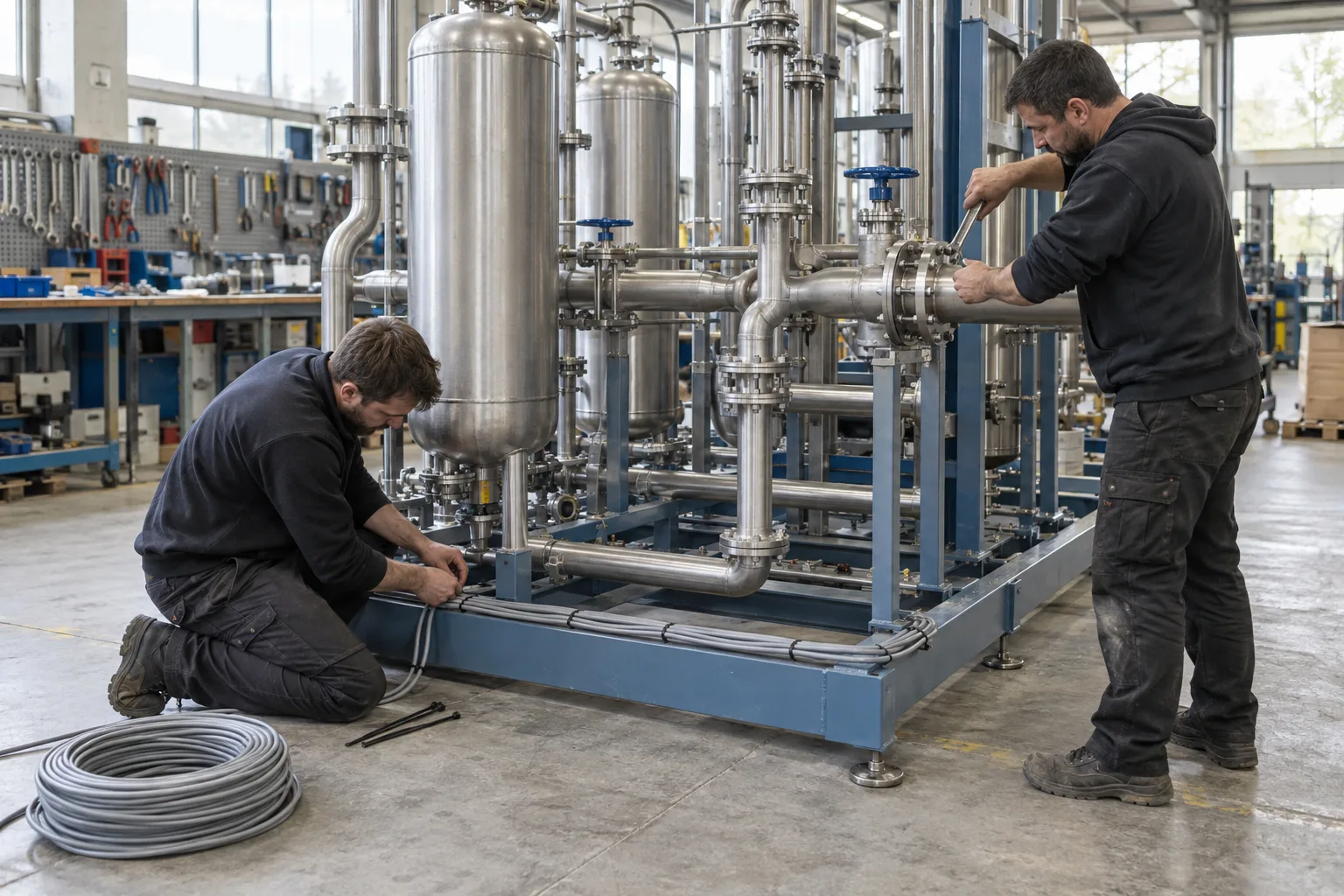
What engineers ask before they choose a probe
An engineer building a dosing controller, a treatment skid or a research rig does not need a dashboard. They need to know, before the order, how the probe talks, what it needs and what it returns. That is what these probes are documented for.
The register map before the order
The datasheet of each water quality, gas and climate probe carries its measurement and configuration registers, the scaling, and example request and response frames. It is published as a PDF and as a plain Markdown copy, for example the PH-110 datasheet and its Markdown version.
One protocol across the parameters
pH, ORP, conductivity, dissolved oxygen, turbidity, suspended solids and MLSS, COD, dissolved ozone, chlorine dioxide, ammonium, nitrate and other ions, chlorophyll, corrosion rate, dissolved CO2, gas and air temperature and humidity all use Modbus RTU over RS-485, so one serial driver reads all of them.
Built for installs nobody visits
The COD, turbidity, suspended solids, MLSS and self-cleaning DO probes carry an automatic wiper or brush, and bodies such as the TUR-110 and MLSS-110 are IP68. A probe that cleans itself is a probe your customer does not call you about.
From datasheet to first reading
-
Read the datasheet first
Range, accuracy, supply voltage, cable and the register map are all in it. Most probes run on 12 to 24 V DC. Browse the range on the sensors page.
-
Wire power and the A/B pair
Most probes ship at 9600 bps, 8 data bits, no parity, at address 0x01, and on many the baud rate can be changed. Give each probe its own address over the bus before you connect the next one, and several probes then share one RS-485 line.
-
Poll the measurement registers
Read with function 0x03, or 0x04 where the datasheet says so, and apply the scaling it gives. The example frames in the datasheet, CRC included, let you check your master against a known answer before writing any logic.
-
Calibrate over the bus
Calibration and offsets are written to configuration registers with function 0x06, so a probe can be calibrated from your own interface. The PH-110, for example, takes a three-point pH calibration this way.
Guides: SDI-12, Modbus, RS-485 and analog outputs · industrial RS-485 pH sensors
Your system or ours
On your own Modbus master
A PLC, a SCADA gateway, a data logger, or a microcontroller such as an Arduino, ESP32 or Raspberry Pi with an RS-485 transceiver. The probes need no Agrinovo controller and no Agrinovo cloud to work.
On the Omni Genesis controller
When the project needs cellular reporting, battery and solar power, a dashboard and alerts without writing code, the same probes plug into any of the four ports of the Omni Genesis, which reports over 4G-LTE to OmniCloud.
Checked before the order
Send us the master you will use, how it is wired and the parameters you need, and we will check the serial settings and register addresses with you before the first unit ships.
Who builds with these probes
Dosing and fertigation controller makers
pH, conductivity and ion probes inside a controller that doses acid, fertilizer or nutrients.
Water treatment skids and panels
Ozone, chlorine dioxide, ORP, turbidity, COD and suspended solids on a treatment line; see water and wastewater treatment monitoring.
Cooling and process water
Conductivity, pH, corrosion rate and flow in cooling towers and liquid-cooling loops.
Research rigs and environmental stations
Data loggers and custom rigs at universities and labs, where the register map decides whether a probe can be used at all.
Aquaculture equipment
Dissolved oxygen, pH and salinity inside aerator, feeder and RAS control equipment.
SCADA and automation integrators
Field probes added to an existing control system over its RS-485 or 4-20 mA inputs.
Integration specifications
| Protocol | Modbus RTU over RS-485 (water quality, gas, climate and flow probes) |
|---|---|
| Default serial settings | 9600 bps, 8 data bits, no parity on most probes; baud rate configurable on many |
| Default address | 0x01 on most probes, changeable over the bus |
| Function codes | 0x03 and 0x04 to read, 0x06 to write configuration and calibration |
| Supply | 12 to 24 V DC on most probes; each datasheet states its range |
| Analog options | PH-110 with RS-485 or analog (0-2 V, 0-5 V, 0-10 V or 4-20 mA), chosen at order; 4-20 mA on the EMF-200 flow meter, GF-201 gas sensors and radar and ultrasonic level meters |
| Documentation | Datasheet as PDF and Markdown, with register map, scaling and example frames |
| Self-cleaning models | COD-130, TUR-110, SS-130, MLSS-110, DO-130 |
Questions from engineers and OEMs
Can I see the Modbus register map before ordering?
Will the probes work with my PLC, data logger or microcontroller?
How many probes can share one RS-485 cable?
Do you supply OEM and recurring volumes?
Do I need your controller or cloud?
Is there a 4-20 mA option?
Tell us what you are building
The parameters, the quantity per year, the device that will read the probes and how they will be mounted. We will match the probes and send the datasheets.