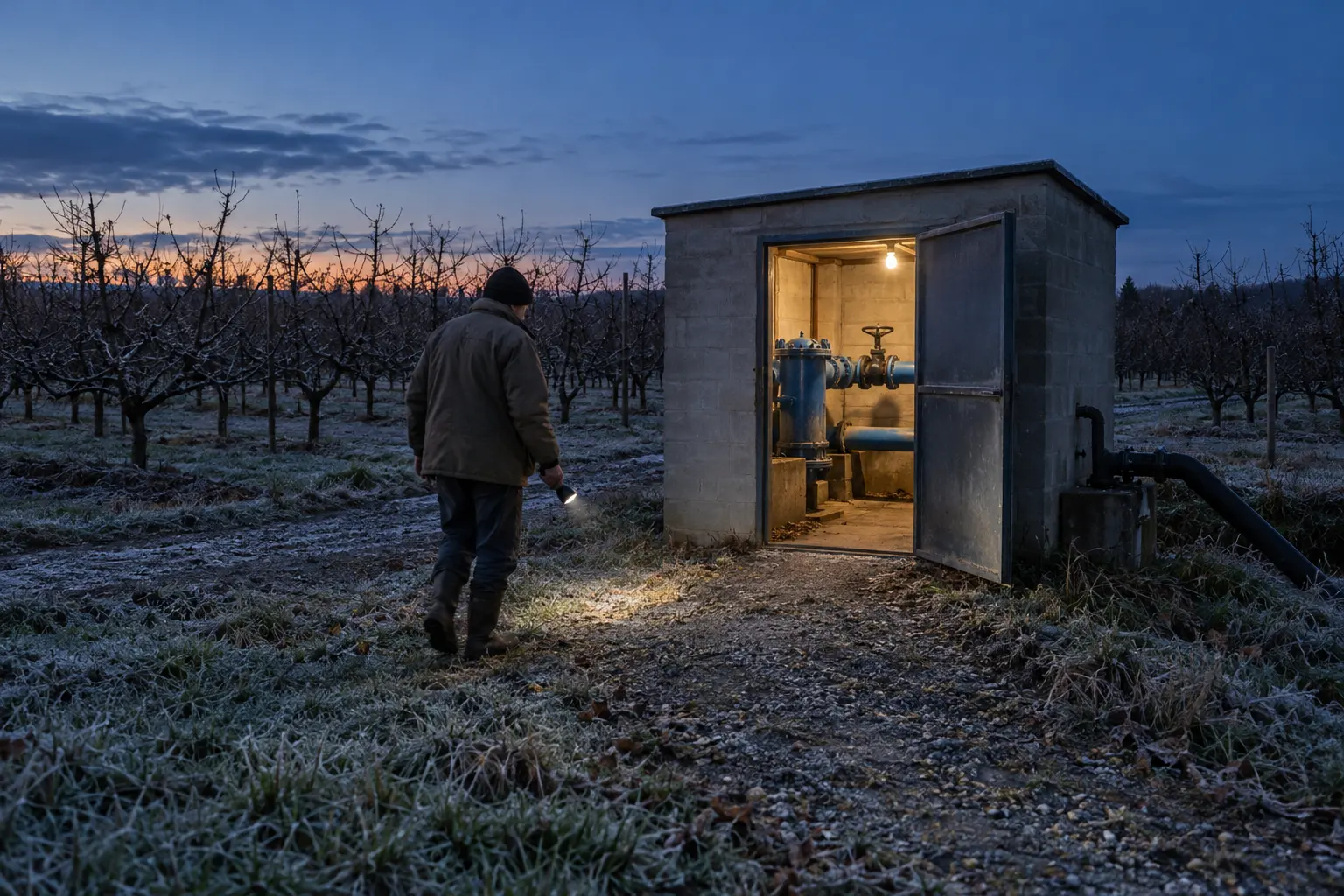
Most temperature alarms are designed for a building with a router in it. The places on a farm where a temperature problem costs the most are usually the ones without one: the pump house at the far end of the orchard, a greenhouse at three in the morning, the cold room in the packing shed, a calf barn on a hot afternoon. Nobody is there when it happens, and often there is no Wi-Fi and no reliable power either.
What “cellular” changes
A home freeze alarm or a Wi-Fi sensor depends on three things that a remote farm building often lacks: a router, mains power, and a stable connection between them. Take any one away and the alarm goes silent at exactly the wrong moment, because the cold night that freezes a pipe is also the night the power line goes down.
A cellular controller removes those dependencies:
- Its own connection. The Omni Genesis controller reports over 4G-LTE with a SIM included. There is no router to install and no network password to keep. Wi-Fi and Bluetooth are built in for sites where a stable network already reaches it.
- Its own power. It runs on two rechargeable 18650 batteries and takes a 6 to 32 V DC solar input, so a small panel keeps it going in a field or a shed with no mains at all, and a power cut does not stop the measurements.
- Its own memory. Readings are stored locally and synced to the cloud when the connection returns, so a gap in coverage does not become a gap in the record.
The controller is rated for -20 to +70°C in an IP65 enclosure, which covers a pump house, a greenhouse wall or a barn post in most climates. In a freezer room it goes on the outside wall and only the sensors go in.
Four sites, four alarms
The sensor and the alarm limits depend on what can go wrong at each site. Four cases cover most farms.
Pump houses and irrigation heads: freezing
A frozen pipe, valve or filter housing can crack overnight, and the damage often shows only when the system is started in the morning. The alarm is a low temperature limit set high enough above freezing to leave time for someone to drive out, close the door or switch on a heater.
Where the pump house has a heater, the alarm belongs below the heater setting. Alberta Agriculture’s guidance on pump houses puts the heater thermostat at 4 to 6°C. Set the low alarm a little below the setpoint you use: it then fires when the heater has failed or the door has been left open, and not every time the heater cycles. Where there is no heater, set it a few degrees above 0°C, so there is still time to get there.
Put the sensor where the cold arrives first, not where it is easy to mount: low, near the door or a vent, and next to the most exposed pipe or the pump body. Cold air settles, so a sensor at head height can read several degrees warmer than the pipe at floor level. A DS18B20 probe (rated -55 to +125°C) can be strapped to the pipe itself, while a THS-100 measures the air in the room.
Greenhouses: heating failure at night, ventilation failure by day
A greenhouse can go wrong in both directions within a day. On a cold night a heater that trips or runs out of fuel can let the house fall below the crop’s limit in an hour or two. On a sunny day a vent motor or fan that fails can push it far above the limit by noon.
That calls for two limits on every greenhouse point, a low one for the night and a high one for the day, taken from the crop rather than from a generic number. Place the sensor at crop height, in the middle of the house rather than by the wall, and shade it from direct sun; a sensor in sunlight reads the sun, not the air. The THS-100 measures temperature (-40 to +80°C, ±0.3°C at 25°C) and relative humidity (±3% RH) on one RS-485 bus, and several can share the same cable, so a long house can carry a point at each end. Our guide to IoT temperature control in greenhouses covers the control side.
Barns and poultry houses: heat stress
In livestock housing the risk is usually heat, and temperature alone understates it, because humid air at the same temperature is harder on the animals. The usual measure combines the two into a temperature-humidity index (THI).
University of Minnesota Extension puts the start of heat stress in dairy cattle at a THI of 68, with mild to moderate stress from 72 and moderate to severe stress from 80, and notes that mild stress begins around 22°C (72°F) at 50% relative humidity. University of Maryland Extension describes 72 as the historical threshold and about 68 for high-producing cows. Those bands are why a barn alarm needs humidity as well as temperature: 26°C in dry air and 26°C in humid air are different days for a cow.
Measure temperature and humidity together at animal height, away from the drinkers and the direct air stream of a fan, and set the alarm on the reading that matters for the herd or flock. For poultry houses, our poultry platform Henlytics has a dedicated ventilation alarm.
Farm cold rooms and packing sheds
A cold room on a farm has the same physics as one in a food factory, with fewer people around to notice a problem. The limits come from the product, and the alarm needs a delay so that loading and defrost cycles do not set it off. Our guide to cold storage alarm limits and delays goes through the setup, and the cold room temperature monitoring page shows what gets installed.
Setting the alarm so people trust it
In OmniCloud every sensor gets its own minimum, maximum and allowed time out of range. The reading may cross a limit briefly, and the alert opens only if it stays out longer than you allow. That delay is what separates a door left open from a door opened for a minute.
Three settings decide whether the alarm works at night:
- Who receives it. Alerts go to the users on the account as push notifications on the phone, through the Agrinovo app. Each user can set quiet hours.
- What counts as critical. A sensor marked as critical comes through quiet hours. Mark the pump house in a freeze and the cold room with stock in it; leave a humidity drift for the morning.
- How long it keeps asking. An open alert repeats every two hours by default until someone acknowledges it, and a recovery notice follows when the reading returns to range, so whoever is driving out knows whether it is still a problem.
The alarm also watches itself
The most dangerous alarm is one that has stopped working without anyone noticing. Three faults matter at a remote site, and each one raises its own alert:
- A failed sensor. The controller detects a disconnected or short-circuited sensor and reports it as a fault, instead of publishing a plausible number. A floating input that reads as 4°C forever is worse than no sensor at all.
- A silent controller. If a controller misses its expected reports, OmniCloud opens a controller offline alert. A screen with no new readings is treated as a problem, never as a site in range.
- A low battery. A low battery alert arrives well before the batteries run out, which matters most at solar sites in the short days of winter.
From alarm to action
An alert still needs someone to act on it. At some sites the action is simple and the same every time: start a heater in the pump house, open a vent, switch on a fan. Each of the Genesis controller’s four ports can work as a sensor input or as a switched 12 V or 5 V output, and that output usually drives an external relay that switches a heater, a fan or a valve.
The rule that decides when to switch runs on the controller itself, from its own sensor readings, so it keeps working when the cellular connection drops. The readings logged during the gap sync when the connection returns, so the history shows what happened and when.
Choosing the sensor
| THS-100 | DS18B20 probe | SHT30 | |
|---|---|---|---|
| Measures | Air temperature and humidity | Temperature | Air temperature and humidity |
| Temperature range | -40 to +80°C | -55 to +125°C | -40 to +125°C |
| Stated accuracy | ±0.3°C at 25°C; ±3% RH | ±0.5°C from -10 to +85°C | ±0.3°C typical; ±2% RH typical |
| Connection | RS-485 Modbus RTU, addressed, long cable runs | 1-Wire | I2C, short runs |
| Typical use | Greenhouses, barns, rooms; several points on one bus | On a pipe, in a product sample, in a sealed spot | A single point close to the controller |
The THS-100 is the usual choice when the point is far from the controller or when one site needs several points, because RS-485 runs long distances on one shared cable. The SHT30 suits a single point next to the controller, as on the stake in our cranberry frost case study.
Test it before the night that matters
- Force an alarm. Warm or cool one sensor past its limit and hold it there longer than the delay.
- Check the phones. Confirm the alert reaches every person who should get it, with a sensor name they recognise, such as “Pump house, floor”.
- Acknowledge and recover. Return the sensor and confirm the recovery notice arrives.
- Pull the plug. Disconnect mains power where there is any and confirm the controller keeps reporting on battery.
- Read the week. Look at the history once a week. A pump house that drifts lower each night, or a barn that peaks a little higher each afternoon, is a warning before it becomes an alarm.
For orchards and vineyards on frost nights, see our guide to frost alarms for orchards and vineyards, and for the full range of setups see wireless temperature monitoring.