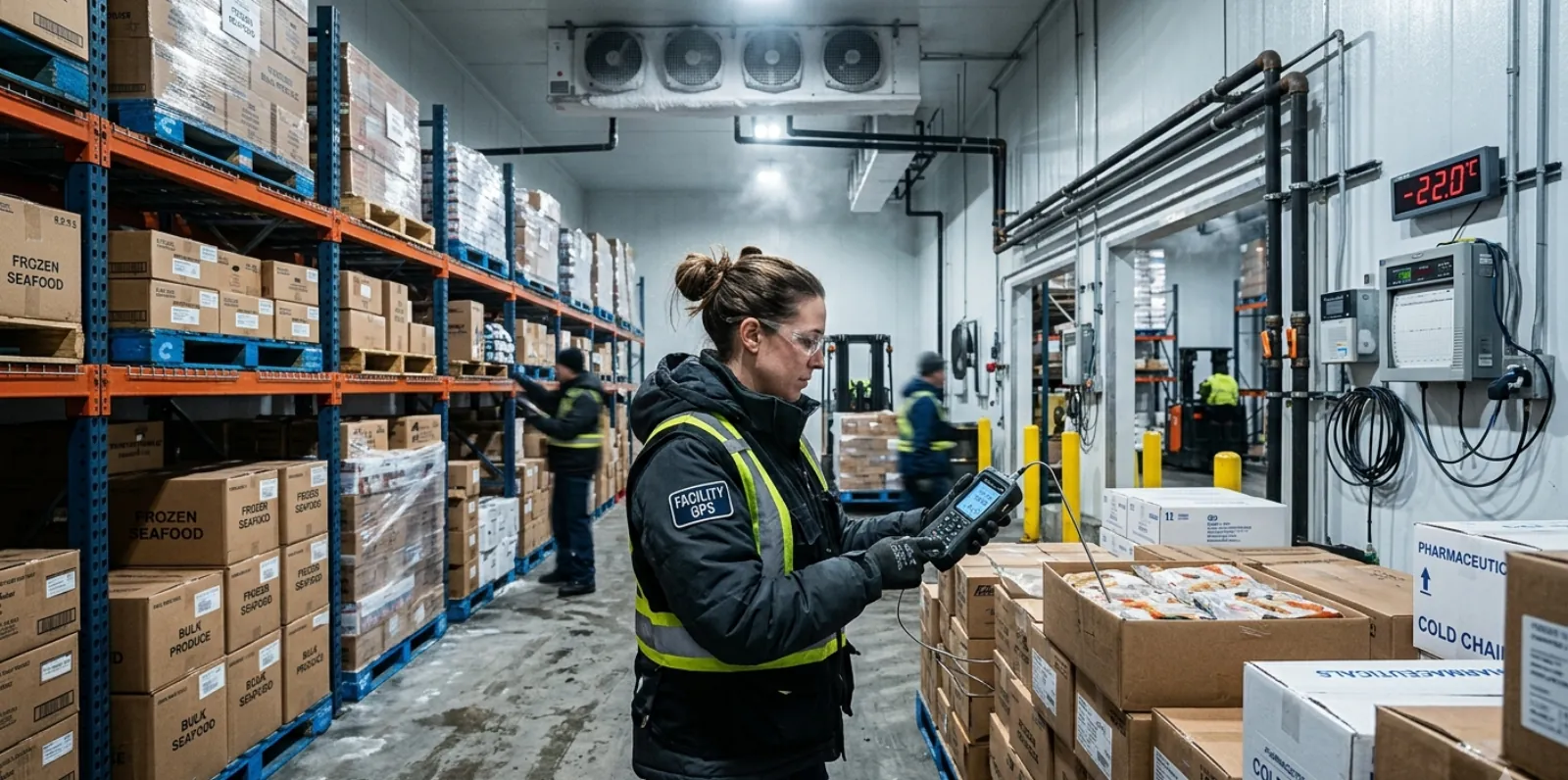
When the outside temperature climbs past 40°C, the risk is not only the heat itself. It is the cold chain that breaks. A meat delivery left twenty minutes on the loading dock, a walk-in door propped open while a worker steps out, a cold room whose compressor quietly starts failing with no one watching. Any one of these scenarios can end in a foodborne illness outbreak.
Food safety authorities worldwide report large numbers of foodborne illness cases every year, and experts agree the true figure is far higher because most mild cases are never reported. The World Health Organization estimates that hundreds of millions of people fall ill each year from contaminated food. Behind most of it sits the same root cause.
That cause is temperature. Bacteria like Salmonella, Listeria, and E. coli multiply quickly when food sits in the “danger zone”, the range between 5°C and 60°C. Under the right conditions, a bacterial population can double roughly every 20 minutes. A chicken portion that arrived with a low, safe bacterial count can become a contamination source within a few hours if it is not held at the right temperature.
This is where HACCP comes in: a systematic method for identifying, evaluating, and controlling food safety hazards, with temperature monitoring as the single most important tool in applying it. This guide covers what you need to build a compliant program, from the regulatory principles to the practical rollout of temperature monitoring systems in your operation.
What HACCP is and why it matters
HACCP, short for Hazard Analysis and Critical Control Points, is a food safety management system originally developed in the 1960s for the NASA space program. The idea was simple but revolutionary: instead of inspecting finished products and hoping for the best, identify in advance the points in the process where risk is highest and monitor them continuously.
The seven HACCP principles
- Hazard analysis. Identify every biological, chemical, and physical hazard that could compromise food safety at each stage of the process.
- Determine critical control points (CCPs). Identify the points where control can be applied to prevent, eliminate, or reduce a hazard to an acceptable level. Temperature monitoring is the most common CCP.
- Establish critical limits. Define measurable values (for example, a minimum core temperature of 75°C for cooking poultry) that must be met at each CCP.
- Establish a monitoring system. Set procedures for ongoing measurement and documentation of every CCP. This is where automated temperature monitoring systems earn their place.
- Establish corrective actions. Define what happens when a reading exceeds a critical limit (for example, discarding food that drifted past its allowed storage temperature).
- Verification. Run periodic checks to confirm the HACCP system is working as intended, including calibration of temperature sensors.
- Documentation and record-keeping. Keep complete records of every measurement, deviation, and corrective action.
The regulatory requirement
Food safety regulations in most jurisdictions require food businesses (restaurants, manufacturers, caterers, bakeries, supermarkets, and food warehouses) to run a HACCP plan or, at minimum, a prerequisite program built on HACCP principles. Licensing rules require food businesses to meet defined sanitary conditions, and routine inspections check temperature records as a matter of course.
Falling short of these requirements is not only a health risk. It is a business and legal risk. An operation caught in a food safety violation can face closure orders, and in serious cases legal proceedings against the owner. Beyond that, public exposure of a food poisoning incident can damage a reputation in ways that are hard to undo.
Temperature is the most common CCP in almost every HACCP plan in the food industry. The reason is straightforward: controlling temperature is the most direct and most measurable way to stop bacterial growth. Whether the point is cold storage, cooking, cooling, or hot holding, temperature monitoring is the key.
Mandatory self-control programmes: what changes for temperature records
Food safety regulators are moving from paper logs and periodic inspection to mandatory, documented self-control programmes built on HACCP principles and tied to the manufacturing licence. Where such a programme is in force it applies to manufacturers, bulk distributors and importers, and to small producers at a scale that matches the complexity of their operation.
A self-control programme covers hazard analysis, critical control points with a limit for each, consistent monitoring and current records. What an inspection checks is control of temperatures, storage conditions and cleanliness, and the record that shows the monitoring actually took place.
For temperature records that means a measurement at every defined critical control point, at the frequency the programme sets, with a time, a value, and who or which device measured it. A handwritten log can meet that, but it depends on whoever remembers to write on a weekend. An automatic record, such as the one produced by Agrinovo’s food factory temperature monitoring, is created on every reading and exports to Excel for the period the inspector asks for.
Temperature requirements by food type
Every food type calls for different handling when it comes to storage temperature. The table below summarizes the main requirements based on common food safety guidance and international standards:
| Food type | Storage temperature | Danger threshold | Notes |
|---|---|---|---|
| Fresh meat and poultry | 0°C to 4°C | Above 4°C | Use within 3-5 days |
| Fish and seafood | 0°C to 2°C | Above 2°C | Highly perishable |
| Dairy products | 2°C to 4°C | Above 4°C | Check daily |
| Fruit and vegetables | 4°C to 8°C | Above 10°C | Varies by type |
| Frozen food | -18°C and below | Above -15°C | Do not refreeze |
| Hot food (holding) | 60°C and above | 5°C-60°C | Danger zone |
The danger zone: 5°C to 60°C
The “danger zone” is perhaps the single most important concept in food safety. The range between 5°C and 60°C is the ideal temperature band for pathogenic bacteria to multiply. Within it, dangerous organisms such as Salmonella, Listeria monocytogenes, Campylobacter, Clostridium perfringens, and E. coli O157:H7 can grow at a fast pace.
The critical detail: bacteria reach their peak growth rate in the warmer part of this band. Within a few hours at those temperatures, food that was safe to eat can become dangerous. The accepted industry rule of thumb is that food held in the danger zone for more than two hours should be discarded (or one hour if the surrounding temperature is above 32°C, a common situation in hot weather).
Bacterial growth is not something you can see, smell, or taste. Food can look, smell, and taste completely fine while it already carries a dangerous concentration of bacterial toxins. That is exactly why temperature monitoring is so critical. It is the first and only line of defense you can rely on.
Additional points by food type
Meat and poultry. Beyond storage, hold to a minimum cooking temperature: 75°C for poultry, 71°C for ground meat, and 63°C for whole cuts such as steak (with a 3-minute rest). Measure core temperature with a probe thermometer rather than relying on appearance.
Fish and seafood. This is the most sensitive category. Fish begins to spoil faster than any other protein, so the allowed temperature range is narrower. Where fresh fish travels a considerable distance from catch to plate, it is especially important to verify an unbroken cold chain the whole way.
Dairy products. Dairy needs close temperature control, particularly pasteurized milk, soft cheeses, and dairy desserts. Monitor cold rooms at least twice a day and run daily checks.
Frozen food. The baseline rule is -18°C and below. Freezing does not kill bacteria; it only halts their growth. Once food is thawed, it must not be refrozen without cooking in between, because during thawing the bacteria start multiplying again.
Critical control points (CCPs) in temperature monitoring
Temperature monitoring in the food industry is not a one-off event. It is a continuous process that follows food from the moment it arrives to the moment it is served. The main critical control points are below.
1. Receiving
The first moment food enters the business is a critical CCP. Measure the temperature of every chilled or frozen delivery on arrival. Meat that arrives at 7°C instead of 4°C may look perfectly fine, but it has already spent time in the danger zone and should be refused. This is the moment to send product back to the supplier, not after it is already in the cold room.
2. Storage
Cold rooms, freezers, and refrigerators are the heart of the system. Monitor their temperature continuously rather than just glancing at the unit’s built-in display. A dedicated DS18B20 sensor wired into a monitoring system gives an independent, continuous record instead of relying on a refrigerator’s built-in readout. Place sensors at the warmest point of the unit, typically near the door or at the top.
3. Preparation and thawing
Thawing frozen food is a critical point that many underestimate. Thawing on the counter at room temperature is one of the most common mistakes. The approved methods are: thawing in the refrigerator (0-4°C), thawing under cold running water (below 21°C), thawing in the microwave (with cooking immediately after), or thawing as part of the cooking process itself.
4. Cooking
Cooking is the CCP where we destroy the bacteria, which makes core temperature measurement essential. Do not rely on the color of the meat, its texture, or “experience”. Only a calibrated probe thermometer gives a reliable answer. Make sure the probe reaches the thickest part of the item, away from bones or fat.
5. Cooling
Cooling cooked food is one of the most dangerous points. The accepted rule is the “2/6” rule: cool food from 60°C to 21°C within two hours, and from 21°C to 4°C within another four hours (six hours total from the start of cooling). If the food has not reached the required temperature in time, discard it. Methods to speed cooling include dividing into shallow containers, an ice bath, and frequent stirring.
6. Hot holding and service
Hot food held for service must stay at 60°C or above. On a hot line (bain-marie), monitor the temperature every 30 minutes and confirm that every tray meets the requirement. Food that drops below 60°C and is not reheated within two hours should be discarded.
7. Transport and cold chain
Transporting chilled or frozen food requires a refrigerated vehicle with an active temperature monitoring system. In hot weather especially, the temperature gap between the inside of the vehicle and the outside can be enormous. Monitor and document the temperature throughout the trip. Opening the vehicle doors for a partial unload should be quick and planned.
Documentation and record-keeping
Documentation is the backbone of any HACCP program. The industry saying is “if you didn’t record it, it didn’t happen”. Inspectors and HACCP auditors check documentation first, and the absence of orderly records is a serious audit finding.
What to document
- Temperature readings at every CCP: receiving, storage, cooking, cooling, and service.
- Deviations. Every instance where a temperature exceeded the defined critical limit.
- Corrective actions. What was done after each deviation (for example: “product returned to supplier”, “food discarded”, “refrigerator repaired”).
- Equipment calibration. Records of periodic calibration checks of thermometers and sensors.
- Maintenance. Logs of cooling and heating equipment maintenance.
Logging frequency
The minimum requirement for most food businesses is logging temperatures at least twice a day, morning and evening. For critical CCPs such as a hot service line or a cold room with heavy product movement, logging every two hours is recommended. This is exactly where automated monitoring systems deliver the most value: they record continuously, 24 hours a day, with nothing forgotten and nothing mistyped.
Manual versus automated logging
Manual logging (forms, pens, and handheld thermometers) is still common in many operations. But this approach has fundamental weaknesses: staff forget to record, fill in retroactively, round numbers, or simply do not measure at all and automatically write “4°C”. Experienced inspectors know how to spot shallow documentation. A long run of identical values is a clear red flag.
For anyone still logging by hand, a printable temperature log form with the columns an inspector expects: unit, time, reading, limit, initials and corrective action.
An automated IoT-based temperature monitoring system solves all of these problems. It measures and records automatically, with no human touch, and creates time-stamped digital records of every reading.
Record retention
Food safety regulations typically require HACCP records to be kept for at least a couple of years. Digital records, such as those produced by the Omni Genesis controller, are saved to the cloud automatically and remain accessible at any time for audit.
What auditors look for
Food safety auditors focus on continuity and consistency. They look for continuous documentation with no gaps, evidence of corrective actions when a deviation occurred, periodic calibration of measurement equipment, and alignment between the written procedures in the HACCP plan and what actually happens on the floor.
How an IoT temperature monitoring system supports HACCP compliance
Moving from manual measurement to automated IoT-based temperature monitoring is not just a technology upgrade. It is a fundamental change in how a food business manages food safety. Here are the main reasons.
Continuous, accurate measurement 24/7
An IoT system with dedicated temperature sensors measures and records at a regular interval, every day, including nights, weekends, and holidays. It does not forget, does not get tired, and does not round numbers. That removes the human factor from the documentation stage entirely and gives a true, complete picture of storage conditions.
Immediate real-time alerts
When the temperature in a cold room rises past its critical limit, the system sends an immediate alert (SMS, app notification, or email) to the relevant people. That enables a response in minutes instead of hours, and can prevent significant product loss or, worse, food poisoning of customers.
Digital records, always audit-ready
Instead of digging through folders of manual forms, all the information is available at the click of a button. You can generate reports by date, by cold room, or by deviation, exactly what an auditor needs. The Omni Genesis controller stores all the data in the cloud, ensuring access from anywhere and no loss of information.
Trend analysis and failure prediction
One of the smartest advantages of an IoT system is the ability to analyze trends. If a cold room takes longer and longer to reach its target temperature, or if there are recurring temperature rises at certain hours, the recorded data shows the pattern. That lets you fix equipment problems before they become a full failure: preventive maintenance instead of reactive repair.
Multi-site monitoring from one interface
For restaurant chains, catering companies, or manufacturers with several sites, an IoT system enables central monitoring of all locations from one dashboard. A single food safety manager can oversee dozens of cold rooms across dozens of branches, receive targeted alerts, and produce comparative reports. Adding SHT30 temperature and humidity sensors brings an extra layer of information that matters especially for dry storage.
A response that pays for itself
An IoT monitoring system can look like an outlay for a small operation. But weigh it against the loss of product in a single cooling incident, or a foodborne illness claim, and the value case is clear: prevented losses, smoother inspections, and confidence that the food you serve is safe.
Common temperature monitoring mistakes
The same mistakes repeat across food businesses. Here are the most common ones.
Measuring once a day only
Many operations check temperature only in the morning when they open. But what happens in the afternoon when the kitchen is at peak activity? Or overnight when no one is around? A temperature deviation that runs for eight hours at night will never surface if you measure only at 07:00. Continuous monitoring with an automated system is the only reliable solution.
Not calibrating sensors and thermometers
A thermometer that has not been calibrated in months can read 2-3 degrees off. That means a refrigerator that appears to sit at 4°C is actually at 6-7°C, deep inside the danger zone. Calibrate thermometers at least once every three months, and document the calibration.
Ignoring the door-opening effect
Every time a cold room door opens, warm air enters and raises the temperature. During busy periods, when staff go in and out every few minutes, the temperature can rise significantly. A sensor placed at a strategic point and monitoring continuously will expose the problem. Fixes include PVC strip curtains, limiting how long doors stay open, or upgrading the cooling system.
No monitoring during off-hours
Most cooling failures happen at night or on weekends, when no one is on site. Without a monitoring system that alerts remotely, the damage is only discovered the next morning, when the product is already lost. An IoT system with SMS or app alerts ensures someone knows about the problem within minutes, at any hour.
Inadequate documentation
“4, 4, 4, 4, 4”, a run like that in a temperature log draws immediate suspicion from any auditor. No refrigerator in the world holds exactly 4.0°C every time you measure. Automated documentation that shows natural variation (like 3.7°C, 4.1°C, 3.9°C) is far more credible and convincing.
No monitoring during power outages
A power outage is one of the most dangerous scenarios for stored food. Without a battery backup for the monitoring system, there is no way to know how long the room went without cooling or what temperature the food reached. An IoT monitoring system with a backup battery keeps monitoring and alerting even during an outage.
Summary and next steps
Temperature monitoring is not just a regulatory requirement. It is the foundation of real food safety and the protection of your customers, your business, and your reputation. As regulatory environments tighten, food businesses that rely on manual methods find themselves at a disadvantage in front of inspectors and at risk in front of customers.
Moving to automated IoT-based temperature monitoring is no longer a luxury. It is a necessity. The technology is now practical and scalable for small and mid-sized operations, and it earns its place quickly through prevented product loss, smooth inspections, and confidence that the food you serve is safe.
If you are looking to deploy a temperature monitoring system that helps you meet HACCP standards, contact the Agrinovo team for a consultation. We will build a solution tailored to cover every CCP in your operation.
For more, read the complete guide to automated temperature logging for food safety.
Related guides
Last updated: August 30, 2026