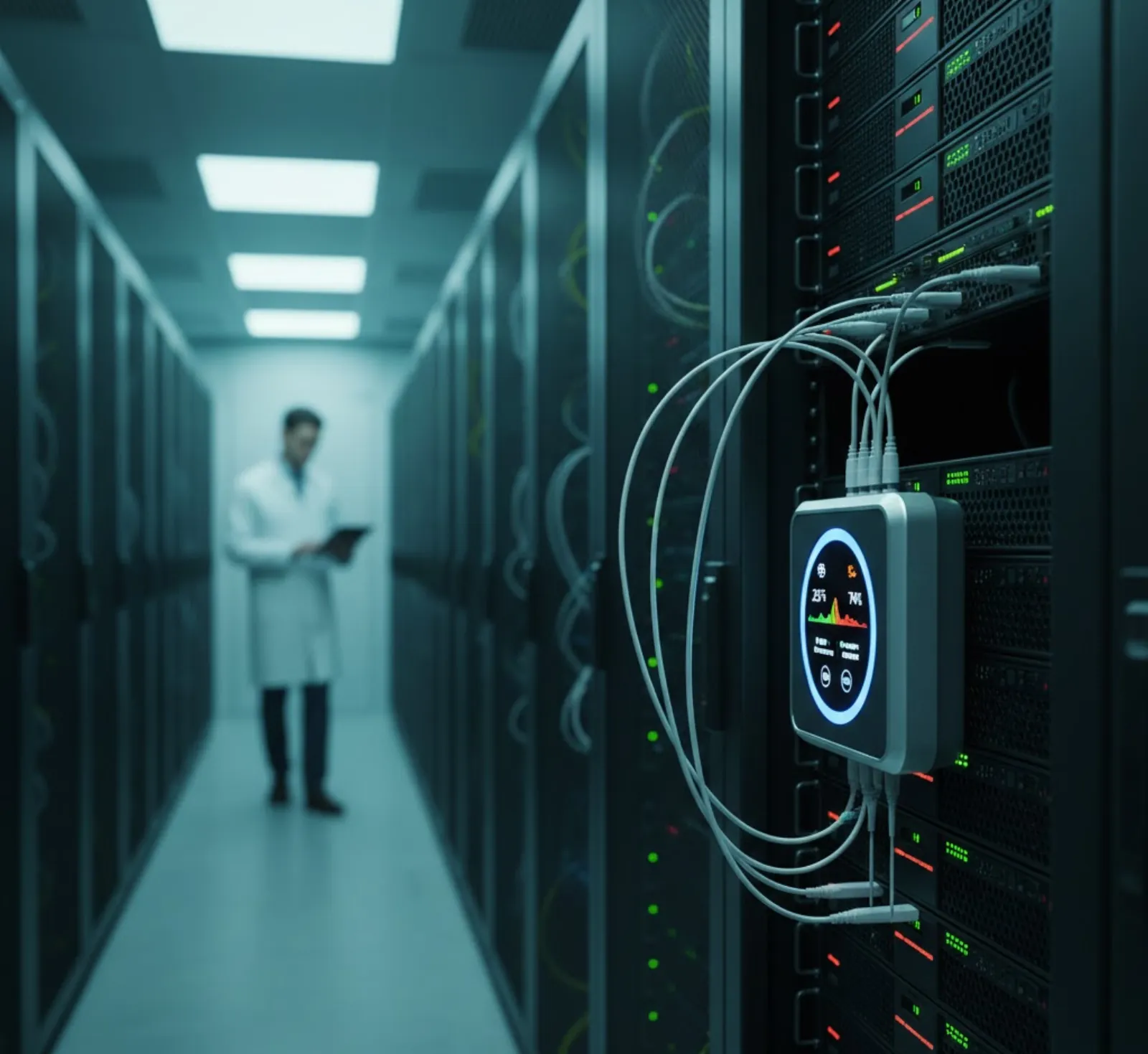
Supply chains are more complex than they have ever been, and regulatory requirements keep tightening. In that environment, a temperature monitoring system is no longer a luxury. It is an operational necessity. Whether you run a cold-storage warehouse, a server room, a farm, a pharmaceutical laboratory, or a restaurant group, the ability to track temperature in real time, receive immediate alerts, and log data automatically can be the difference between a profitable operation and heavy losses.
Businesses lose real money every year to goods rejected because of temperature excursions nobody caught in time. Food held at the wrong temperature becomes unsafe to eat, medicines exposed to heat lose their potency, and harvested crops that were never cooled properly spoil before they reach the consumer. The damage is not only financial. It is also a safety and compliance problem.
An IoT-based temperature monitoring system solves these problems with continuous tracking, 24 hours a day, 7 days a week. The sensors measure, the controller collects the data, the cloud stores and analyzes it, and you get an alert on your phone the moment something drifts out of range. This is not science fiction. It is available, proven technology that already saves operations time, money, and worry.
This guide gives you everything you need to understand, choose, and deploy a temperature monitoring system that fits your exact needs. No filler and no sales talk, just practical, professional information.
What Is a Temperature Monitoring System?
A modern temperature monitoring system is a complete electronic system built from several components working together. It is important to understand the difference between a simple thermometer and a real monitoring system, because that difference is the whole point.
System Components
Sensors: The most basic component. A temperature sensor converts physical temperature into an electrical signal that can be read and processed. There are many sensor types, and we cover each of them later in this guide. The right sensor for a given point depends on the accuracy you need, the environment it has to survive, and the communication protocol it speaks.
Controller / data logger: The brain of the system. The controller receives data from the sensors, processes it, and forwards it to the cloud. A capable controller like the Omni Genesis Controller supports many sensors connected in parallel, performs local processing, and buffers data locally even when the internet connection drops.
Communication infrastructure: How data travels from the sensor, through the controller, to the cloud. The main options are WiFi (short distances inside buildings with existing networks) and cellular 4G (remote or standalone sites). For very large sites, some controllers are also capable of long-range, low-power radio protocols such as LoRaWAN. Each option fits a different scenario.
Cloud platform: The software that stores all the data, presents it in a graphical dashboard, manages alerts, and generates reports. A good platform lets you see live status from any device, analyze trends over time, and export reports for compliance.
Alerting mechanism: When a temperature crosses a predefined threshold, the system sends an immediate alert: SMS, email, an app push notification, or all of them together. Response time matters. Every minute of delay can cost you inventory.
The Difference Between a Thermometer and a Monitoring System
A regular thermometer gives you a point reading: what the temperature is right now. A temperature monitoring system gives you the full picture: what the temperature is now, what it was over the last hour, day, and month, which direction it is trending, and whether an excursion is coming. That is the difference between reacting to a problem and preventing one.
At Agrinovo, our approach is to pair dependable hardware with intelligent software, so monitoring stops being another task on the list and becomes an automatic process that simply runs in the background.
Temperature Sensor Types
Choosing the right temperature sensor is one of the most important decisions in system design. Each sensor type fits different scenarios, and the wrong choice leads to inaccurate readings, unnecessary maintenance, or overspending on precision you do not need.
NTC Thermistors
Temperature range: typically -40°C to +125°C Accuracy: ±0.5°C to ±1°C
NTC (Negative Temperature Coefficient) thermistors are analog sensors whose resistance drops as temperature rises. They are extremely common in the food industry because they are simple and dependable across the ranges that matter most in food storage (0-50°C). If you need to monitor refrigerators, cold rooms, or food production lines, an NTC probe is a sensible, well-proven choice.
The main drawback: NTC sensors are analog, which makes them more sensitive to electrical noise and cable length. Over long runs (more than 10 meters), accuracy can degrade.
PT100 / RTD Sensors
Temperature range: -200°C to +850°C Accuracy: ±0.1°C to ±0.3°C
PT100 sensors are based on platinum resistance that changes linearly with temperature. They are the industrial standard for precision temperature measurement. Their biggest advantage is long-term stability: a quality PT100 sensor holds its accuracy for years without recalibration.
PT100 is the right fit for industrial environments: food factories, laboratories, pharmaceutical production facilities, and chemical processes. If you have to meet strict standards (ISO, GMP), this is usually the correct choice.
Digital DS18B20 Sensors
Temperature range: -55°C to +125°C Accuracy: ±0.5°C
The DS18B20 is one of the most widely used temperature sensors in the IoT world, and for good reason. It is a digital sensor that communicates over the 1-Wire protocol, which means you can connect many sensors on a single cable. Each sensor ships with a unique serial number, so the controller knows exactly which sensor produced each reading.
The advantages of the DS18B20 for IoT systems:
- Simple wiring: only three wires (power, ground, data)
- Multi-sensor support: dozens of sensors on one cable
- Durability: waterproof (IP68) versions are readily available
- Low power consumption: suitable for battery-powered systems
The DS18B20 is an excellent fit for monitoring refrigerators, cold rooms, greenhouses, fish ponds, and warehouses. It is the sensor we recommend at Agrinovo for most projects that need temperature monitoring alone.
SHT30 Sensors: Temperature and Humidity
Temperature range: -40°C to +125°C Temperature accuracy: ±0.3°C Humidity accuracy: ±2% RH
When you need to monitor both temperature and humidity, for example in warehouses, greenhouses, or pharmaceutical storage rooms, the SHT30 is an elegant solution. One sensor measures both parameters with high accuracy, which reduces hardware count and installation complexity.
The SHT30 communicates over I2C, a very common protocol in IoT, and is best suited to installations where the sensor sits close to the controller (up to about 3 meters without an extender). For environments that need longer cable runs, RS485 variants such as the THS-100 are available.
Thermocouples
Temperature range: -270°C to +1,800°C (type-dependent) Accuracy: ±1°C to ±2.5°C
Thermocouples are the answer when you need to measure extreme temperatures: industrial furnaces, welding processes, kilns, or cryogenic environments. They are based on the Seebeck effect, where two dissimilar metals generate a voltage that depends on temperature.
The common types: Type K (up to 1,260°C, the most widespread), Type J (up to 760°C), and Type T (up to 370°C, with better accuracy). Thermocouples are rarely needed for temperature monitoring in food or agriculture, but the category is worth knowing in case you have specialized requirements.
Benefits of an IoT Temperature Monitoring System
If you are still weighing manual monitoring (periodic checks with a thermometer) against an automated temperature monitoring system, here are the key advantages to consider:
Continuous 24/7 Monitoring
People sleep, take vacations, and get pulled into other tasks. An IoT system does not. It measures and logs at the interval you set, without pause. Cooling failures have a habit of happening at night and on weekends, exactly when nobody is there to notice.
Immediate Alerts
The moment a temperature crosses the range you defined, you get an alert. Not an hour later, not the next morning. Now. The first minutes after a failure are the most critical: a refrigerator door left open can recover to a safe temperature if someone closes it immediately. Discover it six hours later and the goods inside are gone.
Standards and Regulatory Compliance
IoT temperature monitoring systems produce automatic records that satisfy HACCP, ISO 22000, and the record-keeping requirements of food safety regulators. Instead of paper forms that are easy to forget (and even easier to falsify), you have a time-stamped digital log recorded automatically on every reading. In a regulatory audit, that is worth a great deal. For more on HACCP compliance, read our guide on automated temperature logging for food safety.
Meaningful Financial Protection
A system that prevents a single inventory-loss event has already justified itself. But the value goes beyond damage prevention: a smart system helps you spot energy waste (a compressor running hard means high power draw), plan preventive maintenance, and cut the labor hours spent on manual checks.
Remote Access
You can check status from your phone or computer, from anywhere in the world. A restaurant group manager can oversee every branch from one screen. A farmer can watch greenhouse temperatures while traveling abroad. It changes how the operation is managed.
Data Analysis and Insight
Historical data reveals patterns: are there specific hours of the day when temperature climbs? Is a refrigerator showing early signs of wear (recovery time after a door opening keeps getting longer)? Do outside weather swings affect the system? Insights like these turn temperature monitoring from a reactive tool into a proactive one.
Scalability
Started with two sensors in one refrigerator? You can grow to 50 sensors across 10 locations without replacing the system. IoT solutions are built for growth from day one, which is a major advantage over closed proprietary systems.
What to Look For in a Temperature Monitoring System
The monitoring market offers everything from basic components to comprehensive enterprise systems. How do you choose? These are the criteria to weigh:
Accuracy Requirements
What accuracy do you actually need? For a standard refrigerator, ±1°C is entirely sufficient. For pharmaceutical storage, you may need ±0.3°C. For sensitive production processes, ±0.1°C. Do not pay for precision you will never use, but do not compromise where precision is critical.
Connectivity Options
WiFi: excellent for buildings that already have a reliable network. Simple to install, with no ongoing connectivity cost. The drawback: it depends on external infrastructure, and if the router goes down, reporting stops. Insulated cold-room walls also weaken the signal.
Cellular (4G/LTE): ideal for remote sites or anywhere without stable WiFi. Completely self-contained, with a modest recurring cost for the SIM. This is what most standalone field deployments run on.
LoRaWAN readiness: long-range, low-power radio protocols were designed for spreading many sensors across a wide area, such as large farms or industrial campuses, and they require a dedicated gateway. If wide-area coverage is in your future, choose a modular controller that is capable of supporting protocols like LoRaWAN, so the option stays open as you grow.
Number of Monitoring Points
How many sensors do you need today, and how many will you need later? A system that tops out at 4 sensors may be enough now, but if you want to add 20 next year, you will be replacing everything. Plan ahead.
Regulatory Requirements
If you operate in food, pharmaceuticals, or biotech, verify that the system produces reports that satisfy your regulator. Look for support for HACCP, FDA 21 CFR Part 11 (for pharmaceuticals), or ISO 22000. Not every system delivers this.
Total Cost of Ownership
The full cost is not just the initial purchase. It includes ongoing items: the cloud platform subscription, battery replacement, sensor calibration, and technical support. Ask any vendor to lay out the total cost of ownership over at least three years so you can compare systems honestly.
Support and Service
An IoT system is not “install and forget.” Sensors need calibration, firmware needs updates, and sometimes things do not behave as expected. Confirm that the vendor offers responsive technical support, reasonable response times, and a communication channel that works for you.
Installation and Setup Steps
Once you have chosen a temperature monitoring system, it is time to install and commission it. The process does not have to be complicated, but it pays to do it right from the start. Here are five ordered steps:
Step 1: Choose the Right Sensor Type
Match the sensor to the environment and the task:
- Refrigerators and freezers: waterproof DS18B20, or an NTC probe with a stainless steel tip
- Cold rooms: PT100 for high accuracy, or DS18B20 as the practical choice
- Greenhouses and agriculture: SHT30 (temperature + humidity) connected to a controller with cellular connectivity
- Warehouses and logistics: DS18B20 with a data logger
- Industry: PT100 or a thermocouple, depending on the temperature range
Step 2: Set Up the Communication Infrastructure
The basic rule: confirm reliable communication coverage at every monitoring point. That means:
- Test WiFi signal strength next to each refrigerator and cold room; insulated walls attenuate signals
- If you are using cellular, verify reception inside the building, not just outside
- If your deployment uses a gateway-based radio protocol, place the gateway in a central, elevated position
Plan for redundancy too: what happens if the primary connection drops? A good system buffers data locally and syncs when the connection returns.
Step 3: Install Sensors at Strategic Locations
Sensor placement matters as much as the sensor itself:
- In refrigerators: place the sensor at the center of the third shelf from the bottom, not against the wall of the unit and not next to the door
- In cold rooms: at least two sensors, one near the door (the warmest point) and one at the spot farthest from the cooling unit
- In greenhouses: sensors at multiple heights (floor, plant height, ceiling), because temperature changes dramatically with height
- In warehouses: near entry and exit doors, near windows, and at the points farthest from the cooling or heating system
Avoid placing sensors in direct sunlight, next to ventilation outlets, or near heat-generating equipment.
Step 4: Configure Custom Alert Thresholds
Temperature thresholds: set a minimum and maximum for each monitored zone. Examples:
- Refrigerator: 2°C to 8°C
- Freezer: below -18°C
- Vegetable cold room: 1°C to 4°C
- Pharmaceutical storage: 15°C to 25°C
Delay: configure a delay of 5-15 minutes before an alert fires. Opening a refrigerator door for a moment raises the temperature temporarily, and you do not want a false alarm every time someone reaches for an ingredient.
Alert channels: configure at least two channels (for example SMS + push). If your phone is in airplane mode, someone else on the team needs to receive the alert.
Step 5: Test the System and Generate Reports
Before you trust the system, run a complete test:
- Confirm every sensor is reporting and showing plausible values
- Simulate an excursion (for example, take a sensor out of the refrigerator) and verify the alert arrives
- Confirm the data is stored in the cloud and accessible from the dashboard
- Set up an automatic daily or weekly report delivered by email
- Verify the reports meet your compliance requirements
Document the installation: photograph sensor locations, save the alert configuration, and record the first calibration date. Good documentation saves time later.
How to Think About Cost and Value
One of the most common objections to a temperature monitoring system is the cost. “Why invest in a system when we can just check the thermometer twice a day?” It is a fair question, so consider the full picture.
The investment side has a simple structure. There is a one-time hardware component, driven mostly by how many monitoring points you need and the accuracy class of the sensors, and a modest recurring component for the cloud platform and connectivity. From the second year onward, only the recurring part remains.
The risk side is what most operations underestimate. Take a mid-sized restaurant:
- A single refrigeration failure that goes unnoticed overnight destroys a large amount of inventory at once
- Small, repeated excursions quietly degrade quality and shorten shelf life all year long
- A regulatory audit that finds gaps in the temperature records can end in penalties
Set those exposures against a measured one-time investment and the conclusion is straightforward: if the system prevents even one inventory-loss event, it has justified itself. That is before counting energy savings (early detection of a compressor working too hard), labor savings (no more manual temperature logging), and the operational calm of knowing someone is always watching.
For a cold-storage logistics warehouse holding temperature-sensitive goods, the math is even more lopsided. A cooling failure that runs undetected for one night can wipe out an enormous amount of product. A full monitoring deployment with dozens of sensors and proper redundancy is a small fraction of that exposure.
For any business that stores, produces, or moves temperature-sensitive products, an IoT temperature monitoring system is one of the highest-leverage investments available.
Summary
A temperature monitoring system is essential for any business that depends on controlled temperature. Whether the driver is food safety, pharmaceutical storage, precision agriculture, or industrial facility management, the technology exists, it is accessible, and it earns its keep.
This guide covered everything you need to get started: what a modern temperature monitoring system includes, how the sensor types compare, why IoT solutions outperform manual checks, which selection criteria matter, and how to plan the installation.
Your next step: define your requirements (how many monitoring points, what accuracy, which connectivity), then reach out for a consultation. The Agrinovo team will help you build a temperature monitoring solution matched precisely to your operation, from the sensor to the dashboard.
Want to learn more?
- Agrinovo temperature monitoring solution: a full overview of our solution
- Temperature control solution: for when you need to act on readings, not just watch them
- Contact us for a personal consultation
Temperature does not wait for anyone. Make sure you are ready.