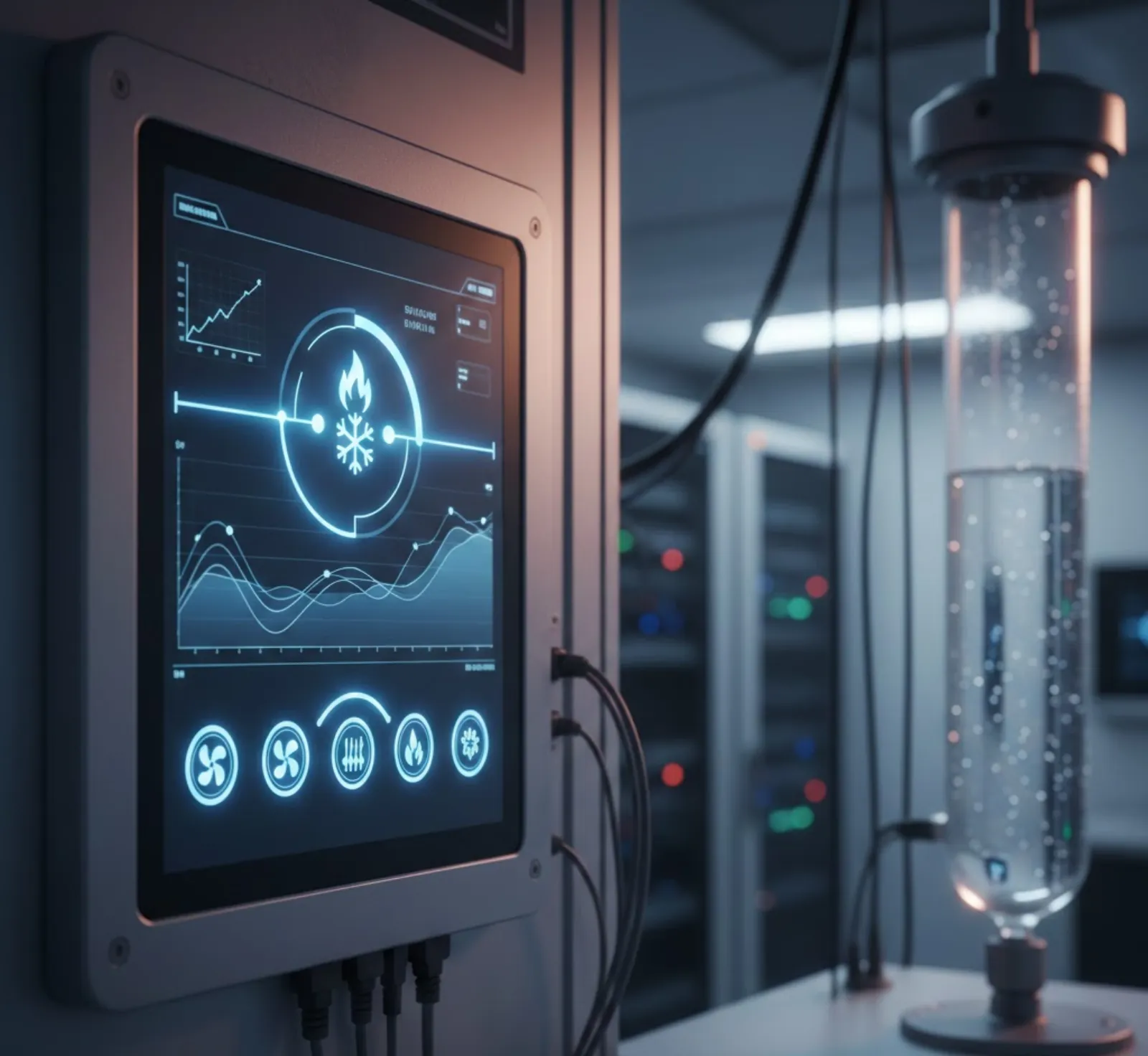
Temperature is one of the most critical parameters in any industrial, agricultural, or scientific process. Whether it is a greenhouse where crops are sensitive to heat swings, a production plant that requires uniform conditions, or a server room that must stay within a narrow band, the ability to control temperature automatically is not a luxury. It is an operational necessity.
A temperature control system is much more than a sensor displaying numbers on a screen. Unlike temperature monitoring, which is a passive act of observing and logging data, temperature control requires active intervention in the environment. A control system reads the current temperature, compares it to the target value (the setpoint), and switches devices such as heaters, coolers, fans, and valves on or off to bring the temperature back into the desired range.
The essential difference is simple: monitoring tells you what is happening. Control does something about it. When you receive an out-of-range alert at three in the morning, a monitoring system requires you to get up and fix the problem yourself. A temperature control system has already switched on the fan or the heater the moment the deviation was detected, before the alert was even sent.
This guide covers every aspect of temperature control systems: the core components, the main control methods, industrial applications, the gap between monitoring and control, energy savings, and practical criteria for choosing the right system. Whether you are an engineer, a grower, a facility manager, or a founder building an operation, this guide was written for you.
What Is a Temperature Control System?
A temperature control system is an automated system whose purpose is to hold a stable, regulated temperature in a given environment. It operates as a closed control loop (closed-loop control): it continuously measures the current state, compares it to the desired state, and applies a correction accordingly. This is the basic principle behind every automatic control system.
System Components
Every temperature control system is built from four main components:
1. Temperature Sensor The sensor is the “eyes” of the system. It measures the current temperature and passes the reading to the controller. Common sensor types include digital DS18B20 sensors (such as our DS18B20 temperature sensor), thermocouples for high temperatures, RTD sensors (PT100/PT1000) for high accuracy, and NTC thermistors for fast measurements. Sensor choice depends on the temperature range, the accuracy the application demands, and the operating environment.
2. Control Unit (Controller) The controller is the “brain” of the system. It receives data from the sensors, processes it according to the configured algorithm, and decides which actions to take. Modern controllers include relay outputs that can switch electrical equipment on and off automatically. The Omni Genesis controller, for example, includes built-in relay outputs for switching heaters, fans, valves, and pumps, turning a monitoring system into a full control system.
3. Actuators These are the physical devices that carry out the action in the field: electric heaters, air conditioners, ventilation fans, motorized valves, shading systems, and more. The controller drives them through its relays according to the control logic.
4. Feedback Loop This is the principle that ties all the components together: the sensor measures, the controller decides, the actuator acts, and the sensor measures again to verify that the action achieved the intended result. Without feedback there is no real control, only blind switching.
The closed control loop ensures the system responds dynamically to changes in the environment. If the temperature rises because of an external heat wave, the system detects the change and increases cooling. If the heater shut off and the temperature keeps dropping, the system switches it back on. It all happens automatically, 24 hours a day, with no manual intervention.
Temperature Control Methods
Not all control systems work the same way. There are several common control methods, and each suits different applications. Understanding the differences between them is essential to choosing the right system.
On-Off Control (Hysteresis)
This is the simplest and most common control method. The principle is basic: when the temperature drops below a threshold, switch heating on. When it rises above another threshold, switch heating off. The same logic applies to cooling in reverse.
The gap between the two thresholds is called hysteresis, and it prevents the system from “chattering”: rapid, repeated switching that damages equipment and shortens the life of relays and actuators.
Practical example: suppose the setpoint is 25°C with 1°C of hysteresis. The heater switches on when the temperature falls to 24°C and switches off when it reaches 26°C. The system never holds exactly 25°C; it oscillates within a band of about ±1°C.
Advantages: simplicity, minimal hardware requirements, easy maintenance, works with standard relays.
Disadvantages: temperature oscillation around the setpoint, not suitable for applications that demand tight accuracy.
Best for: basic greenhouses, warehouses, small cold rooms, simple HVAC systems.
PID Control
PID control (Proportional-Integral-Derivative) is the most widely used advanced control method in industry. Instead of simply switching on or off, a PID controller calculates how much output is needed at every moment, producing a smooth, precise response.
The three components:
- P (Proportional): the response is proportional to the current error. The farther the temperature is from the setpoint, the stronger the response. If the temperature is 5 degrees away from the target, the output is stronger than if it is 1 degree away.
- I (Integral): corrects accumulated error over time. If the temperature consistently sits slightly below the target, the integral term gradually increases the output until the error reaches zero.
- D (Derivative): responds to the rate of change. If the temperature is climbing fast, the derivative term “brakes” the response to prevent overshoot past the setpoint.
Advantages: high accuracy, fast settling to the setpoint, minimal oscillation, adapts to a wide range of conditions.
Disadvantages: requires parameter tuning, more complex to implement, needs a controller with adequate processing capability.
Best for: production processes, laboratories, cleanrooms, precision agriculture, any application that demands tight temperature stability.
Staged Control
Staged control is used in large systems with multiple stages of heating or cooling. Instead of switching all the equipment on at once, the system engages stages incrementally as demand requires.
Example: a large greenhouse with three heating systems. On a cool night, stage one runs. If the temperature keeps dropping, stage two engages. Only in extreme cold do all three stages run together. Operated this way, the system saves energy and reduces equipment wear.
This method is very common in HVAC systems for large buildings, in commercial greenhouses, and in production plants where heating and cooling loads vary through the day.
Advantages: significant energy savings, evenly distributed equipment wear, flexible load management.
Disadvantages: requires careful planning, duplicate or triplicate equipment, more complex controller programming.
Industrial Applications
Temperature control systems are used across an enormous range of industries. These are the main applications:
Greenhouses and Agriculture
In modern agriculture, temperature control is a decisive factor in crop success. Smart greenhouses use automated control systems to manage heating (heaters, heated floors), cooling (fans, wet cooling pads), ventilation (opening and closing vents), and shading (motorized shade screens).
Greenhouse temperature control is not a matter of convenience; it is critical to yield. A shift of just a few degrees can affect growth rate, flowering, fruit ripening, and disease susceptibility. A smart control system adjusts the temperature by time of day, season, crop stage, and even the weather forecast.
To go deeper on combining IoT with greenhouse temperature control, read our detailed article on IoT temperature control for agriculture and greenhouses.
Industry and Manufacturing
In many production processes, temperature is a critical quality parameter. In plastics, injection temperature must be precise. In food processing, pasteurization and sterilization depend on temperature. In metalworking, welding and forging processes require tight control.
Plants typically use PID control with industrial solid state relays (SSRs) that allow fast, precise switching. SCADA systems integrate with the temperature controllers for centralized monitoring and control of all production processes.
Server Rooms and Data Centers
Modern IT infrastructure is highly temperature sensitive. Servers generate substantial heat, and drifting outside the permitted range (typically 18-27°C) can cause failures, downtime, and even physical hardware damage. Precision cooling systems (CRAC/CRAH) work with temperature sensors distributed throughout the server room, with zone-level control that matches cooling to specific hot spots.
Advanced data centers use staged control: mechanical cooling, free cooling with outside air when the weather allows, and airflow management (hot aisle / cold aisle) for maximum efficiency.
Cleanrooms and Pharmaceuticals
In pharmaceuticals and semiconductor manufacturing, cleanrooms demand exceptionally precise temperature and humidity control. A drift of half a degree can disqualify an entire batch of drugs or chips. Cleanroom control systems include calibrated sensors, high-precision PID control, and continuous documentation for regulatory compliance (GMP, FDA).
Smart Buildings and HVAC
Temperature control is the heart of building automation systems (BMS, Building Management Systems). Smart HVAC systems use distributed temperature sensors, zone controllers, and advanced control algorithms to keep occupants comfortable with minimal energy consumption. Schedules, occupancy sensors, and data-driven learning allow the temperature to adjust automatically to usage patterns.
Food Safety and the Cold Chain
Keeping food at the correct temperature through the cold chain is both a regulatory requirement and fundamental to public safety. Temperature control systems in commercial refrigeration, refrigerated trucks, warehouses, and retail cases ensure that sensitive food products stay within the safe range. Drifting outside it can allow dangerous bacterial growth and result in lost product.
For a deeper look at temperature in the food industry, see our article on automated temperature logging for food safety.
The Difference Between Monitoring and Control
One of the most common questions we get is: “What is the difference between temperature monitoring and temperature control?” The difference is fundamental, and it matters before you choose a system.
Temperature monitoring is a passive process of measuring, logging, and reporting. The system measures the temperature, stores the data, and alerts when there is a deviation, but takes no physical action to correct the situation.
Temperature control includes all the monitoring capabilities but adds active response: switching heating, cooling, and ventilation equipment on and off automatically.
| Attribute | Temperature Monitoring | Temperature Control |
|---|---|---|
| Purpose | Observation and documentation | Actively holding a target temperature |
| Output type | Data, charts, alerts | Switching relays and actuators |
| Hardware required | Sensors + controller + cloud | Sensors + controller with relays + actuators |
| Complexity | Low to medium | Medium to high |
| Human intervention | Required on every deviation | Minimal, automatic |
| Typical applications | Regulatory logging, remote monitoring | Greenhouses, plants, HVAC, cold rooms |
| Response time | Depends on a person | Immediate, automatic |
In practice, many systems combine both: monitoring and control together. The system controls the temperature automatically while simultaneously monitoring, logging, and reporting every action and every data point.
For more detail, see our solution pages: temperature monitoring and temperature control.
Saving Energy with Smart Temperature Control
One of the biggest advantages of a smart temperature control system is the reduction in energy consumption. Moving from manual operation to smart automated control cuts waste in several distinct ways, and because the system logs everything, you can measure the reduction against your own baseline instead of guessing.
Scheduling
Programmed schedules match the target temperature to the hours of the day and the seasons of the year. In a greenhouse, for example, you can lower the target temperature overnight (many crops actually prefer a relatively cool night) and save hours of unnecessary heating. In a commercial building, you can shift the temperature on weekends and during hours when the building is empty.
Setback Temperatures
Setback temperatures are reduced target values that apply when full conditions are not needed, such as lowering the target by a few degrees during hours with no human presence. Every degree of setback trims heating demand for those hours, and over a season the reduction compounds.
PID Optimization
A well-tuned PID controller reduces oscillation and prevents equipment from over-running. When an on-off controller drives a heater at full power and then cuts it, excess energy is spent on overshoot past the setpoint. A PID controller delivers exactly the amount of energy required, and no more.
Data-Driven Improvement
A smart temperature control system with IoT connectivity keeps detailed historical data. Analyzing that data exposes patterns: peak energy hours, zones that need better insulation, equipment consuming more than expected, and more. These findings drive targeted improvements that compound into meaningful savings over time.
How to Choose a Temperature Control System
Choosing the right temperature control system means weighing several key criteria. These are the factors to examine:
Number of Control Zones
How many independent zones do you need to control? A small greenhouse may need one zone, but a plant or a large farm will require dozens of independent zones. Verify that the system supports the number of zones you need and that it can be expanded later.
Relay Capacity
Check how many relay outputs the controller has and the maximum load each relay can carry. Relays driving heavy heating equipment (industrial heaters, for example) need high capacity, while small valves can run on lower-rated relays. The Omni Genesis controller offers relay outputs suited to a wide range of control applications.
PID Support
If your application demands tight accuracy, verify that the system supports PID control and not only on-off. Also check whether auto-tuning of the PID parameters is available; it saves significant commissioning time.
Connectivity and Remote Control
A modern control system must allow remote access: changing setpoints, viewing data, receiving alerts, and switching relays, all from a phone or a computer. Check for cellular (4G) or WiFi connectivity, whether the modular design leaves room for options like LoRa, and evaluate the quality of the user interface.
Integration and Compatibility
Verify that the system supports your sensors’ protocols (1-Wire, Modbus, SDI-12, analog) and that it can integrate with existing systems. An open API and MQTT support enable integration with automation systems, SCADA, and cloud platforms.
Scalability
Start with what you need today, but verify the system can grow. Adding sensors, controllers, and zones should be straightforward and should never require replacing the entire infrastructure.
For a broader guide to selecting a system, read our complete guide to temperature monitoring systems.
Where to Start
An automated temperature control system is an essential tool for any operation that depends on stable temperature conditions. Whether it is a greenhouse, a plant, a server room, or a cold chain, automated control delivers accuracy, reliability, and energy savings that manual methods cannot match.
Choose the control method that fits your application: on-off for simplicity, PID for accuracy, and staged control for efficiency. Invest in quality sensors, a controller with sufficient relay outputs, and a system that supports remote monitoring and control.
At Agrinovo we build IoT solutions that combine temperature monitoring and control in a single platform. Our controllers support a wide range of sensors and protocols, include relay outputs for automated control, and provide a straightforward cloud interface for remote management.
Want to see how a temperature control system can improve your operation? Visit our temperature control page or contact us for a consultation.