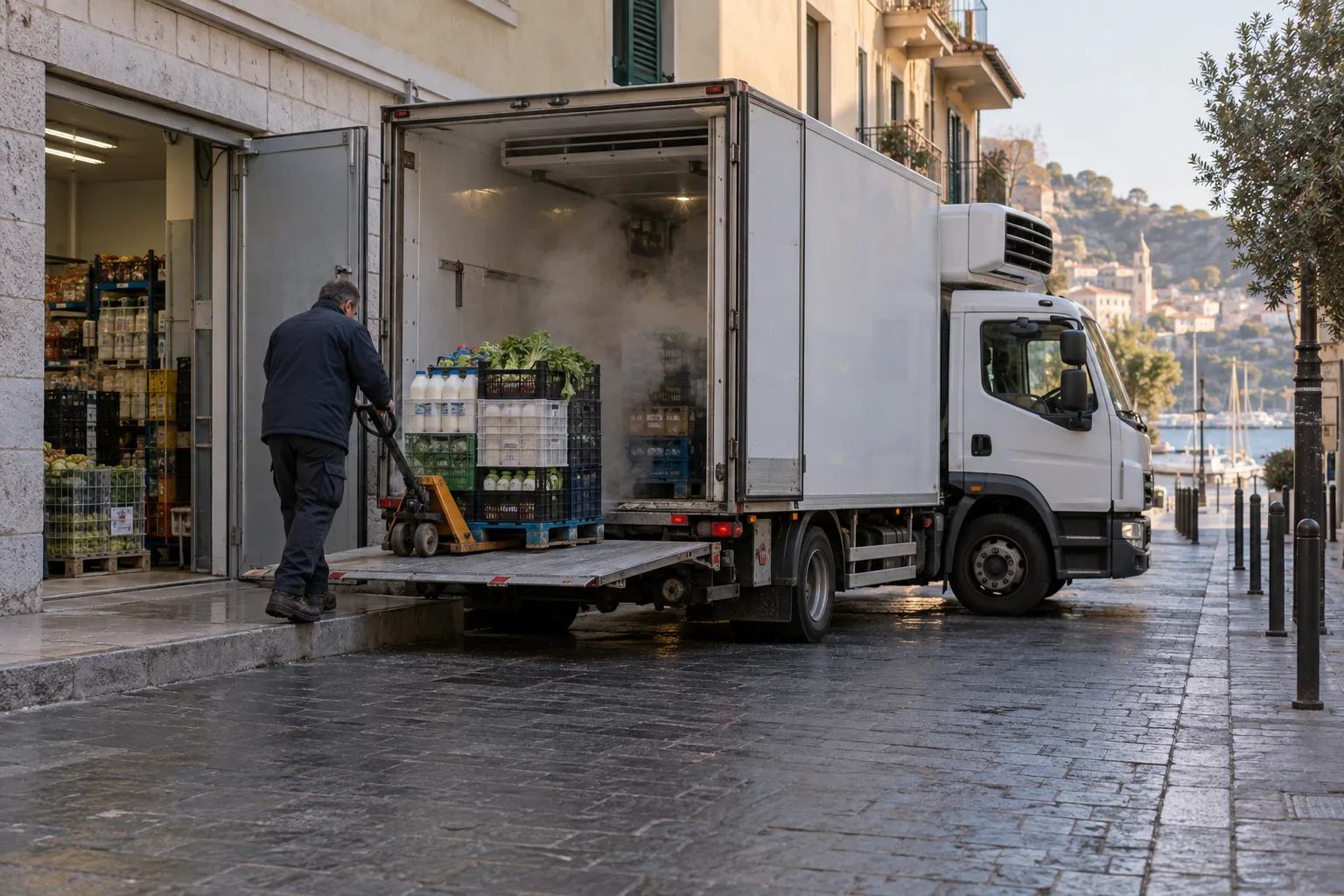
A refrigerated truck is a cold room on wheels. It has the same problems as a cold room: a door that opens, a refrigeration unit that can ice up or switch off, warm spots in the corners. It also has three a cold room does not. The engine stops at every drop-off, there is no network on the road, and the load passes to a customer who holds you responsible for every degree. A temperature monitoring system for transport has to be built around those three, not around a logger you download at the end of the day.
This guide covers what a distribution fleet or food distributor should require from a system before fitting it to the trucks.
Why an end-of-day logger is not enough
A USB logger tells you what happened after it happened. If the refrigeration unit stopped at ten in the morning in the middle of a route, the logger shows it in the evening, when the load has already been delivered to four customers. What you need is an alert during the route, while there is still time to stop, call a technician or move the load to another truck.
The difference is not the sensor, it is what happens to the reading. A real-time system sends every reading to the cloud while the truck is moving, and alerts as soon as a point stays out of range longer than you allow.
A sensor in every compartment, not just the unit display
The refrigeration unit display shows the unit’s own sensor, one point at the front of the box. The load by the rear doors sits in different air. In trucks with a bulkhead between a chilled and a frozen compartment, each compartment needs its own point.
- Chilled compartment: the THS-100 temperature and humidity sensor measures -40 to +80°C at ±0.3°C (at 25°C), and 0-100% RH at ±3% RH. For fresh produce, humidity affects shelf life as much as temperature.
- Frozen compartment or product core: the stainless temperature probe is rated down to -55°C, ±0.5°C from -10 to +85°C, and sealed to IP68.
- Several points on one cable: THS-100 sensors share one RS-485 cable, each at its own Modbus address, so a point by the doors and a point at the front of the box report through the same controller.
Each point has its own name (“chilled, rear doors”), range and history.
Controller outside, sensors inside
The Omni Genesis operates from -20 to +70°C in an IP65 enclosure, so it is mounted outside the refrigerated box, in the cab or on the chassis, with the sensor cable running into the box. Only the sensors are inside.
Vehicle power, battery when the engine is off. The controller’s 6-32 V DC input also accepts fixed DC power, so it runs from the truck’s electrical system. Inside are rechargeable 18650 batteries, and when the engine and refrigeration unit are off, parked overnight at the depot or queuing to unload, it keeps measuring and alerting. That is exactly when a box warms up unnoticed.
Cellular along the route. The controller reports over 4G-LTE with a SIM included, and has Wi-Fi and Bluetooth built in. It does not depend on the driver’s phone or the customer’s network. You choose how often it reports, down to once a minute.
Location. The controller’s modular communication slot is GPS capable for project-specific configurations. If you need temperature alongside location, talk to us about the configuration.
Alerts that understand a drop-off
A distribution truck opens its doors at every drop-off, many times a day. A system that alerts on every opening teaches the driver and the fleet manager to ignore it within a week.
So each point gets three values: a minimum, a maximum and an allowed time out of range. For example 0 to 2°C for meat, 4 to 8°C for vegetables, below -18°C for frozen goods, each with a delay that covers a normal unload. A five-minute drop-off triggers nothing. A door left open, or a unit that switched off, runs past the allowed time, and the alarm goes to every user on the account by SMS, email, phone call or app notification. Everyone on the account, the fleet manager and the driver included, knows at the same moment.
A temperature record for every delivery
A retail chain, a hospital or a food plant receiving chilled goods asks what the temperature was on the way. An inspector visiting the depot asks the same. When a customer claims a delivery arrived warm, the question is not who is right but what the readings show.
Every reading is stored with its time, and any sensor exports to Excel for any period. Pick the truck and the hours of the route and you see whether the temperature went out of range, when, by how much and for how long. It is the same record a HACCP plan calls for, only automatic and without a sheet the driver fills in at the end of the day.
Truck and depot in one system
The load does not start its journey in the truck. It leaves a cold room at the depot and often ends in a customer’s refrigerator. The same controller and sensors are used for cold room temperature monitoring and refrigerator and freezer monitoring, so the depot and the fleet sit on one dashboard, with the same alerts and the same export.
What to check before choosing a system
- A point per compartment. Not the unit display, a sensor in the box, and two in a long box.
- Real-time alerts, not an evening download. Check that the alert arrives during the route, and to how many people.
- A delay per point. Without an allowed time out of range, every drop-off is an alarm.
- Power with the engine off. Ask what happens when the truck is parked overnight.
- Export per delivery. Ask to see one route exported to Excel.
For the full list of criteria, see the guide on how to choose a temperature monitoring system.
Tell us how many trucks you run, how many compartments each has and at which temperatures, and we will plan the measuring points with you.