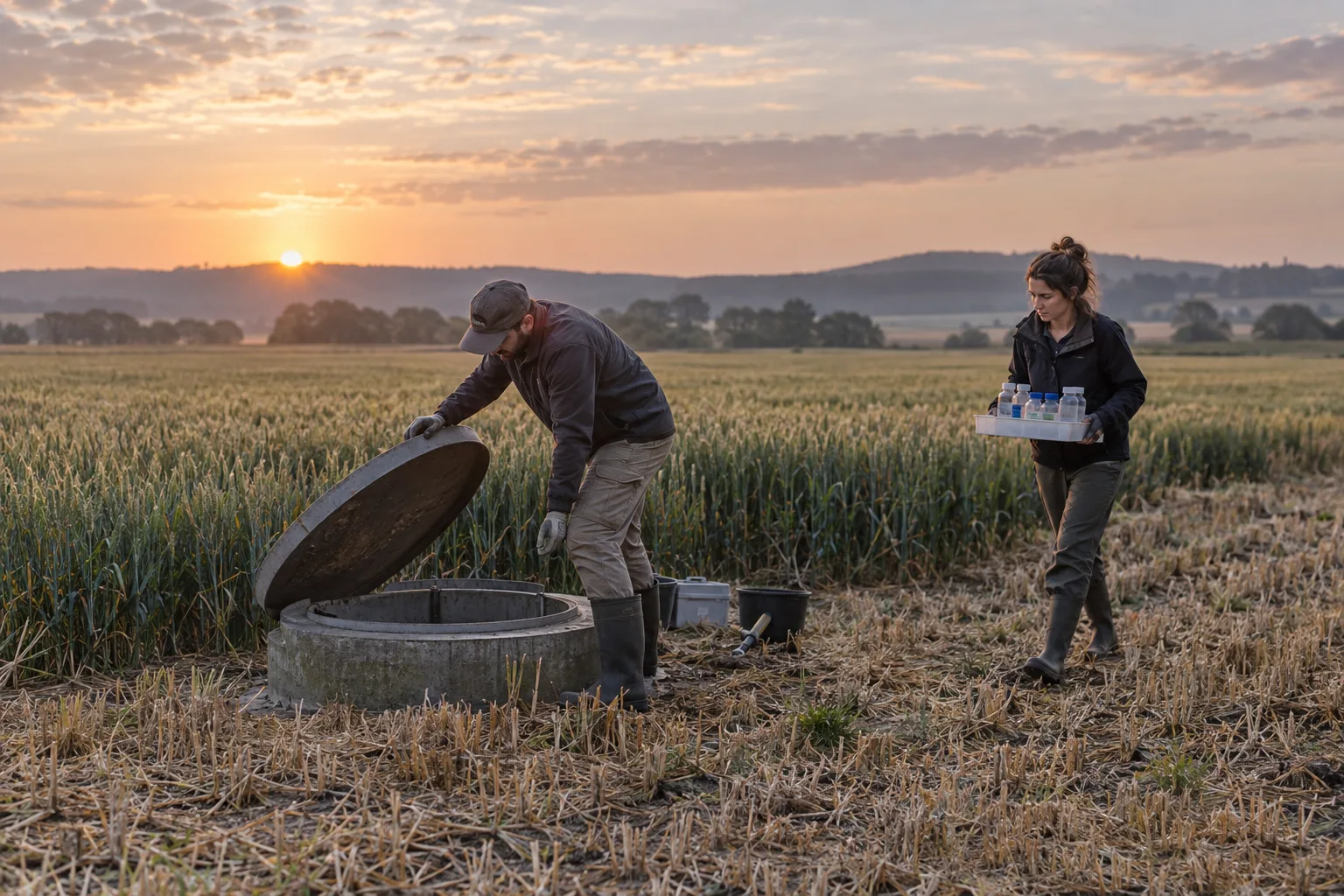
A lysimeter is a block of soil cut off from its surroundings so that the water going in and coming out can be measured. FAO Irrigation and Drainage Paper 56 describes the method as growing the crop in isolated tanks filled with either disturbed or undisturbed soil. The name covers three instruments that answer different questions.
Three types of lysimeter and what each measures
| Type | How it works | What it measures |
|---|---|---|
| Weighing lysimeter | The soil tank rests on a scale; drainage is collected at the bottom | Evapotranspiration over short periods, drainage, and leachate chemistry if the drainage is sampled |
| Drainage (percolation) lysimeter | The tank is not weighed; water draining from the bottom is collected and measured | Drainage volume and leachate chemistry; evapotranspiration over longer periods |
| Suction (tension) lysimeter | A porous cup under vacuum draws water from the surrounding soil | Solute concentrations in soil pore water at one depth |
Weighing lysimeters
In a weighing lysimeter the water lost by the crop is, in the words of FAO-56, directly measured by the change of mass. The paper states that precision weighing lysimeters obtain evapotranspiration with an accuracy of a few hundredths of a millimetre, over periods as short as an hour.
Field installations can be large. The USDA Agricultural Research Service describes its lysimeters at Bushland, Texas as metal containers of soil and plants measuring 10 x 10 x 8 feet deep, each sitting on a scale that records the mass of the soil and plants over time. The published Bushland soybean datasets report mass converted to soil water storage with 0.05 mm accuracy at 5-minute intervals.
The field around the tank matters as much as the scale. FAO-56 requires the vegetation inside and immediately outside the lysimeter to be perfectly matched in height and leaf area index, and notes that this requirement has often been ignored, with severely erroneous crop coefficients as the result.
How ET is computed from a weighing lysimeter
FAO-56 writes the soil water balance of a root zone as:
ET = I + P - RO - DP + CR ± ΔSF ± ΔSW
with irrigation I, rainfall P, runoff RO, deep percolation DP, capillary rise CR, subsurface flow ΔSF and the change in soil water content ΔSW. A lysimeter exists to remove the terms nobody can measure in an open field. The walls stop runoff and subsurface flow, and the closed bottom stops capillary rise and turns deep percolation into drainage that runs into a container. What remains is:
ET = P + I - D - ΔS
All terms are in millimetres. P and I are measured by a rain gauge and by the irrigation meter or the mass gain during the event. D is the drainage collected. ΔS, the change in stored water, comes from the scale:
ΔS (mm) = Δm (kg) / A (m²)
One kilogram of water over one square metre is a layer one millimetre deep.
Worked example. A lysimeter with a 3 m x 3 m surface (9 m²) loses 45 kg between midnight and midnight on a day with no rain, no irrigation and no drainage. ΔS = -45 / 9 = -5 mm, so ET = 0 + 0 - 0 - (-5) = 5 mm for the day.
Drainage lysimeters
A drainage lysimeter, also called a percolation or non-weighing lysimeter, keeps the tank and the drain and leaves out the scale. FAO-56 gives the calculation: evapotranspiration for a given period is determined by deducting the drainage water, collected at the bottom of the lysimeter, from the total water input.
Without a scale, ΔS is not measured. The balance therefore closes only over a period that starts and ends with the soil in the same state of wetness, for example from one drainage event after heavy irrigation to the next. That suits seasonal crop water use and it suits leaching studies, where the quantity of interest is the drainage itself: its volume, its salinity and its nitrate load.
Suction lysimeters
A suction lysimeter holds no soil. It is a sampler: a porous cup on the end of a tube, buried at the depth of interest, to which a vacuum is applied so that soil pore water moves into the cup. The long-term ecological research protocol at Michigan State University’s Kellogg Biological Station calls them low-tension suction lysimeters, also called soil water samplers, with quartz or ceramic cups installed at about 1.2 m, below most roots. A vacuum of -0.5 atm is applied, and over 24 hours enough soil water is drawn in to measure nitrate and other solutes.
The result is a concentration at one point. To turn it into a leaching load in kilograms per hectare, it has to be multiplied by a drainage volume that comes from somewhere else: a drainage lysimeter, a weighing lysimeter, or a water balance.
Mini-lysimeters in pots and greenhouses
The weighing principle scales down to a single container. A pot on a load cell is a mini-lysimeter: the mass falls as the plant transpires and the medium evaporates, and jumps back at each irrigation. Oregon State University Extension describes a scale-and-lysimeter system that weighs each pot and triggers irrigation when it dries down, built by its nursery research team for pot trials.
Our guide to substrate moisture sensing in rockwool and coco coir covers the sensors used inside the slab.
What gets instrumented around a lysimeter
- Soil water tension at several depths. Tension at two or three depths shows which layer the crop is drawing from and when the wetting front arrives. Measured at the same depths inside the tank and in the field next to it, it also shows whether the lysimeter profile is as wet as the soil it is meant to represent. Our article on soil water potential and its units covers the quantity itself.
- Drainage EC and nitrate. Electrical conductivity of the leachate tracks the salt leaving the root zone. Nitrate concentration multiplied by drainage volume is the nitrogen leached.
- Soil temperature. Temperature at depth is needed to interpret nitrogen turnover and root activity, and to compare lysimeter and field.
- Soil oxygen. Oxygen in the soil air falls when the profile stays wet, which is where denitrification and root damage begin.
Agrinovo sensors in and under a lysimeter
Agrinovo supplies the sensors and the logger for these measurements. The tank, the scale and the drainage plumbing belong to the facility.
Matric potential. The Irrometer SR tensiometer carries a 0-100 cb gauge for medium to heavy soils, and the LT a 0-40 cb gauge for coarse and sandy soils and potting soil. Both come in six lengths from 15 to 120 cm, so one model reaches each depth of the profile. The MLT, 171 mm overall with a 0-40 cb gauge, is made for pots and small containers. Where the profile dries beyond a tensiometer, the Watermark 200SS reads 0-200 cb with a stated accuracy of ±15% of reading between 10 and 100 cb.
Leachate EC. The EC-100 conductivity probe with the K=1.0 electrode measures 2 to 10,000 µS/cm at ±1.0% of full scale, with automatic temperature compensation from 0 to 60°C and RS485 Modbus RTU output.
Leachate nitrate. The NO3-100 nitrate electrode measures 0 to 1000 mg/L at ±5% of full scale and is used at nitrate concentrations of 30 mg/L and above. It reports the nitrate ion (NO₃⁻); divide by 4.43 for nitrate-nitrogen. Chloride interferes: keep the chloride concentration below 10 times the nitrate concentration, which is worth checking in leachate from saline irrigation water. Perchlorate, iodide, cyanide, tetrafluoroborate and nitrite also interfere. The sensing tip has to be fully submerged, so the probe goes in a collection vessel or a cell on the drain line that stays full between drainage events. Calibrate at 10, 100 and 1000 ppm. The register map is on the NO3-100 developer page.
Soil temperature. The DS18B20 probe measures -55 to +125°C with ±0.5°C accuracy from -10 to +85°C. It is a 1-Wire device with a unique serial code, so a string of probes at several depths shares one data line.
Soil oxygen. The O2-100 measures 0 to 25 %VOL oxygen at ±2% of full scale (at 25°C) with a response time under 15 seconds, over RS485 Modbus RTU. Install it in the root zone at the depth of interest with the membrane clear of standing water, which in a free-draining lysimeter means above the layer that saturates at the bottom.
Logging. The Omni Genesis controller has four ports, each configurable as analog, 1-Wire, RS485 Modbus RTU or SDI-12. Several RS485 probes share one bus, each at its own Modbus address, and a DS18B20 string uses a port set to 1-Wire. It logs locally with cloud sync over 4G-LTE, runs on solar-charged batteries, and the sampling interval is set from the dashboard.