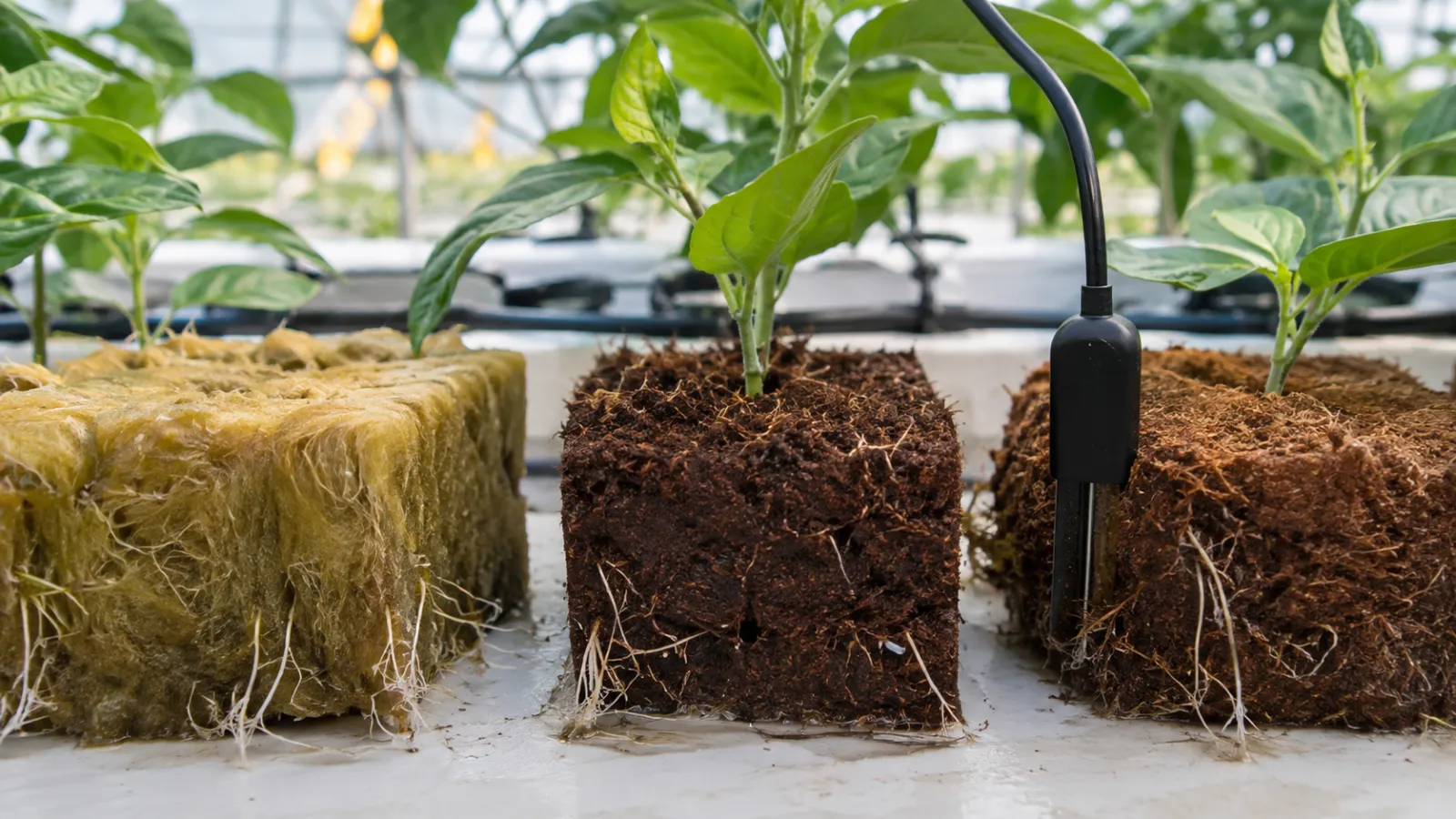
A grower moving from field production into rockwool, coco coir or another soilless medium usually brings the irrigation instruments along. The sensors keep working, the numbers keep arriving, and the readings quietly stop meaning what they used to.
This is not a sensor quality problem. It is a measurement mismatch, and it has a straightforward fix.
Why a soil calibrated probe misreads an inert substrate
Volumetric sensors, capacitance and TDR, do not measure water. They measure the dielectric response of whatever they are buried in, and convert it to water content through a calibration curve. That curve is built for a medium with a particular bulk density, particle structure and salinity.
Rockwool and coco coir share none of those properties with mineral soil. Rockwool is mostly air by volume with fibres arranged directionally. Coco carries its own salt load and changes structure as it ages through a crop. Feed either of them into a soil calibration and you get a number that is beautifully repeatable and does not correspond to the water actually available.
The trap is that this failure is invisible. The sensor does not error. It reports plausible values that trend in plausible directions, and only the crop knows the difference.
Tension is the measurement that transfers
There are two honest ways out. Recalibrate the volumetric probe against gravimetric samples taken in your own medium, which works and is more work than most operations sustain past the first season. Or measure something that does not need a per-medium calibration at all.
That something is matric potential, usually called tension: how hard the plant has to pull to extract water. It is a direct physical measurement of a force rather than an inference from an electrical property, so it means the same thing in rockwool as it does in loam.
It is also the more useful quantity. A root does not sense millilitres. It senses effort. Two substrates at identical volumetric water content can present completely different availability, and tension is the variable that tells them apart.
The range question, which is where instrument choice gets decided
Soilless production runs wet. Very wet, compared to any field crop, because the whole point of an inert medium with frequent fertigation is to keep water freely available and let the grower steer with irrigation frequency rather than with soil buffering.
That has a direct consequence for hardware. Sensors built for field irrigation scheduling span a wide tension range because a soil crop genuinely traverses it between irrigations. A substrate crop never goes anywhere near the dry end of that scale, so a wide-range instrument spends most of its resolution on territory the medium will never visit.
This is why we point substrate growers at tensiometers rather than at granular matrix sensors, even though the granular matrix sensor is the better instrument for a field. The LT tensiometer reads 0 to 40 cb, a low-tension range made for potting and non-soil growing media, and puts the whole dial where a substrate crop actually operates. For small containers and pots, the MLT is the miniature instrument with the same range.
By contrast the Watermark 200SS spans 0 to 200 kPa with no calibration and a multi-season field life, which makes it excellent in orchards, vines and row crops and a poor match for a rockwool slab. Our post on how granular matrix sensors work explains the mechanism, and the tensiometer guide covers installation and maintenance in more depth.
Placement beats coverage
The instinct is to instrument everything. The better design is to instrument representatively.
Substrate moisture is driven by irrigation events that are shared across a zone, so one well-placed sensor per irrigation zone tells you more than a scattering of badly placed ones. Put it in a plant that is typical rather than the strongest or the weakest, at the depth where roots are actually working, and leave it there for the whole crop so the trend is continuous.
Two placement mistakes account for most disappointing installations. Putting the sensor directly under a dripper, where it reads the emitter rather than the substrate. And moving it mid-crop, which destroys the only thing continuous measurement was giving you.
The failure mode nobody instruments for
In field agriculture the risk is drought. In soilless production it is the opposite: over-irrigation, and the consequence is not too much water but too little air.
Water and air compete for the same pore space. A substrate held permanently saturated displaces the oxygen roots need, and the symptoms that follow look like root disease or a nutrient disorder for quite a while before anyone questions the irrigation schedule.
If you are already fighting that pattern, root zone oxygen is measurable directly. The O2-100 soil oxygen sensor reads 0 to 25 percent by volume over RS485 Modbus, which turns a suspicion into a number you can watch against your irrigation events.
Getting it into a schedule
Tension is only worth measuring continuously if somebody acts on it. In practice that means the reading needs to leave the greenhouse.
The Omni Genesis carries four modular ports where each port takes any supported protocol, so tension, root zone oxygen and substrate temperature can arrive on one unit per zone and report over cellular without depending on the house network. Where you would rather feed an existing climate computer, the same values are available over the API.
If you are specifying instrumentation for a new soilless house, tell us the medium, the container depth and how many irrigation zones you run, and we will tell you what to put where. Get in touch, or start with the hydroponic nutrient monitoring post if the nutrient side is the open question, and the soil monitoring solutions page for the wider range.