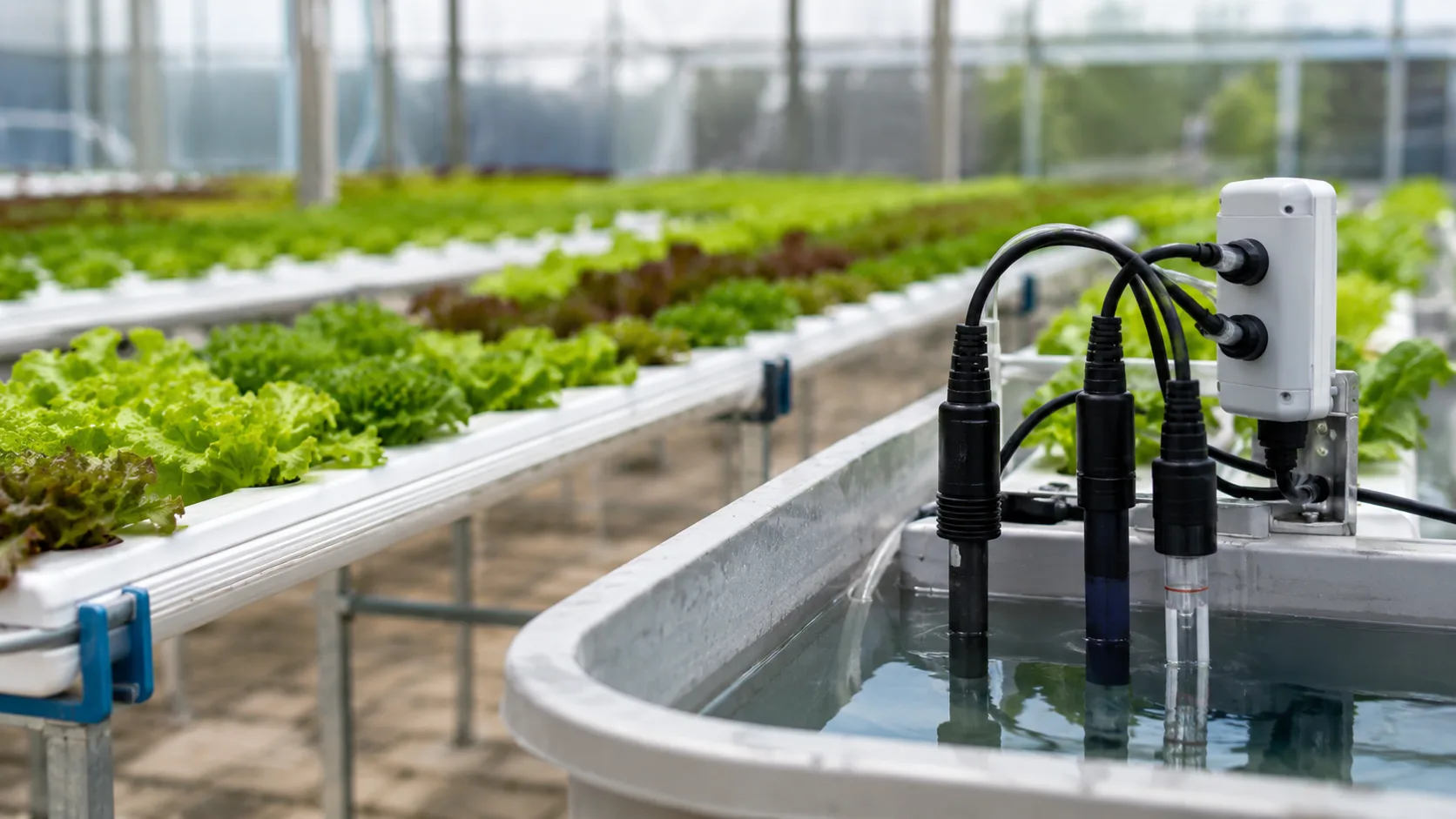
In hydroponics, the nutrient solution is everything. There is no soil to buffer mistakes, so the water your plants sit in is the entire root environment. When it drifts out of range, the crop feels it within hours, not days. That is exactly why nutrient monitoring is not an optional upgrade for a serious hydroponic operation, it is the instrument panel you grow by.
This guide covers how hydroponic nutrient monitoring works, which sensors actually matter, where to place them, and how continuous data turns manual nutrient management into automated control. Whether you run a small greenhouse, a vertical farm, or a commercial NFT system, the principles are the same.
What “Nutrient Monitoring” Actually Measures
Growers often talk about “checking the nutrients,” but no single sensor reads “nutrients.” What you are really tracking is a small set of properties that together describe the health of the solution.
Electrical conductivity (EC) is the workhorse measurement. It reads the total concentration of dissolved salts, which is a proxy for overall nutrient strength. When EC drops, the plants have drawn nutrients down and it is time to feed. When it climbs, water has evaporated or been taken up faster than nutrients, concentrating the solution. EC does not tell you which nutrients are present, only how strong the mix is overall.
pH decides whether the nutrients in the solution are actually available to the roots. Even a perfectly mixed solution starves the plant if pH drifts, because individual nutrients lock out at the wrong pH. Most hydroponic crops want a pH band around 5.5 to 6.5, and holding that band is often more important than hitting an exact number.
Temperature underlies both. Solution temperature affects dissolved oxygen, root health, and the readings of the other sensors themselves, which is why quality EC and pH sensors compensate for it automatically.
Individual ions, for growers who need to go beyond a bulk EC figure, are measured with ion-selective electrodes that read a specific nutrient such as nitrate, potassium, or calcium. This is the difference between knowing your solution is “strong enough” and knowing your nitrate is fine but your calcium is running low.
The Core Sensor Stack for Hydroponics
A practical hydroponic monitoring system is built in layers. Start with the essentials and add specificity as your operation and your margins justify it.
EC and pH: the essential pair
Every hydroponic monitoring system starts here. A digital EC-100 conductivity probe tracks nutrient strength, and a digital PH-100 pH probe with automatic temperature compensation tracks availability. For high-strength solutions or concentrated stock tanks, the EC-120 high-conductivity probe covers the wider range. Together these two readings tell you when to feed and when to correct pH, which covers the majority of day-to-day nutrient management. If you want a deeper look at conductivity specifically, our guide to choosing an EC probe goes through the details.
Ion-selective electrodes: seeing individual nutrients
When bulk EC is not enough, ion-selective electrodes add nutrient-specific readings. The NO3-100 nitrate electrode tracks the single most important nitrogen source for most crops. The K-100 potassium electrode and Ca-100 calcium electrode round out the picture for crops where those elements drive quality and yield, calcium in particular, where a shortfall shows up as disorders like tip burn and blossom end rot. Ion-selective monitoring is where hydroponic growers move from managing a bulk solution to managing a recipe.
One controller to tie it together
Individual probes only become a system when they report to one place. All of these sensors connect to an Omni Genesis controller, which reads EC, pH, temperature, and ion-selective electrodes on the same unit through its multi-protocol ports, logs everything to the cloud, and sends alerts when a reading leaves your range. Because it is modular, you can start with EC and pH and add ion-selective electrodes later without changing the platform.
Where to Place Hydroponic Sensors
Sensor placement decides whether your data reflects what the plants experience or something misleading. A few rules apply across systems.
Measure the solution the roots actually sit in. In recirculating systems, place sensors in the return flow or the reservoir where the solution is well mixed, not in a stagnant corner and not right at a dosing injection point, where you will read the concentrate rather than the blended solution.
Give the solution time to mix after dosing. If a sensor sits too close to where nutrient or pH-down is added, it sees a spike that the plants never experience. Position sensors downstream of mixing, and let the controller account for dosing delay.
Keep probes clean and conditioned. pH and ion-selective electrodes are sensitive instruments. Follow the maintenance and storage guidance for each, and plan periodic checks against a reference solution. Continuous monitoring reduces how often you handle the probes, but it does not eliminate basic upkeep.
From Monitoring to Automated Dosing
The real payoff of hydroponic nutrient monitoring is closing the loop. Reading EC and pH continuously is useful on its own, but when those readings drive dosing outputs, the system holds your solution in range around the clock without anyone standing over it.
The pattern is straightforward. When EC falls below your target, the controller triggers a nutrient dosing pump to bring strength back up. When pH rises above your band, it doses pH-down to bring it back. Because the controller both measures and controls, this happens continuously and consistently, rather than in the large manual corrections that come only when a grower is present, which tend to overshoot and stress the crop.
This is the difference between monitoring and management. A monitoring-only setup tells you the solution drifted overnight. A closed-loop setup keeps it from drifting in the first place. For growers running multiple rooms or benches, the same dashboard shows every zone at once, so you manage a whole facility from one screen and get alerted the moment any zone needs attention.
Beyond Hydroponics: Aquaponics and Fertigation
The sensors and the approach transfer directly to neighboring methods. In aquaponics, you are balancing fish health and plant nutrition in the same water, so continuous EC, pH, and nitrate monitoring is if anything more important, because the margins are tighter. In soil-based fertigation, where nutrients are injected into irrigation water, the same EC and pH monitoring keeps the injected solution consistent from the first emitter to the last. One monitoring platform can span all three, which matters for operations that run more than one growing method.
Getting Started
You do not need every sensor on day one. Most hydroponic growers start with continuous EC, pH, and temperature on their main reservoir, add alerting so drift never goes unnoticed overnight, and then layer in dosing automation and ion-selective electrodes as the operation grows. The platform is modular by design, so the system you install now scales with you instead of being replaced.
If you are managing your nutrient solution with a handheld pen and a notebook, moving to continuous monitoring is the single biggest step you can take toward consistent yields. Get a quote with a note on your system type and crop, or read our EC probe selection guide to choose the right conductivity sensor for your solution.
Frequently Asked Questions
What sensors do I need for hydroponic nutrient monitoring?
The core three are electrical conductivity (EC), which tracks total nutrient strength, pH, which controls whether nutrients stay available to the plant, and temperature, which affects both. For growers who need to see individual nutrients rather than a bulk figure, ion-selective electrodes add specific readings such as nitrate, potassium, and calcium. All of these connect to a single controller for continuous logging and alerts.
What is the ideal EC and pH for hydroponics?
It depends on the crop and growth stage, but most hydroponic crops sit in an EC range of roughly 1.2 to 2.5 mS/cm and a pH of 5.5 to 6.5, where the widest range of nutrients stays available to the roots. Leafy greens run lower, fruiting crops higher. The value of continuous monitoring is not a single target number, it is catching drift away from your chosen range before it stresses the crop.
Can hydroponic nutrient monitoring automate dosing?
Yes. When EC and pH sensors feed a controller with output channels, the system can trigger dosing pumps automatically: add nutrient stock when EC falls, add pH-down when pH rises. This closed-loop control keeps the solution in range around the clock instead of relying on manual checks and corrections that happen only when someone is present.
Why monitor nutrients continuously instead of with a handheld pen?
A handheld EC or pH pen tells you the solution at the moment you dipped it. Hydroponic solutions drift constantly as plants take up water and nutrients at different rates, and the fastest changes often happen overnight or during peak transpiration. Continuous monitoring with alerts covers the gaps a spot check leaves open, which is where most nutrient problems and crop losses begin.
Do hydroponic sensors work for aquaponics and fertigation too?
Yes. The same EC, pH, and ion-selective sensors used in hydroponics apply directly to aquaponics and to soil-based fertigation, where you are dosing nutrients into irrigation water. The measurement principles are identical, so one monitoring platform can cover a hydroponic room, an aquaponics loop, and a fertigation line.