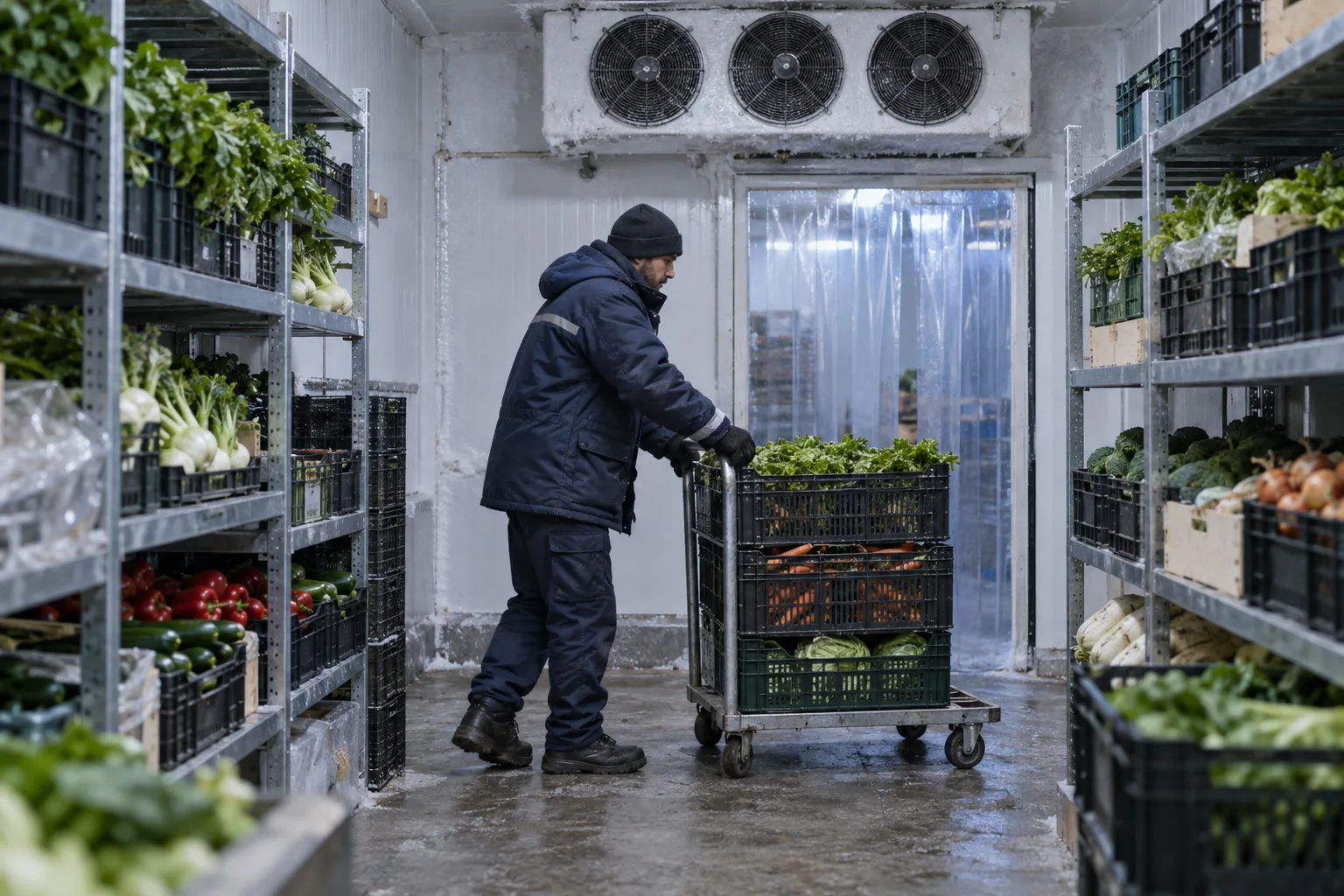
Every cold room already has a thermometer on the door. The question a cold store operator eventually faces is what sits behind it: a data logger that someone downloads once a week, or a system that reports every reading as it happens and calls someone when a room starts to warm. Both produce a temperature record. They differ in when you find out.
This guide compares the two approaches for cold rooms, freezer rooms and cold storage warehouses, with the criteria that decide between them. If you already know you need live alerts and want to see what gets installed, the cold room temperature monitoring solution shows the system.
What a cold room actually needs to know
A cold room is not one temperature. The air near the door warms every time it opens, the air at the evaporator is the coldest in the room, and warm spots form in the far corner behind stacked pallets. A single reading describes a single point, while a customer or an inspector asks about the whole room.
The failures that matter also look different from each other:
- A door left open shows up first on the sensor beside it. Unloading a truck takes a few minutes, a door left open takes an hour.
- An icing evaporator shows as a slow rise over several days, long before anything is visibly wrong.
- A compressor or power failure at night warms the whole room, and nobody is there to see it until the morning shift.
Any monitoring approach should be judged on how it handles those three cases.
Data loggers: a record you read afterwards
A standalone data logger is a battery-powered unit that samples temperature and stores it in internal memory. Someone collects it, connects it to a computer or reads it through an app, and gets a graph and a file of readings.
What it does well:
- It produces a continuous record, which is far better than a clipboard filled in once per shift.
- It needs no network and no installation beyond placing it in the room.
- For a room that is checked in person several times a day, it documents what staff already see.
Where it falls short in a cold room:
- It tells you after the fact. A logger records the night the compressor stopped. It does not wake anyone up. The product is discovered warm when the morning shift arrives, and the logger then documents exactly how long it was lost.
- Someone has to collect the data. Downloads slip during busy weeks, and a gap in the record is itself a finding in an audit.
- One logger is one point. Covering the door and the far corner of each room means several loggers, each downloaded separately, each with its own file.
- The slow trends stay hidden. An evaporator icing up over several days only becomes visible if somebody downloads and reviews the curve in time.
Real-time monitoring: a record plus an alert
A real-time system places sensors in the room and connects them to a controller that sends every reading to the cloud as it is taken. The record builds itself, and the system watches it.
What changes:
- You set a range and an allowed time out of range per point. Routine unloading raises no alert; a door left open does. A meat room might be 0 to 2°C, a vegetable room 4 to 8°C, a freezer room below -18°C.
- The alert reaches people, not a memory chip. When a point stays out of range longer than allowed, the alarm goes to every user on the account by SMS, email, phone call or app notification.
- The history is always current. Every reading is stored with its time, and any room and period export to Excel for an inspection or a dispute over a warm delivery. Nobody has to collect anything.
- Trends become visible. The room history shows a slow rise before the first alert fires, which is the time to schedule a defrost or call a technician.
The cost of that is installation: sensors inside the room, a cable to a controller outside it, and a connection to the network. For most cold rooms that is a short job, covered below.
How to decide
| Criterion | Data logger | Real-time system |
|---|---|---|
| When you learn about an excursion | When someone downloads the data | While it is happening, by alert |
| Unattended nights and weekends | Recorded, not acted on | Alert goes to the people on the account |
| Measuring points per room | One per logger | Several addressed sensors on one cable |
| Collecting the record | Manual download per unit | Automatic, exported per room and period |
| Slow trends such as evaporator icing | Visible only if reviewed in time | Visible in the room history as it develops |
| Humidity | Depends on the unit | Measured with temperature at the same point |
| Installation | Place it in the room | Sensors inside, controller outside, cable through a pass-through |
A useful rule: if one excursion can cost more than a room’s worth of product, or the room is unattended for part of the day, you need the alert, not just the record. A logger is reasonable for a small room checked by staff every few hours, as a documentation tool. A cold store, a distribution centre, a packing house or a freezer room that runs overnight is a real-time case.
Food businesses running a HACCP plan also need the record to be complete, with no gaps from missed downloads. Our guide to temperature monitoring for food safety and HACCP covers what the plan asks for, and the temperature log form covers rooms still recorded by hand.
Where each one fits
Data logger fits:
- A single small cold room in a shop or kitchen, checked every shift.
- Spot studies, such as mapping how a room behaves before deciding where to put fixed sensors.
- Places where a record is required and an alert would have no one to go to.
Real-time system fits:
- Cold storage and distribution with several rooms at different temperatures.
- Freezer rooms, where a failure overnight means a full load.
- Packing houses and pre-cooling rooms, where the time produce takes to reach its target temperature decides its shelf life.
- Ripening rooms for bananas, avocados and mangoes, where relative humidity matters as much as temperature.
For individual refrigerators and freezers in a kitchen or a shop, rather than walk-in rooms, see refrigerator and freezer temperature monitoring.
How a real-time cold room system is installed
The Agrinovo setup is built around three pieces:
- Sensors inside the room. A THS-100 temperature and humidity sensor near the door and another in the far corner, on one RS-485 cable, each with its own address. The THS-100 measures -40 to +80°C (±0.3°C at 25°C) and 0-100% RH (±3% RH), in housings up to IP67. For a freezer room, or to measure inside the product, a stainless DS18B20 temperature probe rated -55 to +125°C (±0.5°C from -10 to +85°C), IP68.
- The controller outside the room. The Omni Genesis controller is mounted on the outside wall at normal temperature, and the sensor cable enters through an existing pass-through or a small sealed hole. It has four modular sensor ports, reports over 4G-LTE with a SIM included or over Wi-Fi, and keeps measuring on its rechargeable batteries during a power cut.
- A range for each point. Each point gets a name, a minimum, a maximum and an allowed time out of range. The controller reports as often as you choose, down to once a minute.
Because the sensors share an addressed cable, one controller outside the rooms reads several points in several rooms, and each point keeps its own name, range and history. For a broader checklist that also covers accuracy, alert escalation and vendor lock-in, see how to choose a temperature monitoring system.
Conclusion
A data logger answers “what happened in this room”. A real-time system answers the same question and also “what is happening now, and who knows about it”. For a small room that staff check all day, the first is enough. For cold storage that runs overnight, holds product worth protecting, or has to show an unbroken record, the alert is the point of the system. See the full setup on the cold room temperature monitoring solution page, and tell us how many rooms you run and at which temperatures to get a plan for the measuring points.