PH-S100 Soil pH Sensor with Spear Tip
PH-S100 soil pH sensor with a piercing spear tip for direct measurement in soil, substrates and compost. 0 to 14 pH, temperature compensated, RS485 or 4-20 mA.
Contact for pricing
Product Highlights
View all in Specifications tabOverview
The PH-S100 is Agrinovo’s soil pH sensor. It measures pH directly in the ground: you push the probe into moist soil, a growing bag or a compost pile and read the value where the roots are, with no sample to dig, mix and filter first.
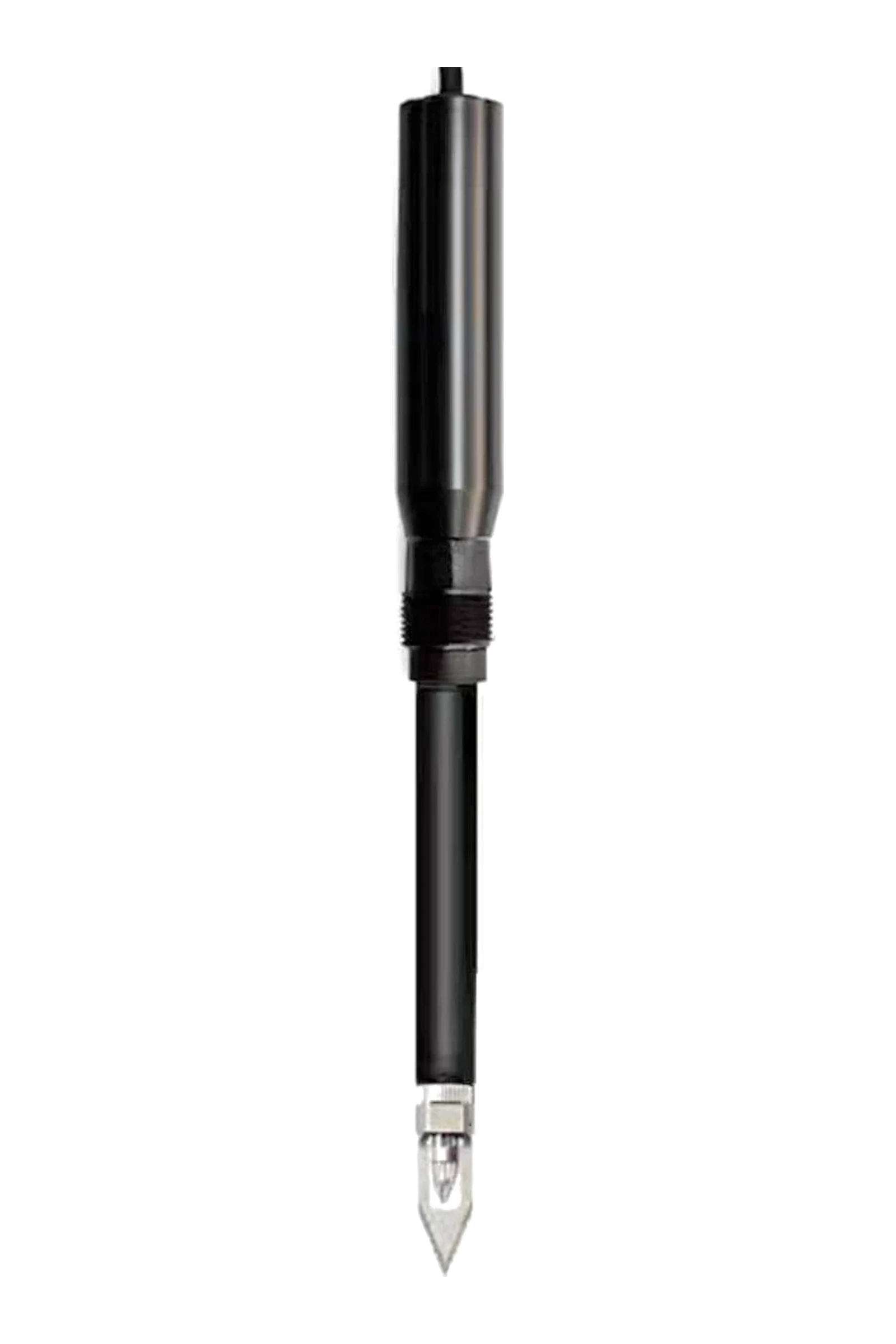
Most pH electrodes are built for liquids. Their glass bulb is exposed, and pushing one into soil is the fastest way to break it. The PH-S100 has a piercing spear tip that opens the way through the soil and shields the glass electrode behind it, on a slim 13 mm shaft that leaves a small hole and disturbs few roots.
The transmitter is built into the probe, so there is no separate pH meter between the electrode and your equipment. The sensor measures temperature along with pH and compensates the reading by itself.
Why Measure Soil pH
Soil pH decides which nutrients a plant can take up. Fertilizer that is in the soil but locked up by a pH that is too high or too low does nothing for the crop, and the first visible sign is usually a deficiency that more fertilizer does not fix. Iron and manganese become hard to reach as pH rises; in strongly acidic soil other elements become too available and damage roots.
pH also moves. Irrigation water with high alkalinity pushes it up over a season, ammonium fertilizers pull it down, and container substrates with little buffering can shift within weeks. A soil test once a year shows where the field was on the day of sampling. A sensor in the root zone shows the direction it is going.
Key Features
- Direct in-soil measurement: reads pH in the soil itself, without preparing a slurry or an extract
- Piercing spear tip: opens the soil ahead of the electrode and protects the glass during insertion
- Slim 13 mm insertion shaft: enters pots, bags and planted beds with little root disturbance
- Full 0 to 14 pH range: 0.01 pH resolution and ±0.1 pH accuracy
- Temperature compensated: built-in temperature measurement, automatic or manual compensation
- Calibration in standard buffers: up to three points, with either common buffer set
- Two output versions: RS485 or 4-20 mA, chosen when you order
- Isolated power and output: stable readings on long cable runs and shared power supplies
- Waterproof body with PG13.5 thread: for fixed mounting through a holder or a fitting
Applications
- Open-field crops and orchards: follow root-zone pH through the season under drip and fertigation
- Acid-loving crops: blueberries and other crops that need a narrow acidic range, where drifting upward costs yield
- Greenhouse beds and substrates: coir, peat and mixed media, where pH moves faster than in mineral soil
- Nurseries and potting media: check batches of mix and spot-check containers on the bench
- Compost and organic amendments: follow pH through the composting process and before spreading
- Soil research and trial plots: repeatable readings at the same point, without removing soil each time
Using the Sensor
A pH electrode needs moisture to measure. In soil at or near field capacity, push the probe straight in to the depth you want to read and press the soil around the shaft so the tip is in full contact. In dry soil, wet the spot with distilled water first and give it a few minutes. Stony or compacted ground should be loosened or pre-holed, because the tip is made for piercing soil, not for levering against rock.
For spot checks, take several readings across the plot and compare them; soil pH varies over short distances, and the pattern usually tells more than a single number. For continuous monitoring, leave the probe installed in an irrigated zone where the soil stays moist, and keep it away from the direct stream of a dripper so that it reads the soil and not the irrigation water.
After use, rinse the tip with clean water. Store the probe with the tip moist, never dry, and do not strike the tip or carry the probe by its cable.
Calibration
The PH-S100 is calibrated in standard pH buffer solutions, at up to three points. The mid point (6.86 or 7.00) is always done first, followed by the low point (4.00 or 4.01) and the high point (9.18 or 10.01). The sensor recognises the buffer, waits for a stable signal and reports whether the calibration was accepted. For crops grown in acidic soil, a two-point calibration with the mid and low buffers covers the working range.
Calibrate before first use and at regular intervals after that. Soil is abrasive and wears a pH electrode faster than clean water does, so a sensor that is inserted often needs checking more often than one left in place.
Technical Specifications
The PH-S100 measures 0.00 to 14.00 pH with 0.01 pH resolution and ±0.1 pH accuracy, and temperature from 0 to 60°C with ±0.5°C accuracy. The probe is 240 mm long with a 13 mm insertion shaft, a 23 mm head and a PG13.5 mounting thread.
It is built in two output versions. The RS485 version runs on 9 to 27 VDC and reports pH, the raw electrode signal in millivolts and temperature. The 4-20 mA version runs on 24 VDC and outputs a current proportional to pH across the full 0 to 14 range. Power and output are isolated to 2500 Vrms. The register map, wiring and calibration commands are in the product datasheet.
Installation
The RS485 version connects to the Omni Genesis and Omni Genesis Lite controllers alongside soil moisture, temperature and oxygen sensors, so pH is recorded together with the rest of the root-zone picture. Wire the sensor with the power off, check polarity before switching on, and route the cable where machinery and animals cannot pull on it.
Part of our IoT Soil Monitoring System
Discover our complete soil monitoring solution for precision agriculture and smart irrigation management.
Related Products
Other solutions in the soil category