EC-100 with Arduino, ESP32, Raspberry Pi and Python
How to wire the EC-100 Digital Conductivity Probe to your own microcontroller or computer and read it over RS485 Modbus RTU. The tables are the ones in the datasheet, and both code examples are run against the datasheet example frame before this page is published.
Product page Datasheet (PDF) Datasheet (Markdown) Arduino sketch (.ino) Python script (.py)
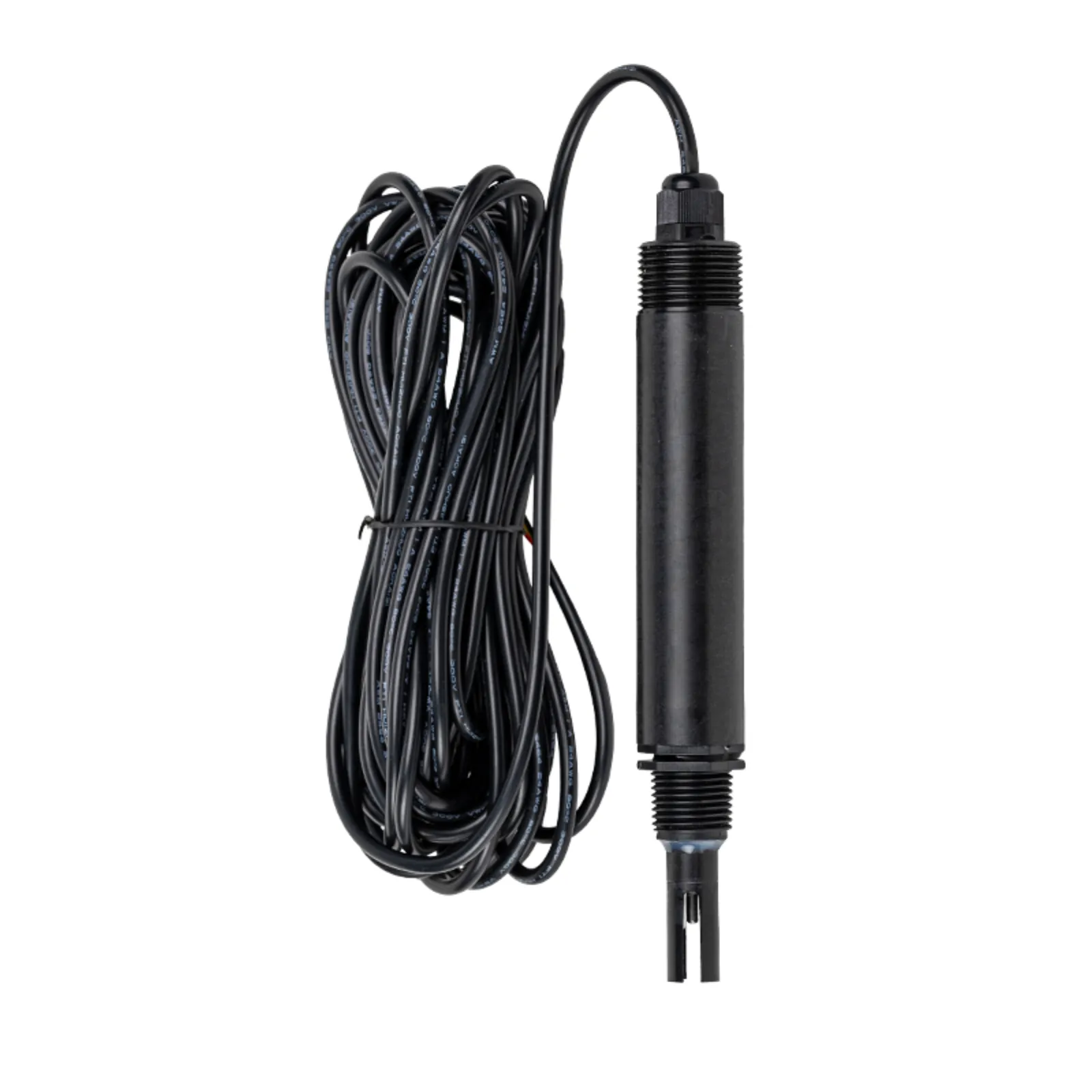
Connecting the EC-100
The probe is an RS485 device, so it needs a transceiver between it and your board. On a computer or a Raspberry Pi that is a USB to RS485 adapter. On a microcontroller it is a MAX485-type module on a hardware serial port. Power the probe from a supply within the voltage range in the table and join its ground to the ground of the transceiver.
| Wire Color | Function | Description |
|---|---|---|
| Red | V+ | Power Supply (12-24V DC) |
| Black | GND | Power Ground |
| Yellow | RS485-A | Data+ |
| Green | RS485-B | Data- |
Python example (Raspberry Pi, Linux, macOS, Windows)
The script needs only pyserial. It builds the Modbus request itself, checks the CRC of the reply and prints one reading every five seconds. On Windows pass the COM port as the argument.
#!/usr/bin/env python3
"""Read the Agrinovo EC-100 over RS485 Modbus RTU.

Works on a Raspberry Pi or any computer with a USB to RS485 adapter.
Install the serial library once:  pip install pyserial
Run:  python3 ec_100.py /dev/ttyUSB0
"""
import struct
import sys
import time

import serial

PORT = sys.argv[1] if len(sys.argv) > 1 else "/dev/ttyUSB0"
ADDRESS = 0x01  # the sensor's Modbus address


def crc16(frame: bytes) -> bytes:
    crc = 0xFFFF
    for byte in frame:
        crc ^= byte
        for _ in range(8):
            crc = (crc >> 1) ^ 0xA001 if crc & 1 else crc >> 1
    return struct.pack("<H", crc)


def read_registers(port, address, function, start, count):
    request = struct.pack(">BBHH", address, function, start, count)
    port.reset_input_buffer()
    port.write(request + crc16(request))
    reply = port.read(5 + 2 * count)
    if len(reply) >= 5 and reply[1] == function | 0x80:
        raise IOError(f"sensor returned Modbus error {reply[2]}")
    if len(reply) != 5 + 2 * count or crc16(reply[:-2]) != reply[-2:]:
        raise IOError("no valid reply from the sensor")
    return reply[3:-2]


def read_probe(port):
    data = read_registers(port, ADDRESS, 0x03, 0x0000, 2)
    return {
        "conductivity": struct.unpack(">H", data[0:2])[0],  # µS/cm
        "temperature":  struct.unpack(">H", data[2:4])[0] * 0.1,  # °C
    }


if __name__ == "__main__":
    with serial.Serial(PORT, 9600, bytesize=8, parity="N", stopbits=1, timeout=1) as port:
        while True:
            print(read_probe(port))
            time.sleep(5)
Arduino example (Uno, Mega, ESP32, ESP8266, MKR, Pico)
The sketch uses the Agrinovo library: in the Arduino IDE open Sketch > Include Library > Manage Libraries and install "Agrinovo". The library picks the serial port for your board, and the pins are listed at the top of AgrinovoDefaultPort.h. DE and RE of the transceiver go to one output pin.
// Agrinovo EC-100 conductivity probe
// Prints conductivity and temperature every 5 seconds.
//
// Sensor cable
//   Red     supply +, 12-24 V DC
//   Black   supply ground, joined to the board's ground
//   Yellow  RS485 A
//   Green   RS485 B
//
// The board talks to the sensor through an RS485 transceiver (MAX485 or
// similar). AgrinovoDefaultPort.h lists the serial pins used on each board.
//
// https://agrinovo.io/products/sensors/aqua/ec/ec-100-probe/

#include <Agrinovo.h>
#include <AgrinovoDefaultPort.h>

const int DE_PIN = 4;  // transceiver DE and RE, tied together

AgrinovoBus bus(AGRINOVO_PORT, DE_PIN);
AgrinovoEC100 probe(bus);  // Modbus address 1

void setup() {
  Serial.begin(115200);
  agrinovoPortBegin(9600);
  bus.begin();
}

void loop() {
  if (probe.read()) {
    Serial.print("Conductivity: ");
    Serial.print(probe.conductivity(), 0);
    Serial.println(" µS/cm");
    Serial.print("Temperature: ");
    Serial.print(probe.temperature(), 1);
    Serial.println(" °C");
  } else {
    Serial.println(probe.errorText());
  }
  delay(5000);
}
What the examples read
Both examples send one request, function 0x03, 2 registers from 0x0000, and decode these values:
| Value | Unit | Register | Encoding |
|---|---|---|---|
| Conductivity | µS/cm | 0x0000 | Unsigned 16-bit integer, scaled |
| Temperature | °C | 0x0001 | Unsigned 16-bit integer, scaled |
Other Modbus tools
The same request works from any Modbus RTU master: pymodbus, minimalmodbus, Node-RED, LabVIEW, a PLC or a third-party data logger with a Modbus port. Use the serial settings, function code and register addresses above.
Logging without writing code
The Omni Genesis controller reads the EC-100 and sends the readings to the Agrinovo cloud over the cellular network, where they can be exported or read through the cloud API.
Datasheet reference
Specifications
| Parameter | Specification |
|---|---|
| Accuracy | ±1.0% FS |
| Temp Compensation | 0 to 60°C (automatic) |
| Power Consumption | ≤0.5W |
| Supply Voltage | 12-24 VDC |
| Operating Humidity | ≤85% RH |
Electrode Constants and Ranges
| K Value | EC Range | TDS Range | Resolution |
|---|---|---|---|
| 0.1 cm⁻¹ | 0.2 to 200 µS/cm | 0.1 to 100 ppm | 0.01 |
| 1.0 cm⁻¹ | 2 to 10,000 µS/cm | 1 to 5,000 ppm | 1 |
| 10.0 cm⁻¹ | 20 to 100,000 µS/cm | 10 to 50,000 ppm | 1 |
Communication Settings
| Parameter | Value |
|---|---|
| Protocol | Modbus-RTU |
| Baud Rate | 9600 bps |
| Data Bits | 8 |
| Parity | None |
| Stop Bits | 1 |
| Default Address | 0x01 |
Register Map
Measurement Registers (Function 0x03)
| Address | Description | Scaling |
|---|---|---|
| 0x0000 | Electrical Conductivity | Direct (µS/cm) |
| 0x0001 | Temperature | Value ÷ 10 (°C) |
Configuration Registers (Function 0x06)
| Address | Description | Range/Notes |
|---|---|---|
| 0x0004 | Slope (Gain) | Value × 1000 (default: 1000) |
| 0x000B | Intercept (Offset) | µS/cm (default: 0) |
| 0x0050 | Slave Address | 0x01 to 0xFE |
Reading Data
Read 2 registers from 0x0000:
Request:  01 03 00 00 00 02 C4 0B
Response: 01 03 04 02 AE 01 64 9A 11
Decoding:
| Register | Hex | Decimal | Scaling | Result |
|---|---|---|---|---|
| EC | 0x02AE | 686 | Direct | 686 µS/cm |
| Temperature | 0x0164 | 356 | ÷10 | 35.6°C |
TDS Calculation: TDS = 686 ÷ 2 = 343 ppm
Address Configuration
Change Address (0x01 → 0x02)
Request:  01 06 00 50 00 02 08 1A
Response: 01 06 00 50 00 02 08 1A
Broadcast Discovery
Use address 0xFE with only one device connected.
Calibration
Set Slope (1.200)
Slope = 1200 (1.200 × 1000) = 0x04B0
01 06 00 04 04 B0 CB 7F
Set Intercept (10 µS/cm)
01 06 00 0B 00 0A 78 0F
Revision History
| Rev | Date | Changes |
|---|---|---|
| 1.0 | June 2026 | Initial release |
| 1.1 | August 2026 | Layout revision |
| 1.2 | October 2026 | New layout; corrected Modbus example CRC values |
| 1.3 | November 2026 | Corrected product photo |
Contact
Agrinovo, https://agrinovo.io/products, [email protected], +972 54 688 8148 (direct / WhatsApp). Specifications subject to change without notice.
Questions about wiring or the protocol?
Tell us which board or logger you are using and what you need to measure.