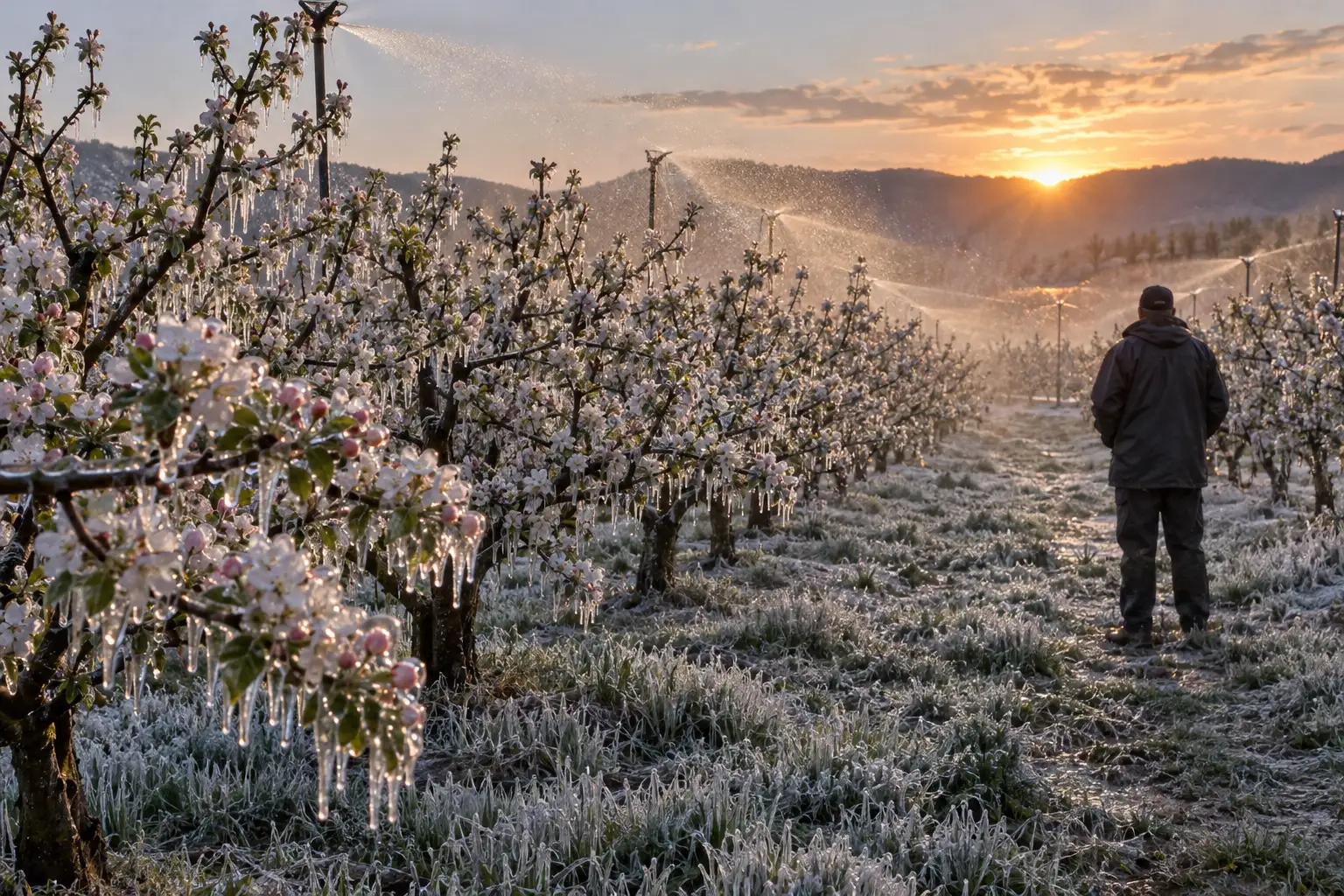
On a frost night, the thermometer answers one question: how cold is it now. Two other numbers answer the questions that decide the night: how far can it fall, and is it safe to start the sprinklers. Both come from humidity, through the dew point and the wet-bulb temperature.
Dew point: the brake on a falling temperature
The dew point is the temperature at which the air becomes saturated if it cools without gaining or losing moisture. On a clear, calm night the ground and the plants radiate heat to the sky and the air near them cools. When it reaches the dew point, water starts to condense as dew or as frost, and condensation releases latent heat. The FAO frost protection manual describes the effect plainly: when dew forms, the latent heat released reduces the rate of temperature drop.
That is why two nights that start at the same temperature can end several degrees apart. Rutgers Cooperative Extension puts it in one line: a higher dew point is associated with relatively slow drops in temperature, and vice versa. With humid air the brake comes early. With dry air it comes late, or not before sunrise, and the temperature keeps falling.
The dew point also warns about damage on nights that look safe. The FAO manual notes that if the dew-point temperature is low, damage can occur to sensitive crops even if the air temperature remains above 0°C. Dry air with no visible frost on the grass, sometimes called a black frost, is the night growers tend to underestimate.
What to watch: the dew point at sunset and through the evening. A dew point well below zero on a clear, calm evening means a steep night ahead.
Wet-bulb: the temperature a wet bud falls to
The wet-bulb temperature is what a wet surface cools to as water evaporates from it. It always sits between the dew point and the air temperature: close to the air temperature in humid air, far below it in dry air.
For most of the night that number is academic. It becomes the deciding number the moment the sprinklers start. Over-plant sprinkling protects buds through the heat released when water freezes, but evaporation comes first and evaporation cools. When the sprinklers start, the wet buds drop toward the wet-bulb temperature before the ice forms and begins to release its heat. In dry air that drop can take a bud below the air temperature and below its critical temperature, which is exactly the damage the sprinklers were meant to prevent.
The FAO frost protection manual gives the rules that follow from this:
- Start over-plant sprinklers when the wet-bulb temperature is still higher than the critical damage temperature of the crop. Starting at a wet-bulb of 0°C is less risky.
- Do not stop until the wet-bulb temperature, measured upwind of the protected area, has risen above the critical temperature.
The manual’s table of starting temperatures turns this into air temperatures. At sea level, a wet-bulb of 0°C corresponds to an air temperature of 2.8°C when the dew point is -5°C, and 4.9°C when the dew point is -10°C. The drier the air, the earlier the start. The same chapter recommends setting the frost alarm about 1°C above the table’s starting temperature, so there is time to get the system running, and keeping each sprinkler’s rotation to 60 seconds or less, with 30 seconds better.
Calculating both from a temperature and humidity sensor
A sensor that measures air temperature and relative humidity at the same point gives everything needed. The equations below come from FAO Irrigation and Drainage Paper 56, Chapter 3, with T in °C, RH in % and pressures in kPa.
Saturation vapour pressure:
e°(T) = 0.6108 × exp[17.27 × T / (T + 237.3)]
Dew point. The actual vapour pressure is ea = e°(T) × RH / 100, and the dew point is the temperature at which e° equals ea. Rearranged:
x = ln(ea / 0.6108), then Td = 237.3 × x / (17.27 - x)
Wet-bulb. FAO-56 gives the psychrometric equation:
ea = e°(Tw) - γpsy × (T - Tw), with γpsy = apsy × P
For a ventilated psychrometer apsy = 0.000662. P is the atmospheric pressure, 101.3 kPa at sea level; FAO-56 gives it at elevation z (in metres) as P = 101.3 × [(293 - 0.0065 × z) / 293]^5.26. The equation has no closed form for Tw, so solve it by trial: try a value, compare both sides, adjust. A spreadsheet goal-seek or ten lines of code does it in a fraction of a second.
You will also find one-line wet-bulb approximations. The best known, Stull (2011), is fitted for sea-level pressure and carries a stated error of -1 to +0.65°C. That is fine for heat stress work. Near freezing, on the night a sprinkler decision depends on it, a degree is the whole margin, so use the psychrometric equation.
Here is what the equations give at sea level for typical late-evening readings:
| Air temperature | RH | Dew point | Wet-bulb |
|---|---|---|---|
| 4°C | 90% | 2.5°C | 3.3°C |
| 4°C | 70% | -1.0°C | 2.0°C |
| 4°C | 50% | -5.5°C | 0.6°C |
| 2°C | 90% | 0.5°C | 1.4°C |
| 2°C | 70% | -2.9°C | 0.2°C |
| 2°C | 50% | -7.3°C | -1.1°C |
| 0°C | 90% | -1.4°C | -0.6°C |
| 0°C | 70% | -4.8°C | -1.7°C |
Read the 2°C rows. At 90% humidity the wet-bulb sits 0.6°C below the air and the dew point is just above freezing. At 50% the wet-bulb is already below zero and the dew point is more than 7°C below it. The same thermometer reading means a very different night.
Starting temperatures by dew point and elevation
Solving the same equations for the air temperature at which the wet-bulb is 0°C gives a starting point for each dew point. The sea-level column reproduces the FAO table within rounding. Pressure falls with altitude, and that moves the start temperature up, which matters in hill orchards and vineyards.
| Dew point | Air temperature for a 0°C wet-bulb, sea level | At 1,000 m |
|---|---|---|
| -2°C | 1.2°C | 1.4°C |
| -4°C | 2.3°C | 2.6°C |
| -6°C | 3.3°C | 3.7°C |
| -8°C | 4.1°C | 4.6°C |
| -10°C | 4.8°C | 5.5°C |
These are starting points for a 0°C wet-bulb, the conservative choice the FAO manual describes. If your crop’s critical temperature at its current stage is lower, the start can come later; our guide to frost alarms for orchards and vineyards lists critical temperatures by bud stage.
How much does sensor accuracy matter?
The decision sits within a degree, so it is worth knowing how sensor error carries through. Take a reading of 2°C and 70% RH and the stated accuracy of the THS-100 temperature and humidity sensor, ±0.3°C at 25°C and ±3% RH:
- Dew point: ±3% RH moves it by about ±0.6°C; ±0.3°C moves it by about ±0.3°C.
- Wet-bulb: ±3% RH moves it by only about ±0.2°C; ±0.3°C moves it by about ±0.3°C.
The wet-bulb, the number the sprinkler decision depends on, is the more forgiving of the two, and the combined error stays inside the 1°C margin the FAO manual builds into the alarm. Two practical points keep it there. Check the sensor against a reference thermometer near 0°C before the season, because stated accuracy is given at 25°C, and use the THS-100’s offset registers to correct a small difference in the sensor itself. And choose a sealed or sintered housing for frost nights, where condensation and frost form on everything, including the sensor.
Where to measure
Dew point and wet-bulb are only as good as the temperature and humidity behind them, and both must be measured at the same point: at the height of the buds you are protecting, in the coldest part of the block, inside a ventilated radiation shield. The frost alarm guide covers placement in detail. For the decision to stop sprinkling, the FAO manual is specific that the wet-bulb is measured upwind of the protected area, outside the spray.
A station built on the Omni Genesis controller does this from the block itself: temperature and humidity at bud height, reported over 4G-LTE from a solar-powered stake, with a phone alert when the temperature crosses the limit you set. Our cranberry frost case study shows one such station in a bed.