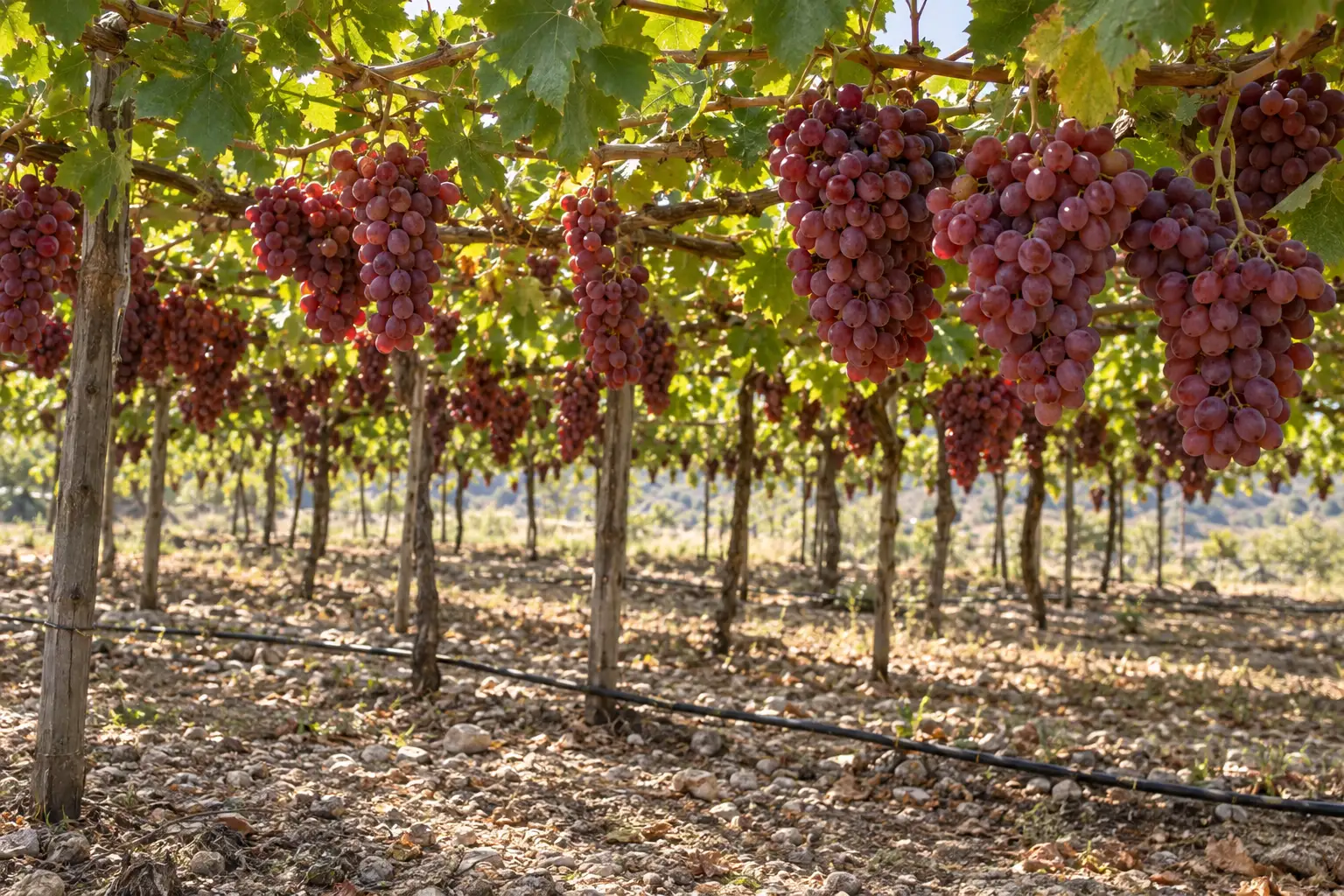
Berry cracking late in the season is one of the most expensive problems in table grapes, because a cracked berry is an open door for sour rot. Growers have long suspected that vine water status plays a part. A study published in Agricultural Water Management in 2026 by a team at Israel’s Volcani Institute now puts three seasons of field evidence behind that suspicion, and its findings say a lot about how irrigation should be measured.
What the study found
The paper is The relationships between the water status of the vine, berry firmness, cracking and sour rot by Kushwaha, Morozov, Yoktan, Kochanek, Sadka, Lichter and Hochberg. It is open access. The researchers worked on ‘Scarlotta Seedless’ vines over three seasons, 2023 to 2025, with four irrigation regimes that varied both how much water the vines received and when they received it. They followed vine water status as stem water potential, along with berry weight, berry firmness and the incidence of sour rot.
The main results, as the authors report them:
- Less water, softer berries, less sour rot. The low-water treatments had lower stem water potential, smaller berries, lower firmness and a lower incidence of sour rot. The size of the effect depended on the season.
- Timing mattered. A deficit applied only before veraison, or only after it, was less effective at reducing cracking than a deficit sustained through the season.
- The season counts more than the moment. Stem water potential correlated with firmness, and the correlation was stronger when the researchers used the seasonal integral of stem water potential in place of single measurements. In their words, the instantaneous water balance is less critical in shaping firmness than the effect of irrigation on berry development.
- Firmness predicted cluster health. The share of healthy clusters fell as firmness rose. A firmness of 2.47 N corresponded to 80% healthy clusters.
The authors describe this as the first demonstrated link between irrigation, firmness and sour rot, presumably acting through cracking. They are also clear about the limits: one cultivar, one set of conditions, and a recommendation that the approach be tested on more cultivars and environments before anyone treats it as a rule.
Why this is a measurement problem
Two details in those results change what a grower needs from an irrigation program.
The first is the seasonal integral. If berry firmness follows the accumulated water status of the vine across the season, then a reading taken on the day you happen to walk the block describes very little. What shapes the fruit is the whole curve: how dry the vine ran, for how long, and at which stages. A weekly spot check cannot reconstruct that curve. A continuous record can.
The second is that a sustained deficit worked better than a short one. Holding a moderate deficit for months is much harder than cutting water for two weeks. Weather, crop load and canopy all move the target, and the margin is narrow in both directions. Too wet, and the deficit you planned never happened. Too dry, and you pay in berry size, which the study also recorded in the low-water treatments. For table grapes, where size is a market requirement, a deficit has to be held inside a band, and that takes a number you can watch every day.
What to measure in the block
The researchers measured the vine itself. Stem water potential, usually taken at midday with a pressure chamber, is the reference for plant water status, and nothing in the soil replaces it. It is also a manual reading on a few leaves, a few times a season. It cannot run every hour in every block.
Soil water tension can. Tension is the force a root has to exert to pull water from the soil, read in centibars (cb) or kPa, and it is the side of the system you control with the valve. The two measurements work as a pair: periodic pressure chamber readings show which soil tension range in a given block corresponds to the vine water status you are aiming for, and soil sensors keep the block in that range between visits. The study does not publish soil tension thresholds, so those bands have to be built per block, from your own readings.
Two sensor types cover the job:
- Tensiometers read soil water tension directly across 0 to 80 cb, with no calibration for soil type. The tensiometer range comes in three lengths by root-zone depth: the SR for 15 to 30 cm, the MLT for 45 to 60 cm and the LT for 90 to 120 cm. In a vineyard the mid and deep models do the most work, since vines root deep.
- The Watermark 200SS granular matrix sensor reads 0 to 200 cb. A deficit program deliberately lets the soil dry, and when tension passes 80 cb a tensiometer has reached the end of its scale. The Watermark keeps reading there, and it needs no refilling.
A practical station uses two depths, one in the active root zone and one below it, so you can see whether an irrigation reached the roots or ran past them. Sensor depth and station placement for vines are covered in the vineyard soil moisture guide, and reading and maintaining a tensiometer in the tensiometer guide.
From a gauge to a season-long record
A gauge on a tensiometer gives you the moment. The study says the moment is the less useful half.
Connected to an Omni Genesis controller, the same sensors report to a cloud dashboard over cellular, and the reading becomes a continuous line for each block and each depth. That gives a deficit program three things a field round cannot:
- The full curve. Every drying cycle and every irrigation from budbreak to harvest is on record, which is the closest practical view of the accumulated water status the researchers found most closely tied to firmness.
- Alerts at the edges of the band. When a block dries past the limit you set, or stays wetter than the deficit you planned, you know that day and not at the next visit.
- A season you can compare. At harvest, the tension record of each block sits next to its cracking and sour rot counts. Next year’s targets come from your own vines.
The hardware is modular: any sensor of any type connects to the Genesis controllers, so a station can start with tension at two depths and take on soil temperature or irrigation water EC later. This is the same IoT soil monitoring setup used across orchards and field crops.
What the study does not tell you
The paper is careful, and a grower should be too.
- One cultivar. The work was done on ‘Scarlotta Seedless’. Cultivars differ in skin strength and in how prone they are to cracking, and the authors ask for more cultivars and environments to be tested.
- Season-dependent results. The reduction in sour rot was not the same every year.
- A cost in berry size. The low-water vines had smaller berries. Whether that trade is worth making depends on your market and on how much fruit sour rot takes from you in a normal year.
- No soil thresholds. The study is built on stem water potential. It supports the direction, a sustained and measured deficit, and leaves the numbers for your block to you.
That is a reasonable place to start a trial: one block, a pair of tension sensors at two depths, pressure chamber readings through the season, and a firmness and rot count at harvest. If you want help specifying the stations, contact us with the block size, soil type and irrigation layout.