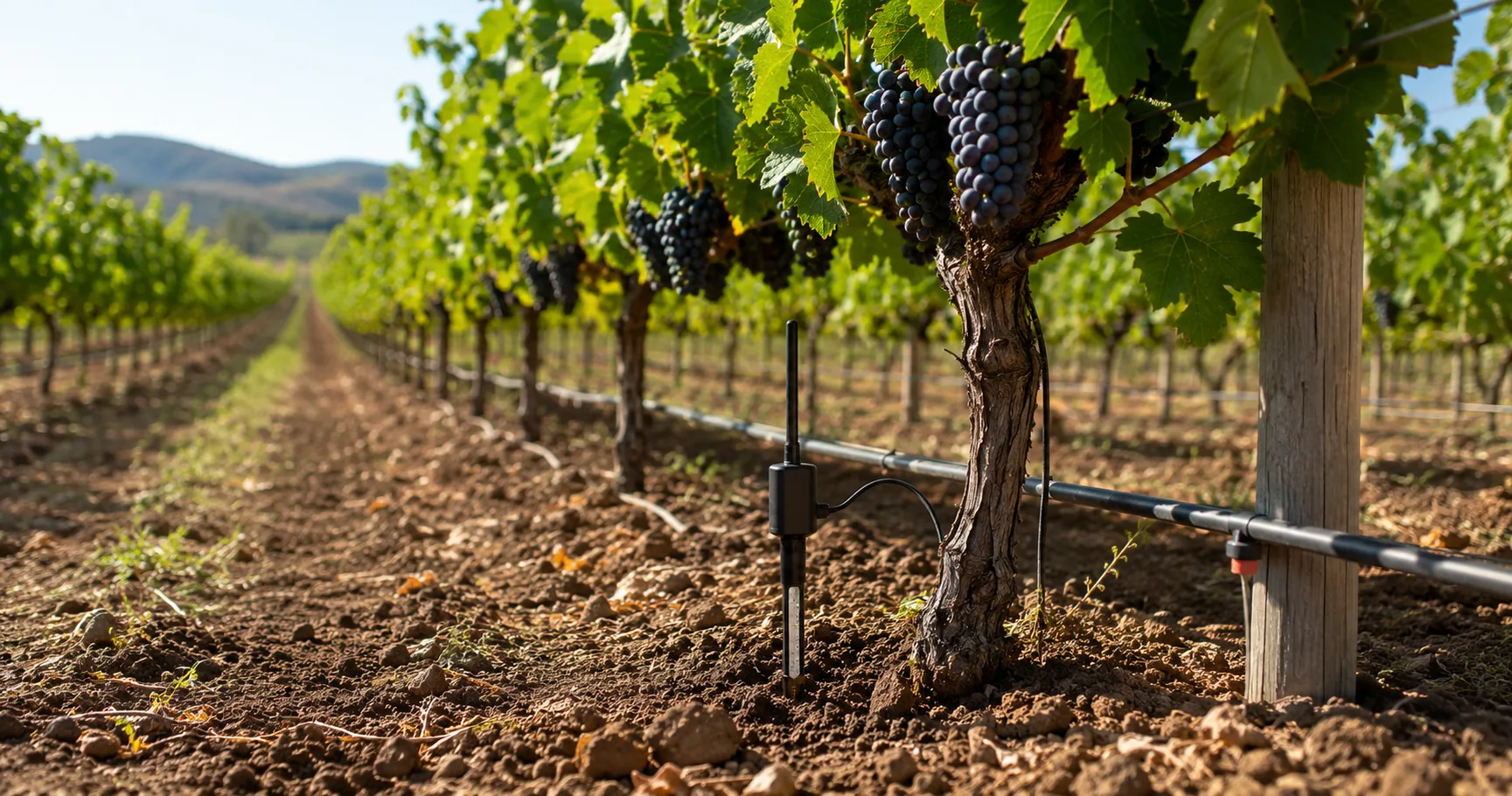
A vineyard manager once described his irrigation strategy to me as “water when the vines look stressed.” The problem is that by the time a vine looks stressed from the row, it has usually been under real water deficit for days, and in the other direction, a vine that looks lush is often the one you should have cut off weeks ago. Vines are one of the few crops where you frequently want controlled stress, and eyeballing the canopy is a poor way to control anything.
This is why soil moisture monitoring pays off faster in vineyards than in almost any other crop. The whole art of quality viticulture is managing vine water status: enough water to carry a healthy crop, but a deliberate deficit at the right stages to control vigor and concentrate the fruit. That is a measurement problem, and it is exactly what soil sensors solve.
Why tension is the right measurement for vines
There are two broad families of soil moisture sensor. Volumetric sensors report the percentage of water in the soil. Tension sensors report soil water tension, the force a root must exert to pull water out of the soil, in centibars (cb) or kilopascals (kPa).
For vineyards, tension is the more actionable number. Regulated deficit irrigation is defined in terms of how hard the vine is working for water, not how many percent of the soil volume is water. A tension reading of 50 cb means the same level of vine effort whether your block is sandy or clay, with no calibration curve. A volumetric reading of “18%” means very different things in different soils and tells you little about vine stress on its own.
Tension also maps cleanly onto the deficit-irrigation decisions viticulturists already make. You are choosing a target range of vine effort by growth stage, and tension reads that effort directly.
Deficit irrigation by growth stage
Regulated deficit irrigation (RDI) is the practice of deliberately withholding water during specific growth stages to steer the vine. Soil tension gives you the dial. The bands below are starting points; variety, rootstock, soil, climate, and the wine style you are aiming for all shift them, so refine against your own fruit and vine data.
| Growth stage | Objective | Rough tension target |
|---|---|---|
| Budbreak to flowering | Establish canopy, no stress | 20-40 cb |
| Fruit set to veraison | Control vigor, begin measured deficit | 40-60 cb |
| Veraison to harvest | Concentrate fruit, manage sugar and color | 50-70 cb |
| Post-harvest | Recover reserves, avoid deep stress | 30-50 cb |
The point is not to hit a number exactly. It is to see, day by day, where the vine sits and how fast it is drying, so that you apply water on purpose instead of on a calendar. A block that reaches 60 cb three days earlier than last week is telling you something about the weather and the canopy before any leaf shows it.
Sensor depth and placement in a vineyard
Install sensors in pairs, at two depths, per monitoring station:
- Shallow sensor, around 25-35 cm: this sits in the active root zone and is your irrigation trigger. It responds first when you irrigate and first when the block dries.
- Deep sensor, around 60-80 cm: vines root deep, and this sensor tells you whether water is reaching the full root zone or draining past it, and whether salts are accumulating below.
Reading the pair together is where the value is. If the shallow sensor is dry but the deep sensor is wet, you are under-irrigating the surface roots. If both drop right after irrigation and the deep one keeps dropping, you may be pushing water below the roots and wasting it. In salinity-prone blocks, a deep sensor that stays stubbornly high can be an early sign of salt buildup that needs a leaching fraction.
Place stations in representative vines, not at the end of a row, next to a leaking emitter, or in an odd soil pocket. Because vineyard soils vary along and across rows, use at least two stations per irrigation block. On a hillside, monitor top and bottom separately: they will not dry at the same rate.
The sensors that fit
For continuous, remotely monitored soil tension in vines, the Watermark 200SS granular matrix sensor is the workhorse. It reads tension across a wide 0-200 cb range, which is important in vineyards because deficit irrigation deliberately pushes into the drier part of the scale where narrower-range instruments stop working. It is a solid-state sensor with no refilling, so it suits unattended blocks and multi-season installs. How the granular matrix principle works, and how it compares to a classic tensiometer, is covered in our granular matrix sensor guide.
Classic dial tensiometers (the SR, MLT, and LT models by root-zone depth) remain an excellent manual reference for spot-checking tension at a specific depth, and the tensiometers for irrigation guide explains how to read and maintain them. For a vineyard that wants continuous data and remote access, pair the Watermark sensors with a controller rather than relying on walking the rows.
Two more measurements round out a vineyard station:
- Root-zone temperature with a DS18B20 soil temperature sensor, useful for tracking soil warming in spring and interpreting root activity.
- Salinity, by monitoring the EC of your irrigation water where you use recycled or brackish sources. Rising root-zone salinity is a slow, silent yield thief in arid viticulture, and watching EC lets you plan leaching before it costs you.
From sensors to irrigation decisions
A sensor you have to walk out and read only tells you the past. Connected to a controller, it tells you what to do now. The Watermark sensors and soil temperature probe connect to an Omni Genesis controller, which reports readings to a cloud dashboard over cellular. From there you can:
- Watch tension trends per block and per depth without leaving the office
- Set alerts when a block crosses your deficit threshold, so you irrigate on the vine’s schedule instead of a fixed calendar
- Keep a season-long record that lets you repeat what worked and adjust what did not
For larger sites, the Omni Exodus controller handles more sensors per unit, so you can run two depths across multiple stations from one device. This is the IoT soil monitoring approach, and it is the difference between knowing your vineyard’s water behavior and guessing at it.
The hardware is modular: any sensor of any type connects to the Genesis controllers, so a vineyard station can grow from tension-only to tension plus temperature plus salinity as your program matures.
Practical notes from the field
Trends beat single readings. A block at 55 cb that has been stable for three days is in a different situation from one that was 35 cb yesterday. Rate of change is your early warning.
Read at a consistent time. Soil tension follows a daily cycle, peaking in the afternoon when transpiration is highest. Comparing morning readings day to day gives you a stable baseline.
Deficit is a tool, not a default. Young vines, hot spells, and light soils all narrow your margin for error. Push deficit deliberately on established, balanced vines, and back off when the weather or the phenology says so.
Match stations to your management zones. If you farm two soil types or two varieties as separate blocks, monitor them separately. One averaged number across dissimilar blocks hides exactly the differences you are trying to manage.
Conclusion
Vineyards reward soil moisture monitoring more than most crops because the goal is not simply to avoid stress but to apply the right stress at the right time. Tension-based sensors give you a direct, soil-independent read on vine water status, and pairing shallow and deep sensors turns regulated deficit irrigation from an art into a measured, repeatable practice.
Start with continuous tension monitoring using the Watermark 200SS at two depths per block, add root-zone temperature and irrigation-water salinity where they matter, and connect it all through a precision agriculture platform so the data reaches you in time to act. For the wider picture of what each soil sensor measures, see our guide to soil sensors, and for how to build a full monitoring setup, the IoT soil monitoring guide.