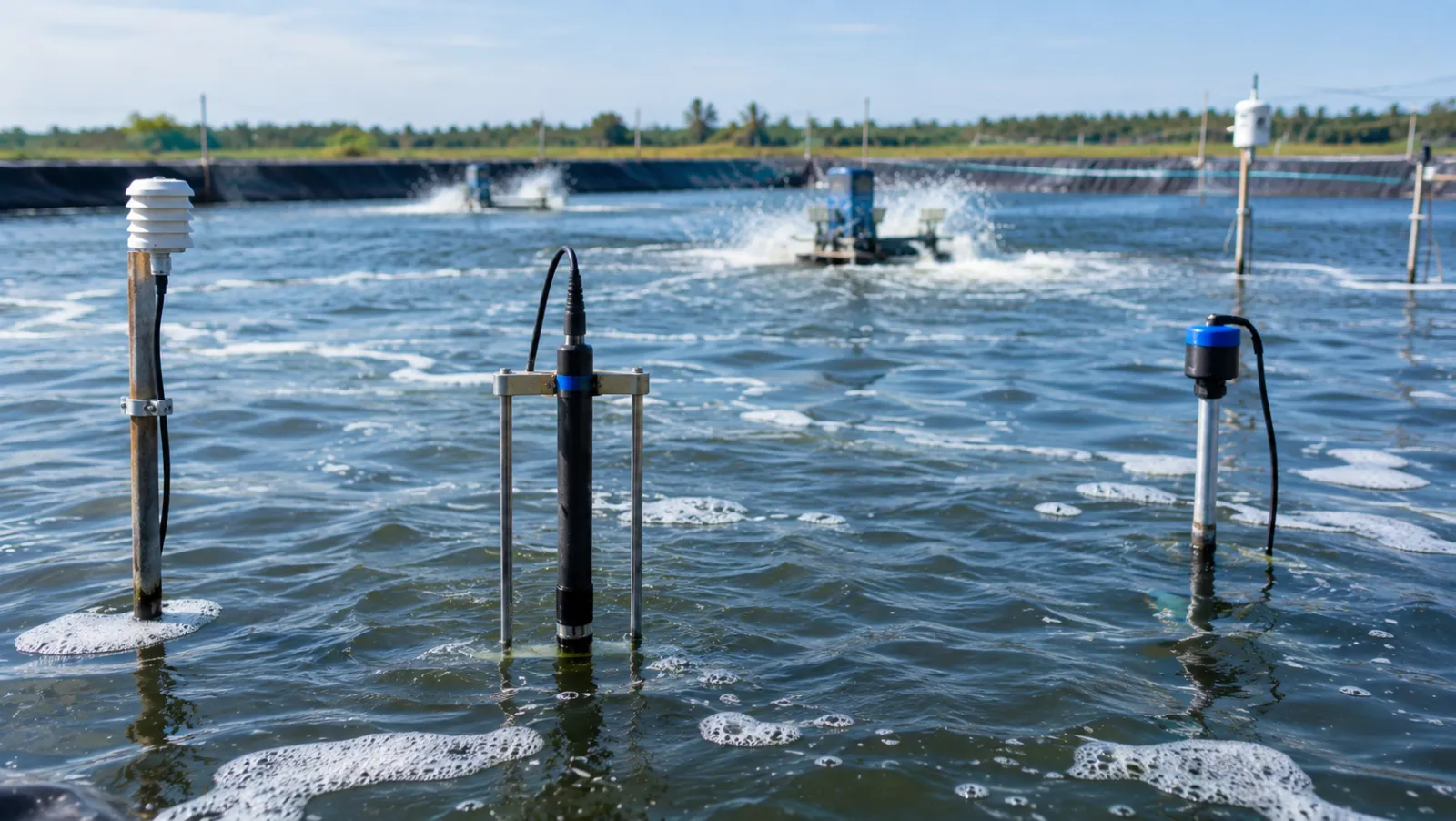
There is no shortage of writing about shrimp pond water quality parameters. There is much less about which of those parameters justify buying an instrument, which ones a handheld meter covers perfectly well, and how that answer changes between a semi-intensive pond and an intensive one.
That is the decision this covers. Not what to measure, but what to install.
The ranking, and why it is a ranking
Sensors are not equally valuable, and treating them as a shopping list rather than a priority order is how farms end up with a well-instrumented pond and an unmonitored crash.
Dissolved oxygen, first and by a distance. Oxygen is the only parameter that reliably kills a pond overnight. It falls through the night as respiration continues without photosynthesis, reaches its minimum shortly before dawn, and does so at the one hour when nobody is standing at the pond. Every other measurement describes how a crop is trending. Oxygen describes whether the crop still exists. If exactly one continuous sensor goes in the pond, it is a DO probe, and the case for it is not really water quality management at all, it is loss prevention. Our guide on preventing overnight DO crashes covers the mechanism.
Salinity second, because it moves without warning. Ponds change salinity through evaporation and through rainfall, neither of which the farm controls or schedules. A heavy rain event is a salinity event, and for a species being farmed across a wide salinity tolerance the question is rarely whether the value is survivable but whether it moved fast.
pH third, and mostly as an interpreter. pH matters in its own right, but its larger value on a shrimp farm is that it makes other readings meaningful. It swings daily with photosynthesis, and it determines how much of the measured ammonium is actually in the toxic form.
Ammonium fourth, and never alone. It rises with feeding rate and falls with a functioning nitrogen cycle, so it is the parameter that tells you whether the biology is keeping up with the feed. Installed without pH beside it, it produces a number you cannot act on.
Temperature is on every list, but it comes free: it is built into the probes above because they need it for compensation.
Continuous or handheld: the question that actually saves money
Density decides this, not species or pond size.
At extensive and semi-intensive densities, most parameters change slowly, and a handheld meter on a proper round is a reasonable instrument. The exception, again, is oxygen at night, which no round will ever catch.
At intensive density the calculus inverts. Feed rates are high, the biological load is high, the margin between a healthy pond and a failing one narrows, and the rate of change of every parameter increases. Continuous measurement stops being a monitoring luxury and starts being the only way to see events that begin and end between two rounds.
The middle path most farms should consider: continuous DO on every stocked pond, one fully instrumented reference pond, and handheld rounds for the rest. Salinity, pH and ammonium tend to move together across ponds drawing from the same source, so a reference pond genuinely informs its neighbours. Oxygen does not, because it is driven by that pond’s own biomass, feeding and aeration.
What to specify, and the one thing that quietly ruins deployments
Self-cleaning on the DO probe. A pond is a productive environment and everything left in it grows a film. Biofouling on an optical sensor rarely produces an obvious fault. It produces a slow downward drift indistinguishable from a pond that is genuinely deteriorating, which is the worst kind of wrong reading: it triggers aeration and interventions that are not needed, and it masks the day when they are. Regular cleaning on a fixed schedule prevents it. Where the water is very dirty or heavy with algae, the DO-130 self-cleaning probe carries a wiper that does the cleaning for you.
Conductivity for salinity, with temperature compensation. The EC-110 probe in seawater, or the EC-100 in freshwater culture, measures conductivity and derives salinity, which is the standard and correct approach.
pH and ammonium as a pair. The toxic fraction is un-ionised ammonia, a function of ammonium, pH and temperature together. In seawater, the PH-110 runs continuously and ammonia is tested by kit, because ion-selective probes work in freshwater only. In freshwater culture, the PH-100 pairs with the NH4-100 for trend tracking, with a weekly test kit confirming the level. Our post on ammonia, nitrite and nitrate sensors goes through the nitrogen set in more detail.
A fault code, not a plausible number. When a probe fails or a cable is damaged, the system must say so rather than reporting a believable value. On a farm where a low DO reading triggers aerators, a sensor that fails into a comfortable number is a genuine hazard.
Power and connectivity at the pond
Ponds are the wrong place for mains power and site networks, which is why so much pond instrumentation ends up as a meter somebody reads rather than a system that alerts.
The Omni Genesis runs on battery with solar charging and reports over cellular, with four modular ports where each port takes any supported protocol. In practice that means one controller at a pond bank can carry the DO probe and the pH, EC or ammonium probes for that pond, with no trenching and no site network. Where several ponds sit close together, RS485 probes share a bus back to one unit.
The alerting side is where the DO argument closes. A continuous reading nobody is watching at 04:00 is worth very little. A threshold that raises an alarm to a phone is the entire point of instrumenting oxygen in the first place.
Where to start
If you are stocking your first intensive ponds, start with DO on every pond and nothing else, and add the rest after one cycle when you know which parameter surprised you. If you are already running instrumented ponds, the question worth asking is whether your DO probes are drifting between cleanings, because that single failure mode accounts for more bad decisions than every other sensor problem combined.
Our shrimp farm water quality guide covers the parameters and the target ranges, and the shrimp farm monitoring system post covers how the parts fit together.
Tell us the pond count, the stocking density and whether you have power at the bank, and we will tell you what to instrument and what to leave handheld. Get in touch, or see the aquaculture monitoring page.