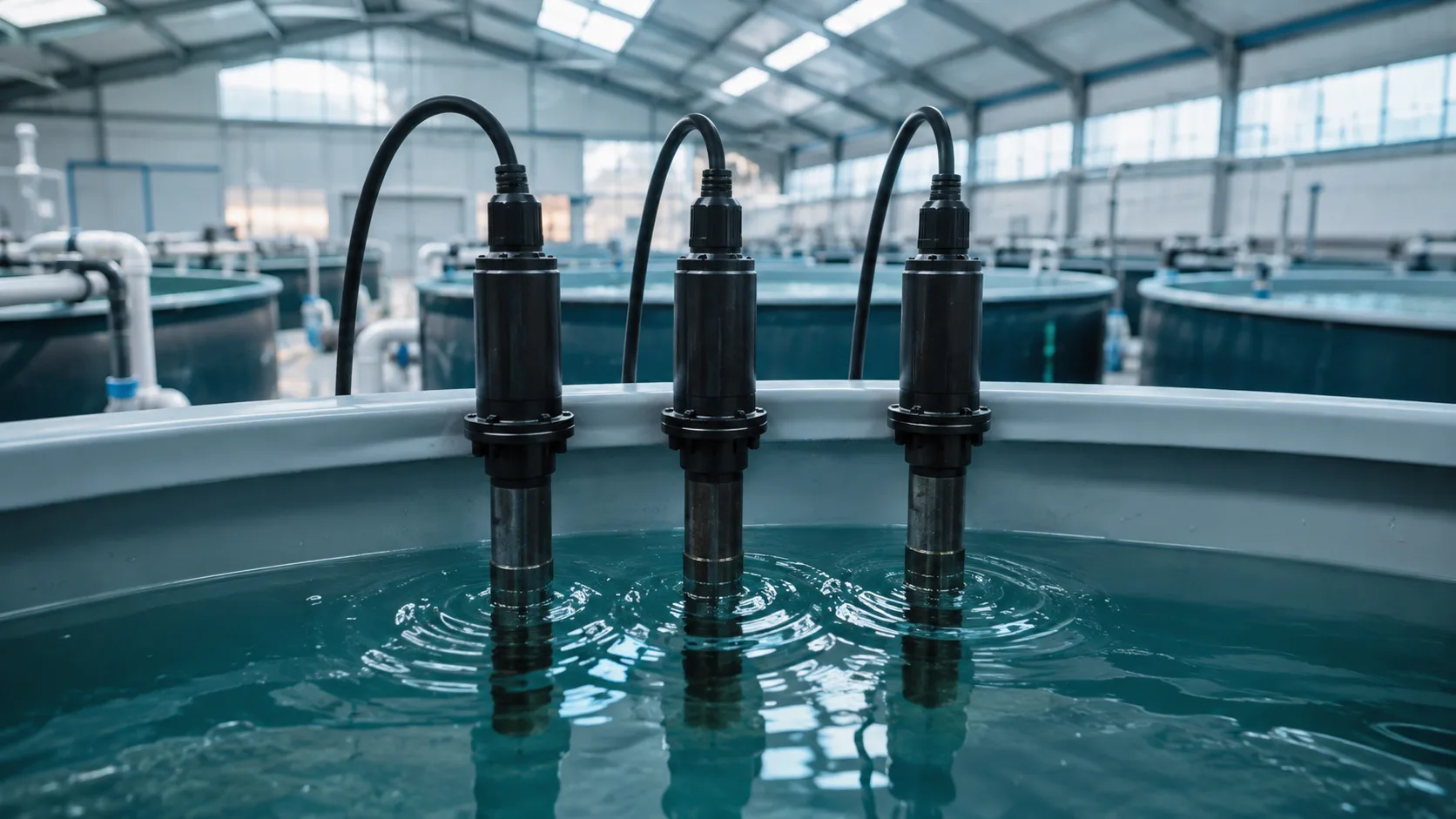
If you searched for an ammonia, nitrite or nitrate sensor, you are probably past the chemistry lesson and at the buying decision: three nitrogen parameters, three different probes, and a budget that has to be spent in the right order. The three readings are related, because they are stages of the same nitrogen cycle, but they answer different questions and they are not equally urgent in every type of farm.
This guide is the decision layer: which of the three sensors your system actually needs, which sensing technology to choose, what to check on a spec sheet before ordering, and what the readings look like once they arrive on a controller. If you want the biology in depth, we cover it separately in our nitrate monitoring guide and our post on ammonia spikes and emergency response.
Three readings, three different jobs
| Parameter | What it tells you | Time scale of harm | Where it matters most |
|---|---|---|---|
| Ammonia (NH4+) | Nitrogen entering the system from feed and waste, and whether nitrification is keeping up | Hours to days | Ponds, high-density tanks, hatcheries |
| Nitrite (NO2-) | Whether the middle step of nitrification is healthy; toxic intermediate | Days | RAS and any biofilter-dependent system, shrimp |
| Nitrate (NO3-) | Long-term nitrogen accumulation; drives water exchange decisions | Weeks | RAS, low-exchange and recirculating systems |
Ammonia is the acute killer: it rises fast after heavy feeding, in warm water, and when pH climbs. Nitrite is the intermediate that accumulates when the bacteria converting it onward fall behind; it interferes with oxygen transport in fish blood, and shrimp are particularly vulnerable. Nitrate is the end product, mild by comparison but a chronic stressor as it accumulates in systems that reuse water.
Which sensors your system needs
Ponds and open tanks: ammonia first
In ponds, the biofilter is the pond itself, and the reading that changes fast enough to hurt you is ammonia. Feed-driven ammonia spikes on warm afternoons are the classic pond emergency, and they develop far faster than a weekly test routine can catch. Start with an ammonium probe, interpret it alongside pH and temperature, and add nitrate later if you operate with low water exchange.
RAS: the full trio
A recirculating system lives and dies by its biofilter, and the three readings together are effectively a continuous biofilter health report. Rising ammonia means the first stage of nitrification is falling behind the feed load. Rising nitrite means the second stage is struggling, which is exactly what happens during biofilter maturation and after medication or salinity changes. Nitrate tells you whether denitrification and water exchange are keeping up over weeks. For RAS, buying the trio and running them on one bus is the configuration that actually matches how the system fails. Our RAS water quality guide covers the wider parameter set.
Shrimp farms: nitrite deserves its own probe
Shrimp are more sensitive to nitrite than most finfish, and intensive shrimp ponds combine heavy feeding with immature or stressed microbial communities. An ammonium probe plus a dedicated nitrite probe is the pairing that catches both the input side and the dangerous intermediate. More in our shrimp farm water quality guide.
Hatcheries: low ranges, fast response
Larval stages tolerate far less nitrogen than grow-out animals, and hatchery tanks are small volumes where concentrations move quickly. Ammonia and nitrite are the two to watch continuously; response time and resolution matter more here than maximum range.
ISE, optical or colorimetric: which technology to buy
- Colorimetric test kits are manual: take a sample, add reagent, judge a color. Fine as a cross-check, not a monitoring system. Nothing happens between tests, which is precisely when spikes develop.
- Optical and lab analyzer methods offer high accuracy in a laboratory or municipal context, at instrument sizes and workflows that rarely fit a farm.
- Ion-selective electrodes (ISE) are the technology built for continuous, in-water monitoring: a membrane selective to one ion, a reading every few seconds, and a digital output a controller can act on. This is the category the rest of this guide assumes.
The honest trade-off of ISE technology is maintenance: membranes age, electrodes drift, and calibration against standard solutions has to be part of the routine. What you get in exchange is the only measurement mode that supports alerts and trends, which is the entire point of buying a sensor rather than a test kit.
What to check on the spec sheet
- Target ion and range. Each probe measures one ion. Check the range fits your system: the NH4-100 ammonium probe covers 0.2 to 1,000 ppm, the NO2-100 nitrite probe covers 0.2 to 1,000 ppm, and the NO3-100 nitrate probe covers 0 to 1,000 mg/L. Aquaculture readings sit at the very bottom of those ranges, where the stated accuracy (±5% of full scale) is loose, so use these probes to catch trends and spikes and confirm the actual level with a weekly test kit. The 0.01 ppm figure is display resolution, not accuracy. All three are freshwater sensors: ion-selective electrodes do not work in seawater.
- Temperature compensation. Ion-selective readings shift with temperature, so automatic compensation is not optional. This line uses an integrated NTC10K thermistor for automatic compensation.
- Output signal. RS485 Modbus RTU output means the probe speaks directly to an IoT controller or PLC with no transmitter box in between, and multiple probes share one cable run. All three probes here are RS485 Modbus RTU.
- Response time. For alarm duty, look for a specified response; the NO2-100, for example, reaches 90% of a reading change in 30 seconds.
- Housing and mounting. Check chemical-resistant housing materials and a practical process connection; these probes use 3/4 inch threaded mounts for pipe or immersion fittings.
What the controller does with three nitrogen readings
Individually, each probe is a number. On a controller, the trio becomes a picture of the nitrogen cycle. All three probes connect to the same Omni Genesis controller over one RS485 Modbus bus, alongside pH, dissolved oxygen or any other sensor, and report over cellular to the cloud platform. That gives you:
- Alerts with context. An ammonia threshold alert at 2 a.m. is useful; seeing that nitrite is still flat tells you whether the biofilter is coping or the event is about to cascade.
- The nitrification chain as a trend. Ammonia falling while nitrite rises is a mid-cycle biofilter problem. All three rising together is an overloading problem. The pattern is the diagnosis.
- A record for stocking decisions. Weeks of nitrogen data show how close to capacity a system runs before you raise density.
Because the hardware is modular, any sensor of any type connects to the same controller, so a farm can start with one nitrogen probe and grow to the full trio without replacing anything.
Practical notes
Buy in the order your system fails. Ponds: ammonia first. RAS and shrimp: ammonia and nitrite together, nitrate close behind. Nobody regrets this order.
Pair nitrogen with pH and temperature. The toxicity of an ammonia reading depends on both. Reading them on the same controller is what makes the number interpretable.
Plan calibration from day one. ISE probes are consumable at the electrode level. Put calibration standards on the shelf when you order the probe, not after the first drift.
Keep a test kit for cross-checks. A monthly manual test against the probe reading catches drift early and builds trust in the continuous data.
Conclusion
The right purchase is rarely “a nitrogen sensor”; it is the subset of the trio that matches how your system fails, connected so the readings land in one place. Ponds start with the NH4-100 ammonium probe, biofilter-dependent systems add the NO2-100 nitrite probe, and low-exchange systems complete the chain with the NO3-100 nitrate probe, all reporting through one Omni Genesis controller. See how the pieces fit together on our aquaculture monitoring solution page, read the deeper background in the nitrate monitoring guide and the ammonia spike response guide, or contact us to spec the right combination for your farm.