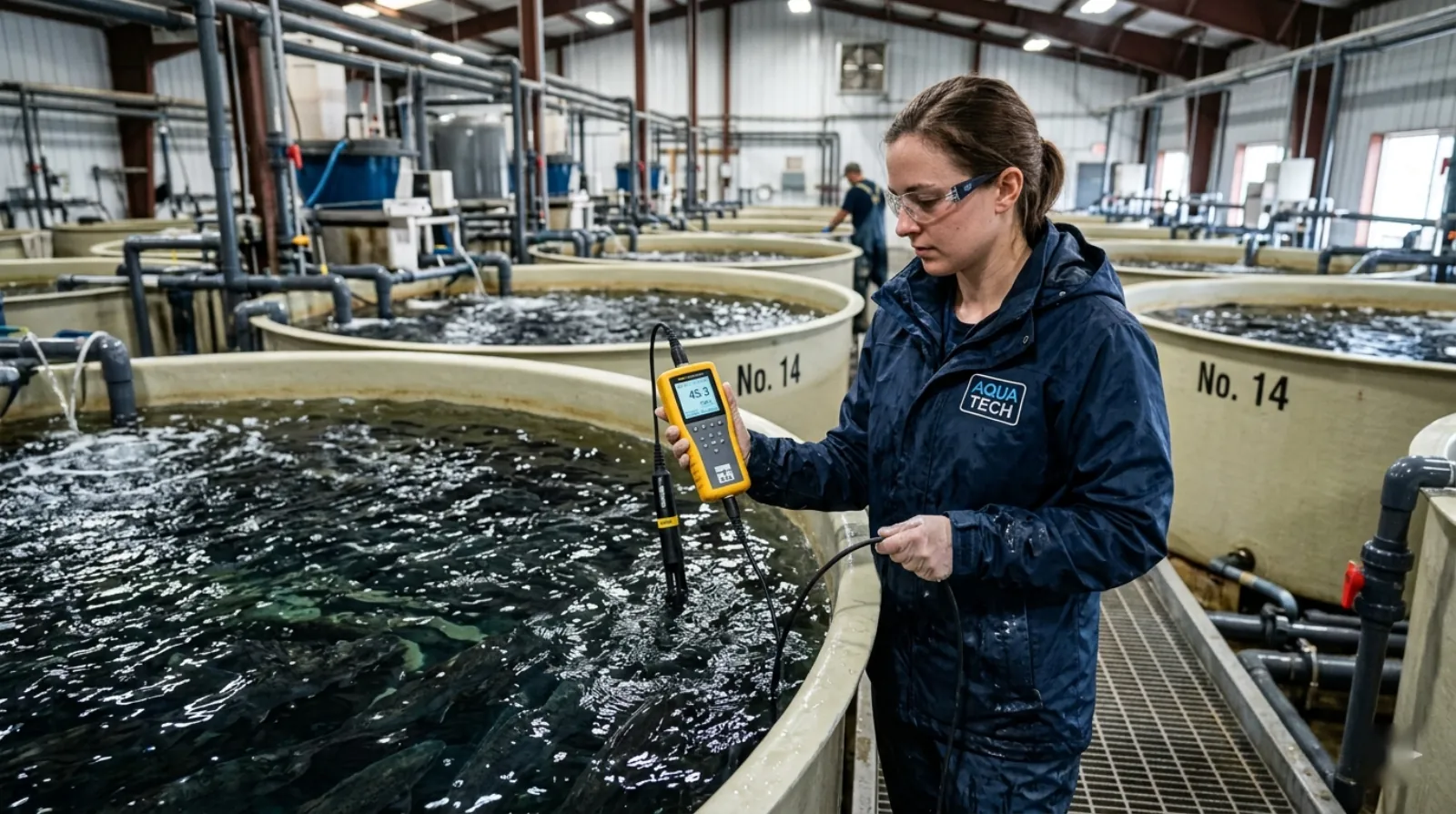
Ammonia gets the attention. When people talk about RAS water quality or pond crashes, the first three questions are always about TAN, dissolved oxygen, and pH. Nitrate shows up somewhere on slide seven, in small type, as “the one that accumulates.”
We have lost fish to all three. The ammonia kill we remember by the hour. The dissolved oxygen kill we remember by the day. The nitrate problems took weeks to show up and months to diagnose, and they cost more than the other two combined because by the time we noticed, two quarters of production were already compromised.
This guide is about how to keep that from happening. It covers what nitrate actually does at different concentrations, safe ranges for the species you are likely to farm, where nitrate comes from in different system types, and how to monitor it properly. We will also explain when a manual test kit is enough and when you need a continuous probe like the NO3-100 nitrate ion-selective electrode.
Why Nitrate Is the One You Forget About
In the nitrogen cycle, fish excrete ammonia, nitrifying bacteria convert it to nitrite, and a second group of bacteria converts nitrite to nitrate. Each step is less toxic than the one before it. If ammonia is a fire alarm and nitrite is a smoke alarm, nitrate is a slow carbon monoxide leak. It will not trip any of your short-term warning systems. It will quietly compromise the animal’s physiology until you notice a production problem you cannot explain.
Three things make nitrate easy to miss:
-
It does not leave the system on its own. Ammonia is oxidised, nitrite is oxidised, but nitrate has no further aerobic conversion path. In a closed RAS with no water exchange and no denitrification, every gram of protein you feed eventually ends up as nitrate in the water column.
-
Fish tolerate a lot of it, until they do not. Most warmwater finfish look fine at nitrate concentrations of 100 mg/L or more. You will not see dead fish. You will see subtle reductions in feed conversion, immune response, and growth rate. By the time you see mortality, the levels are already extreme.
-
It correlates with other problems. High nitrate usually means you are also letting phosphate, organics, and off-flavour compounds accumulate. Fish exposed to sustained high nitrate often have other water quality problems at the same time, which makes the nitrate itself hard to diagnose.
Safe Nitrate Levels by Species
There is no single safe nitrate number. Tolerance depends on species, life stage, temperature, and salinity. The numbers below are working thresholds we use in the field. Check specific research for your species and adjust based on your own observations.
Freshwater Food Fish (tilapia, catfish, carp)
Adult fish tolerate up to 200 mg/L NO3-N without acute effects. Growth slows noticeably above 100 mg/L. Target range for production: 20-80 mg/L NO3-N. Hatchery and fingerling stages are more sensitive and should stay below 40 mg/L NO3-N.
Salmonids (trout, salmon)
Keep NO3-N below 30 mg/L in grow-out. Fry and smolts should see less than 10 mg/L. Higher nitrate reduces smoltification success and increases susceptibility to gill disease. In freshwater RAS salmon operations, nitrate management is often the single biggest reason for water exchange.
Marine Finfish (seabream, barramundi, grouper)
Marine species generally tolerate less nitrate than freshwater species at the same life stage. Keep broodstock under 20 mg/L NO3-N. Grow-out can go to 50-80 mg/L, but growth impacts appear earlier than in freshwater counterparts.
Shrimp (Vannamei, Monodon)
This is where nitrate monitoring pays for itself. Shrimp are far more sensitive to nitrate than finfish. Larvae and post-larvae should see less than 10 mg/L NO3-N. Adult shrimp in grow-out tolerate up to 60 mg/L but show reduced growth and molting irregularities at 30-40 mg/L. In biofloc and RAS shrimp, managing nitrate is critical.
Ornamental and Reef Systems
Marine ornamental tanks and reef aquaria target under 5 mg/L NO3-N for best coral and invertebrate health. Freshwater planted tanks tolerate 10-20 mg/L without visible plant or fish stress.
A note on units: always check whether a reference reports nitrate as NO3- (the ion) or NO3-N (nitrogen). To convert NO3- to NO3-N, divide by 4.43. The same water with 44 mg/L NO3- has only 10 mg/L NO3-N. Confusing these has caused more than one overreaction to an actually safe reading, and more than one underreaction to a genuinely dangerous one.
Where Nitrate Comes From in Different Systems
Understanding nitrate generation tells you how fast it will accumulate and therefore how often you need to measure.
Flow-Through Systems
In a flow-through system with constant inflow of fresh water, nitrate rarely accumulates to problem levels. New water dilutes whatever nitrate the biofilter produces. Monitor weekly. If you start seeing consistent readings above 30 mg/L NO3-N, your flow rate is too low for the biomass.
Partial Water Exchange Systems
Most commercial earthen pond operations and many indoor flow-through systems fall here. Some water is replaced daily or weekly, but not enough to fully dilute biofilter output. Nitrate reaches a steady state that depends on feed load, exchange rate, and any biological nitrate removal. Test biweekly, or weekly during peak feeding cycles.
Recirculating Aquaculture (RAS)
This is where nitrate matters most. In a properly functioning RAS biofilter, nearly all dissolved nitrogen from feed ends up as nitrate. Without denitrification, the only way to remove it is water exchange. Typical well-managed RAS run 5-15% daily water exchange just to hold nitrate at target levels. If your exchange is lower, you need either a denitrification reactor or daily monitoring to catch accumulation.
Biofloc Systems
Nitrate dynamics are different here because heterotrophic bacteria incorporate nitrogen directly into microbial biomass, bypassing nitrification. Well-managed biofloc systems keep nitrate low without dedicated denitrification. However, if the C/N ratio drifts or feeding changes sharply, biofloc systems can shift toward nitrification and accumulate nitrate rapidly. Weekly monitoring is the minimum.
Aquaponic Systems
Aquaponics uses plants as the nitrate sink. Target nitrate depends on whether you are optimising for fish growth (lower, 20-50 mg/L NO3-N) or plant growth (higher, up to 100 mg/L NO3-N). Leafy greens take up more nitrate than fruiting plants. Monitor weekly and adjust stocking density or plant biomass if levels drift outside target.
Manual Test Kits vs Continuous Probes
There are two main ways to measure nitrate in practice. Each has a place.
Colorimetric Test Kits
Cadmium reduction or chromotropic acid methods, sold by the major test-kit brands. A kit has a low upfront cost, and each individual test is inexpensive. Accuracy is typically ±10-20%, good enough for a health check. Disadvantages are well known: they require 5-15 minutes of operator time, they consume reagents, reading colour charts is subjective in poor light, and you cannot log trends.
Test kits are the right choice for small hobby systems, occasional spot checks during routine rounds, and as a sanity check against a continuous probe.
Ion-Selective Electrode (ISE) Probes
A dedicated nitrate probe uses a polymer membrane selective for the nitrate ion. Output is continuous, typically digital via RS485 Modbus or 4-20mA. Accuracy of a good ISE is ±5-10% across the working range, with a response time under 60 seconds.
Probes are the right choice for anything that is not a hobby system. In a commercial RAS or shrimp grow-out, continuous nitrate data tells you three things a test kit never will:
-
Rate of change. If nitrate is climbing 5 mg/L per day, you need to act within a week. If it is climbing 0.5 mg/L per day, your system is stable. A twice-weekly manual reading cannot reliably distinguish those two trends.
-
Event response. When you exchange water, feed changes, or restart the biofilter after maintenance, you want to see the nitrate response immediately. Waiting for the next scheduled manual test is guessing.
-
Correlation with other parameters. Continuous nitrate data overlaid with DO, pH, and feeding records shows you exactly how much nitrate each gram of feed produces in your specific system. That is the data you need to size water exchange correctly.
The NO3-100 nitrate ion-selective probe has RS485 Modbus output, IP68 rating, and a measurement range of 0-1,000 mg/L NO3-N (customisable). It pairs with an Omni Genesis or Exodus controller for cloud logging and alerting.
Installing and Calibrating a Nitrate Probe
A nitrate ISE is not a DO probe. It does not tolerate neglect. If you want accurate readings a year from now, you need to do three things.
Placement
Install the probe in a well-mixed section of the loop, typically after the biofilter and before oxygenation. Avoid dead zones, bubble streams from aerators, and areas where suspended solids accumulate. If your loop has a sump, the return line from the sump to the fish tank is often a good spot. Mount the probe at a slight downward angle so air does not get trapped around the sensing membrane.
Keep the probe at least 30 cm away from any ORP or ozone injection point. Strong oxidisers damage the ISE membrane.
Initial Calibration
Two-point calibration is standard. Use prepared standards at 10 mg/L and 100 mg/L NO3-N (or equivalent NO3- concentrations, if that is the unit you will work in). Store standards in dark bottles, refrigerated, and replace them every 90 days. Do not use expired standards, even if they look fine: nitrate standards drift as plastic leaches back into solution over time.
Run the calibration at the same temperature you will be measuring at. Nitrate ISE readings have a temperature dependency of about 2% per °C. Probes with automatic temperature compensation via a built-in thermistor handle this for you, but the calibration itself should still be done at operational temperature for best accuracy.
Recalibration Interval
Every 30 days in a commercial system. Every 7 days if your water has high suspended solids or biofouling potential. If you see drift, do not assume the probe is broken. Check calibration first, then inspect the membrane for fouling.
Cleaning
A soft brush and distilled water once a week. Do not use alcohol, acetone, or acidic cleaners on a nitrate ISE membrane. For biofouling, a brief soak in dilute vinegar solution (1:10) is safe. Stronger acids will destroy the membrane.
Reading Trends, Not Numbers
The single most important thing a continuous nitrate probe gives you is trend visibility. A one-off reading of 50 mg/L NO3-N tells you where you are. A two-week graph showing steady climb from 30 to 50 tells you where you are heading.
Three patterns to watch for in the trend data:
Slow upward drift. This is normal in RAS and means your exchange rate is slightly below biological production. If the drift is predictable, schedule water exchanges to bring levels back down before they cross your action threshold. If the drift is accelerating, something has changed: higher feed load, reduced exchange, biofilter shift toward nitrification, or denitrification reactor failure.
Flat line near the top of the working range. Your exchange and production are balanced but at a level that may stress fish. Consider increasing exchange or adding a denitrification step.
Sudden drop. Usually means a larger-than-normal water exchange, a system shutdown, or a denitrification reactor starting up. Not usually a problem, but worth correlating with operational logs so you know what caused it.
Sudden spike. Rare, but possible if a sludge bed in the system goes anaerobic, then releases accumulated nitrogen compounds when the sludge is disturbed. If you see an unexplained jump, check for dead zones and sludge accumulation.
Common Mistakes We Have Seen
A few recurring issues from the field:
- Mixing NO3- and NO3-N values between records and reports, leading to false alarms or missed problems by a factor of 4.4.
- Trusting a test kit reading without cross-checking against a probe, or vice versa. Run both for the first month after commissioning.
- Placing the probe in a location that fouls quickly, then blaming the probe when readings drift.
- Assuming biofilter output equals nitrate output. A struggling biofilter may be producing nitrite or pass-through ammonia rather than nitrate. If nitrate readings drop suddenly while fish start stressing, your nitrification may be failing, not improving.
- Running a denitrification reactor without monitoring its output. A denitrifier that has gone septic can produce hydrogen sulfide faster than it reduces nitrate. If you have one, monitor ORP and H2S downstream.
Where Nitrate Fits in the Broader Monitoring Picture
Nitrate is one piece of a larger water quality picture. In a commercial system, you want continuous readings on dissolved oxygen, pH, temperature, ammonia, and nitrate at a minimum. For a full walkthrough of how these parameters interact in a recirculating system, see our RAS water quality monitoring guide. For pond systems, the aquaculture water quality monitoring guide covers the broader parameter set.
If you are evaluating a first sensor package for a new build, the aquaculture monitoring system buyer’s guide walks through what to prioritise at different operation sizes.
The Short Version
Nitrate is the slow leak in your water quality system. It will not kill fish overnight, but it will quietly compromise growth, immune response, and feed conversion over weeks. Test kits are fine for small hobby systems and spot checks. Any commercial aquaculture operation that is not using a continuous nitrate probe is flying blind on the one parameter that cumulative feeding guarantees will build up.
Measure the trend, not the number. Calibrate monthly. Keep the membrane clean. And when the trend crosses your action threshold, exchange water or fix your denitrification before the fish tell you something is wrong.
Deciding which of the three nitrogen probes to buy first? Our ammonia, nitrite and nitrate sensor buying guide walks through the choice by system type. To track nitrate alongside DO, pH, and ammonia on one dashboard, see our remote aquaculture monitoring system. Contact our team to build a sensor package for your system.