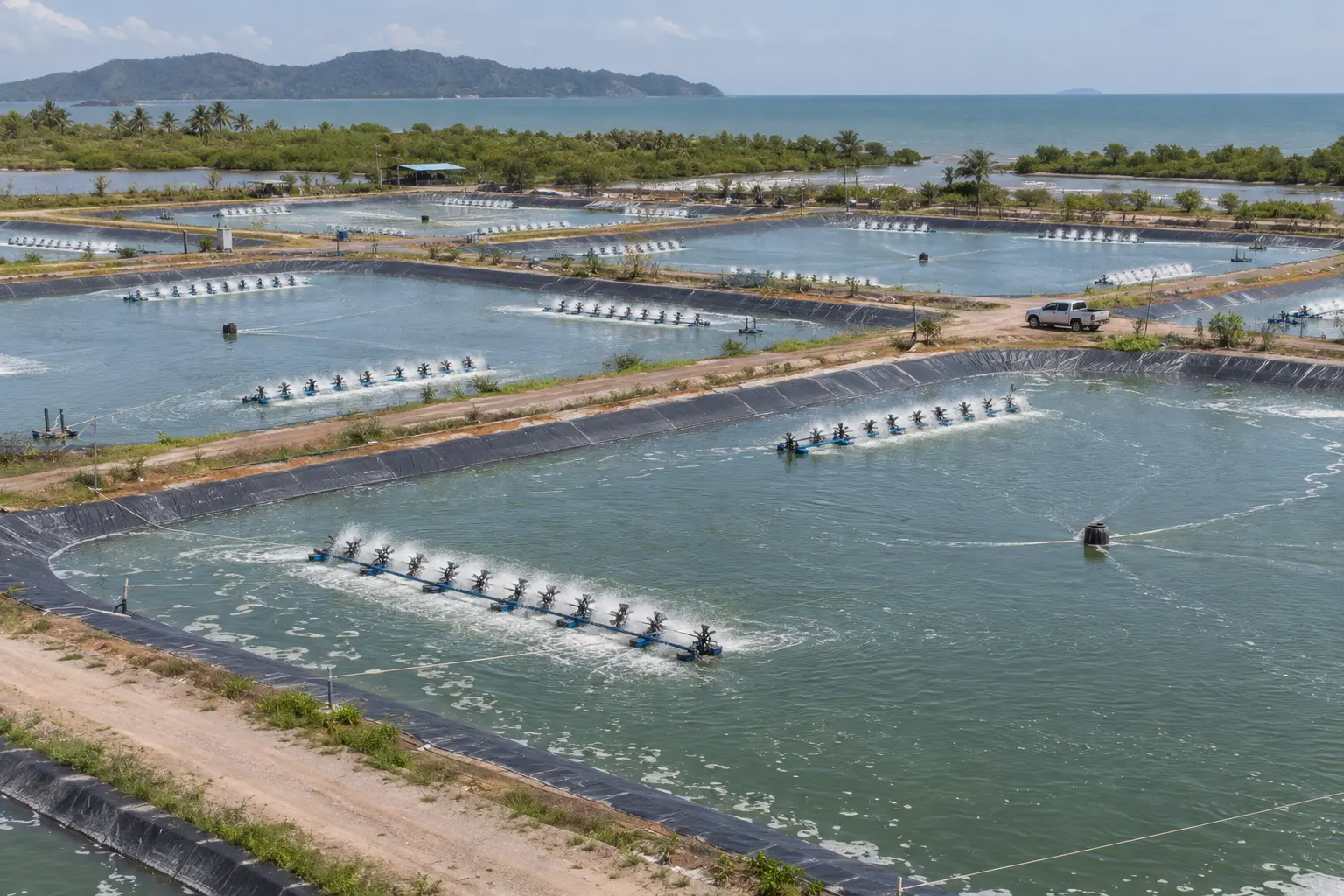
A shrimp farm monitoring system is not a single device. It is sensors in the water, a field controller that reads them, a cellular link to the cloud, and an alert that reaches your phone before a pond goes critical. The difference between that and a person walking the ponds with a handheld meter is the difference between catching a 2 AM oxygen drop and finding dead shrimp at 7 AM.
This page covers what a working system measures, which sensors hold up in pond conditions, where to put them, how to turn readings into alerts that arrive in time, and how to scale the whole thing across a farm. For the exact safe ranges by species and growth stage, pair it with our shrimp farm water quality guide.
The same platform runs as a fish farm monitoring system for finfish ponds and RAS.
Why shrimp ponds punish slow reactions
Shrimp live on the pond bottom, which is the worst place to be when water quality slips. Oxygen is lowest there, ammonia and sulfide accumulate in the sediment, and the animals cannot swim to the surface to gulp air the way some fish can. By the time you see shrimp crowding the edges or floating, the event is already well advanced and most of the crop is lost.
Two things make the bottom dangerous on a daily cycle. Dissolved oxygen swings with photosynthesis: the algae that oxygenate the water by day consume oxygen at night, so the low point lands in the small hours, long after the last person left the pond. Feed and waste drive the second risk: uneaten feed and shrimp waste break down into ammonia, and the share of that ammonia in its toxic un-ionized form rises as pH and temperature rise. A warm afternoon with a high pH and a heavy feed load is exactly when toxicity peaks.
Stocking density multiplies both problems. The more shrimp per cubic meter, the faster oxygen is drawn down, the more waste enters the water, and the narrower every safe range becomes. Intensive and biofloc systems are productive precisely because they push density, which is the same reason they leave almost no margin for a late response. Continuous monitoring exists to buy back that margin.
What a shrimp farm monitoring system measures
Start with the parameters that decide whether the crop lives, in priority order.
- Dissolved oxygen (DO). The one that kills fastest. DO follows a daily cycle, and the danger window is roughly 2 AM to dawn. This is the sensor you monitor continuously and alarm on first. A cloudy day that suppresses photosynthesis, or a sudden algae die-off, can pull the night-time low far below normal, so the alarm matters even when the pond behaved yesterday.
- pH. Drifts with algae activity and the water’s alkalinity, and tends to peak in the afternoon. Sudden swings stress shrimp directly and shift how much of the ammonia present is in its toxic form, which is why pH and ammonia are read together rather than in isolation.
- Salinity (EC). Defines which species and growth stage your water suits, and moves with rain, evaporation, and water exchange. A heavy rain event can stratify a pond with a layer of fresh water on top, which is worth seeing on a trend line rather than discovering at harvest.
- Temperature. Drives metabolism, oxygen demand, feeding, and disease pressure all at once. Warmer water holds less oxygen while the shrimp need more of it, so temperature and DO have to be read against each other. It usually comes bundled with the DO or pH probe.
- Ammonia and ORP. For intensive and biofloc ponds, where feed loads are high and water exchange is limited, these move from optional to essential. Ammonia tells you the waste load is outrunning the system; ORP gives a fast, single-number read on the overall oxidative health of the water and on any disinfection or ozonation you run.
Choosing sensors that survive shrimp ponds
Pond water is brackish to fully saline, warm, and biologically active, so probe selection is about durability as much as accuracy. A sensor that reads beautifully in a calibration cup and fouls within a week is worse than useless, because it gives you false confidence.
- Dissolved oxygen: use an optical (fluorescence) probe rather than an old membrane type, because optical sensors are stable and low-maintenance and do not consume oxygen at the membrane the way galvanic cells do. Match the housing to your water. The DO-100 suits freshwater to moderately brackish ponds, while the titanium-bodied DO-110 is built for full-strength saltwater and high-salinity brackish water, where corrosion is the enemy. For heavy biofouling or hard-to-reach mounts, the self-cleaning DO-130 carries a wiper. Our DO sensor selection guide walks through the choice in detail.
- pH: the PH-110 in seawater, or the PH-100 in freshwater culture, both digital with automatic temperature compensation, so the reading stays honest as the pond heats and cools through the day.
- Salinity (EC): the EC-110 conductivity probe in seawater, or the EC-100 in freshwater culture. If you run inland low-salinity culture, our EC probe guide covers matching the range to your water.
- Ammonia: ion-selective electrodes work in freshwater only. In seawater ponds, test by kit on a fixed schedule. In freshwater intensive and biofloc systems, the NH4-100 ammonium electrode tracks trends and spikes between test-kit checks.
- ORP: the ORP-110 in seawater, or the ORP-100 in freshwater, where you manage oxidation or ozonation.
Because the platform is modular, you fit only the probes a given pond needs and add more later without replacing the controller. A nursery pond and a grow-out pond can run different sensor sets on identical hardware.
Where to place the sensors
Placement decides whether your data reflects the pond or just the surface. Put the dissolved oxygen probe near the pond bottom, in the zone the aerators move water through, because that is where shrimp sit and where oxygen bottoms out first. A surface reading looks reassuring and misses the crash entirely. In larger or irregularly shaped ponds, a single point is not enough; aerators create well-mixed zones and the corners between them can go stagnant, so add measurement points where a dead spot would otherwise go unseen.
Keep every probe away from direct fill streams and feed trays, both of which create local readings that do not represent the pond. Mount each sensor so you can lift it for cleaning without wading in, because the cleaning will happen often. Biofouling, not electronics, is what makes pond sensors drift, so plan a quick wipe-down on a fixed schedule and choose a self-cleaning probe where access is genuinely hard. A probe you can service in thirty seconds gets serviced; one that requires a boat does not.
Turning readings into alerts that reach you in time
Continuous data only matters if it reaches you while you can still act. The point of the system is not the dashboard you check in the morning; it is the message that wakes you at 3 AM with enough warning to start an aerator.
A useful shrimp monitoring system sends a tiered alert. A first warning fires when DO approaches the safe floor, giving you time to respond before anything is at risk. An escalation follows if the value keeps falling through the night, and it should reach a second person if the first does not acknowledge it, because a single missed notification should never be the failure point. Dissolved oxygen is the alarm that earns the whole system, with a common low-DO warning near 4.5 mg/L for vannamei and 5.0 mg/L for monodon. Set pH, salinity, and temperature alerts to the species ranges in the shrimp water quality guide, and add an ammonia alert on intensive ponds using the response steps in our ammonia spikes guide.
Trends matter as much as thresholds. A DO reading that is still inside the safe band but has been sliding for three hours tells you tonight will be tight, which is information you can act on in daylight rather than in a panic at dawn. Our guide on preventing overnight fish kills covers the response playbook once an alert lands.
Connectivity and power in the field
Ponds sit away from buildings, mains power, and Wi-Fi, so the link to the cloud has to assume none of those are nearby. Each pond, or a cluster of nearby ponds, gets a field controller that publishes readings over cellular, which is the proven default for open-air sites. The Omni Genesis controller is built for exactly this setting: outdoor-rated, solar and battery powered so a grid outage does not blind you, and able to read the digital probes above on a single RS485 bus. If the difference between digital and analog sensor wiring is new to you, our sensor protocols explainer covers why a shared digital bus simplifies a multi-sensor pond.
The controller’s modular design is also LoRaWAN-ready for very large sites without cellular coverage, as a future option rather than a default. Cellular is the connectivity you deploy today.
Scaling across the farm: one dashboard, many ponds
A single pond is a starting point, not the goal. Every controller reports to one cloud dashboard, so you watch all of your ponds at once, compare oxygen and consumption trends side by side, and receive consolidated alerts instead of juggling a separate gadget per pond. Seeing the whole farm together also surfaces patterns a single pond hides: the pond that always runs lowest on oxygen, the one whose pH swings hardest, the cluster that shares an aeration problem. That is the shape of the aquaculture monitoring solution we deploy, and it works the same whether you run traditional ponds, inland low-salinity culture, or biofloc. You change the sensor mix per pond; the system stays one system.
What monitoring does and does not replace
Monitoring is the early-warning layer, not the whole operation. It will not feed the shrimp, run your biosecurity, or fix an undersized aeration system, and it should not be sold as if it does. What it does is remove the blind spot between farm visits, turn “I think the pond is fine” into a trend you can see, and give you the minutes that decide whether a crash becomes a loss. If you want the economics laid out plainly, our piece on manual versus automated water testing compares the two approaches without the sales gloss.
A phased rollout that pays its way
Most farms begin with dissolved oxygen and temperature on the highest-value ponds, where a single prevented crash justifies the install, then add pH, salinity, and ammonia as the data shows where the real risk sits. Because the system is modular, you scale pond by pond instead of committing to everything up front, and the hardware you buy first keeps working as you grow. To size a system for your species, pond count, and water type, contact our team for a configuration matched to your operation.