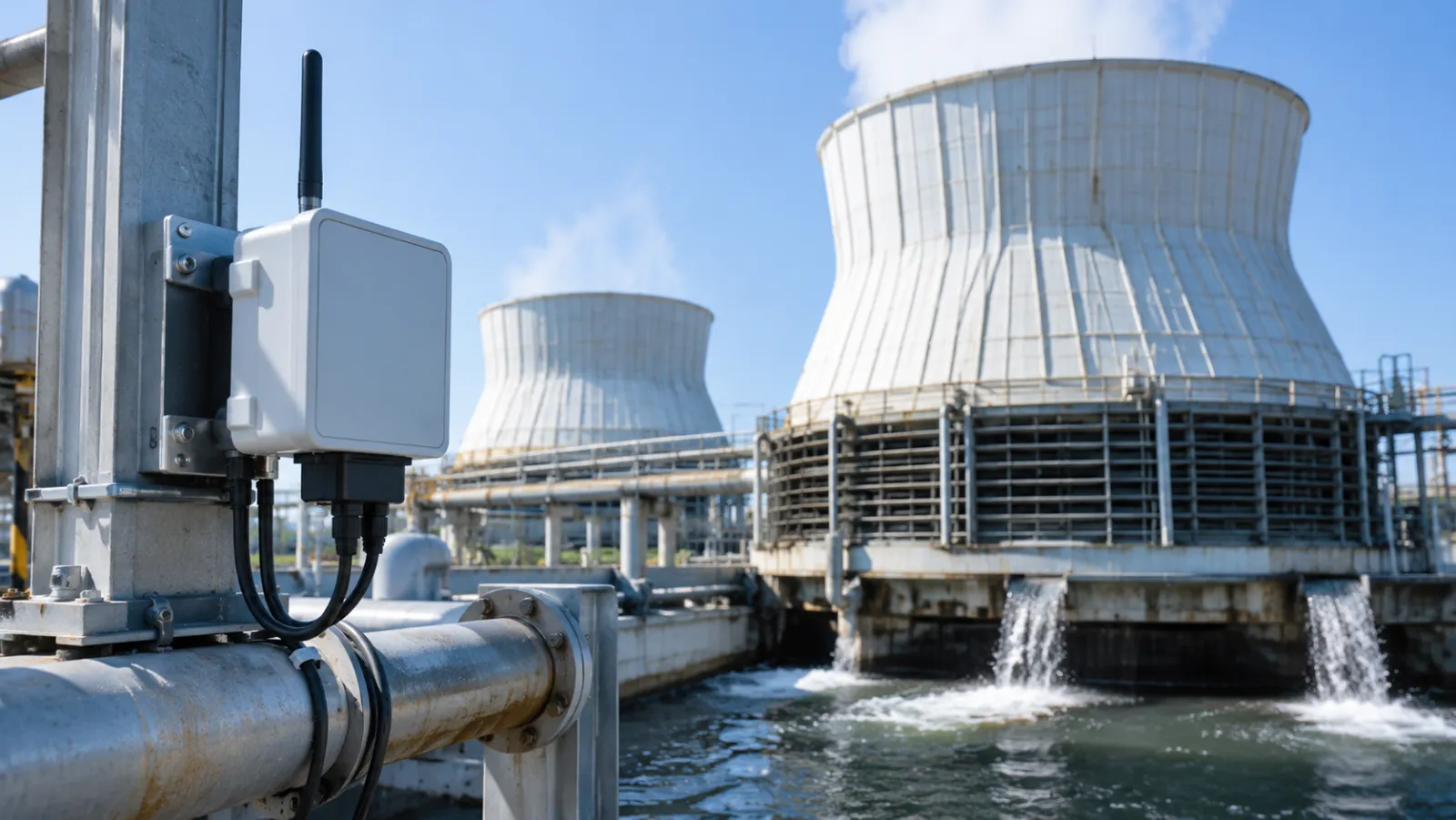
Cooling water corrosion is normally discovered twice: once when the coupon rack is pulled and weighed, and again, much later, when a heat exchanger is opened. Both are retrospective. By the time a 90 day coupon says the corrosion rate doubled, the three weeks of poor inhibitor residual that caused it are long gone, and so is any chance of connecting the number to what actually happened in the tower.
An online corrosion rate sensor changes what the measurement is for. Instead of a record of what the water did to a metal strip last quarter, you get a live signal that responds to dosing, to cycles of concentration, and to whatever went wrong last weekend. This guide covers what to look for when selecting one, which supporting parameters make the corrosion number interpretable, and how the sensor gets into a control system on a tower that was never designed for it.
What coupons cannot tell you
Coupons are not wrong, and they are not going away. They are the reference method, they cost little to run, and they give a physical artefact you can photograph and show an insurer. What they cannot do is resolve time.
A coupon integrates everything that happened over its exposure. A system that ran clean for eleven weeks and badly for one produces the same average as a system that ran mildly badly throughout, and the two need completely different responses. Coupons also cannot separate general corrosion from localized attack without visual examination after the fact, and they say nothing at all while they are still in the rack.
The practical consequence is that a coupon programme measures the treatment programme’s average performance, while an online sensor measures its current performance. Most sites want both: the coupon as the auditable reference, the sensor as the thing that triggers a phone call.
LPR and EIS: what each technique measures
Two electrochemical techniques dominate online corrosion measurement, and the distinction matters when comparing datasheets.
Linear Polarization Resistance (LPR) applies a small voltage perturbation to the electrode and measures the current that flows in response. The ratio of the two gives the polarization resistance, which is inversely proportional to the corrosion rate. LPR is fast, repeatable and well suited to general uniform corrosion, which is the dominant mode in a properly inhibited cooling system. It is the technique behind most single-method online corrosion instruments.
Electrochemical Impedance Spectroscopy (EIS) applies a range of AC frequencies and analyses how the impedance of the electrode responds across them. That response carries information LPR alone does not: whether a protective inhibitor film is present and intact, whether a coating is breaking down, and whether the attack has a localized character rather than a uniform one.
The reason this matters commercially is that a rising LPR number and an intact film mean something different from a rising LPR number and a collapsing one. The first suggests a chemistry adjustment; the second suggests the film-forming inhibitor is no longer doing its job. The FSL-100 corrosion rate electrode integrates both techniques in a single probe, which is why it reports rate and mechanism rather than rate alone.
Specifications that actually decide the selection
Most corrosion sensor datasheets look similar until you compare the fields that constrain installation.
Measurement range, chosen deliberately. The FSL-100 offers four configurable ranges: 0 to 0.25, 0 to 0.5, 0 to 1 and 0 to 5 mm/a. Because 1 mm/a is exactly 39.37 mpy, those correspond to roughly 0 to 9.8, 0 to 19.7, 0 to 39.4 and 0 to 197 mpy. A well treated system with mild steel sits low in that span, so the narrow ranges concentrate the instrument’s resolution where the readings live. Selecting the widest range because it feels safer wastes the sensitivity you bought the sensor for.
Resolution and repeatability against expected movement. A resolution of 0.0001 mm/a and repeatability of ±0.001 mm/a matter because the signal of interest is often a slow drift rather than a step change. An instrument that cannot resolve a gradual upward trend will only alarm once the problem is obvious by other means.
Drift between calibrations. Specified at ≤0.3% of full scale over 24 hours on the FSL-100. Drift is what determines whether a three month old reading can be compared to today’s without a service visit, which on a roof-mounted tower is a real operating cost.
Wetted material and mounting. 316L stainless steel and a 1 inch NPT thread put the probe into standard pipe tees, side-stream loops and flow cells without custom fabrication. IP68 rating covers the basin and outdoor enclosure reality rather than a laboratory bench.
Temperature range against the actual loop. An operating range of 0 to 75°C covers condenser water on the return side of most comfort cooling and many process duties. Check it against your own hot-side temperature rather than assuming, because this is the specification that quietly rules instruments out.
Response time in context. A 50 second response is fast relative to how quickly cooling water chemistry moves. Corrosion rate is not a control loop you close in seconds, so the value of a fast response is trend fidelity during upsets, not high-speed control.
The parameters that make the corrosion number readable
A corrosion rate on its own tells you something is happening. The parameters around it tell you what. In cooling water, four sensors do most of that work, and all of them share the same RS485 Modbus bus back to the controller.
pH governs whether the water tends to scale or to corrode, and it is the first thing to check when the corrosion trend moves. The PH-110 industrial pH probe reads 0 to 14.00 pH at ±0.02 pH and is ordered with RS485 Modbus RTU or an analog output (0-2V, 0-5V, 0-10V or 4-20mA), which matters when an existing panel expects a current loop.
ORP reflects the oxidizing environment, which is where biocide dosing and corrosion meet: too little oxidant lets biofilm establish under-deposit attack, too much is itself aggressive to metal. The ORP-110 probe covers -1999 to +1999 mV at ±3 mV.
Conductivity, which in a cooling tower is the practical stand-in for cycles of concentration, and therefore for how concentrated the dissolved salts driving corrosion have become. Cell constant selection is the detail people get wrong here. The EC-100 conductivity probe has a selectable cell constant of 0.1, 1.0 or 10.0 covering 0.2 µS/cm to 100 mS/cm at ±1.0% of full scale, so the cell is matched to the conductivity band the tower actually runs at instead of using a high-range cell for mid-range water.
Chloride, the specific ion behind pitting of stainless steel, and the one that concentrates with every cycle. The Cl-100 chloride ion-selective electrode measures 1 to 1000 mg/L as standard at ±5% of full scale, customizable to higher ranges where makeup water is already saline.
Where fouling and suspended matter are part of the picture, the TUR-110 self-cleaning turbidity sensor covers 0.01 to 3000 NTU with an optional wiper, which is what keeps an optical measurement usable in circulating water over months rather than weeks.
Getting the signal into a control system
Three situations cover most towers.
There is a PLC or BMS with a spare analog input. Use the 4-20mA output and treat the corrosion rate as any other process variable. This is the least disruptive path and needs no new network.
There is a controller but no spare inputs. RS485 Modbus RTU puts several sensors on one twisted pair back to a single point, which is usually easier than adding analog cards. The FSL-100 provides both outputs simultaneously, so a 4-20mA loop to the existing panel and a Modbus link to a data system can run in parallel.
There is nothing at the tower. This is the common case on older roof-mounted installations, where the nearest control panel is several floors away and pulling cable is the entire project cost. An IoT controller at the tower collects the RS485 sensors locally and transmits over cellular. The Omni Genesis controller has four modular sensor ports and 4G-LTE, Wi-Fi and Bluetooth connectivity, so corrosion rate, pH, ORP and conductivity report from one enclosure at the basin with no building network involved and no changes to the existing control panel.
Low power draw matters in this last case. The FSL-100 consumes under 0.2W on a 12-24V DC supply, which keeps a solar-assisted installation practical where mains power at the tower would otherwise be its own electrical project.
Where to install the probe
The measurement is only representative of what the probe sees, so placement decides the value of the data.
- In flowing water, not in the basin corner. A side-stream loop or a pipe tee on the recirculation line gives velocity across the electrode that resembles conditions in the exchangers. Stagnant water reads its own local chemistry.
- Downstream of chemical injection and after mixing. Immediately at the injection point the probe reads a slug of neat product rather than treated water.
- On the same loop as the coupon rack, where one exists. Keeping both methods in comparable conditions lets the coupon validate the sensor and the sensor explain the coupon.
- Accessible without a shutdown. Electrodes need periodic cleaning. A probe that requires draining the loop to service will not be serviced.
A short selection checklist
- Confirm the hot-side temperature of your loop sits inside the sensor’s operating range.
- Choose the measurement range from expected severity, not from the widest option available.
- Confirm the wetted material suits the water chemistry, and that the process connection matches fittings you already have.
- Decide the output before ordering: 4-20mA into an existing panel, RS485 into a data system, or both.
- Decide who owns the acceptance threshold. The sensor reports a rate, the treatment programme defines what that rate should be.
- Plan the installation point for flow, mixing and access at the same time, not after delivery.
Corrosion monitoring earns its place when it turns a quarterly post-mortem into a signal someone can act on this week. The instrument is the easy part of that. Choosing the range honestly, giving the number the supporting chemistry it needs to be interpretable, and putting the probe somewhere representative is what makes the reading worth having.
On the other side of the heat exchanger, the sealed glycol loops that cool data center racks call for different limits and methods, covered in our guide to corrosion monitoring for data center liquid cooling.
If you are scoping corrosion or cooling water monitoring for a specific system, tell us the loop temperature, the metallurgy and what control equipment is already at the tower, and we will scope the sensor package with you.