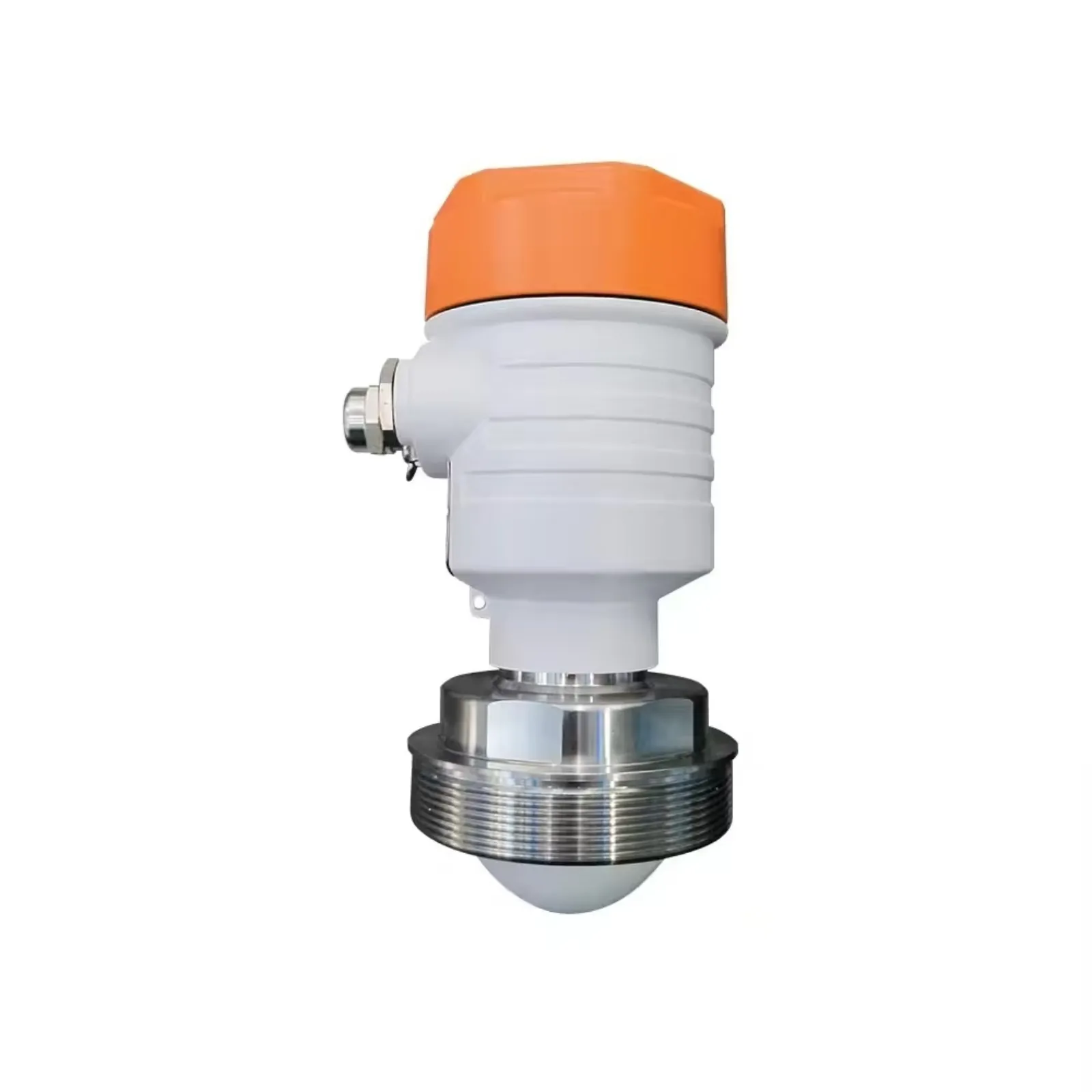
ULM-110 Explosion-Proof Ultrasonic Level Sensor (Ex d)
Hazardous-area ultrasonic level meter for fuel, solvent and chemical liquid tanks. Ex d IIC T6 and Ex ib IIB T6 certified, 4-20mA and RS485 Modbus outputs.
Contact for pricing
Product Highlights
View all in Specifications tabOverview
The AGRINOVO-ULM-110 is the hazardous-area variant of the AGRINOVO-ULM-100 ultrasonic level meter. It carries Ex d IIC T6 Gb (flameproof) and Ex ib IIB T6 Gb (intrinsic safety) certifications, allowing deployment in fuel storage, solvent tanks and other Zone 1 and Zone 2 liquid-handling environments.
Electrical performance, measurement principle, output options and Modbus protocol are identical to the ULM-100. The differences are mechanical: a heavier explosion-proof housing, upgraded display protection (IP67) and an optional stainless steel probe (IP68).
Key Features
- Ex d IIC T6 Gb (flameproof) and Ex ib IIB T6 Gb (intrinsic safety)
- Selectable range: 5 m / 10 m / 15 m / 20 m
- 4-20 mA (two-wire or four-wire) plus RS485 Modbus-RTU
- Up to 2 programmable relays
- Display IP67, probe IP68
- Stainless steel probe option for harsh chemistry
- 24 VDC standard, 220 VAC optional
- LCD display with menu keypad
Applications
- Fuel and lubricant tanks. Diesel, gasoline, jet fuel and lubricating oil storage on farms, fleet depots and small industrial sites.
- Solvent and condensate. Alcohol storage, solvent recovery vessels, condensate receivers and intermediate process tanks.
- Petrochemical and coatings. Paint, ink, coating and resin storage where the vapour space is classified.
- Classified-zone wastewater. Lift stations and digesters in facilities where the surrounding area is Zone 1 or Zone 2.
- Any classified liquid level. When the application calls for ultrasonic level but the area classification rules out a standard housing.
Hazardous Area Classification
| Code | Meaning |
|---|---|
| Ex d IIC T6 Gb | Flameproof enclosure. Group IIC covers hydrogen and acetylene. Temperature Class T6 means maximum surface temperature 85°C. Equipment Protection Level Gb suits Zone 1 installation. |
| Ex ib IIB T6 Gb | Intrinsic safety. Group IIB covers ethylene and town gas. T6 and Gb as above. |
Installation in a classified area must follow IEC 60079-14 and any applicable local code. Cable glands, junction boxes and conduit seals must be certified to the same EPL or higher.
How Ultrasonic Level Sensing Works
The probe emits a short ultrasonic pulse downward and listens for the echo from the liquid surface. The transit time, combined with the speed of sound in air (corrected for temperature), gives the distance from the probe face to the liquid. The meter converts this to level using the configured tank geometry and outputs it on the 4-20 mA loop and the RS485 bus.
Ultrasound needs a gaseous medium between the probe and the liquid. The ULM-110 is for atmospheric and slightly pressurised vessels (up to 0.3 MPa). Vacuum vessels are not suitable.
When to Choose ULM-110 over ULM-100
| Condition | Choose |
|---|---|
| Non-classified area, ordinary process liquid | AGRINOVO-ULM-100 |
| Zone 1 or Zone 2 hazardous area | AGRINOVO-ULM-110 |
| Flammable liquid (fuel, solvent, condensate) | AGRINOVO-ULM-110 |
| Stainless steel housing needed (washdown, marine, sterile process) | AGRINOVO-ULM-110 |
| IP67 display required (heavy washdown) | AGRINOVO-ULM-110 |
For non-hazardous water, wastewater and pond applications, the standard AGRINOVO-ULM-100 is the right choice. For grain silos and dusty bulk-solid vessels, see the AGRINOVO-RLM-120 80 GHz Radar Level Sensor.
Installation Notes
Hazardous-area compliance. Installation must follow IEC 60079-14 and local code. Do not open the enclosure when energised. Wait at least 5 minutes after power removal before opening.
Mounting. Install perpendicular to the liquid surface. Maintain at least the blind-zone distance between the probe face and the maximum liquid level. Avoid placement directly above fill streams or agitators.
Connecting pipe (nozzle). Length must not exceed 60 mm and inner diameter must be at least 100 mm. The probe emitting face must protrude at least 3 cm below the underside of the flange.
Open container. Minimum wall distance per range: 0.5 m (5 m), 1.0 m (10 m), 1.5 m (15 m), 2.5 m (20 m).
Integration
Integration matches the ULM-100. The ULM-110 communicates via RS485 Modbus-RTU at 9600 baud (default), 8N1, with the measurement register returning instantaneous distance or level in centimetres. Full register map is in the datasheet. The 4-20 mA output supports two-wire and four-wire configurations into standard PLCs and SCADA.
For 24 VDC installations alongside VFDs or motors, route signal cables separately from power cables and ground the meter independently.
Part of our IoT Silo Monitoring System
Learn about our complete silo and container level monitoring solution for feed and grain management.
Related Products
Other solutions in the sillo category