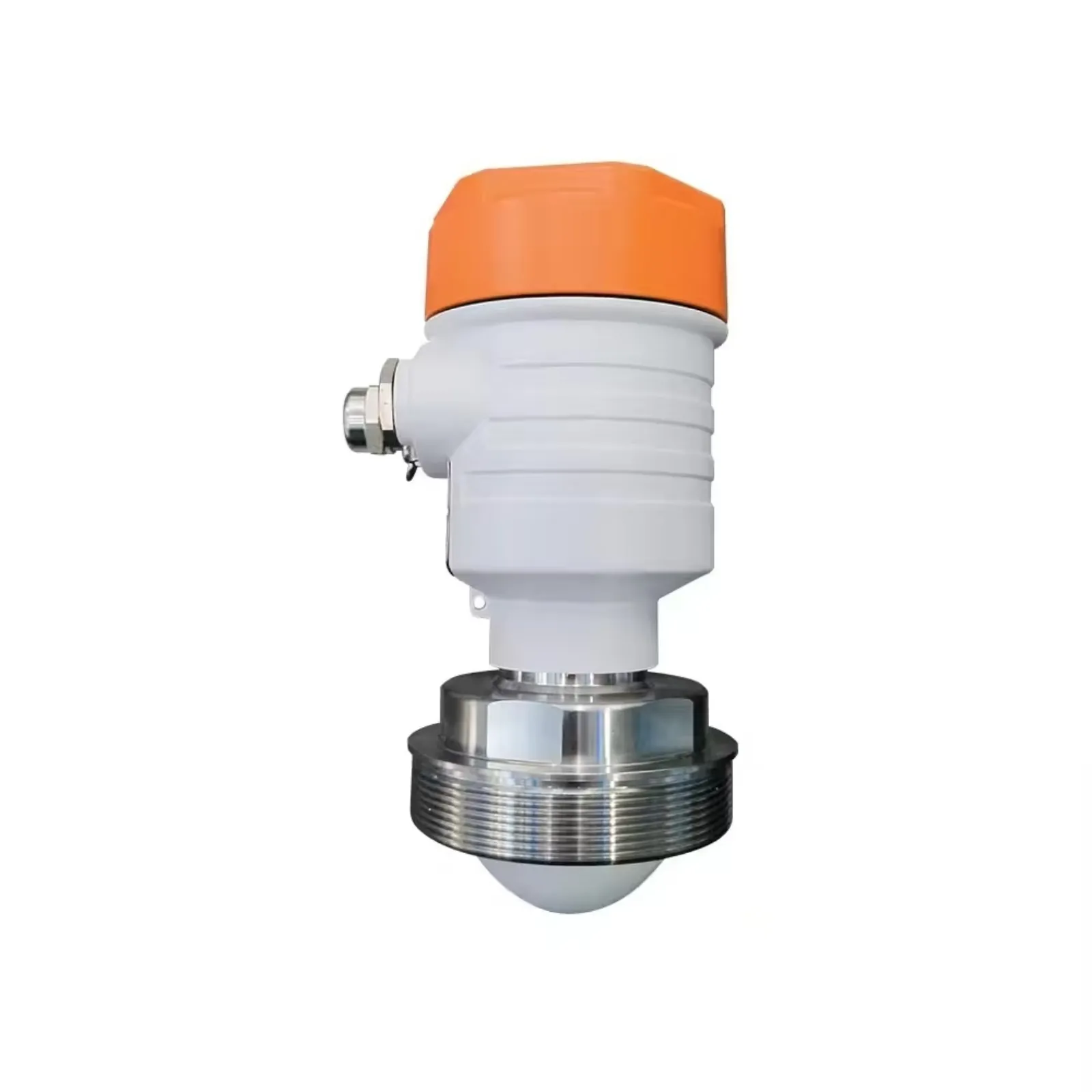
ULM-100 Ultrasonic Level Sensor for Tanks & Reservoirs
Integrated ultrasonic level meter for liquid tanks, reservoirs, wells and open channels. 5 to 20 m range, 4-20mA and RS485 Modbus outputs, IP68 probe.
Contact for pricing
Product Highlights
View all in Specifications tabOverview
The AGRINOVO-ULM-100 is an integrated ultrasonic level meter for non-contact liquid level measurement in tanks, reservoirs, wells and open channels. Transmitter, transducer and LCD display sit in a single field-mounted housing. Outputs include 4-20 mA (two-wire or four-wire) and RS485 Modbus-RTU, with optional dual programmable relays for level alarms or pump control.
Range is selected at order time from the 5 m, 10 m, 15 m and 20 m probe variants.
Key Features
- Non-contact measurement, no wetted electronics
- Selectable range: 5 m / 10 m / 15 m / 20 m
- 4-20 mA (two-wire or four-wire) plus RS485 Modbus-RTU
- Up to 2 programmable relays for pump control or level alarms
- LCD display with menu keypad for field configuration
- Display IP66, probe IP68
- 24 VDC standard, 220 VAC optional
- Automatic temperature compensation
- Anti-corrosion probe option (PVDF or PTFE)
- Multiple thread and flange process connections
Applications
- Water tanks and irrigation reservoirs. Continuous level readout for booster pumps, fertigation tanks and storage basins.
- Wastewater treatment. Lift stations, equalisation basins, sedimentation tanks and weir-flow measurement.
- Aquaculture. Pond and tank level monitoring for RAS, hatcheries and grow-out systems where a non-wetted sensor avoids biofouling.
- Slurry and effluent. Dairy lagoons, livestock waste tanks and food-processing effluent vessels.
- Open channel flow. Combined with a weir or flume geometry, the level reading is converted to flow.
- Chemical and dosing tanks. Non-hazardous liquids in agriculture, water treatment and small industrial processes.
How Ultrasonic Level Sensing Works
The probe emits a short ultrasonic pulse downward and listens for the echo from the liquid surface. The transit time between transmit and receive, combined with the speed of sound in air (corrected for temperature), gives the distance from the probe face to the liquid. The meter converts this to level using the configured tank geometry and outputs it on the 4-20 mA loop and the RS485 bus.
Because ultrasound needs a gaseous medium to travel through, the AGRINOVO-ULM-100 is for atmospheric and slightly pressurised vessels (up to 0.3 MPa). Vacuum vessels are not suitable.
When to Choose Ultrasonic vs Radar
Ultrasonic and 80 GHz radar each fit a different set of conditions. Choose by application, not by spec sheet.
| Condition | Ultrasonic (ULM-100) | 80 GHz Radar (RLM-120) |
|---|---|---|
| Liquid in open or vented tank | Good fit | Good fit |
| Solid material, grain, feed, powder | Not supported | Required |
| Heavy dust during filling | Affected | Unaffected |
| Steam, vapour, condensation | Affected | Unaffected |
| Narrow silo with internal obstructions | Wider beam, more false echoes | 3° beam, clean signal |
| Range beyond 20 m | Not available | Up to 120 m |
| Vacuum vessel | Not suitable | Suitable |
| Simple water, wastewater or pond tank | Right tool | Overspecified |
For liquid tanks under 20 m where dust and vapour are not a concern, the ULM-100 is the right tool. For grain silos, dusty vessels or harsh conditions, see the AGRINOVO-RLM-120 80 GHz Radar Level Sensor. For hazardous-area liquid applications (Zone 1, fuel and solvent tanks), see the AGRINOVO-ULM-110 Explosion-Proof Ultrasonic Level Meter.
Installation Notes
Mounting: install perpendicular to the liquid surface. Maintain at least the blind-zone distance between the probe face and the maximum liquid level (see Specifications). Avoid placement directly above fill streams, agitators or internal pipes.
Connecting pipe (nozzle): when a short pipe is used, length must not exceed 60 mm and inner diameter must be at least 100 mm. The probe emitting face must protrude at least 3 cm below the underside of the flange.
Open container: maintain minimum wall distance per range (0.5 m for 5 m, 1.0 m for 10 m, 1.5 m for 15 m, 2.5 m for 20 m). The probe may be mounted at the centre of an open container; focusing effects only apply to closed arch-top tanks.
Wells and casings: narrow wellheads typically require a measuring casing. A casing enlarges the blind zone by 50 to 100 %, so size the meter range accordingly. Casing inner diameter must be at least 150 mm for measuring ranges up to 4 m.
Integration
The ULM-100 integrates directly with Genesis IoT controllers via RS485 Modbus-RTU, with no external converter. Communication settings: 9600 baud (default), 8 data bits, 1 stop bit, no parity. The measurement register returns instantaneous distance or level in centimetres; full register map is in the datasheet.
The 4-20 mA output supports either two-wire (loop-powered, 250 Ω max load) or four-wire (510 Ω max load) configurations and connects to standard PLCs, panel meters and SCADA inputs. Optional dual SPDT relays can drive pump start/stop directly without a separate controller.
For 24 VDC installations, route signal cables separately from power cables (or at least 1 m apart) and ground the meter independently to avoid VFD and motor interference.
Part of our IoT Silo Monitoring System
Learn about our complete silo and container level monitoring solution for feed and grain management.
Related Products
Other solutions in the sillo category