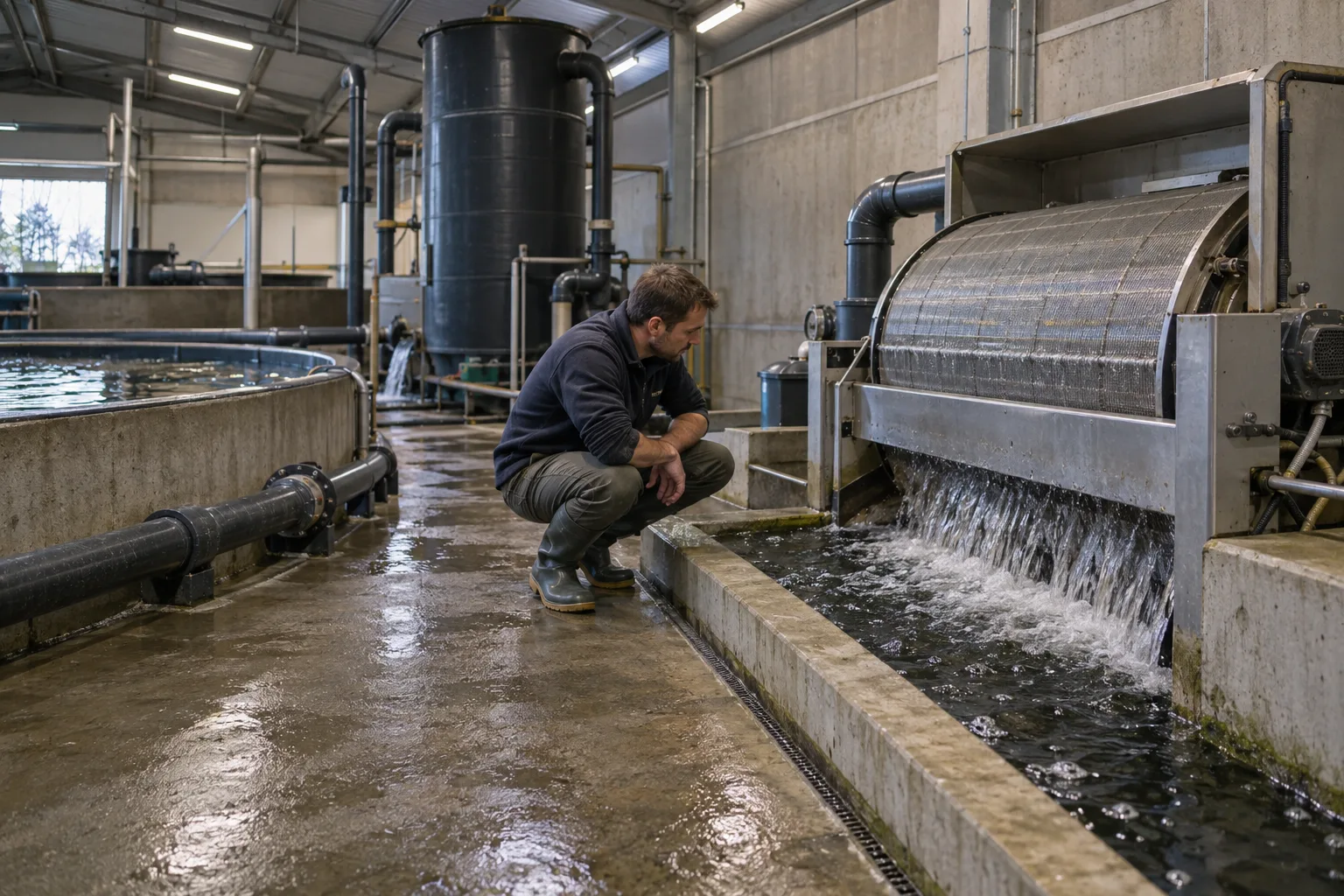
A recirculating aquaculture system keeps fish alive on a small volume of water cycled through a biofilter, which means there is almost no buffer when something goes wrong. A RAS monitoring system is what gives you the warning: sensors in the loop, a controller that reads them, and an alarm that reaches you before dissolved oxygen falls or the biofilter slips.
This page covers what to measure, where to place each probe, how to turn readings into alarms that arrive in time, and how to scale across tanks. For the deep technical detail on probe placement and biofilter protection, pair it with our RAS water quality guide.
Why a RAS leaves no margin for error
A pond holds thousands of cubic meters of water that buffer a problem for hours. A recirculating loop does the opposite: it concentrates a large standing stock into a small, fast-moving volume that depends on equipment running continuously. That design is what makes RAS productive and water-efficient, and it is also what removes your safety margin. When oxygenation, flow, or the biofilter falters, the water chemistry moves in minutes, not hours.
The biofilter is the part that makes a RAS more than a tank of water, and it is also the part most operators underestimate. Beneficial bacteria convert toxic ammonia from fish waste into nitrite and then into far less harmful nitrate. That biology is alive, so it can be knocked back by a temperature swing, a pH drop, a disinfection overdose, or simply a feed increase the colony has not grown to handle yet. When the biofilter falls behind, ammonia and nitrite climb while pH drifts, and the first visible symptom is stressed fish, which is already too late.
Stocking density sharpens every one of these risks. The more fish per cubic meter, the faster oxygen is drawn down, the more waste the biofilter must process, and the smaller the error you can afford. Continuous monitoring exists to watch the loop during the hours nobody is standing next to it, and to turn a developing fault into an alarm instead of a loss.
What a RAS monitoring system measures
In a closed loop, a few values decide everything, so monitor them continuously rather than sampling them once a shift.
- Dissolved oxygen (DO). The fastest killer. Stocking density is high and the water volume is small, so oxygen can fall quickly if oxygenation or flow falters. A pump trip or a clogged diffuser can move DO in minutes, which is why this is the alarm you build the system around.
- pH. Drifts downward as the biofilter consumes alkalinity converting ammonia. A falling pH is both a direct stress on the fish and an early signal that the biofilter is working hard or that alkalinity needs topping up, so it carries more information in a RAS than in an open pond.
- Temperature. Sets metabolic rate and oxygen demand across the whole system, and it also governs how hard the biofilter and the fish are working. A heater fault that drifts the loop warm raises oxygen demand at the same moment it lowers what the water can hold.
- Ammonia and nitrate. This is the nitrogen the biofilter is supposed to process, so it is the most direct readout of biofilter health. Rising ammonia or nitrite is the clearest early sign of a biofilter problem, and tracking nitrate over time tells you how loaded the system is between water exchanges.
- ORP. Where ozone or disinfection is part of the loop, ORP gives a fast single-number read on oxidative conditions and helps you dose without overshooting and harming the biofilter.
Choosing the sensors
RAS water is warm, biologically active, and runs continuously, so pick probes for stability and low maintenance. A probe that needs constant recalibration defeats the purpose of a closed system that is supposed to run unattended overnight.
- Dissolved oxygen: an optical probe such as the DO-100, which is stable and low-maintenance, or the self-cleaning DO-130 where biofouling is heavy. For high-salinity marine RAS, the titanium-bodied DO-110 resists corrosion. Our DO sensor selection guide covers the trade-offs.
- pH: the PH-100 with automatic temperature compensation, so the reading stays honest as the loop temperature shifts.
- Ammonia and nitrate: the NH4-100 ammonium and NO3-100 nitrate ion-selective electrodes around the biofilter. Our nitrate monitoring guide explains how nitrate trends reveal system loading.
- ORP: the ORP-100 where you run ozonation. Our guide on ORP control for ozonation in RAS covers that loop in detail.
The system is modular, so you fit each module with the probes it needs and add more without changing the controller. A quarantine module and a grow-out module can carry different sensor sets on identical hardware.
Where to place the sensors
Placement is what turns raw readings into early warning. Place dissolved oxygen after the oxygenation stage, and again before the fish where the loop allows, so you see both what the system is supplying and what the fish actually receive. A gap between those two points tells you the loop is losing oxygen before it reaches the tank, which is a fault you want to see before the fish do.
Keep pH and temperature in the main flow, where they represent the whole loop rather than a stagnant corner. Put the nitrogen indicator around the biofilter, because that is where a developing fault shows first and where you have the most time to act on it. The principle throughout is to catch a problem upstream, while it is still a number on a dashboard rather than a tank of stressed fish. If the digital versus analog wiring choice is new to you, our sensor protocols explainer covers why a shared digital bus simplifies a multi-probe loop. The RAS water quality guide maps each point in detail.
Turning readings into alarms that reach you in time
The value of continuous data is the alarm that fires while you can still act. A biofilter crash announces itself as rising ammonia or nitrite and drifting pH before fish show any symptom, and catching that window is the entire reason to monitor a RAS rather than test it by hand. Our ammonia spike guide covers the response once the alarm lands.
A useful RAS monitoring system sends a tiered alert: a warning as a value approaches its limit, and an escalation if it keeps moving, reaching a second person if the first does not acknowledge it. Dissolved oxygen and biofilter chemistry are the alarms that justify the whole system. Trends matter as much as thresholds here, because a slow drift in pH or nitrate over days is a planning signal you can act on calmly, while a sudden DO drop is an emergency you respond to in minutes. A system that shows you both is doing its job.
Connectivity and power
Each module gets a controller that publishes readings to the cloud. The Omni Genesis controller reads the digital probes above on a single RS485 bus and connects over cellular for sites without a reliable local network, or over Wi-Fi for indoor facilities near infrastructure. Because a recirculating system depends on continuous equipment, battery backup in the controller matters: a grid blip should never be the moment your monitoring goes dark, which is the same window your pumps and oxygenation are most at risk.
Scaling across tanks: one dashboard, many loops
A single module is a starting point, not the goal. Every controller reports to one cloud dashboard, so a multi-tank facility watches all of its loops together, compares trends side by side, and receives consolidated alarms instead of checking each module separately. Seeing the whole facility at once surfaces the patterns a single loop hides: the module whose pH always drifts fastest, the biofilter that lags after every feed increase, the tank that runs warm. That is the aquaculture monitoring solution in a recirculating context, and it works the same whether you run freshwater or marine RAS. You change the sensor mix per module; the system stays one system.
What monitoring does and does not replace
Monitoring is the early-warning layer, not the operation. It will not run your biofilter, manage feeding, or replace sound system design and maintenance, and it should not be sold as if it does. What it does is remove the blind spot between manual tests, turn biofilter health into a trend you can see developing, and give you the minutes or hours that decide whether a fault becomes a loss. For the economics of automated versus manual testing, our piece on manual versus automated water testing lays out the comparison plainly.
A phased rollout that pays its way
Begin with dissolved oxygen, temperature, and a nitrogen indicator on the highest-value modules, where a single prevented crash protects the entire standing stock, then add pH and ORP as the data shows where the risk concentrates. Because the system is modular, you scale module by module and the hardware you buy first keeps working as you grow. To size a system for your tanks, species, and loop design, contact our team for a configuration matched to your facility.