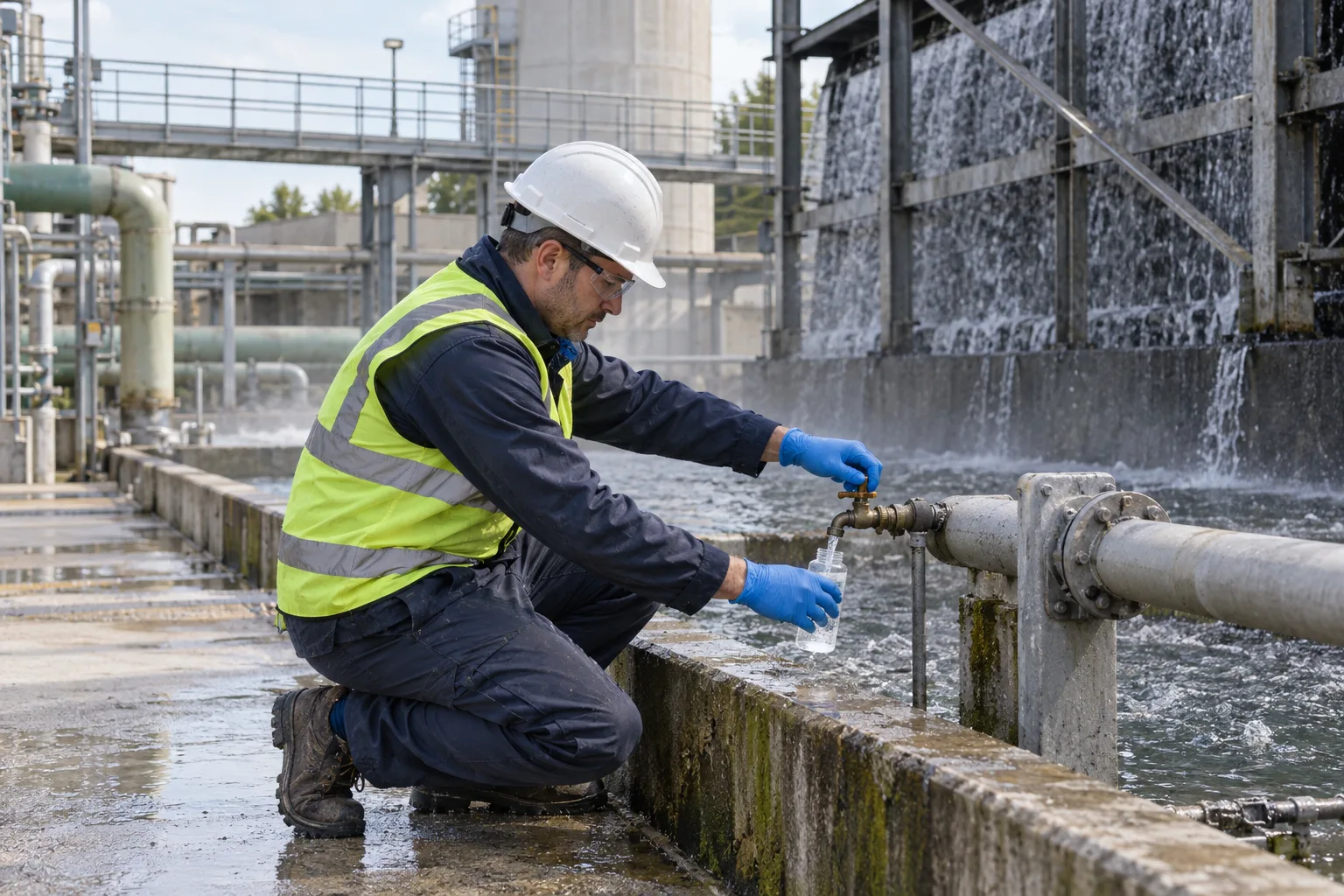
Chlorine dioxide dosing is set by a pump, but it is judged by what is left in the water. The dose reacts with whatever the water carries, the demand changes with the water, and the only number that shows whether disinfection is working is the residual measured downstream. An online chlorine dioxide analyzer turns that residual from a grab sample taken once a shift into a reading every few minutes, with an alarm when it drifts.
This guide covers what to look for in a ClO2 analyzer used for dosing control: what the residual does and does not tell you, how to choose range and accuracy, where the sample point goes, how to keep the reading honest, and how to set the alarms. For the chemistry, the regulations and the measurement methods in more depth, see our ClO2 monitoring guide for water treatment.
What the residual tells you, and what it does not
The residual is the chlorine dioxide still present after the dose has met the water’s demand. That makes it the right control variable: if the demand rises because the water carries more organic load, the same dose leaves less residual, and the analyzer shows it before anyone sees it in the process.
Three limits to keep in mind:
- It is one point. The residual at the sample point says nothing about a dead leg at the far end of a cooling circuit or a tank with poor mixing. A large system may need more than one point.
- It is not the dose. Two different doses can give the same residual on two different days. The pump stroke and the residual together tell the story; the residual alone does not.
- It is not the byproducts. Chlorine dioxide forms chlorite as it reacts. In US drinking water the EPA’s national primary drinking water regulations set a maximum residual disinfectant level of 0.8 mg/L for chlorine dioxide and a maximum contaminant level of 1.0 mg/L for chlorite. A ClO2 sensor measures the first and not the second; chlorite needs its own method.
Where a ceiling like that applies, overdosing is a compliance problem as well as a cost, and the analyzer’s high alarm protects against it as much as the low alarm protects against underdosing.
Choosing range and accuracy
The two specifications that decide whether an analyzer can control a dose are range and accuracy, and they should be read against your own working band: the gap between the lowest residual that still disinfects and the highest you are allowed or willing to run.
The ClO2-100 chlorine dioxide sensor is an electrochemical electrode with these specifications from its datasheet:
| Specification | ClO2-100 |
|---|---|
| Range | 0.00 to 20.00 mg/L |
| Resolution | 0.01 mg/L |
| Accuracy | ±0.1 mg/L |
| Temperature measurement | -10.0 to 110.0°C, ±0.5°C, TH10K thermistor |
| Compensation | Automatic temperature compensation; pH compensation from a set pH value |
| Calibration | Two-point, zero and slope, stored in the sensor |
| Output | RS-485 Modbus RTU, 2500 Vrms isolation |
| Supply | 9 to 27 V DC, 0.5 W or less |
| Housing and thread | PPS, M20×1.5 or G3/4 |
How to read that against an application:
- Cooling water, process water, wastewater and aquaculture usually run working bands where ±0.1 mg/L is small compared with the distance between the low and high limit. Here a 0 to 20 mg/L range also leaves room to see a dosing upset rather than a reading pinned at the top of the scale.
- Drinking water near the 0.8 mg/L ceiling is a tighter case. If you aim for a residual a few tenths below the ceiling, ±0.1 mg/L is a large share of that margin. Decide whether the band you need to hold is wide enough before relying on any sensor with that accuracy for compliance.
The pH compensation deserves a note. The sensor applies pH compensation using a pH value written into it, set to your water’s typical pH. If your water’s pH swings widely, measure it, and update the setting when the process changes, or the compensation is applied to the wrong value.
Where the sample point goes
The most common installation mistake is measuring too close to the injection point. Right after the dose, the chlorine dioxide has not yet met the demand, so the reading overstates what reaches the process. The sample point belongs:
- After mixing and contact time, where the dose has had the time your process assumes before the water reaches what you are protecting.
- In steady flow. An electrochemical electrode needs water moving past it at a steady rate. A flow cell on a sample line, or a fitting in a pipe that does not stop and start, gives a stable reading; a dead leg does not.
- Where the water represents the system. In a cooling tower that is usually the return or the basin; in a process line, the point before the water reaches the product or the heat exchanger.
The ClO2-100 mounts on an M20×1.5 or G3/4 thread, so it fits a standard flow cell or a pipe tee. Its RS-485 cable runs to an Omni Genesis controller, which supplies the sensor from a switched 12 V output, inside the sensor’s 9 to 27 V range, and reports every reading over 4G-LTE or Wi-Fi.
Keeping the reading honest: calibration
An online analyzer is only as good as its last comparison with a reference. The routine that works:
- Take a grab sample at the sensor’s sample point, at the same moment you note the online reading.
- Measure it with your reference method, the lab or field kit your process already trusts.
- Compare. If the two agree within your tolerance, record it and move on. If they drift apart, clean the electrode and recalibrate.
The ClO2-100 uses a two-point calibration, a zero point and a slope point, and stores both in the sensor along with a calibration status. The datasheet allows a zero offset of up to ±0.30 mg/L and a slope from 30 to 300 percent. Recording the slope after each calibration gives a simple history of the electrode’s condition: a slope that keeps drifting from one calibration to the next is the sign to inspect the electrode and plan a replacement.
Setting the alarms
Dosing control fails in both directions, so the analyzer needs both a low and a high limit.
- Low limit. A residual below it means underdosing: an empty chemical tank, a stopped pump, a generator fault, or a jump in demand. This is the alarm that protects the process.
- High limit. A residual above it means overdosing: a pump stuck on, a wrong setpoint, or a drop in demand that the dose did not follow. Where a regulatory ceiling applies, set the high limit inside it.
- Allowed time out of range. A short spike when a pump starts or a valve moves is not a fault. In OmniCloud each reading has its own minimum, maximum and the time it may stay outside them before an alert opens, so short transients are ignored and a sustained excursion is not.
When an alert opens, every user on the account gets an app notification. It repeats every two hours by default until someone reads it, and a second notification follows when the residual is back in range. A reading marked as critical comes through users’ quiet hours. If the controller itself stops reporting, a separate offline alert opens, so a silent analyzer is never mistaken for a residual in range.
Where an online ClO2 analyzer fits
From the sensor’s own application list and the cases it is built for:
- Cooling water and cooling towers, where chlorine dioxide is dosed as a biocide and the residual moves with the load. Our post on cooling tower corrosion monitoring covers the sensors that usually sit beside it.
- Food and beverage process water, where the residual has to be present at the point of use and absent where it would affect the product.
- Wastewater disinfection, where demand changes with every batch.
- Aquaculture and RAS water management, where disinfection of make-up water or equipment has to stay away from the fish.
- Drinking water treatment and distribution, with the accuracy caveat above.
A short checklist
| Question | What to check |
|---|---|
| Working band | Low and high residual limits, and whether the sensor’s accuracy is small compared with the gap |
| Range | Covers the target with room for an upset above it |
| Sample point | After mixing and contact time, steady flow, representative of the system |
| Compensation | Temperature automatic; pH value set to your water |
| Calibration | Regular grab-sample comparison; slope recorded each time |
| Alarms | Low and high limits, an allowed time out of range, a named person on call |
| Byproducts | Chlorite measured separately where a limit applies |
Conclusion
An online chlorine dioxide analyzer does not replace the dosing pump or the lab. It closes the gap between them: the pump sets the dose, the lab confirms the method, and the analyzer shows the residual every few minutes and raises an alarm when it leaves the band in either direction. Choose it by your working band, put it where the water represents the system, calibrate it against your reference, and give it both a low and a high limit. To plan a ClO2 measuring point on your line, send us the water type, your target residual and where the sample can be taken.