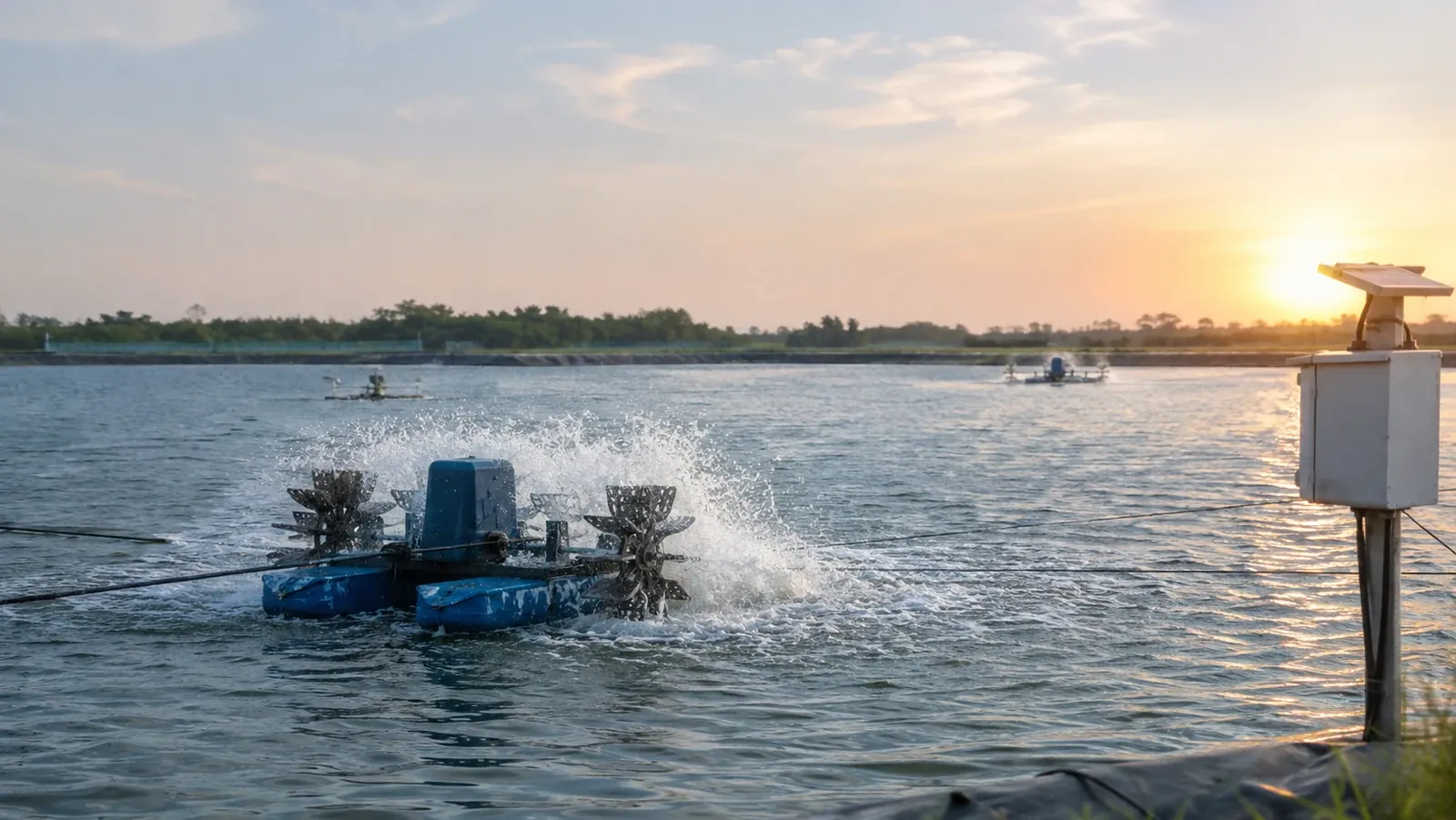
The aerator was on. That is what the panel said, that is what the schedule said, and that is what anyone standing at the switchboard would have reported. The fish still died.
This is the failure mode that makes aeration different from every other piece of farm equipment. A pump that stops waters nothing and someone notices by morning. An aerator that stops looks exactly like an aerator that is working, from every vantage point except the surface of the water at three in the morning, and the cost of the gap is the standing stock of the pond.
“On” and “running” are different measurements
A control system knows what it commanded. It closed a contactor, it energized a circuit, and it logged that it did so. Everything downstream of that command is invisible to it.
Consider what actually goes wrong with an aerator, and where in the chain it happens:
- A contactor welds shut or drops out silently
- A drive belt snaps or slips off its pulley
- A bearing seizes, or a coupling shears
- A three-phase motor loses a phase and stalls
- A paddlewheel or propeller wraps in weed, rope, or netting
- A float tips and lifts the impeller clear of the water
- A gearbox fails while the motor keeps spinning freely
Every one of those leaves the control circuit in the state it expects. The panel is not lying; it is reporting the last thing it did, which was to switch power toward a motor. Whether the motor turned, and whether turning accomplished anything, are questions it was never able to ask.
A run-hour meter inherits the same blindness. It counts energized time, so it faithfully accumulates hours on a machine that has been dead since Tuesday.
What current tells you
Current is the first quantity in the chain that changes when the machine stops doing work, and it is measurable without touching the machine.
Three states are worth distinguishing, and they cover nearly every case:
Normal running current. The motor is turning and loaded. If dissolved oxygen is still falling, the aeration is working and the problem is demand: biomass, temperature, an algae crash, a still and overcast night. That is a stocking and feeding decision, not a maintenance call.
Zero current. The machine is not running, whatever the panel says. A tripped breaker, a dropped contactor, a burnt motor, a lost supply. This is the alarm that has to reach a person at night, because nothing about it resolves on its own.
Current well below normal. The motor is turning but not doing the work it should. An unloaded motor draws a fraction of its loaded current, so a snapped belt, a sheared coupling, a lifted impeller, or a failed gearbox all show up here. This is the state that is invisible to everything else on the farm, and it is often the early warning: a bearing that is starting to go, or a paddlewheel gradually fouling, shows as drift before it shows as a stop.
The useful reference is not a number from a catalogue, it is the machine’s own baseline. Record what each aerator draws when it is running normally, in its own pond, at its own immersion depth. Deviation from that baseline is the signal. Motor nameplate current is a starting sanity check, not a threshold.
Pairing current with dissolved oxygen
A dissolved oxygen alarm tells you the pond is in trouble. It does not tell you why, and at two in the morning the difference decides what you do next: drive out with a spare aerator, or start an emergency water exchange.
Read together, the two measurements sort themselves out immediately:
| DO | Aerator current | What it means |
|---|---|---|
| Falling | Normal | Aeration is working, demand exceeds it |
| Falling | Zero | The aerator stopped, this is mechanical |
| Falling | Below baseline | The aerator is turning but not aerating |
| Stable | Zero | A backup is carrying the pond, fix before night |
That last row is worth pausing on. A pond with redundant aeration can lose a unit and hold its oxygen through a mild night, which means the failure goes unnoticed until the first hot, still evening removes the margin. Current monitoring finds it on the day it happens rather than on the night it matters.
Timing matters too. The motor stops at the instant it fails, while dissolved oxygen has to fall far enough to cross a threshold, and in a stocked pond at night that is a slow slide with fish already under stress. Current gives back the interval between the failure and its consequence, and that interval is the entire opportunity to act.
Fitting one to an existing aerator
This is the part farms expect to be difficult, and it is not. A split-core current sensor opens on a hinge, clips around one conductor of the aerator’s existing supply cable, and closes. The power wiring is not cut, the circuit is not opened, and the aerator does not come out of service.
Three practical points:
One conductor only. The core goes around a single insulated conductor of the circuit. Clamp it around two conductors of the same circuit and the fields cancel, giving a reading near zero on a perfectly healthy machine. This is the most common installation mistake and it looks exactly like a failure.
Close it fully. The two faces of the core have to meet flush. A gap holds the reading low, which imitates the “turning but unloaded” state you are trying to detect.
Qualified work. Clipping a core onto insulated cable is not electrical work, but getting to the cable often means opening a panel. That part belongs to an electrician working under local regulations.
For the signal side, a sensor with a digital output earns its place. The CT-100 reports over RS485 Modbus-RTU, so the current value is converted inside the sensor and arrives at the controller as a number rather than as an analog signal that degrades over a long run back from the pond bank. It shares the same RS485 bus as the water quality probes, which means one controller holds both the dissolved oxygen reading and the aerator current behind it.
What to alarm on
Keep the alarm set small enough that people still respond to it at night:
- Zero current while the aerator is scheduled to run. This is the one that wakes someone up.
- Current below the machine’s baseline for longer than a few minutes, to catch the unloaded states.
- No reading at all from the sensor, which is a comms or power fault and should not be mistaken for a healthy silence.
Resist the urge to alarm on small deviations. Aerator current moves with water level, fouling, and temperature, and a threshold set too tight trains everyone to ignore the alerts, which costs more than the alerts were worth.
The same logic beyond the pond
Nothing about this is specific to aeration. Any motor whose failure is expensive and silent benefits from the same measurement:
- An irrigation pump running dry, which draws noticeably less than a primed pump
- A blower or compressor that has lost a belt
- A feed auger or conveyor that has jammed or emptied
- Ventilation fans in a poultry or livestock house, where a failed fan on a hot day has the same shape as a failed aerator on a still night
The pattern is always the same: the control system reports its own command, and the current reports the world.