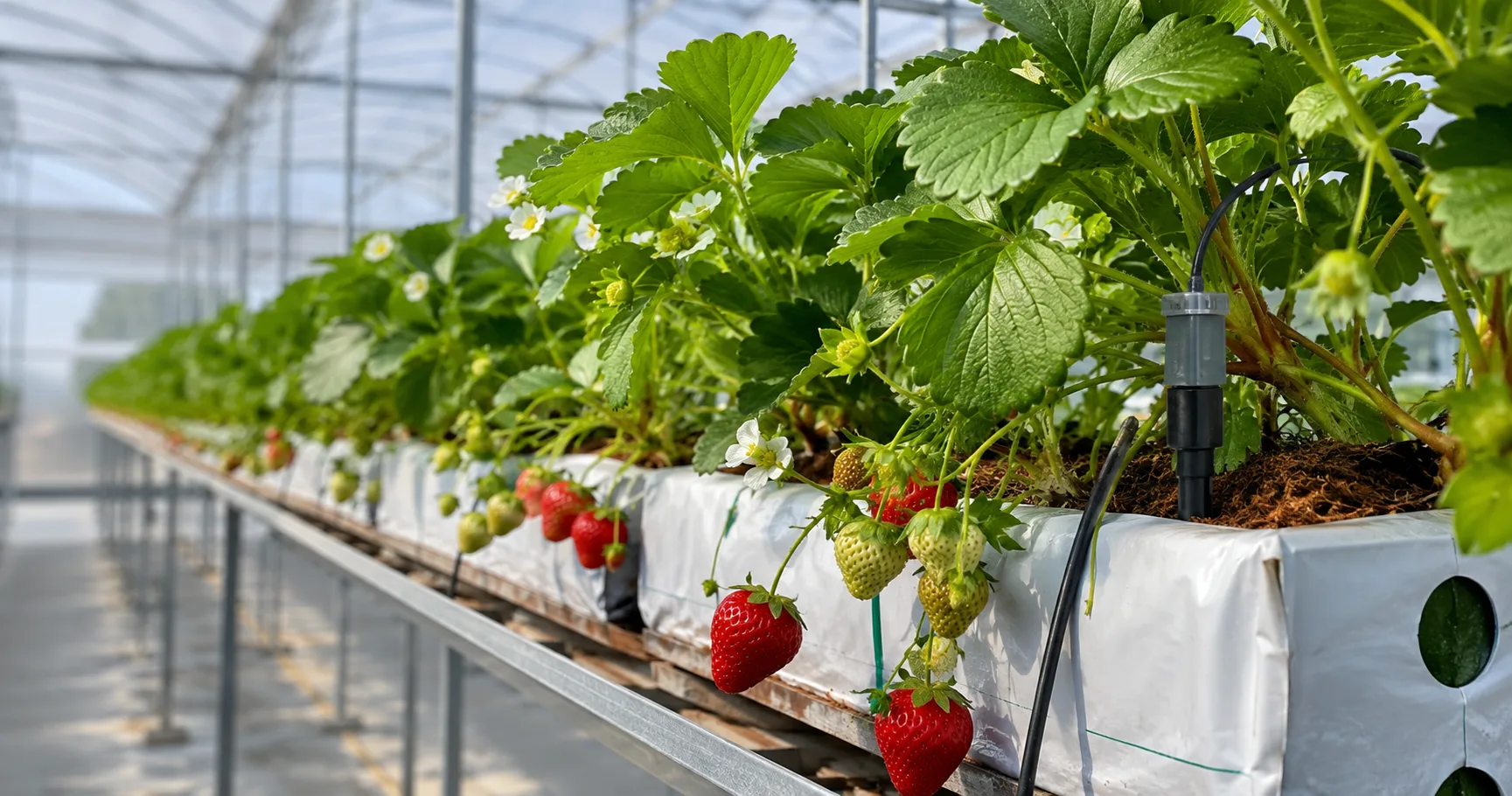
Substrate-grown strawberries, the tabletop systems of coir, rockwool, or peat slabs that have become standard in protected cultivation, are effectively hydroponic crops with a strawberry on top. The substrate holds the roots, but it does very little buffering. Almost everything the plant experiences comes from the fertigation solution you deliver and the greenhouse climate around it. That is a double-edged situation: you have precise control, and you have very little margin when something drifts.
The growers who do well with substrate strawberries are the ones who treat it as a measurement problem. The substrate does not hide your mistakes the way field soil does, so the feedback loop between what you feed and what the plant gets is short and unforgiving. Get the sensing right and that same short loop becomes your biggest advantage: you see problems within a single irrigation cycle instead of a week later.
The measurement that runs a substrate crop: feed versus drain
In substrate culture, the single most important routine measurement is the comparison between the solution you feed and the solution that drains out.
- Feed EC and pH are what you apply at the dripper. They tell you what is going in.
- Drain EC and pH are measured in the runoff leaving the slab or pot. They tell you what is actually building up around the roots.
The gap between the two is the signal. When drain EC sits close to feed EC, your salt balance is healthy. When drain EC climbs well above feed EC, salts are accumulating in the substrate faster than they are leaching out, and the crop is heading toward salinity stress and reduced uptake. The correction (increase the leaching fraction, or adjust the feed) is straightforward once you can see the gap. The same logic applies to pH: comparing feed pH to drain pH shows how the substrate is shifting your solution, so you can hold the root zone in range.
This is why “the best substrate sensor” is really a small system rather than a single probe. You are measuring a relationship, not a spot value.
What to monitor, and with what
Feed and drain EC
EC (electrical conductivity) is your proxy for nutrient concentration and salinity. Put EC monitoring on both the feed line and the drain:
- The EC-100 digital conductivity probe (RS485) for continuous inline measurement, with multiple probes on one bus so feed and drain report to the same controller.
- The analog EC-10 conductivity probe for a simpler single-point install.
Choosing an EC probe for a fertigation loop is covered in our EC probe selection guide.
Feed and drain pH
pH governs nutrient availability. Even a well-mixed feed can arrive at the roots shifted if the substrate and water chemistry push it around:
- The PH-110 industrial pH probe for continuous inline monitoring in irrigation lines, or the PH-100 digital pH probe on an RS485 bus.
- The PH-10 in-line pH probe for an analog setup.
Greenhouse climate
Climate is the context that explains your fertigation numbers. Temperature and humidity drive transpiration, which drives how much water and nutrient the plants pull and how fast the substrate concentrates:
- The THS-100 RS485 temperature and humidity sensor, built for greenhouse conditions and easy to run on the same bus as your EC and pH probes.
- The SHT30 temperature and humidity sensor as a compact alternative.
For the wider climate-control picture in protected crops, see our greenhouse temperature and climate control guide.
Moisture: an honest note
Water content inside a rockwool or coir slab is normally managed through irrigation scheduling and by watching drain volume and drain EC, not through a soil moisture sensor, because tension and volumetric soil sensors are designed for soil rather than soilless media. Agrinovo sensors measure the feed and drain solution and the greenhouse climate, which are the actionable levers in substrate culture. We do not make an in-slab water-content probe and will not present one. If your strawberries are grown in soil or raised beds rather than substrate, then a tension sensor such as the Watermark 200SS does apply and reads how hard roots work for water.
Bringing it together
These probes connect to an Omni Genesis controller, which reports to a cloud dashboard over cellular. For a substrate strawberry operation that means:
- Feed and drain EC and pH side by side, so the feed-to-drain gap that governs the crop is visible continuously rather than sampled by hand.
- Climate in the same view, so when drain EC jumps you can see whether a hot, dry stretch drove it, and respond correctly instead of guessing.
- Alerts when drain EC pulls away from feed EC or pH drifts out of range, so you adjust leaching or feed before the plants show stress.
- A season-long record tying your fertigation and climate management to actual crop performance.
Because a strawberry greenhouse has feed, drain, and climate to watch at once, the Omni Exodus controller is often the better fit, handling more sensors per unit. The hardware is modular, so any sensor of any type connects to the Genesis controllers and a station can grow as you add benches or zones. This is the precision agriculture approach applied to protected, substrate-grown fruit.
Practical notes
Measure the gap, not just the feed. It is tempting to trust your mixing tank. The drain is where you learn what the roots actually received.
Read climate and fertigation together. A drain EC spike on a hot afternoon and the same spike on a mild morning mean different things. Context prevents overcorrection.
Sample the drain representatively. Collect drain from a consistent, representative slab or pot, not the one nearest the door or the driest corner, or your numbers will mislead you.
Substrate has little buffer. That is the whole point of the system and the whole risk. Short irrigation intervals and continuous monitoring go together; you cannot run tight fertigation blind.
Conclusion
Substrate strawberries give you fine control over the crop in exchange for demanding that you actually measure what you are doing. The feed-to-drain relationship, EC and pH going in versus coming out, is the core of the whole system, and greenhouse climate is the context that makes those numbers interpretable. Monitor both continuously and you convert a low-margin, unforgiving system into a precise and repeatable one.
Start with feed and drain EC and pH plus greenhouse climate, and connect them through a precision agriculture platform so the feed-to-drain gap reaches you in time to act. Our hydroponic nutrient monitoring guide goes deeper on EC and pH in soilless systems, and the soil sensors guide explains how each measurement fits into a complete monitoring setup.