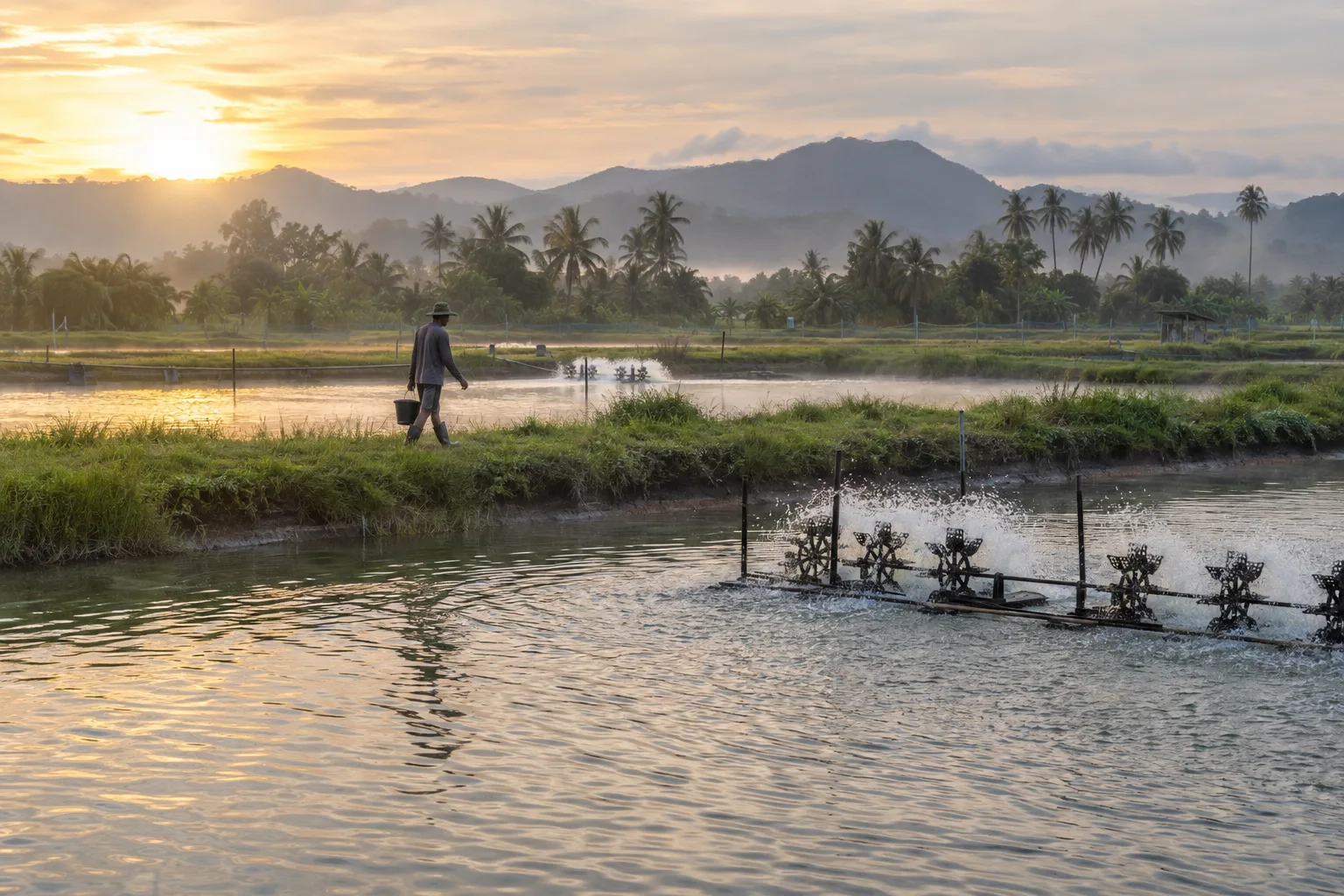
Tilapia are the workhorse of global aquaculture: hardy, fast-growing, and farmed in ponds, cages, and tanks across Latin America, Africa, and Asia. That hardiness is also a trap, because it makes it easy to under-invest in monitoring until an intensive pond crashes overnight. A tilapia water quality monitoring system gives you the early warning: sensors in the water, a controller that reads them, and an alert that reaches you before a problem becomes a die-off.
This page covers what to measure, which sensors to use, where to place them, and how to scale across a farm. For the broader picture across species, see our aquaculture monitoring buyer’s guide.
Why hardy fish still die
Tilapia earned their reputation by surviving conditions that would kill more delicate species. They tolerate a wide temperature band, handle marginal water quality, and keep feeding when other fish stop. The problem is that this resilience hides risk rather than removing it, and it tempts operators to push stocking density and feed rates right up to the edge, where the cushion that hardiness provides has already been spent.
Two situations still kill tilapia regardless of how tough they are. The first is the overnight oxygen crash. In a densely stocked pond, the algae that produce oxygen by day consume it at night, and after a cloudy day or an algae die-off the pre-dawn low can fall below what even a tilapia can survive. Hardiness buys you a wider margin before that point, but at high density you have already traded that margin away for yield. The second is ammonia. Heavy feeding loads the water with nitrogen, and the share of that ammonia in its toxic un-ionized form rises as pH and temperature climb, so a warm afternoon with a high pH and a heavy feed is exactly when even a hardy fish is under chemical stress.
Cold is the third killer, and it is the one operators outside the tropics underestimate most. Tilapia are a warm-water fish, so as water cools their feeding slows, their immune response weakens, and below a certain point survival itself is at stake. In regions with a real winter or in seasonal ponds, a cold snap can do as much damage as an oxygen crash, and it builds over days rather than hours. Watching the temperature trend gives you time to move fish, adjust feeding, or add heat before a slow decline becomes a loss, which is exactly the kind of gradual risk a once-a-day spot check tends to miss.
The lesson is not that tilapia are fragile. It is that the more you push their hardiness for production, the more you need to see the few moments that overrun it, because by the time hardy fish show distress, the situation is already severe.
What to monitor on a tilapia farm
Tilapia tolerate a wide range, so the goal is not tight control of every value; it is catching the few situations that actually kill a crop.
- Dissolved oxygen (DO). The priority by a wide margin. Even hardy fish suffocate when the night-time oxygen cycle bottoms out in a dense pond, particularly after cloudy days or an algae crash. This is the sensor you monitor continuously and alarm on first.
- Temperature. Drives growth, feeding, and oxygen demand, and tilapia are notably sensitive to cold, with feeding and immunity falling as the water cools. Temperature and oxygen also work against each other, since warm water holds less oxygen while raising the fish’s demand for it.
- pH. Shifts with algae activity through the day and changes how toxic the ammonia present actually is, which is why it is read alongside ammonia rather than on its own.
- Ammonia. Rises with heavy feeding and becomes more toxic as pH climbs. On intensive ponds, tracking it continuously turns a slow buildup into something you see coming.
- ORP and salinity. For intensive, cage, and biofloc systems, where feed loading is higher and water exchange is more limited.
Choosing the sensors
Warm, biologically active pond water fouls probes quickly, so choose sensors for stability and low maintenance as much as for accuracy.
- Dissolved oxygen: an optical probe such as the DO-100, which is stable and low-maintenance, or the self-cleaning DO-130 where algae and biofouling are heavy. Our DO sensor selection guide walks through the choice.
- pH: the PH-100 with automatic temperature compensation, so the reading holds as the pond heats and cools through the day.
- Ammonia: the NH4-100 ammonium ion-selective electrode for intensive and biofloc systems.
- Salinity (EC): the EC-100 for low-salinity and brackish culture, where tilapia are increasingly grown.
The system is modular, so you start with dissolved oxygen and temperature and add probes as the farm intensifies, without replacing the controller.
Where to place the sensors
Placement decides whether your reading reflects the fish or just the surface. Put the dissolved oxygen probe where oxygen bottoms out: lower in the water column, in the aerator influence zone, with more than one point in large or irregular ponds so a dead spot does not go unseen. In cage culture, measure inside the stocked volume at the depth the fish hold, because the wider water body buffers more slowly than the crowded cage interior.
Keep every probe accessible so you can lift it for cleaning without wading in, because biofouling, not electronics, is the main cause of drift in warm pond water. A probe you can service in seconds gets serviced; one that requires a boat does not. On cages, mount the probe to the cage frame so it stays at a fixed depth as the water moves, rather than letting it swing free where the reading drifts with the current. If the digital versus analog wiring choice is unfamiliar, our sensor protocols explainer covers why a shared digital bus keeps a multi-sensor unit simple.
Turning readings into alerts that reach you in time
Continuous data only matters if it reaches you while you can still act. The alarm, not the dashboard, is the product. A low-DO warning with overnight escalation is what protects the crop, covering the same pre-dawn risk window described in our guide on preventing overnight fish kills. The escalation should reach a second person if the first does not respond, because a single missed notification should never be the failure point.
Set ammonia and pH alerts as feeding intensifies, with the response detail in our ammonia spike guide. Trends matter as much as thresholds: a DO reading still inside the safe band but sliding for hours tells you tonight will be tight, which is something you can act on in daylight rather than in a 4 AM scramble.
Connectivity and power in the field
Tilapia ponds and cages sit on open water, away from buildings and reliable power, so the link to the cloud has to assume neither is nearby. Each pond or cage cluster gets a controller that reports over cellular, the proven default for open-water sites. The Omni Genesis controller is outdoor-rated, solar and battery powered so an outage does not blind you, and reads the digital probes above on a single RS485 bus. Cellular is the connectivity you deploy today; the controller’s modular design is LoRaWAN-ready as a future option for very large sites without coverage, not a default.
Scaling across the farm
A single unit is a starting point, not the goal. Every controller feeds one cloud dashboard, so you watch all of your ponds and cages at once, compare oxygen and consumption trends side by side, and receive consolidated alerts instead of juggling a gadget per unit. Seeing the whole farm together surfaces the patterns one unit hides: the pond that always runs lowest on oxygen, the cage that swings hardest on pH. That is the same aquaculture monitoring solution we deploy for shrimp and recirculating systems. If you run a recirculating tilapia operation, see our RAS monitoring system page; for shrimp, see the shrimp farm monitoring system page.
What monitoring does and does not replace
Monitoring is the early-warning layer, not the whole operation. It will not feed the fish, fix an undersized aeration system, or manage your pond water for you, and it should not be sold as if it does. What it does is remove the blind spot between farm visits, turn “the fish look fine” into a trend you can see, and give you the minutes that decide whether a crash becomes a loss. For the economics laid out plainly, our piece on manual versus automated water testing compares the two approaches without the sales gloss.
A phased rollout that pays its way
Most tilapia farms start with dissolved oxygen and temperature on the densest ponds, where a single prevented crash justifies the install, then add pH and ammonia as stocking and feed rates climb. Because the system is modular, you scale unit by unit and the hardware you buy first keeps working as you grow. To size a system for your ponds, cages, or tanks, contact our team for a configuration matched to your operation.