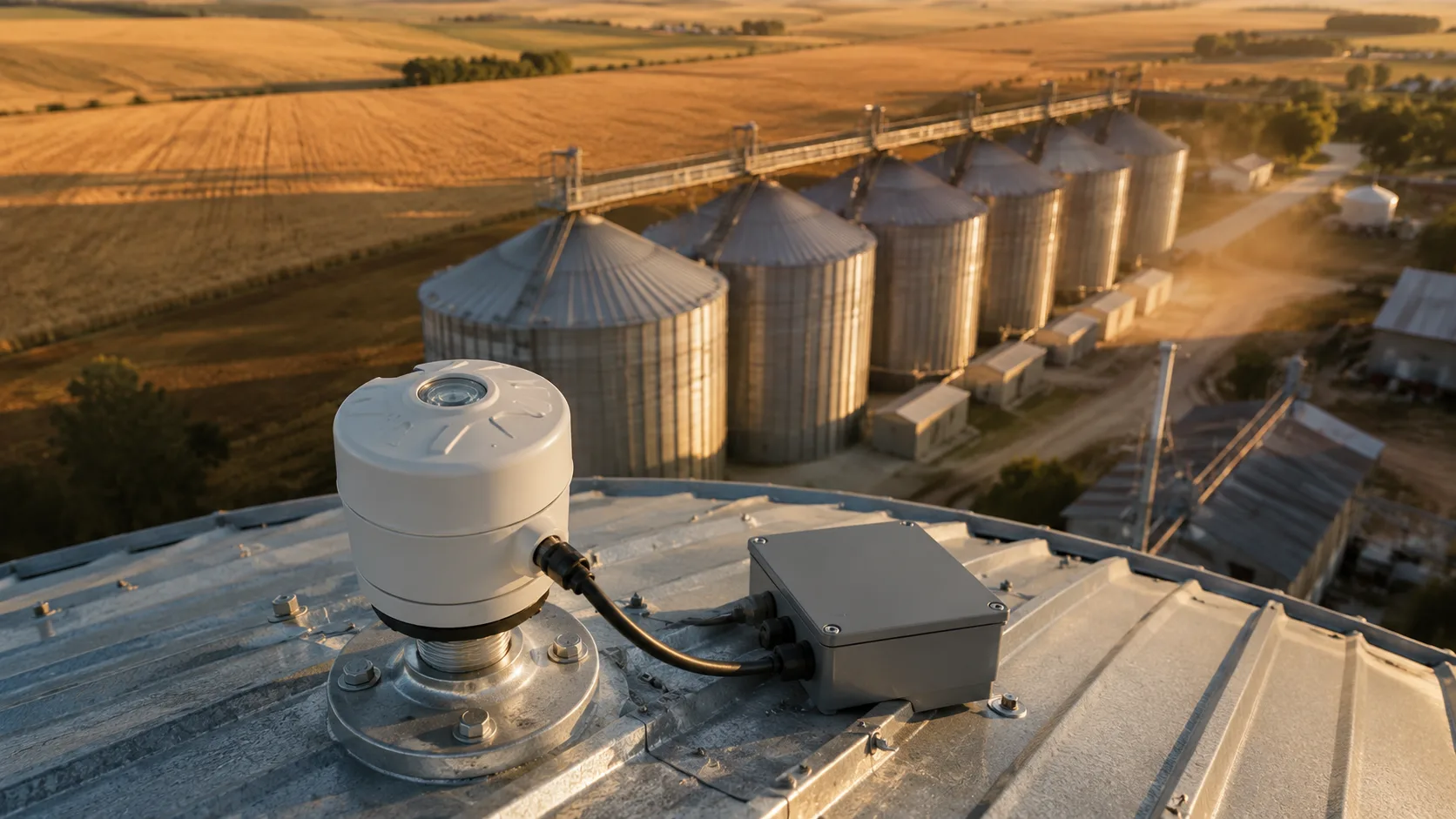
Grain is one of the harder materials to measure the level of, which surprises people who assume a bin of wheat is simpler than a tank of chemicals. The surface is never flat, the air is full of dust exactly when you most want a reading, and the bins themselves are often tall, narrow, and far from power and network. A grain silo level sensor has to be chosen around those specific problems, not around a generic spec sheet.
This guide covers the selection decision for grain: why the material defeats some sensor technologies, what to look for in a radar unit, and how single-bin measurements become site-wide inventory. If you are still comparing sensor families from scratch, our silo level monitoring overview covers radar, ultrasonic, load cells and capacitive side by side, and our load cells vs radar comparison goes deep on the weighing option.
What makes grain difficult
The surface is a cone, not a plane. Grain piles at its angle of repose: filling builds a peak under the inlet, discharge pulls a crater over the outlet. Any sensor measuring one point on that surface is sampling a shape, so where the beam lands matters, and a wide beam that averages walls, peak and crater produces numbers that wander.
Dust arrives with every fill. Auger and pneumatic filling raise a dust cloud that can hang in the headspace for hours. Sound-based sensors lose their echo in it; the practical result with ultrasonic units is a sensor that goes blind during and after every delivery, which is precisely when you want to confirm how much arrived.
Moisture means bridging and crusting. Grain stored at the wrong moisture can crust at the surface or bridge over the outlet, leaving voids no top-mounted sensor of any kind can see. A level sensor will not detect a bridge; what it does is make the symptom visible early, when discharge is running but the level refuses to fall.
Bins are tall, narrow and remote. Farm and elevator bins combine depth with small diameters, which demands a narrow measurement beam, and they rarely offer power or connectivity, which shapes the whole system design.
Radar, ultrasonic or load cells for grain
For continuous grain measurement the practical shortlist is 80 GHz radar, ultrasonic, or weighing the silo on load cells. Ultrasonic units are workable in temperature-stable, low-dust installations, but grain bins are neither, and dust blindness during filling is a structural weakness rather than a tuning issue. Load cells measure true weight, which is their real advantage, but installing them under an existing bin generally means lifting the structure, and most grain operations want inventory data rather than legal-for-trade weight. The full comparison covers when weighing is worth it; for a typical grain bin, a top-mounted radar through a roof port wins on installation alone.
What to look for in a grain radar
- 80 GHz FMCW with a narrow beam. The RLM-120 radar level sensor measures at 76 to 81 GHz with a 3 degree beam (an 8 degree variant exists for shorter, wider vessels). In a tall narrow bin, the narrow beam reads the grain surface without wall echoes from ladders, seams or the fill stream.
- Range that matches the bin, not the brochure. The RLM-120 comes in 15 m, 35 m, 85 m and 120 m variants; a farm bin usually needs the smallest, an elevator or port silo the larger ones. Oversizing range buys nothing.
- Accuracy for inventory, not just alarms. Millimeter-class accuracy (±1 mm on the RLM-120) turns a level reading into usable stock volume, tight enough to see daily consumption on a feed or seed bin rather than just full-versus-empty.
- Non-contact, no recalibration. The sensor never touches the grain, has no moving parts, and FMCW radar does not drift with temperature, humidity or dust conditions, which matters on bins that bake in the day and cool at night.
- Both output types. The RLM-120 provides RS485 Modbus RTU and 4-20 mA, so it drops into an IoT controller, a PLC, or an existing panel without an adapter in between.
From one bin to site inventory
A single reading answers “how full is this bin”. The commercial value shows up when every bin reports to one place:
- Sensors connect to an Omni Genesis controller over RS485 Modbus, with four modular sensor ports per controller so neighboring bins share one unit.
- The controller transmits over cellular (4G LTE), so a bin site needs no network, and runs on batteries with solar charging, so it needs no mains power either. Remote bin clusters become monitorable exactly as they stand.
- The cloud dashboard holds every bin side by side: current level, fill and consumption trends, and low-stock alerts that turn ordering from a climb-and-look ritual into a threshold event.
For the complete deployment architecture, see our silo monitoring solution page.
Installation notes for grain bins
Mount away from the fill stream. A sensor directly under the filling point reads the incoming grain column, not the surface. Offset the roof port so the beam lands between the center peak and the wall.
Mind the cone in your math. Because the surface is a cone, level-to-volume conversion is an approximation. Keep the measurement point consistent and calibrate the volume curve against a known delivery once; after that, trends and deltas are dependable.
Use the beam angle you paid for. A 3 degree beam is only about 0.5 m wide at a depth of 10 m. Aim it through a clean nozzle without internal weld seams or edges in view.
Watch for the level that refuses to drop. Discharge running with a flat level trace is the classic bridging signature. Treat it as an operational alert, not a sensor fault.
Conclusion
Grain punishes the wrong sensor choice with blind spots at filling time and wandering readings the rest of the year. An 80 GHz narrow-beam radar such as the RLM-120, mounted through a roof port and reporting through an Omni Genesis controller over cellular, turns each bin into a live inventory line with no site network and no structural work. See the system view on our silo monitoring solution page, compare the alternatives in the silo sensor overview and the load cells vs radar comparison, or contact us to size the right variant for your bins.