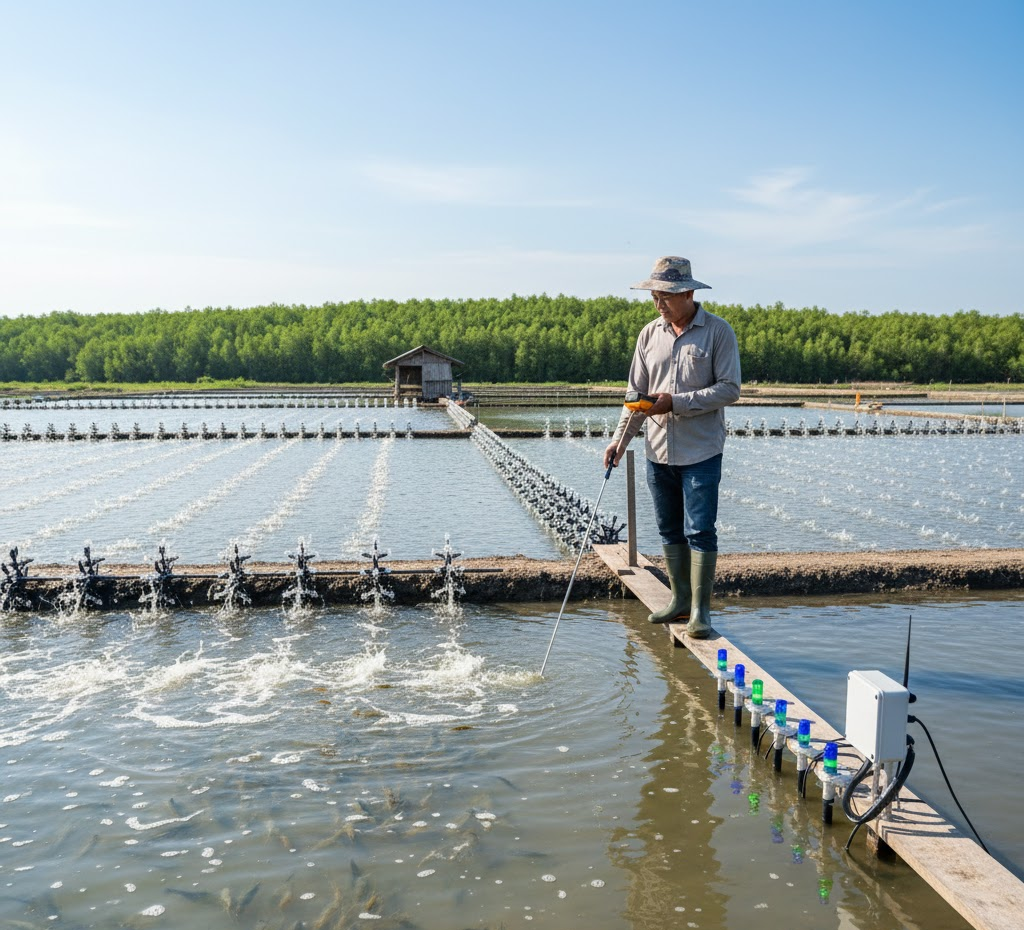
A single pond of vannamei shrimp, stocked at 150 per square meter in a well-managed intensive system, can be worth $30,000 to $50,000 at harvest. That same pond can go to zero in 48 hours if water quality falls apart. We have watched it happen. A farmer outside Chanthaburi, Thailand, lost three hectares of P. monodon in 2023 to an early morning dissolved oxygen crash that nobody caught because their monitoring was a guy with a handheld meter who showed up at 7 AM. By then, the shrimp had been suffocating since 2 AM.
Shrimp are not fish. They are benthic animals living at the bottom of the water column where oxygen is lowest, ammonia is highest, and problems hit first. They cannot swim to the surface to gulp air. When conditions deteriorate, shrimp simply die on the pond bottom, and by the time you see them floating, you have already lost most of the crop.
The global shrimp farming industry produces over 6 million metric tons annually, dominated by two species: Litopenaeus vannamei (Pacific white shrimp) and Penaeus monodon (black tiger shrimp). Both are vulnerable to Early Mortality Syndrome (EMS/AHPND), White Spot Syndrome Virus (WSSV), and a host of bacterial diseases that are directly linked to poor water quality. The farms that survive and profit are the ones that monitor continuously and respond before thresholds are breached.
This guide covers the specific water quality parameters for both species, the sensor configurations that actually work in shrimp pond environments, and the monitoring strategies for traditional pond culture, inland low-salinity farming, and biofloc systems. If you are new to aquaculture monitoring in general, start with our aquaculture water quality guide and come back here for shrimp-specific detail.
Understanding Your Species: Vannamei vs Monodon
Before you buy a single sensor, you need to understand what you are farming. These two species have overlapping but meaningfully different requirements, and getting the ranges wrong costs money.
L. vannamei (Pacific White Shrimp)
Vannamei accounts for roughly 75% of global farmed shrimp production, and for good reason. This species is remarkably tolerant. It handles salinity from 0.5 ppt all the way up to 45 ppt, which is why inland freshwater vannamei farming has exploded across Asia, Latin America, and even parts of the United States. It grows fast, reaching 20-25 grams in 90-120 days under good conditions. It tolerates higher stocking densities than monodon. It is the workhorse of the industry.
But “tolerant” does not mean “bulletproof.” Vannamei at the edges of its salinity range grows slower and is more susceptible to disease. Optimal production happens in a much narrower band than survival allows. The farms that push stocking densities highest are the ones that need the tightest monitoring, because the margin between optimal conditions and catastrophic conditions shrinks as biomass increases.
P. monodon (Black Tiger Shrimp)
Monodon is the prestige species. It grows larger (up to 100+ grams), commands premium prices, and dominates traditional extensive and semi-intensive pond culture across Southeast Asia, India, and parts of Africa. But it is more demanding. Monodon prefers higher salinity (15-25 ppt optimal), is less tolerant of ammonia and nitrite, and is more susceptible to stress-induced disease.
Monodon farms tend to run at lower stocking densities (20-40 per square meter for semi-intensive), but the value per animal is higher. Losing a pond of large monodon hurts more per head than losing vannamei.
Why This Matters for Monitoring
The practical difference is that vannamei gives you slightly more room for error on salinity and temperature, but monodon demands tighter control on nitrogen compounds (ammonia and nitrite). Both species require continuous dissolved oxygen monitoring without exception. The parameter ranges we will cover below reflect these species-level differences, and your alert thresholds should be set accordingly.
The 6 Critical Parameters for Shrimp
Dissolved Oxygen
Dissolved oxygen is the parameter that kills shrimp fastest and most reliably. Everything else on this list matters, but DO is the one that turns a profitable pond into a mass mortality event in hours.
Species-specific requirements:
- L. vannamei: Minimum 4 mg/L for survival, optimal range 5-8 mg/L. Growth slows measurably below 4.5 mg/L. At 3 mg/L, shrimp stop eating and congregate at pond edges.
- P. monodon: Minimum 4 mg/L, optimal range 5-7 mg/L. Monodon is slightly less tolerant of DO fluctuations. Sustained levels below 4.5 mg/L increase Vibrio susceptibility significantly.
The 3 AM problem: Shrimp ponds have a predictable DO cycle. During the day, phytoplankton produce oxygen through photosynthesis, and DO climbs to 7-10 mg/L by late afternoon. At night, photosynthesis stops but respiration continues, from the phytoplankton, from bacteria decomposing organic matter on the pond bottom, and from the shrimp themselves. DO drops steadily after sunset and hits its minimum between 2 AM and 5 AM.
This is when shrimp die. Not during the day when someone is watching. At 3 AM, when everyone is asleep. If your only DO monitoring is a technician with a handheld meter during working hours, you are flying blind during the most dangerous period.
The problem compounds as culture cycles progress. Early in the cycle, shrimp biomass is low and DO stays comfortable overnight. By week 8-10 of a grow-out, you have 10-15 tons of shrimp per hectare consuming oxygen, plus all the accumulated organic matter from weeks of feeding. The overnight DO drop gets steeper and deeper as the cycle progresses. This is exactly when a crop loss costs the most.
Sensor selection: For brackish water shrimp ponds (5-25 ppt salinity), the DO-100 does the job well. It is built with 316L stainless steel, covers 0-20 mg/L, and carries a 1-year warranty. For full marine conditions or high-salinity operations above 25-30 ppt, the DO-110 titanium sensor is the right choice. Its titanium construction handles up to 60 ppt salinity without the corrosion issues that destroy stainless steel sensors in marine environments. Monodon farms operating at 20-30 ppt should seriously consider the DO-110 for longevity alone.
Set alerts at 4.5 mg/L for vannamei, 5.0 mg/L for monodon. That gives you a response window before you hit critical thresholds.
pH and Alkalinity
pH in shrimp ponds follows a daily cycle driven by the same photosynthesis-respiration dynamics that affect DO. During the day, phytoplankton consume CO2, which reduces carbonic acid and pushes pH up. At night, CO2 accumulates from respiration and pH drops. A daily swing of 0.3-0.5 pH units is normal and acceptable. Swings greater than 1.0 unit per day indicate serious buffering problems.
Species-specific ranges:
- L. vannamei: Optimal pH 7.5-8.5. Can tolerate 7.0-9.0 short-term. Vannamei is relatively forgiving on pH as long as ammonia levels are controlled.
- P. monodon: Optimal pH 7.8-8.5. Monodon prefers the upper end of the range and is less tolerant of low pH conditions. Below 7.5, monodon shows stress behavior and reduced feeding.
Alkalinity is the buffer: Total alkalinity (as CaCO3) should be maintained at 80-150 mg/L for both species. Low alkalinity means the pond has no buffering capacity, and pH will swing wildly with the day-night cycle. When alkalinity drops below 80 mg/L, pH swings become dangerous. Add agricultural lime (CaCO3) or sodium bicarbonate to maintain alkalinity. If your pH sensor data shows increasing daily swings even though absolute values seem acceptable, check alkalinity immediately.
For continuous pH monitoring, the PH-100 digital probe provides the accuracy you need with its +/-0.01 pH precision. Calibrate monthly, clean biweekly. pH electrodes in warm shrimp ponds foul faster than in cooler systems.
Salinity (Electrical Conductivity)
Salinity is managed through electrical conductivity (EC) sensors, and this is where species choice dramatically changes your sensor requirements.
Why EC, not refractometers? A refractometer gives you a snapshot in time that requires someone to physically take a sample, add it to the instrument, and read it. An EC sensor gives you continuous data, logged every few minutes, with alerts when salinity shifts suddenly. After a heavy rain, salinity in a coastal shrimp pond can drop 3-5 ppt in hours. A refractometer tells you about it the next morning. An EC sensor tells you while it is happening, giving you time to add brine or close water inlets.
Species-specific ranges:
- L. vannamei: Survives 0.5-45 ppt. Optimal for growth is 15-30 ppt. Inland low-salinity farming operates successfully at 2-10 ppt, though growth is 10-15% slower than at optimal salinity. Key mineral ratios (Na:K, Ca:Mg) become critical at low salinity.
- P. monodon: Survives 5-35 ppt. Optimal 15-25 ppt. Less adaptable to low salinity than vannamei. Monodon does not perform well below 10 ppt and should not be attempted at freshwater salinities.
Sensor selection based on your operation:
- Inland/low-salinity vannamei (0-10 ppt): The EC-100 with K=1.0 handles up to 20 mS/cm, which covers the low-salinity range comfortably.
- Brackish ponds (10-30 ppt): The EC-120 with K=0.45 handles up to 500 mS/cm, giving you headroom for the full brackish-to-marine range.
- Full marine or high-salinity (>30 ppt): The EC-J100 with four fluorine plus titanium construction and K=10 is purpose-built for marine environments where corrosion destroys lesser sensors.
Temperature
Temperature controls everything in shrimp farming. It determines metabolic rate, oxygen consumption, ammonia toxicity, and disease susceptibility. You do not need a separate temperature sensor because the DO and pH probes include temperature measurement, but you need to watch the data carefully.
Species-specific ranges:
- L. vannamei: Optimal 28-32 degrees C. Growth slows significantly below 25 degrees C and above 33 degrees C. Mortality risk increases above 35 degrees C.
- P. monodon: Optimal 28-33 degrees C. Slightly more heat-tolerant than vannamei but less cold-tolerant. Below 20 degrees C, monodon stops feeding entirely.
Temperature and ammonia: This interaction is critical and often overlooked. At 20 degrees C and pH 8.0, about 2.9% of total ammonia is in the toxic NH3 form. At 30 degrees C and the same pH, that jumps to 5.6%. At 35 degrees C, it is 7.5%. Warmer water makes the same ammonia concentration nearly three times as toxic. If your ponds run hot during summer months, your ammonia alert thresholds need to be tighter.
Temperature and DO: Warm water holds less dissolved oxygen. At 30 degrees C and 20 ppt salinity, DO saturation is approximately 7.1 mg/L. That means even with perfect aeration, you cannot get above 7.1 mg/L. With 15 tons of shrimp consuming oxygen, the gap between saturation and your minimum threshold shrinks to almost nothing. This is why late-cycle summer ponds are the highest-risk scenario in shrimp farming.
Ammonia (Total Ammonia Nitrogen)
Ammonia is the metabolic waste product that accumulates relentlessly in shrimp ponds. Shrimp excrete it, uneaten feed decomposes into it, and bacteria in the pond bottom produce it. Your biofilter or phytoplankton must convert it to nitrite and then nitrate fast enough to keep up with production.
The NH3/NH4+ equilibrium: Total ammonia nitrogen (TAN) exists as a mixture of toxic unionized ammonia (NH3) and relatively non-toxic ammonium (NH4+). The ratio between them is controlled by pH and temperature. Higher pH and higher temperature push the equilibrium toward toxic NH3. This is why ammonia, pH, and temperature are inseparable parameters. You cannot interpret ammonia without knowing pH and temperature.
Species-specific limits:
- L. vannamei: TAN below 0.1 mg/L ideal. Chronic stress begins at 0.5 mg/L TAN at typical pond pH of 8.0. Lethal concentrations depend heavily on pH and temperature but generally 2-3 mg/L TAN at pH 8.0 causes mortalities within 96 hours.
- P. monodon: More sensitive. TAN below 0.1 mg/L is the target. Monodon shows stress at lower concentrations than vannamei, and sublethal ammonia exposure significantly increases susceptibility to WSSV and Vibrio infections.
Monitoring approach: For continuous ammonia monitoring, you have two options depending on what form you want to measure directly. The NH4-100 ammonium sensor measures the ammonium ion (NH4+) across a range of 0.1-18,000 mg/L. The NH3-100 ammonia sensor measures unionized ammonia (NH3) directly from 0.05-1,400 mg/L, which gives you the toxic fraction without calculation. For shrimp farming, measuring NH3 directly is arguably more useful since that is the form that kills, but measuring NH4+ and calculating NH3 from pH and temperature data also works.
Nitrite
Nitrite is the intermediate product of nitrification, where ammonia-oxidizing bacteria convert ammonia to nitrite, and then nitrite-oxidizing bacteria convert nitrite to nitrate. When this two-step process gets out of balance, typically because the second step is slower than the first, nitrite accumulates.
Brown blood disease: Nitrite binds to hemocyanin (the oxygen-carrying molecule in shrimp blood, analogous to hemoglobin in fish) and forms methemocyanin, which cannot carry oxygen. Shrimp with nitrite poisoning effectively suffocate even when DO levels are adequate. You will see shrimp at the surface, gasping, with brown-colored gills. By the time you observe this, you have already lost production.
Species-specific limits:
- L. vannamei: Nitrite below 1.0 mg/L. Vannamei is relatively tolerant of nitrite compared to monodon, especially at higher salinities where chloride ions competitively inhibit nitrite uptake across the gills.
- P. monodon: Nitrite below 0.5 mg/L. Monodon is significantly more sensitive. In low-salinity environments, even 0.3 mg/L can cause chronic stress.
Chloride-to-nitrite ratio: This is a management tool that experienced shrimp farmers use. Chloride (from salt) competes with nitrite for uptake across gill membranes. In marine or high-salinity ponds, there is enough chloride to provide natural protection. In low-salinity inland ponds, there is not. Maintaining a chloride-to-nitrite ratio of at least 20:1 provides significant protection. This is one reason low-salinity vannamei farming requires more careful nitrite monitoring than coastal operations.
Nitrite spikes during biofilter maturation: If you are running a system with a biofilter (recirculating aquaculture system or intensive BFT), expect a nitrite spike during the first 3-6 weeks as nitrifying bacteria establish. This is the most dangerous period. The NO2-100 nitrite sensor provides continuous monitoring during this critical maturation phase. Once the biofilter is mature and stable, nitrite typically stays near zero, and continuous monitoring becomes more about catching upsets than routine tracking.
Biofloc Technology (BFT) Monitoring
Biofloc is the fastest-growing intensive shrimp culture method globally, and it demands more monitoring than any other approach. If you are running or considering biofloc, this section is essential.
What Biofloc Is and Why It Changes Everything
Biofloc technology works by cultivating dense communities of bacteria, microalgae, fungi, and detritus into flocculated particles (flocs) that serve dual purposes: they consume ammonia and other nitrogen waste, and they provide supplemental feed for the shrimp. The system operates with zero or near-zero water exchange, which eliminates disease introduction from incoming water, reduces environmental impact, and allows inland operations without large water sources.
The tradeoff is that everything accumulates. There is no flushing away problems with water exchange. Every gram of feed, every milligram of ammonia, every shift in microbial community composition stays in the system. Monitoring is not optional in biofloc. It is the management system.
DO in Biofloc: The Critical Constraint
Biofloc systems have dramatically higher oxygen demand than conventional ponds because the microbial community itself consumes enormous amounts of oxygen. In a conventional pond, shrimp and phytoplankton are the primary oxygen consumers. In biofloc, add the entire heterotrophic bacterial community.
Practical DO requirements in biofloc are 5 mg/L minimum, with a target of 6-7 mg/L. Below 5 mg/L, the microbial community shifts toward less desirable species, floc settles poorly, and ammonia processing slows. Below 4 mg/L, you get simultaneous shrimp stress and biofilter collapse, which is the worst possible combination.
Aeration in biofloc systems runs 24 hours a day with no exceptions. Backup power is not a luxury; it is infrastructure. Your DO sensor needs to log continuously and alert before you reach 5 mg/L, not after. A DO-100 or DO-110 on every tank is baseline.
Why Chlorophyll Monitoring Matters in Biofloc
Biofloc systems exist on a spectrum between heterotrophic biofloc (bacteria-dominated, driven by carbon addition) and autotrophic biofloc (algae-dominated, driven by light). Most practical systems are a mix. Monitoring chlorophyll-a gives you a window into the balance between these two communities.
Rising chlorophyll indicates increasing algal dominance. This is not necessarily bad, but algal-dominated biofloc produces more dramatic DO swings (high during the day from photosynthesis, low at night). Declining chlorophyll in an outdoor system might indicate shading from excessive floc density, or a crash in the algal community that can trigger sudden ammonia spikes.
The CHL-100 chlorophyll sensor covers 0-500 micrograms per liter with a self-cleaning mechanism, which is critical in biofloc where sensor fouling is a constant battle. Tracking chlorophyll trends alongside DO and ammonia gives you early warning of community shifts before they become problems.
Biofloc-Specific Parameter Targets
| Parameter | Biofloc Target | Notes |
|---|---|---|
| DO | >5 mg/L, target 6-7 | Higher than conventional due to microbial demand |
| pH | 7.0-8.0 | Tends to drop from nitrification; needs alkalinity management |
| Alkalinity | >120 mg/L CaCO3 | Critical buffer; biofloc consumes alkalinity faster |
| TAN | <1.0 mg/L | Biofloc processes ammonia, but monitor for upsets |
| Nitrite | <1.0 mg/L | Watch during startup and after carbon source changes |
| Floc volume | 10-15 mL/L (Imhoff cone) | Manual test, but correlates with sensor data |
| TSS | 300-500 mg/L | Total suspended solids; turbidity sensor can approximate |
Freshwater and Low-Salinity Shrimp Farm Setup
Inland vannamei farming is one of the fastest-growing segments of the shrimp industry. Farmers hundreds of kilometers from the coast are successfully producing vannamei at salinities of 2-10 ppt, using well water supplemented with sea salt or mineral mixes. It works, but the monitoring requirements are different from coastal operations.
The Challenges of Low Salinity
At low salinities, vannamei faces three additional challenges. First, mineral ratios become critical. The Na:K ratio should be maintained around 28:1 and Ca:Mg around 3:1 for optimal growth and survival. These ratios are naturally present in seawater but must be actively managed in low-salinity systems. Second, the protective effect of chloride against nitrite toxicity is reduced, making nitrite monitoring more important. Third, osmoregulatory stress is higher, so any additional stressor (ammonia spike, DO dip, temperature swing) has a more severe impact.
Recommended Inland Sensor Kit
For an inland low-salinity vannamei operation, here is the sensor package we would deploy on each pond or group of ponds:
- DO-100: 316L stainless steel is fine at low salinity. No need for titanium in freshwater or low-brackish environments.
- PH-100: Daily pH cycling data is essential for ammonia toxicity calculation.
- EC-100: K=1.0, handles up to 20 mS/cm. Perfectly suited for the 0-10 ppt salinity range of inland farms. Tracks salinity stability after rain events and mineral supplementation.
- ORP-100: General water quality indicator. In inland systems without the buffering capacity of seawater, ORP drops are earlier indicators of organic accumulation.
- NH4-100: Ammonium monitoring is especially important in low-salinity systems where reduced chloride makes shrimp more vulnerable to nitrogen compounds.
- Omni Exodus controller: 6 sensor ports accommodate this full suite with room for expansion. Marine-grade connectors ensure reliable connections even in humid pond-side environments.
Contact us for current pricing on the complete inland shrimp monitoring package. The investment protects a crop worth $20,000-$40,000 per pond per cycle.
Marine Shrimp Farm Setup
Coastal operations farming vannamei or monodon at full marine salinity (20-35 ppt) face different challenges: corrosion is relentless, biofouling is aggressive, and the higher salinity provides some natural buffering against certain water quality issues while introducing others.
Recommended Marine Sensor Kit
- DO-110 titanium sensor: The titanium construction is not optional at marine salinities. Stainless steel sensors in 25+ ppt saltwater degrade within 6-12 months. The DO-110 handles up to 60 ppt and lasts.
- PH-100: pH electrodes handle marine salinity without issues, but expect faster fouling rates. Clean biweekly at minimum.
- EC-J100: Four fluorine plus titanium construction with K=10 for full marine conductivity ranges. This sensor is built for the environment that destroys others.
- ORP-100: Especially useful in marine ponds where sediment sulfide production can indicate bottom degradation.
- NH3-100: Direct unionized ammonia measurement. In marine systems at pH 8.0-8.3, a larger fraction of TAN is in the toxic NH3 form, so direct measurement of the toxic fraction is particularly valuable.
- CHL-100: Algae monitoring is critical in marine ponds where Harmful Algal Blooms (HABs) can produce toxins that kill shrimp directly. Self-cleaning is essential in marine environments.
- Omni Exodus controller: All six sensor ports utilized. The marine-grade connectors on the Exodus are specifically why it is the right controller for coastal installations. The Omni Genesis with 4 ports works if you need to phase sensor deployment, but most marine operations will use all six ports.
Contact us for current pricing on the complete marine shrimp monitoring package. For a marine monodon farm producing jumbo shrimp at $15-20 per kilogram, one hectare-pond can produce $40,000-$60,000 per cycle. The monitoring system is a small fraction of one crop’s value.
Sensor Placement in Shrimp Ponds
Where you put the sensors matters as much as which sensors you buy. Shrimp ponds are not homogeneous environments. Water quality varies dramatically based on position and depth.
Thermal and Chemical Stratification
In ponds deeper than 1.2 meters, thermal stratification develops during calm, sunny days. The surface layer warms, becomes less dense, and floats on the cooler bottom layer. Oxygen transfers from the atmosphere into the surface layer but does not reach the bottom. Meanwhile, organic decomposition on the pond bottom consumes oxygen and produces ammonia and hydrogen sulfide in the lower layer. A sensor placed near the surface reads 7 mg/L DO while shrimp sitting on the bottom are at 3 mg/L.
Place DO sensors at shrimp depth, which means 10-20 centimeters above the pond bottom in grow-out ponds. That is where the shrimp live and where conditions are worst.
Center Drain Dead Zones
Most intensive shrimp ponds use center drains to remove sludge. The area around the center drain accumulates the densest organic sediment and has the worst water quality in the pond. Shrimp do not typically congregate there, but if your only sensor is near the center, you will get readings that are worse than what the shrimp are actually experiencing. Conversely, a sensor at the pond edge near an aerator will read better than average conditions.
Recommended Placement
- Primary sensor station: Mid-pond, at shrimp depth. This gives you the most representative reading.
- Secondary station (for ponds >0.5 hectare): Opposite side of the pond from the primary. Large ponds can have significant variation across their area.
- Avoid: Directly in the aerator plume (inflated DO readings) and directly at the center drain (worst-case readings that do not represent what shrimp experience).
- For biofloc tanks: Center of the tank, mid-depth. Biofloc tanks are better mixed than ponds, but dead zones still form behind baffles and in corners.
Early Warning Signs from Sensor Data
Raw numbers matter, but trends and patterns tell you what is coming before it arrives. Here are the patterns that experienced shrimp farmers watch for.
DO Dropping Below 4 mg/L Between 2-5 AM
This is the classic pre-crash pattern. If your overnight DO minimum is trending lower each night, approaching 4 mg/L, you have a narrowing safety margin. Increase aeration immediately. Do not wait for it to actually hit 3 mg/L. As grow-out progresses and shrimp biomass increases, overnight DO minimums will naturally trend downward. If the trend accelerates, something else is happening: an algae bloom crash, a dead pocket of sediment going anaerobic, or a failing aerator.
pH Swings Greater Than 1.0 Unit Per Day
This means your alkalinity is depleted and your pond has lost its buffering capacity. A pond swinging from pH 7.3 at dawn to pH 8.5 at mid-afternoon is stressing shrimp twice daily with rapid pH transitions. Add alkalinity immediately. If you are also seeing ammonia, remember that the afternoon pH peak is when ammonia toxicity is highest.
Rising Ammonia Combined With Dropping pH
In biofloc systems, this combination signals that your nitrifying bacteria are in trouble. Nitrification produces acid (it consumes alkalinity), so in a functioning system, pH tends to drift down slowly while ammonia stays low. If ammonia rises while pH is also dropping, it suggests the bacterial community has shifted, possibly because of a DO dip that stressed the nitrifiers. Check aeration, add alkalinity, and reduce feeding until TAN comes back down.
Sudden Salinity Drops After Rain
Coastal ponds without proper berm maintenance can experience rapid freshening after heavy rainfall. A drop of 5 ppt in a few hours is an osmotic shock to shrimp, especially monodon. Your EC sensor will catch this in real time. The response is to close water inlet gates during rain, have brine available to add, and in extreme cases, reduce feeding until salinity stabilizes since stressed shrimp do not eat efficiently and uneaten feed becomes an ammonia problem.
ORP Crash Below 100 mV
A rapid ORP decline indicates that reducing conditions are developing, likely due to organic matter accumulation outpacing the system’s ability to process it. In ponds, this often means the bottom sediment has gone anaerobic and is producing hydrogen sulfide. In biofloc systems, it may indicate excessive floc density. Either way, it demands immediate attention: increase aeration, consider emergency water exchange if available, and reduce feeding.
ROI: The Cost of Not Monitoring
Let us be specific about the economics because this is ultimately a business decision.
The value at stake: A well-managed 1-hectare vannamei pond at 100-150 per square meter stocking density, achieving 80% survival to 20-gram average weight, produces 16,000-24,000 kg of shrimp. At farm-gate prices of $3-5 per kilogram (varies by region and market), that is $48,000-$120,000 in gross revenue per cycle, with 2-3 cycles per year possible in tropical climates. Even a conservative 1-hectare semi-intensive operation produces $10,000-$30,000 per crop.
The cost of a complete loss: When water quality fails catastrophically, mortality is typically 80-100%. That is a total crop loss. You do not recover partial value from dead shrimp. You lose the crop, you lose the feed already invested (40-60% of production costs), and you lose 3-4 months of time. For a single intensive hectare, one crop loss can exceed $50,000 in direct costs.
The cost of monitoring: A full marine sensor suite with the Omni Exodus controller is a modest investment relative to the crop value it protects. Sensors last 2-5 years depending on type and maintenance. Annual operating cost including calibration solutions and replacement membranes is roughly $200-$400. Contact us for current pricing on complete monitoring packages.
The math: The annual cost of monitoring is tiny compared to the $50,000-$200,000+ per year in production value it protects. A monitoring system that prevents even one partial crop loss every 3-5 years pays for itself many times over. And that does not account for the value of optimized feeding (better FCR from continuous monitoring), reduced labor (automated alerts vs manual testing), and better sleep.
The shrimp farmers who tell us monitoring is too expensive are usually the ones who have not lost a crop yet. The ones who have lost a crop never question the investment.
Conclusion
Shrimp farming is one of the most profitable forms of aquaculture when things go right and one of the most devastating when they go wrong. The difference between those outcomes is information: knowing what is happening in your ponds before problems become irreversible.
Both vannamei and monodon have well-established optimal ranges for DO, pH, salinity, temperature, ammonia, and nitrite. The parameters are known. The thresholds are documented. What separates profitable farms from failing ones is not knowledge of what the ranges should be, but the ability to detect in real time when conditions deviate from those ranges.
Whether you are running a coastal monodon operation in Southeast Asia, an inland vannamei farm in Brazil, or a high-tech biofloc system anywhere in between, the monitoring fundamentals are the same: continuous dissolved oxygen sensors, reliable pH monitoring, appropriate salinity tracking for your environment, and nitrogen compound detection with ammonia and nitrite sensors. Connect them to a controller that logs data and sends alerts. Place them where the shrimp live. Set thresholds conservatively. And take every alert seriously.
The shrimp cannot tell you when conditions are deteriorating. Your sensors can. That is the entire point.
Frequently Asked Questions
What are the optimal water quality parameters for vannamei shrimp?
L. vannamei thrives at DO above 5 mg/L (ideally 6-8), pH 7.5-8.5, salinity 15-25 ppt (though tolerant of 0.5-45 ppt), temperature 28-32°C, ammonia below 0.1 mg/L, and nitrite below 1 mg/L. These ranges narrow significantly at high stocking densities.
How often should I test water quality in a shrimp pond?
Dissolved oxygen and temperature should be monitored continuously with sensors. pH and salinity should be checked at least twice daily - at dawn and dusk. Ammonia, nitrite, and alkalinity should be tested daily during the first 30 days and at least every other day after that.
Why do shrimp die overnight and how do I prevent oxygen crashes?
Overnight DO crashes are the leading cause of shrimp mortality. Algae consume oxygen at night instead of producing it, while shrimp and bacteria continue consuming oxygen. Prevent crashes by running aerators through the night, monitoring DO continuously with alarms set at 4 mg/L, and maintaining moderate algae density.
What sensors do I need for a shrimp farm monitoring system?
At minimum you need: a dissolved oxygen sensor (optical/fluorescence type for saltwater durability), a pH sensor, a salinity/EC sensor, and a temperature sensor. For intensive or biofloc systems, add ammonia (ion-selective), ORP, and turbidity sensors. All sensors should be rated for saltwater environments.
What is the difference between vannamei and monodon water quality requirements?
Monodon requires higher and more stable salinity (15-30 ppt vs vannamei’s 0.5-45 ppt range), is less tolerant of ammonia spikes, and prefers slightly warmer water (28-33°C). Monodon is also more sensitive to handling and environmental stress, requiring tighter monitoring of all parameters.