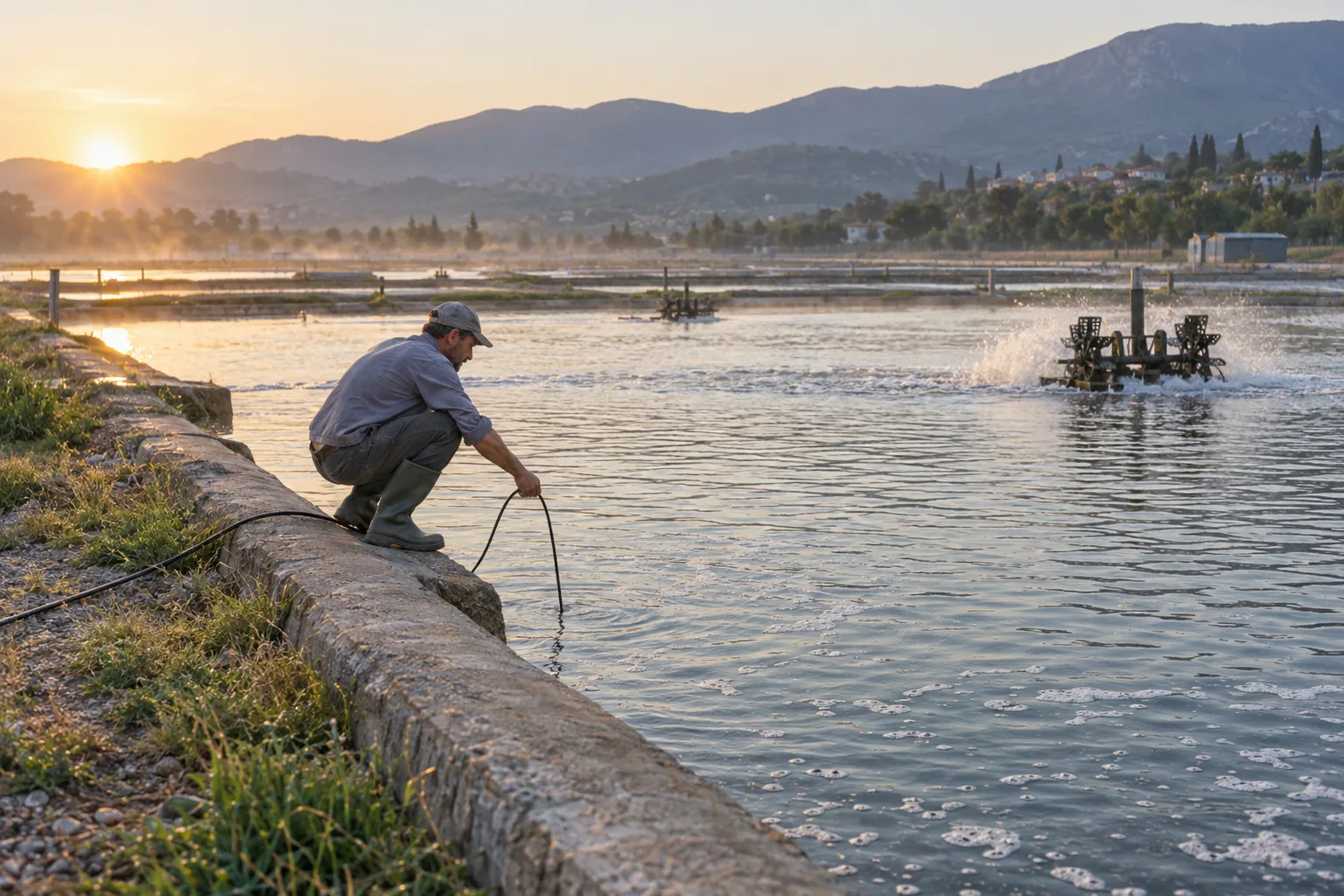
Picture the morning round on a fish farm with twenty ponds. A worker walks out with a handheld meter, dips the probe in the first pond, reads the dissolved oxygen, writes it on a clipboard, and moves on. By the time the round is finished, there is a sheet of numbers that someone will later type into a spreadsheet. Nobody can say for certain which pond each number came from, what time it was taken, or whether pond fourteen was actually checked or just filled in to match yesterday.
The handheld meter is a good instrument. The problem is everything that happens after the reading. The number lives on a screen for a few seconds and then depends on a person to copy it correctly, in the right row, for the right site. That is where field data quietly falls apart.
The reading is the easy part
A modern digital probe already does the hard work. It measures pH, dissolved oxygen, EC, or ammonium and outputs a clean value over a standard interface. A handheld meter is really just a screen, a keypad, and a battery wrapped around that probe. So is the phone in your pocket, and the phone is also a camera, a GPS, and an internet connection.
That is the idea behind MobileSense. It is a small adapter that plugs into a phone’s USB-C port and connects to any Agrinovo probe. The phone becomes the meter. You dip the probe, the live value appears in the app, and the reading is captured the moment it is taken. No separate handheld unit to buy, calibrate, charge, or replace when it goes into the water.
If you want the full picture of how the hardware fits together, the MobileSense product page walks through it, and our aquaculture water quality monitoring guide covers the parameters themselves.
What the phone adds that the meter never could
The moment a phone takes the reading instead of a dedicated meter, three things happen for free that a handheld can never do.
It remembers. Every value is stored automatically, so there is no transcription step and no spreadsheet to fill in by hand.
It knows where it is. The app records the GPS location of each measurement. On a site with many ponds, tanks, or plots, that means every reading is placed on a map without anyone naming the site. You can finally see which points were sampled and which were skipped.
It knows who and when. The worker and the exact time are stamped on every reading. The record itself becomes the proof that the round was done, instead of a sheet that could have been completed from memory.
This is the part that matters for a manager. The old debate of whether the work was done properly disappears, because the data carries its own evidence. If a parameter drifts on pond nine, you know who measured it, at what time, and standing where.
Monitoring many sites without hardware everywhere
There is a common assumption that monitoring a large operation means installing a controller and a sensor at every single point. For continuous, unattended readings on a critical pond, a fixed device is exactly right, and our guide to choosing an IoT controller explains when that is worth it.
But most sampling points do not need a reading every minute. They need a reliable spot check once or twice a day, with a record that it happened. Spreading fixed hardware across all of them is expensive and unnecessary. A worker carrying one adapter and a probe can cover dozens of points, and each reading lands in the same dashboard as the permanent devices, on the same map, in the same history.
The practical setup for a large farm is a blend: fixed controllers where you need continuous data, and a phone-based reader everywhere else. Both feed one platform, so handheld field checks and permanent installations sit side by side in one timeline.
From paper to a live record
The deeper shift here is not about a gadget. It is about removing the paper and the spreadsheet from the middle of the process. When the meter, the form, and the connection to the manager are all the same device, the data is correct by default, located by default, and attributed by default.
For a farm comparing manual testing against automated monitoring, the trade-off is no longer just accuracy. It is whether the readings can be trusted, found, and acted on. Our look at manual versus automated water testing goes through that comparison in detail, and MobileSense sits in the middle: the speed of a handheld check, with the record-keeping of a connected system.
A handheld meter answers one question, once, and forgets it. A phone with the right adapter answers it, keeps it, places it, and shows it to the person who needs to know. For a multi-site operation, that difference is the whole job.
Two ready-made kits cover the most common rounds on a fish farm: the dissolved oxygen meter for oxygen checks, and the multiparameter water quality meter, which reads DO, pH and EC at once on a split cable.
To see which probes work with it and how to put a kit together for your sites, visit the MobileSense page or get in touch.