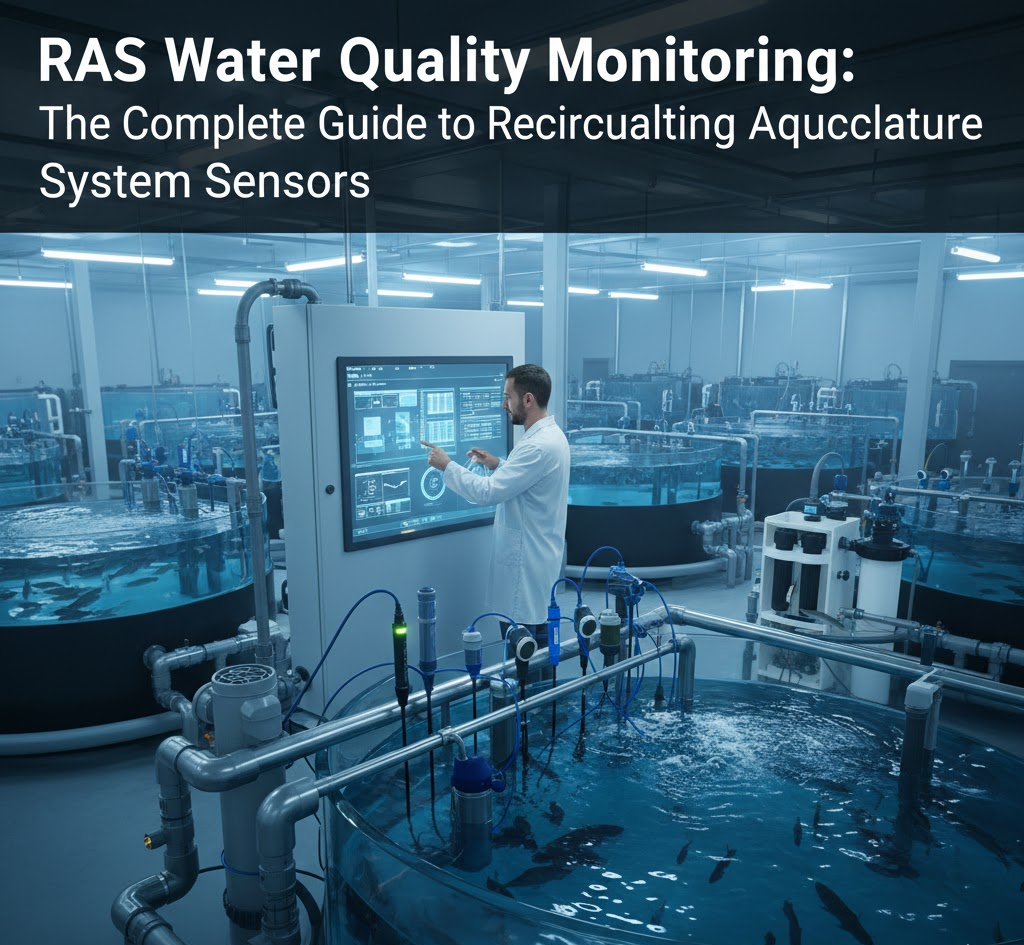
We’ve operated pond systems, cage systems, and recirculating aquaculture systems. And we’ll tell you this without hesitation: RAS water quality monitoring is a completely different animal from anything else in aquaculture. In a pond, nature provides buffering. In a cage, the ocean dilutes your problems. In a RAS, every milligram of waste your fish produce stays in the system until you remove it. There is no forgiveness, no natural reset, no “the tide will flush it out.”
We learned this the hard way during our first year running a 40-tank tilapia RAS. We were monitoring the same way we had in our pond days: checking DO and pH once in the morning, running an ammonia test kit every few days. That approach worked fine when we had a two-acre pond with 500 fish. It nearly bankrupted us when we had 12,000 fish sharing 80 cubic meters of recirculated water.
The problem with RAS is that everything is connected. Your biofilter consumes oxygen and produces CO2. Your degasser strips CO2 but can also strip oxygen if misconfigured. Your pH drops as nitrification consumes alkalinity, and that pH drop changes how toxic your ammonia is. One parameter shifting pulls three others with it. If you’re not monitoring all of them continuously, you’re flying blind in a system that can crash in hours.
This guide covers what we wish someone had told us before we started: which parameters matter most in RAS, where to place sensors in the recirculation loop, what the numbers actually mean, and how to set up a monitoring system that catches problems before they become catastrophes. If you’re new to aquaculture monitoring in general, start with our aquaculture water quality guide first, then come back here for the RAS-specific details.
Understanding the RAS Water Quality Loop
Before we talk about sensors, you need to understand where water goes in a RAS and what happens at each stage. This determines where you place sensors and which readings matter at each point.
A typical RAS loop runs like this:
Fish Tank —> Mechanical Filter (drum filter or settling basin) —> Biofilter (moving bed, fluidized sand, or trickling filter) —> Degassing Column —> UV or Ozone Disinfection —> Oxygen Injection/Aeration —> Back to Fish Tank
Some systems add a denitrification reactor or a pH adjustment stage, but the core loop above covers 90% of commercial RAS.
Here’s what matters at each stage:
Fish Tank
This is where your animals live, so it’s where conditions matter most. But it’s also where readings are the result of everything upstream. High ammonia in the tank means your biofilter isn’t keeping up. Low DO means your aeration or oxygen injection is insufficient. The fish tank tells you the outcome; the other stages tell you why.
Post-Mechanical Filter
Solids removal happens here. Not much to monitor chemically, but flow rate matters. If your drum filter is backwashing too frequently, your organic load is too high.
Biofilter
This is the heart of any RAS, and it’s the single most important place to monitor. The biofilter converts toxic ammonia (TAN) to nitrite, then nitrite to nitrate. It consumes oxygen doing this, a lot of oxygen. It also produces CO2 and consumes alkalinity. A failing biofilter doesn’t announce itself with dead fish immediately. It whispers through subtle changes in ammonia, nitrite, pH, and dissolved oxygen that build over days before they suddenly become a crisis.
Degassing Column
CO2 removal. If your fish are lethargic despite adequate DO, check CO2 levels post-degasser. Dissolved CO2 above 15-20 mg/L impairs oxygen uptake at the gills even when DO is technically fine.
UV/Ozone Stage
Pathogen control. ORP monitoring tells you whether your disinfection is actually working.
Oxygen Injection/Aeration
The last stage before water returns to the fish. This is where you verify that DO is back to target levels before it hits the tank.
Critical Parameter #1: Dissolved Oxygen
In RAS, dissolved oxygen isn’t just about keeping fish alive. Your biofilter needs oxygen too, and it’s a greedy consumer. A well-functioning nitrifying biofilter in a production-loaded RAS can consume 30-50% of your system’s total oxygen. That means if you’re sizing aeration only for your fish, you’re undersized for the system.
Why RAS Needs Multiple DO Sensors
This is the single biggest difference between RAS monitoring and pond monitoring. In a pond, one DO sensor tells you what the fish experience. In a RAS, you need at minimum two, ideally three:
-
In the fish tank: This is your primary life-safety reading. Target 6-8 mg/L for salmonids, 4-6 mg/L for tilapia and warmwater species.
-
Post-biofilter: This tells you how much oxygen your biofilter consumed. If DO entering the biofilter is 8 mg/L and leaving is 3 mg/L, your biofilter is healthy and working hard. If the drop is only 1 mg/L, either your biofilter bacteria are dead or your ammonia load is very low.
-
Post-aeration (return to tank): This verifies your oxygen injection or aeration is achieving target levels before water re-enters the fish tank.
The delta between post-biofilter DO and post-aeration DO tells you your aeration efficiency. The delta between post-aeration DO and fish tank DO tells you your fish oxygen consumption rate. Both numbers are critical for capacity planning.
Freshwater vs. Saltwater DO Saturation
This trips up a lot of operators who transition from freshwater to marine RAS. Saltwater holds significantly less dissolved oxygen than freshwater at the same temperature.
At 20 degrees C:
- Freshwater: 100% saturation = 9.1 mg/L
- Seawater (35 ppt): 100% saturation = 7.4 mg/L
That’s a 19% reduction in oxygen carrying capacity. In a saltwater RAS running salmon or shrimp, your margin for error on DO is substantially thinner. You simply cannot afford the same buffer you’d have in freshwater.
Sensor Selection for RAS
For freshwater RAS, we recommend the DO-P100. It uses fluorescent quenching technology (no membranes to replace), covers the 0-40 degrees C range that freshwater systems operate in, and the PE housing handles the job without adding unnecessary cost. Putting two or three of these across your system is financially realistic.
For saltwater RAS, there is no substitute for the DO-110 titanium sensor. It’s priced at a premium, but titanium alloy construction is essential when you’re dealing with saltwater at up to 60 ppt salinity. Standard stainless steel housings will corrode in marine environments within months. The DO-110 is rated for full seawater conditions and uses the same fluorescent measurement principle with +/- 2% full scale accuracy. We’ve seen operators try to save money with freshwater DO sensors in marine RAS. They replace them every four months. The math doesn’t work.
Both sensors output RS485/Modbus, which means you can daisy-chain multiple sensors on one bus back to an Omni Exodus controller. With 6 sensor ports and marine-grade connectors, a single Exodus can handle your complete RAS monitoring from one unit.
Critical Parameter #2: Ammonia and Ammonium (TAN)
The nitrogen cycle is the backbone of every RAS. Fish excrete ammonia. Bacteria in your biofilter convert it. If that conversion stops or slows, ammonia accumulates and fish die. RAS water quality monitoring without ammonia tracking is like driving without a speedometer. You’ll find out you’re going too fast only when you crash.
The Nitrogen Cycle in RAS
Here’s the chain:
Fish waste/feed —> Total Ammonia Nitrogen (TAN = NH3 + NH4+) —> Nitrite (NO2-) [by Nitrosomonas bacteria] —> Nitrate (NO3-) [by Nitrobacter bacteria] —> Removed by water exchange or denitrification
Each step requires specific conditions. Nitrosomonas and Nitrobacter need dissolved oxygen above 2 mg/L (preferably above 4 mg/L), pH between 7.0 and 8.5 (optimal around 7.5-8.0), and temperature above 15 degrees C for reasonable conversion rates.
Why Continuous TAN Monitoring Matters in RAS
In a pond, ammonia levels change slowly because you have a massive volume of water diluting everything. In a RAS, the water volume is small relative to fish biomass. A 50 kg/m3 stocking density (common in intensive RAS) produces ammonia fast enough that a biofilter failure can push TAN from safe to lethal in 6-12 hours.
We used to rely on colorimetric test kits for ammonia. The problem: we’d test at 8 AM and get 0.5 mg/L TAN. Fine. What we didn’t know was that TAN spiked to 3.0 mg/L at 2 AM after the heavy evening feeding and our biofilter couldn’t keep up with the pulse load. Continuous monitoring revealed feeding-related ammonia spikes we never knew existed.
The NH4-100 ammonium sensor measures ammonium (NH4+) continuously with a response time under 30 seconds and a range of 0.1 to 18,000 mg/L. For direct measurement of the toxic form, the NH3-100 ammonia sensor measures unionized ammonia from 0.05 to 1,400 mg/L with response under 60 seconds. In a serious RAS operation, having both gives you the complete picture: total ammonia load (NH4+) and actual toxicity (NH3).
The Unionized Ammonia Problem
This is where RAS operators get burned. Total ammonia nitrogen might read 1.0 mg/L, which sounds fine. But the fraction that’s actually toxic, unionized NH3, depends entirely on pH and temperature.
At pH 7.0 and 20 degrees C, 1.0 mg/L TAN means about 0.004 mg/L NH3. No problem.
At pH 8.0 and 25 degrees C, that same 1.0 mg/L TAN becomes 0.04 mg/L NH3. Getting into chronic stress territory for sensitive species.
At pH 8.5 and 28 degrees C, it’s 0.10 mg/L NH3. That’s acutely dangerous for trout and causing significant stress in tilapia.
This is exactly why RAS water quality monitoring requires simultaneous pH, temperature, and ammonia data. Any one of these readings in isolation can mislead you. Together, they tell the true story.
Critical Parameter #3: pH
If dissolved oxygen is the parameter that kills fish fastest and ammonia is the slow killer, pH is the orchestrator that determines how dangerous everything else is. In RAS, pH management is fundamentally different from open systems because the recirculation loop actively depletes alkalinity.
Buffer Depletion: The RAS-Specific Problem
Nitrification, the process that saves your fish from ammonia, is an acid-producing reaction. For every gram of ammonia-nitrogen converted, the biofilter consumes approximately 7.14 grams of alkalinity (as CaCO3). In a heavily stocked RAS, this means your alkalinity is constantly being consumed.
We’ve seen RAS systems lose 50-100 mg/L of alkalinity per day during peak production. If you start with 200 mg/L alkalinity (typical for many freshwater sources), you can burn through your entire buffer in two to four days without supplementation. When alkalinity crashes, pH follows. Fast. And a sudden pH drop from 7.5 to 6.0 does two things simultaneously: it stresses your fish, and it inhibits your nitrifying bacteria (which prefer pH above 7.0). So your biofilter slows down right when your fish need it most.
The Alkalinity Crash Cascade
This is the nightmare scenario in RAS, and we’ve seen it happen to experienced operators:
- Alkalinity slowly depletes over several days (not monitored)
- pH drops gradually from 7.5 to 6.8 (noticed but not alarming)
- pH drops suddenly from 6.8 to 6.0 as buffering capacity exhausts (alarming)
- Biofilter nitrification rate drops 50-80% at pH 6.0 (now you’re in trouble)
- Ammonia starts accumulating because the biofilter can’t convert it
- Fish start dying from combined pH stress and ammonia toxicity
The fix is simple: monitor alkalinity weekly (manual titration test, takes 5 minutes) and supplement with sodium bicarbonate or calcium carbonate to maintain 100-200 mg/L. But you only know to do this if your pH sensor is giving you the early warning of a downward trend.
The PH-100 sensor delivers +/- 0.01 pH accuracy with automatic temperature compensation and RS485 output. For inline RAS piping where space is tight, the PH-10 offers a compact form factor designed specifically for plumbing integration. We install pH sensors in the fish tank itself for the reading that matters most to the animals, and sometimes a second one post-biofilter to track how much pH drops across the nitrification stage.
Critical Parameter #4: Nitrite and Nitrate
Nitrite and nitrate are the intermediate and end products of the nitrogen cycle. In RAS, both accumulate in ways they don’t in open systems.
Nitrite: The Startup Killer
Nitrite (NO2-) is an intermediate product. Nitrosomonas bacteria convert ammonia to nitrite, then Nitrobacter bacteria convert nitrite to nitrate. The problem is that Nitrobacter populations establish more slowly than Nitrosomonas. During biofilter startup (or after a crash), you get a “nitrite spike” where ammonia drops but nitrite skyrockets because the second-stage bacteria aren’t ready.
Nitrite is toxic to fish. It binds to hemoglobin and prevents oxygen transport, essentially suffocating your fish from the inside even when dissolved oxygen in the water is fine. This is called “brown blood disease” because the blood turns chocolate brown.
Toxic levels vary by species and salinity:
- Freshwater trout: Lethal above 0.1-0.5 mg/L NO2-N
- Freshwater tilapia: Tolerant to 5-10 mg/L NO2-N, but growth impacts above 1 mg/L
- Saltwater species: Much more tolerant because chloride ions compete with nitrite uptake at the gills
During biofilter commissioning, we monitor nitrite daily. In a new system, the nitrite spike typically occurs 2-4 weeks after introducing fish and can last 1-3 weeks. Having continuous monitoring during this period is the difference between catching a 0.5 mg/L rise early and discovering a 5 mg/L crisis too late.
The NO2-100 nitrite sensor covers 0.5 to 46,000 mg/L. For startup monitoring and ongoing biofilter health assessment, this sensor pays for itself with the first crisis it prevents.
Nitrate: The Slow Accumulator
Nitrate (NO3-) is the end product of nitrification and is far less toxic than ammonia or nitrite. But in RAS, it accumulates continuously because you’re recirculating water. In open systems, water exchange removes nitrate naturally. In a tight RAS with minimal water exchange (which is the whole point of RAS, water conservation), nitrate can build to 200-400 mg/L or higher over weeks.
Most freshwater species tolerate nitrate well up to 100-200 mg/L, but chronic exposure above these levels causes:
- Reduced growth rates
- Impaired immune function
- Reproductive failure in broodstock
Marine species are generally less tolerant, with some showing stress above 50 mg/L.
We use nitrate levels to determine our water exchange rate. Target: keep nitrate below 100 mg/L in freshwater systems, below 50 mg/L in marine. The NO3-100 nitrate sensor measures 0.6 to 62,000 mg/L, which covers everything from pristine source water to concentrated RAS systems.
The ratio of nitrite to nitrate also tells you about biofilter health. In a mature, healthy biofilter, nitrite should be near zero while nitrate accumulates. If nitrite starts appearing alongside stable nitrate, your second-stage bacteria (Nitrobacter) are struggling, possibly due to low DO in the biofilter, pH drop, or temperature shock.
CO2 and Degassing: The Often Overlooked Parameter
Here’s something that surprised us when we moved from ponds to RAS: CO2 is a bigger problem in recirculating systems than most operators realize. In ponds, CO2 escapes to the atmosphere naturally across the large water surface. In a RAS, the enclosed piping and tanks provide minimal gas exchange surface, and CO2 accumulates.
Where CO2 Comes From in RAS
Three sources, all significant:
- Fish respiration: Fish produce CO2 proportional to their oxygen consumption. Roughly 1.0-1.4 mg of CO2 produced for every mg of O2 consumed.
- Biofilter respiration: Nitrifying bacteria also respire, producing additional CO2.
- Organic decomposition: Uneaten feed and fecal matter decomposition produces CO2.
In a heavily stocked RAS, CO2 can reach 20-40 mg/L without adequate degassing. For reference, atmospheric equilibrium is about 0.5 mg/L. You’re running at 40-80 times natural levels.
Why High CO2 Matters
Respiratory impairment: CO2 in the water crosses the gills and enters the fish’s blood, lowering blood pH (respiratory acidosis). Fish lose the ability to efficiently unload oxygen from hemoglobin. The result: fish exhibit hypoxia symptoms (gasping, lethargy, reduced feeding) even when dissolved oxygen is at 7-8 mg/L. We spent two weeks troubleshooting a tank where fish were lethargic at DO 7.5 mg/L before we thought to measure CO2. It was 28 mg/L. Installed a proper degassing column and behavior normalized within 24 hours.
pH depression: Dissolved CO2 forms carbonic acid in water, lowering pH. In RAS where alkalinity is already being depleted by nitrification, CO2 accumulation accelerates pH decline. If your pH keeps dropping despite alkalinity supplementation, measure CO2.
Target ranges:
- Below 10 mg/L: Ideal for most species
- 10-15 mg/L: Acceptable short-term
- 15-20 mg/L: Chronic stress, reduced performance
- Above 20 mg/L: Active impairment, requires immediate degassing improvement
The CO2-100 sensor measures dissolved CO2 from 0.5 to 5,000 mg/L. We install it post-degassing column to verify CO2 removal efficiency and set an alert at 15 mg/L. If post-degasser CO2 is still above 15 mg/L, it means either the degassing column needs maintenance (clogged media, insufficient airflow) or CO2 production has exceeded your degassing capacity and you need to upgrade.
EC and Salinity Management
Electrical conductivity monitoring serves different purposes in freshwater and saltwater RAS, but it’s important in both.
Freshwater RAS: Mineral Depletion and Salt Creep
Freshwater RAS operators face an interesting paradox. On one hand, minerals accumulate from fish waste and feed. On the other hand, if you’re running a tight system with minimal water exchange, certain essential minerals can become depleted while waste salts accumulate.
EC trending upward in a freshwater RAS means dissolved solids are accumulating, which means it’s time to increase water exchange. EC dropping unexpectedly could indicate a dilution event (leak, unintended freshwater addition) or a shift in feed composition.
The EC-100 with a K=1.0 cell constant covers 1 to 20,000 microsiemens/cm, which is the right range for freshwater systems. We monitor EC weekly in freshwater RAS to track water exchange needs and catch any unusual shifts.
Saltwater RAS: Salinity Stability is Everything
Marine species are far less tolerant of salinity fluctuations than most operators expect. A swing of 2-3 ppt in a day can stress marine finfish and devastate shrimp. In a saltwater RAS, you’re constantly losing water to evaporation (especially if using cooling towers or degassing columns), and the salt concentration in the remaining water increases.
If you top up with freshwater, salinity drops. If you don’t top up fast enough, salinity rises. Either way, your animals feel it.
For saltwater RAS, you need the EC-120 with a K=0.45 cell constant rated for 10 to 500,000 microsiemens/cm. This covers the full marine salinity range and beyond. Continuous EC monitoring in marine RAS isn’t optional. It’s how you maintain the stable salinity your animals require.
ORP for Disinfection Monitoring
ORP (oxidation-reduction potential) measures the overall oxidizing or reducing condition of your water. In RAS, its primary value is monitoring the effectiveness of your UV or ozone disinfection stage.
UV Systems
UV doesn’t directly change ORP, but ORP gives you an indirect read on the organic load hitting your UV unit. Higher organic loads reduce UV transmittance, making your sterilizer less effective. If ORP is trending downward, your water has more organic matter, which means your UV dose is effectively declining.
Ozone Systems
For RAS using ozone injection, ORP is your primary control variable. Ozone raises ORP, and you target specific ORP levels:
- 250-350 mV: Adequate pathogen control without residual ozone toxicity
- Above 400 mV: Risk of residual ozone in the water, which is toxic to fish
- Below 200 mV: Insufficient disinfection
We run our ozone system with ORP-based feedback control: ozone injects until ORP reaches 320 mV, then pauses until it drops below 280 mV. The ORP-100 sensor with a range of -2000 to 2000 mV provides the continuous measurement needed for this kind of automated control. For a deep dive into using ORP to control ozone dosing, see our ORP control for ozonation in RAS guide. For more on dissolved ozone measurement methods, see our dissolved ozone monitoring guide.
Sensor Placement Strategy: Where Everything Goes
Sensor placement in RAS isn’t random. Each location serves a specific diagnostic purpose. Here’s our recommended placement map for a complete RAS monitoring system:
Location 1: Fish Tank (Primary Life-Safety)
- DO sensor: the reading your fish experience
- pH sensor: actual conditions at the animal
- Temperature: included in most DO sensors
Location 2: Biofilter Outlet (Biofilter Health)
- DO sensor: measure oxygen consumption by the biofilter
- NH4+/NH3 sensor: verify the biofilter is converting ammonia
- NO2- sensor: catch nitrite breakthrough early
Location 3: Post-Degasser (Gas Exchange Verification)
- CO2 sensor: verify degassing column effectiveness
- DO sensor (optional third): verify oxygen isn’t being stripped by the degasser
Location 4: Post-Disinfection/Pre-Return (Final Quality Check)
- ORP sensor: verify disinfection effectiveness, catch residual ozone
- DO sensor: verify oxygen injection is achieving target before return to tank
Location 5: Sump/Mixing Tank (System-Wide Baseline)
- EC sensor: track salinity/TDS trends
- NO3- sensor: track nitrate accumulation for water exchange scheduling
Not every RAS needs sensors at all five locations. But understanding what each location tells you helps you prioritize based on your budget and species.
Freshwater RAS Example Setup: Tilapia or Trout
Let’s build a concrete monitoring system for a freshwater RAS producing tilapia or trout at commercial scale (say, 10-20 metric tons per year).
Sensor Package
| Sensor | Model | Location | Purpose |
|---|---|---|---|
| DO (primary) | DO-P100 | Fish tank | Life-safety |
| DO (secondary) | DO-P100 | Post-biofilter | Biofilter O2 consumption |
| pH | PH-100 | Fish tank | Ammonia toxicity context, alkalinity tracking |
| Ammonium | NH4-100 | Biofilter outlet | Biofilter conversion efficiency |
| Nitrite | NO2-100 | Biofilter outlet | Biofilter health, startup monitoring |
| Nitrate | NO3-100 | Sump | Water exchange scheduling |
| CO2 | CO2-100 | Post-degasser | Degassing efficiency |
| EC | EC-100 | Sump | Mineral/salt tracking |
| Controller | Omni Exodus | Central | 6 sensor ports, Wi-Fi, alerts |
Contact us for current pricing on complete RAS monitoring packages.
For a smaller operation or tighter budget, you can start with just the Exodus controller, two DO-P100 sensors, the PH-100, and the NH4-100. That covers the parameters most likely to kill your fish. Add nitrite and CO2 sensors when budget allows.
If you’re running a smaller system and only need 4 sensor ports, the Omni Genesis saves you on the controller. But for a production RAS, we’d spend the extra for the Exodus’s 6 ports and marine-grade connectors. You’ll want the expansion capacity.
Alert Thresholds (Tilapia)
- DO below 4.0 mg/L: Critical alarm
- DO below 5.0 mg/L: Warning
- pH below 6.5 or above 8.5: Critical alarm
- pH below 7.0 or above 8.0: Warning
- NH3 (unionized) above 0.05 mg/L: Warning
- NH3 above 0.1 mg/L: Critical alarm
- NO2- above 1.0 mg/L: Warning
- CO2 above 15 mg/L: Warning
- CO2 above 20 mg/L: Critical alarm
For trout, tighten all of these: DO warning at 6.0 mg/L, critical at 5.0 mg/L. Trout are cold-water salmonids with much less tolerance for suboptimal conditions.
Saltwater RAS Example Setup: Atlantic Salmon or Shrimp
Marine RAS demands more robust sensors and tighter monitoring. Saltwater is corrosive, species are often higher-value, and the cost of a crash is substantially higher.
Sensor Package
| Sensor | Model | Location | Purpose |
|---|---|---|---|
| DO (primary) | DO-110 (titanium) | Fish tank | Life-safety, saltwater rated |
| DO (secondary) | DO-110 (titanium) | Post-biofilter | Biofilter O2 consumption |
| pH | PH-100 | Fish tank | Ammonia toxicity, alkalinity |
| Ammonia | NH3-100 | Biofilter outlet | Direct toxic ammonia measurement |
| Nitrite | NO2-100 | Biofilter outlet | Biofilter second-stage health |
| EC/Salinity | EC-120 (K=0.45) | Sump | Salinity stability monitoring |
| ORP | ORP-100 | Post-ozone | Ozone dosing control |
| CO2 | CO2-100 | Post-degasser | CO2 removal verification |
| Controller | Omni Exodus | Central | 6 ports, marine-grade, IP65 |
Contact us for current pricing on complete marine RAS monitoring packages.
Note that we specified the DO-110 titanium sensor for both DO positions. In saltwater, this isn’t a luxury; it’s a requirement. The titanium alloy housing handles up to 60 ppt salinity without corrosion. The 316L stainless steel on the DO-100 will eventually pit and fail in full marine conditions. We’ve tried it. Don’t make the same mistake.
For the ammonia position, we chose the NH3-100 (direct ammonia) over the NH4-100 (ammonium) for the saltwater setup. Marine systems typically run at higher pH (7.8-8.2), which means a larger fraction of TAN is in the toxic NH3 form. Measuring NH3 directly gives you the reading that matters most for animal welfare without needing to calculate it from TAN and pH.
The EC-120 with its K=0.45 cell constant is specifically designed for high-conductivity solutions. Standard freshwater EC sensors saturate at marine salinity levels and give you garbage data. The EC-120 handles up to 500,000 microsiemens/cm, well beyond full-strength seawater.
Alert Thresholds (Atlantic Salmon)
- DO below 6.0 mg/L: Critical alarm
- DO below 7.0 mg/L: Warning
- pH below 7.0 or above 8.5: Critical alarm
- pH below 7.5 or above 8.2: Warning
- NH3 above 0.01 mg/L: Warning (salmon are sensitive)
- NH3 above 0.025 mg/L: Critical alarm
- Salinity change > 1 ppt in 24 hours: Warning
- ORP above 400 mV: Critical alarm (ozone residual risk)
- ORP below 250 mV: Warning (insufficient disinfection)
- CO2 above 10 mg/L: Warning
Biofilter Crash: Early Warning Signs
A biofilter crash is the most dreaded event in RAS operation. When your biological filtration fails, ammonia and nitrite spike simultaneously, and you have a very short window to respond before you start losing fish. RAS monitoring with continuous sensors gives you the early warning that manual testing cannot.
Here’s the timeline of a typical biofilter crash and what your sensors will show you at each stage:
48-72 Hours Before Visible Crisis
What sensors show:
- Ammonia (NH4+/NH3) rising 10-20% above normal baseline
- pH dropping slightly faster than usual (0.1-0.2 units per day instead of 0.05)
- DO consumption across the biofilter decreasing (less oxygen being used means less nitrification happening)
What you should do:
- Check biofilter media. Is it clogged? Is the water flow through it adequate?
- Check temperature. Did it drop suddenly? Nitrifiers slow dramatically below 15 degrees C
- Check DO in the biofilter. If it dropped below 2 mg/L, the bacteria are oxygen-starved
- Reduce feeding by 30-50% to reduce ammonia input
12-24 Hours Before Crisis
What sensors show:
- Ammonia clearly elevated, 2-3x normal
- Nitrite appearing and rising (the classic sign of disrupted second-stage nitrification)
- pH dropping faster as you add more buffer to compensate
- Biofilter DO consumption is clearly abnormal
What you should do:
- Stop feeding entirely
- Increase water exchange rate dramatically (if you have the capacity)
- Check for any chemical contamination that could have killed bacteria (cleaning agents, medications, high chlorine in makeup water)
- If you have a backup biofilter media or seeded media, deploy it now
Active Crisis
What sensors show:
- Ammonia at 5-10x normal levels
- Nitrite spiking
- pH unstable
- Fish showing stress behavior
What you should do:
- Emergency water exchange, as much as your system can handle
- Add zeolite or other ammonia-adsorbing media as a temporary measure
- Consider emergency chemical detoxification (ammo-lock type products)
- Prepare for potential fish losses and have a plan for triage (reduce density, move fish to clean water if available)
The critical point: without continuous recirculating aquaculture system sensors, you don’t get the 48-72 hour early warning. You discover the problem at the “active crisis” stage when fish are already stressed. That early warning window is what justifies the entire investment in automated monitoring.
Common Biofilter Crash Triggers
From our experience and conversations with other RAS operators, here are the most common causes:
-
Power failure: No water circulation through the biofilter means no oxygen for bacteria. Nitrifying bacteria can survive 4-8 hours without flow in warm conditions, longer in cold. But recovery takes days.
-
Medication dosing: Antibiotics and antiparasitics can kill nitrifying bacteria. If you must treat, dose the fish tank directly and bypass the biofilter if your plumbing allows it.
-
pH crash: Below 6.0, nitrification essentially stops. If you let your alkalinity deplete and pH drops, the biofilter goes offline.
-
Temperature shock: Rapidly dropping the system temperature by more than 5 degrees C can shock nitrifying bacteria.
-
Chlorinated makeup water: Even 0.1 mg/L chlorine in your makeup water can damage nitrifiers over time. Always dechlorinate.
Recommended Monitoring Schedule and Calibration
Having the sensors installed is step one. Keeping them accurate is the ongoing work that most operators underestimate. Here’s our maintenance schedule based on years of trial and error.
Daily (Automated, No Human Action Required)
- DO logging every 5 minutes, 24/7
- pH logging every 5 minutes
- EC logging every 15 minutes
- ORP logging every 15 minutes
- NH4+/NH3 logging every 15 minutes
- Alert system active at all times
The Omni Exodus controller handles all of this automatically. Wi-Fi connectivity pushes data to the cloud; optional 4G-LTE ensures you get alerts even if your local network goes down. With IP65 waterproofing and solar power capability, it’s designed for exactly this kind of always-on agricultural monitoring.
Weekly (5-10 Minutes of Work)
- Visual inspection of all sensor housings for fouling/biofilm
- Manual alkalinity test (titration kit, can’t automate this cheaply yet)
- Compare sensor readings against a calibrated handheld meter (spot check for drift)
- Review data trends for any slow changes you might miss in daily glances
- Clean DO sensor optical windows if fouled
Monthly (30-60 Minutes of Work)
- Full pH sensor calibration (two-point with pH 4.0 and 7.0 buffers)
- DO sensor verification against Winkler titration or calibrated reference
- EC sensor calibration check with standard solution
- Clean all sensor housings thoroughly
- Check cable connections and controller enclosure seals
- Review and adjust alert thresholds if species or stocking density changed
Quarterly (Half-Day Maintenance)
- Full system calibration of all sensors
- Replace pH sensor electrolyte if applicable
- Inspect and clean sensor connectors with contact cleaner
- Test alert delivery (trigger a test alarm and verify you receive it)
- Review historical data for long-term trends (nitrate accumulation rate, pH buffer consumption rate, seasonal DO patterns)
- Update firmware on controllers if updates are available
Annual
- Replace pH sensor junction (or entire sensor if past warranty)
- Evaluate whether your sensor placement is optimal based on a year of data
- Budget for sensor replacements: plan for pH sensors lasting 1-2 years, DO sensors lasting 2-3+ years with proper maintenance (all DO sensors come with 1-year warranties), ISE sensors (ammonia, nitrite, nitrate) lasting 1-2 years depending on usage intensity
Putting It All Together
RAS water quality monitoring isn’t a luxury or an upgrade. It’s a fundamental operating requirement. The closed-loop nature of recirculating aquaculture means that every parameter interacts with every other parameter, and problems that would self-correct in open systems amplify in RAS.
The good news is that sensor technology has reached a price point where comprehensive monitoring is accessible to commercial operations of all sizes. A complete freshwater or marine RAS sensor package with controller is a modest investment compared to the value of fish inventory it protects. Contact us for current pricing on complete RAS monitoring solutions.
If you’re building a new RAS, install monitoring from day one. Biofilter commissioning is the most dangerous period, and it’s precisely when you need continuous data most. If you’re running an existing RAS with manual testing, start by adding DO and pH sensors. Those two parameters together catch the majority of acute problems.
And whatever you do, don’t skimp on the controller. A reliable controller with cellular backup for alerts is worth more than the most expensive sensor in the world. Because a perfect sensor reading that nobody sees when the Wi-Fi goes down at 2 AM is worth exactly nothing.
Your fish can’t tell you they’re in trouble. Your sensors can. Let them.
Frequently Asked Questions
What sensors do I need for a RAS system?
At minimum: dissolved oxygen, pH, temperature, and ammonia (TAN) sensors. For a complete system, add nitrite, CO2, ORP, and turbidity sensors. Place sensors at multiple points in the recirculation loop - after the fish tank, after the biofilter, and after gas exchange/disinfection.
Where should I place sensors in a RAS loop?
Place DO sensors after the fish tank (to catch lows) and after the oxygenation stage (to verify injection). Place pH and ammonia sensors after the biofilter to monitor nitrification. Place ORP sensors after ozone/UV disinfection. Temperature sensors go in the fish tank and at the system return.
How do I prevent a biofilter crash in RAS?
Monitor pH continuously - nitrifying bacteria slow dramatically below pH 6.8. Maintain alkalinity above 100 mg/L CaCO3 to buffer against pH drops from nitrification. Never let DO in the biofilter drop below 2 mg/L. Avoid sudden temperature changes, medication additions, or large water exchanges that shock the bacteria.
What is a safe dissolved oxygen level for RAS fish?
Most warmwater species (tilapia, barramundi) need DO above 5 mg/L, with 6-8 mg/L being optimal. Coldwater species (trout, salmon) need 7-9 mg/L minimum. In RAS, target 80-100% saturation at the fish tank outlet and never let it drop below 60% saturation.
How often should I monitor water quality in a RAS?
RAS requires continuous, real-time monitoring - not periodic testing. DO, pH, and temperature should be measured every few seconds with automated sensors and alarms. Ammonia and nitrite should be monitored at least every 15 minutes by sensor or tested manually twice daily as a backup.