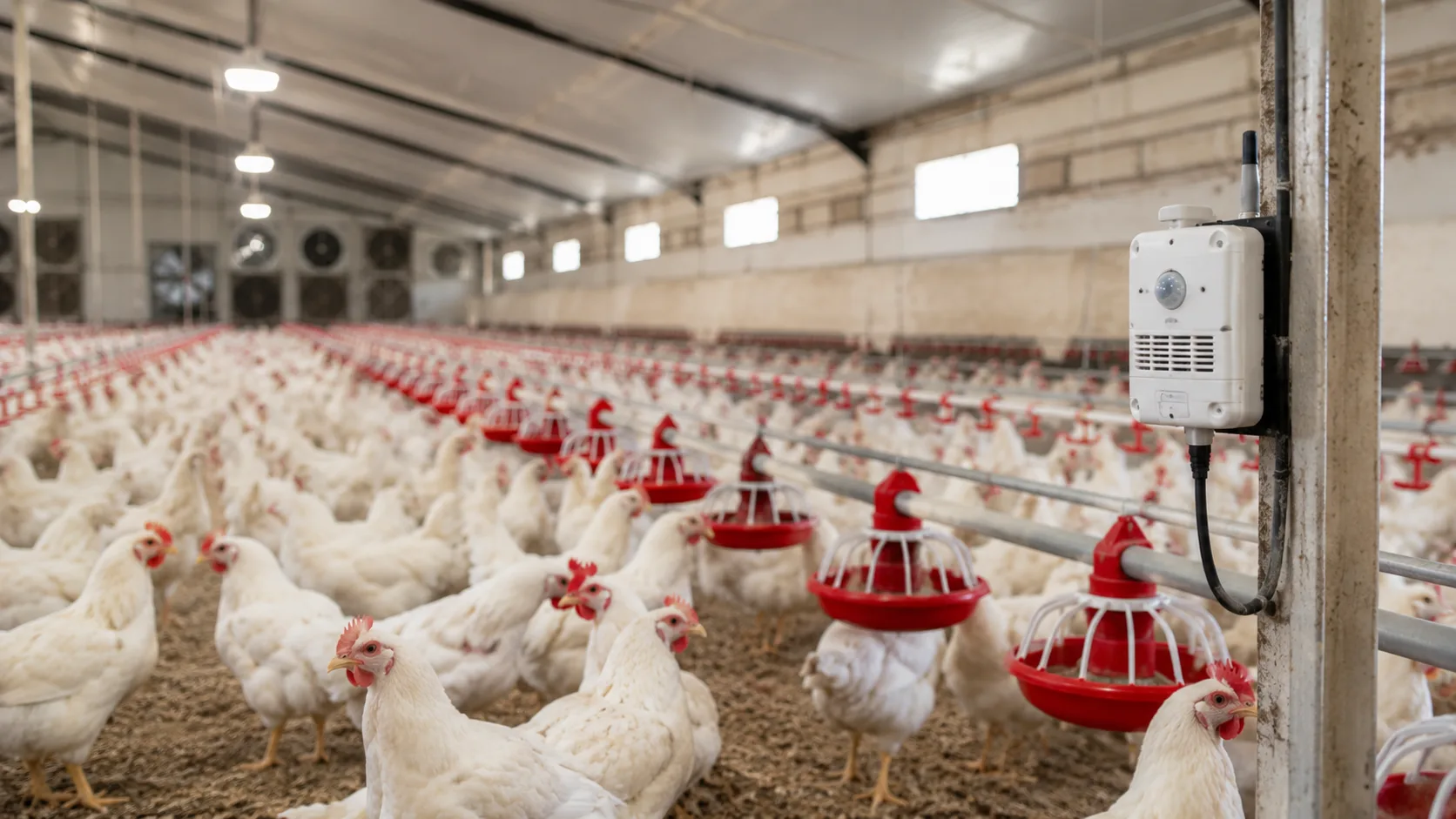
In a poultry house, the environment is the production system. Birds convert feed to weight efficiently only inside a fairly narrow band of temperature, humidity, and air quality, and when the house drifts out of that band the cost shows up fast: reduced growth, higher feed conversion, respiratory stress, and in a bad failure, mortality. The margins in poultry are thin enough that small, sustained environmental problems quietly erode profit even when nothing dramatic happens.
Continuous poultry house monitoring gives you a live, recorded picture of the house environment and warns you the moment it moves the wrong way. This guide covers what to monitor and why, how temperature and humidity connect to air quality and ammonia, and how to build a system that watches every house for you.
The Parameters That Matter
Poultry house environment comes down to a few interlinked values. Understanding how they connect is what makes monitoring useful rather than just a wall of numbers.
Temperature is the headline parameter. Birds have a target temperature that changes with age, high for young chicks, lower as they feather and grow, and both overheating and chilling hurt performance directly. Temperature also swings fast: a ventilation or heater fault can move a full house into dangerous territory quickly, which is why it needs continuous watching, not spot checks.
Relative humidity is the parameter that is most often under-managed, and it drives more than comfort. Humidity controls how effective the temperature feels to the bird, and, crucially, it controls litter moisture. Damp litter is the source of most air-quality problems in a poultry house.
Air quality, especially the gases that build up from litter and manure, follows directly from humidity and ventilation. When litter stays wet, nitrogen compounds break down and release ammonia, and decomposition can release hydrogen sulfide (H2S). Good ventilation removes moisture and gases; poor ventilation lets them accumulate. So air quality is not a separate problem from climate, it is the downstream result of temperature, humidity, and ventilation working together or failing together.
The practical takeaway is that if you monitor and manage temperature and humidity well, and ventilate on that data, you are already controlling the conditions that create bad air quality, before any gas ever reaches a harmful level.
Building a Poultry House Monitoring System
A monitoring system for a poultry house has the same three parts as any IoT setup: sensors in the house, a controller that collects and transmits, and a dashboard where you act on the data.
Temperature and humidity sensing
The foundation is continuous temperature and relative humidity measurement. The SHT30 temperature and humidity sensor covers both in one unit, giving you the two values that together define the effective environment and drive ventilation decisions. Placed at bird level in representative spots, several sensors across a long house reveal the temperature and humidity gradients that a single reading near the door would hide.
Hydrogen sulfide sensing
Where decomposition gases are a concern, the GF-201 H2S gas sensor monitors hydrogen sulfide continuously. H2S is dangerous to both birds and people at elevated levels, and because it can accumulate in enclosed spaces, continuous monitoring with an alert is far safer than relying on smell, which fails exactly at the concentrations that matter.
Measuring ammonia directly
Ammonia (NH3) is the gas most associated with poultry houses. The GF-201 NH3 ammonia gas sensor measures it continuously at bird height, 0 to 100 ppm at 0.1 ppm resolution, with its own display and two alarm relays that can drive a local siren. Reading ammonia next to humidity shows the whole chain: humidity keeps litter wet, wet litter releases ammonia, and ventilation is what brings both down. Measuring the result directly tells you whether the ventilation strategy is working, especially overnight on minimum ventilation.
The controller and dashboard
The sensors connect to an Omni Genesis controller, which is cellular-native and solar-capable, so a shed with no local network is still online. It reads the sensors, sends the data to the cloud, and holds the history. From the dashboard you see every house at once, set thresholds, and receive alerts. The same platform behind temperature monitoring generally applies here, tuned to the poultry environment.
From Monitoring to Ventilation Control
Monitoring tells you the house drifted. Control keeps it from drifting. Because the controller both measures and has output channels, poultry house climate data can drive the equipment that fixes it.
The logic mirrors how a good stockperson manages a house, but continuously and without gaps. When humidity climbs, increase ventilation to dry the litter and suppress gas production. When temperature rises above target, ramp ventilation or cooling; when it falls, bring in heat. Driving this from live temperature and humidity data means the house responds to actual conditions minute by minute, rather than to a timer or a manual round, and it means the response happens at 3 a.m. as reliably as at midday.
This is also where the air-quality benefit compounds. Ventilating on real humidity data keeps litter drier, and drier litter produces less ammonia and fewer decomposition gases in the first place. Good climate control is, in practice, the first line of air-quality control.
Alerts: The Feature That Prevents Disasters
The single most valuable output of a poultry monitoring system is the alert that arrives before a problem becomes a catastrophe. A ventilation failure, a stuck inlet, a heater that quits on a cold night, or a power event can turn a healthy house dangerous within a short window, especially with a full flock generating heat and moisture.
Continuous monitoring with threshold alerts closes that window. Set the limits for each house, and the moment temperature or humidity crosses them, you are notified by app, SMS, or email, wherever you are. On a farm where minutes matter and a single lost house is a serious financial event, that early warning is often the entire justification for the system.
One Dashboard for the Whole Farm
Few poultry operations run a single house. Continuous monitoring earns its keep at scale, when every house across the farm, or across multiple sites, reports to one dashboard. You compare houses at a glance, spot the one drifting before it becomes a problem, and manage alerts for the whole operation in one place, instead of walking sheds with a handheld thermometer and hoping you check the right one at the right time.
If you are managing poultry house environment by manual rounds and a thermostat, continuous monitoring with remote alerts is the upgrade that protects both bird performance and your peace of mind. Get a quote with a note on how many houses you run, or see the temperature monitoring solution for how the pieces fit together.
Frequently Asked Questions
What should you monitor in a poultry house?
The parameters that most directly affect bird health and performance are temperature, relative humidity, and air quality. Temperature and humidity together determine the effective temperature birds feel and drive the ventilation rate. Litter moisture, which follows humidity, is what turns into ammonia and other gases. Continuous monitoring of temperature and humidity, with alerts, is the foundation, because these are the values that change fastest and cause losses when they drift.
How does humidity relate to ammonia in a poultry house?
Ammonia in a poultry house comes from nitrogen in the litter breaking down, and that process accelerates in wet litter. High relative humidity keeps litter damp, which raises ammonia and other gas production, while good ventilation lowers humidity and suppresses it. That is why monitoring temperature and humidity, and driving ventilation from them, is central to controlling air quality, even before you measure a gas directly.
Does the Agrinovo system measure ammonia gas directly?
Yes. The GF-201 NH3 fixed ammonia detector measures airborne ammonia continuously from 0 to 100 ppm with 0.1 ppm resolution, mounted at bird height, and reports to the same controller and dashboard as the temperature, humidity and H2S sensors. Alerts fire at a limit you set for each house. Humidity and ventilation still matter, because wet litter is what produces ammonia, so the two readings together show both the cause and the result.
Can I get alerts if the temperature in my poultry house goes wrong?
Yes. Temperature and humidity sensors report continuously to a cloud dashboard, and you set high and low thresholds per house. If a reading crosses a limit, for example a ventilation or heater failure sending temperature the wrong way, you get an alert by app, SMS, or email immediately, which is critical because a climate failure in a full house can harm birds within a short time.
Does poultry house monitoring work without wiring to each shed?
Yes. A solar-capable, cellular-native controller reports over 4G-LTE, so a shed away from the farm office or without a local network is still online. Sensors in each house feed a controller, and every house appears on one dashboard, so a multi-house farm is managed from a single screen.