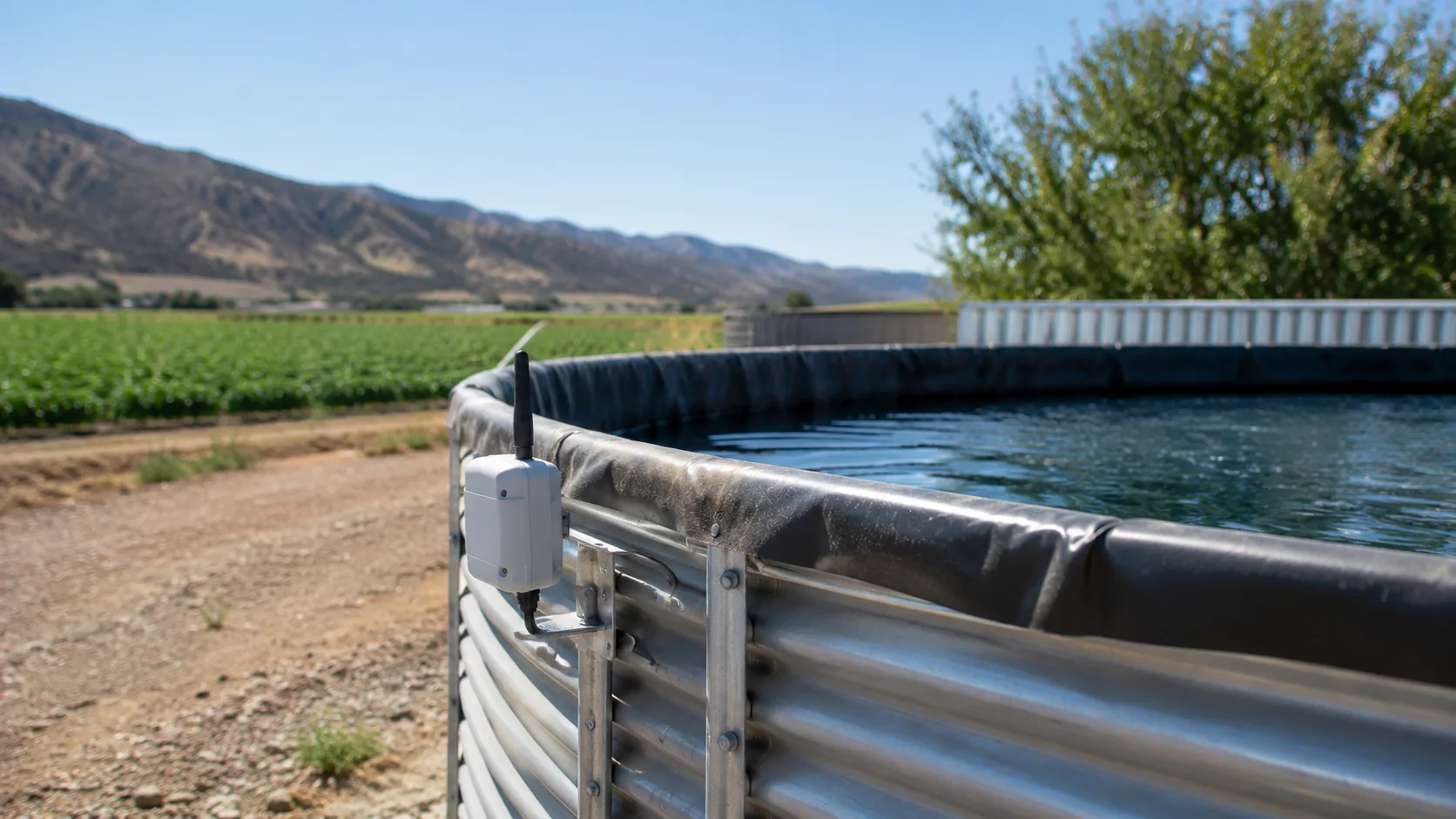
A water reservoir or storage tank is only useful when you know how much is in it. Run one dry and you stall irrigation, burn out a pump, or leave a herd without water. Let one overflow and you waste water, energy, and sometimes damage the surrounding ground. Yet on most farms the answer to “how full is the tank?” is still a guess, a sight tube nobody can see from the office, or a drive out to look.
Water level monitoring closes that gap. A single non-contact sensor and a cellular controller turn any reservoir or tank into a live reading on your phone, with alerts before it runs dry or overflows and, if you want, automatic pump and valve control. This guide walks through how it works, how to choose the sensor, and what a working system looks like on a farm.
What You Actually Want to Know About a Tank
Level monitoring sounds simple, but the useful system answers several questions at once.
How much water is there right now, as a level or a usable volume, so you can plan irrigation and refills. How fast is it changing, so you can see draw-down during an irrigation cycle and catch a leak or an unexpectedly heavy demand. Is it about to cross a limit, so you get a warning before a low-level stall or a high-level overflow rather than discovering it afterward. And, in many cases, can the system act on the reading itself, cutting a pump that would otherwise run dry or opening a fill valve to keep a tank in range.
A good water level monitoring setup delivers all four. A float switch on the wall delivers none of them from anywhere but arm’s reach.
Choosing a Water Level Sensor
The sensor is the foundation, and the right choice depends on the vessel and the conditions.
Ultrasonic: the practical default for reservoirs and tanks
A non-contact ultrasonic level sensor is the workhorse for irrigation reservoirs, storage tanks, and open channels. It mounts above the water and sends a sound pulse down to the surface, timing the echo to calculate distance and therefore level. Because nothing is submerged, there are no wetted electronics to foul with algae or corrode in hard water, which is a real advantage in agricultural water that is rarely clean. Ultrasonic sensors are accurate and cost-effective across the ranges most farm tanks and reservoirs need, and they output both a 4-20 mA signal and RS485 for easy integration.
Ultrasonic has known limits. Heavy dust, thick foam, and vapor can weaken the return signal, and the speed of sound changes with temperature, so quality sensors compensate for it. For clean water in an open or vented reservoir, none of these are usually a problem.
80 GHz radar: for range and harsh conditions
Where conditions are tougher, an 80 GHz radar level sensor is the more robust choice. Radar uses microwaves instead of sound, so it is unaffected by vapor, condensation, foam, or temperature, and it reaches longer distances. Radar costs more than ultrasonic, so it is worth the premium when you have a deep or long-range tank, a covered vessel with condensation, or a demanding environment. For a straightforward open irrigation reservoir, it is usually more sensor than you need.
What to avoid for most farm water
Contact-based options like submersible pressure sensors and float switches have their place, but on agricultural water they tend to foul, corrode, or stick over time, and float switches give you a single trip point rather than a continuous level. For a monitored, remotely visible reservoir, a non-contact sensor is the more reliable long-term choice.
Turning a Sensor Into a Remote System
A sensor on its own gives a local reading. To check your water from anywhere and get alerts, it needs a controller and a cloud platform.
On a farm, reservoirs and tanks almost never sit next to mains power or a network, so the controller has to be self-sufficient. The Omni Genesis controller is solar powered and reports over 4G-LTE cellular, so a tank out in a field is online with no wiring and no local Wi-Fi. It reads the ultrasonic or radar sensor, sends the level to the cloud, and holds the history.
From the dashboard you see every tank’s level in real time, set high and low alerts that reach you by app, SMS, or email, and review how levels have trended. The approach is the same one used for silo and level monitoring generally, applied to liquids, and it ties into the wider IoT soil and irrigation monitoring picture when you want reservoir level, soil moisture, and pump status on one platform.
Protecting Pumps and Automating Fills
The step beyond monitoring is control, and for water tanks it pays for itself quickly.
Dry-run pump protection. An irrigation pump that keeps running after its source reservoir empties can be destroyed in minutes. When the level sensor feeds a controller with output channels, a low-level reading can cut the pump automatically and restart it when the water recovers. That single function often justifies the system on its own.
Automatic fill control. For tanks that are topped from a borehole, a mains connection, or another reservoir, the controller can drive a fill valve or transfer pump to keep the tank within a set band, avoiding both run-dry and overflow without anyone watching.
Overflow and leak alerts. A high-level alert catches an overflow before it wastes water and floods the pad. A level that keeps dropping when nothing should be drawing from the tank flags a leak or a stuck valve you would otherwise find much later.
A Typical Farm Deployment
On a working farm, a reservoir monitoring setup is refreshingly simple. An ultrasonic sensor mounts on a bracket above the reservoir, aimed straight down at the water and set back from the walls and any inflow splash. It wires to a nearby solar-powered controller, which sends readings to the cloud over cellular. If pump protection is wanted, the pump contactor is wired to a controller output so the system can cut and restore it on level.
Two placement details matter. Keep the sensor clear of the fill stream, so it reads the settled surface rather than turbulence, and mount it far enough above the maximum water line to respect the sensor’s minimum measuring distance. Get those right and the readings are stable from day one.
Worth It for Any Farm With Stored Water
Water level monitoring is one of the lower-cost, higher-certainty pieces of farm automation. The failure it prevents, a dry irrigation stall at the wrong moment, a burned-out pump, an overnight overflow, are concrete and expensive, and the hardware is modest. For any operation that stores water in reservoirs or tanks, especially across remote sites, continuous level monitoring quickly pays for itself in avoided losses and saved trips.
If you want eyes on every tank without driving out to look, get a quote with a note on how many reservoirs or tanks you have and how far they sit from power, or browse the level sensor range to see the options.
Frequently Asked Questions
What is the best sensor for irrigation reservoir level monitoring?
For open reservoirs and water tanks, a non-contact ultrasonic level sensor is usually the best fit. It mounts above the water and measures the distance down to the surface, with nothing submerged to foul or corrode. For very long ranges, harsh conditions, or where vapor and condensation are a factor, an 80 GHz radar level sensor is the more robust option. Both connect to an IoT controller for remote readings and alerts.
How can I monitor my water tank level remotely?
Mount a non-contact level sensor above the tank, connect it to a solar-powered cellular controller, and the level is sent to a cloud dashboard you can check from any phone. You set high and low alerts, so you are warned before a tank runs dry or overflows, without driving out to look. No mains power or Wi-Fi is needed at the tank.
Can level monitoring protect my irrigation pump?
Yes. A pump running dry because a reservoir emptied is a common and expensive failure. When a level sensor feeds a controller with output channels, the system can cut the pump on a low-level reading and restart it when the water recovers, protecting the pump automatically. It can also drive fill valves to keep a tank topped within a set band.
What is the difference between ultrasonic and radar level sensors for water?
Ultrasonic sensors use sound and are an excellent, cost-effective fit for clean liquids in open or vented tanks at moderate range. Radar sensors use microwaves, cost more, and stay accurate through vapor, condensation, foam, and temperature swings, and reach longer distances. For a typical irrigation reservoir or storage tank, ultrasonic is the practical default; radar suits harsher or longer-range situations.
Does water level monitoring work on remote or off-grid sites?
Yes. A solar-powered controller with built-in 4G-LTE cellular sends level data from reservoirs and tanks that have no mains power and no network. This is the normal case in agriculture, where water storage sits out in the field far from any building, and it is exactly what a cellular-native system is built for.