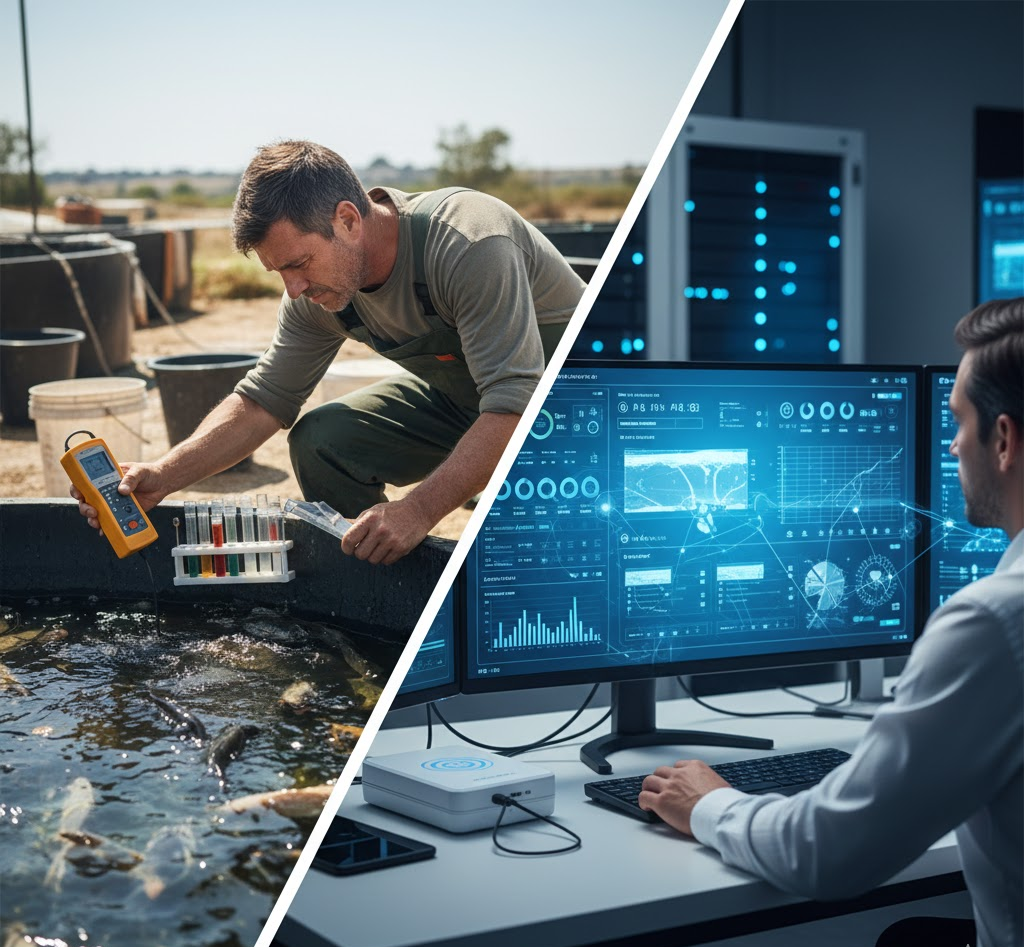
We’ve had the same conversation with maybe fifty farm managers over the past few years. It always starts the same way: “We’ve been doing manual testing for years and it works fine.” And we get it. Manual testing does work, right up until it doesn’t. The problem is that you rarely find out it stopped working until you’re staring at a pond full of dead fish at 6 AM, doing the math on how much money just floated belly-up.
This post isn’t a sales pitch disguised as analysis. We’re going to walk through actual numbers: real hardware costs, real labor calculations, real estimates on mortality risk. And then you can draw your own conclusions about IoT aquaculture monitoring ROI. We’ll even tell you when manual testing still makes perfect sense. But we think if you’re honest with yourself about the numbers, the answer is going to be pretty clear.
The 3 AM Problem
Here’s the fundamental issue with manual water testing: it’s a snapshot. You test dissolved oxygen at 8 AM and 4 PM, and you get two data points in a 24-hour period. What happened at 3 AM? You have no idea.
And 3 AM is exactly when things go wrong. That’s when algal respiration peaks and dissolved oxygen bottoms out. That’s when equipment failures go unnoticed for hours. That’s when a sudden temperature shift from a cold front can crash your DO levels from 6 mg/L to 2 mg/L in ninety minutes.
If you’ve been in aquaculture long enough, you know someone who’s lost a crop overnight. Maybe you are that someone. We certainly have. We talked about it in our aquaculture water quality guide. The fish don’t care that your testing schedule says the next check is at 7 AM.
So when we compare manual vs automated water testing, we’re not just comparing measurement methods. We’re comparing a system with built-in blind spots against one with continuous visibility. That distinction matters a lot when we get to the money.
The True Cost of Manual Testing
Most farm managers know what they spend on test kits and handheld meters. What they usually underestimate is the labor cost, and what they almost never account for is the cost of information gaps.
Labor Cost
Let’s build this out honestly. A typical aquaculture operation monitors at minimum five parameters: dissolved oxygen, pH, temperature, ammonia, and either salinity (marine/brackish) or electrical conductivity (freshwater). Each parameter takes 15 to 30 minutes per test point when you factor in walking to the pond, taking the sample, running the test, recording the result, and cleaning up.
For simplicity, let’s call it 20 minutes per parameter per location.
Daily testing time for a single pond:
- 5 parameters x 20 minutes = ~100 minutes per test round
- 2 tests per day (morning and afternoon) = 200 minutes = 3.3 hours
- If you add a third test during critical periods (summer, high stocking density): 5 hours/day
Annual labor for a single pond (2 tests/day):
- 3.3 hours/day x 365 days = 1,205 hours/year
Now, what does that labor cost? In the US, aquaculture technicians typically earn $15-25/hour depending on region and experience. Let’s use $18/hour as a reasonable midpoint.
- 1,205 hours x $18/hour = $21,690/year for one pond, two tests per day
That’s just one pond. A five-pond operation at the same testing frequency:
- $21,690 x 5 = $108,450/year in labor just for water testing
Now, in practice you can be more efficient than this. An experienced tech can batch-test multiple ponds in a circuit, and some parameters are faster than others. Let’s be generous and cut that number in half for batching efficiency:
- ~$54,225/year for a five-pond operation
That’s still a full-time employee doing nothing but water testing.
And here’s the thing nobody budgets for: weekends and holidays. Water quality doesn’t take Christmas off. Either you’re paying overtime, or you’re skipping tests, or you’re doing it yourself when you should be taking a break. Based on our experience working with farm operators, weekend and holiday coverage typically adds 15-25% to the effective labor cost.
Reagent and Equipment Costs
Manual testing consumables aren’t cheap, and they add up:
- pH test kits: $20-50 per kit, replaced every 50-100 tests. At 2 tests/day, that’s a new kit roughly every month. ~$240-600/year per pond.
- Ammonia test kits: $15-40 per kit, similar replacement rate. ~$180-480/year per pond.
- DO meter membranes and electrolyte: If you’re using a handheld DO meter ($300-800 for a decent one), membrane caps and electrolyte need replacement every 3-6 months. ~$100-200/year.
- Calibration solutions: pH buffers, DO calibration standards. ~$50-100/year.
- Refractometer (saltwater): $30-100 upfront, minimal ongoing cost.
A reasonable annual budget for manual testing consumables and equipment upkeep is $500-1,500 per pond, depending on how many parameters you’re tracking and how often you replace equipment.
For a five-pond freshwater operation: roughly $2,500-7,500/year in supplies alone.
If you want a multi-parameter handheld meter ($1,000-3,000) instead of individual test kits, the upfront cost is higher but the per-test cost is lower. Either way, the consumables keep coming.
Hidden Costs
This is where the manual vs automated water testing comparison gets uncomfortable.
Human error. Color-matching reagent tests are subjective. We’ve seen two experienced techs read the same ammonia test and get different results. Handheld meters drift between calibrations. Readings taken in direct sunlight are unreliable. One industry survey we’ve seen referenced suggested that manual colorimetric tests can carry error margins of 10-20%, which is significant when you’re trying to detect early warning signs of a water quality problem.
No continuous data history. A notebook full of handwritten readings is not a dataset. You can’t run trend analysis on a clipboard. You can’t see that your DO has been declining by 0.1 mg/L every day for the past two weeks, a pattern that’s invisible in daily spot-checks but obvious in a continuous data log.
No alerts. This is the 3 AM problem again. Manual testing gives you data only when someone is actively testing. The other 20+ hours of the day, you’re flying blind. If your aerator fails at midnight, you won’t know until morning.
Decision delay. With manual testing, there’s always a gap between “something changed” and “we know about it.” That gap might be hours. In aquaculture, hours matter.
The True Cost of IoT Monitoring
Now let’s be equally honest about the cost of going digital. IoT monitoring isn’t free, and we don’t want to pretend otherwise.
Hardware Investment
Here are real system configurations using actual product prices. We’re building these from our current catalog so you can verify every number.
Basic Freshwater Setup (single pond): Budget-friendly for farms monitoring the critical basics.
| Component | Details |
|---|---|
| DO-P100 dissolved oxygen sensor | PE body, fluorescent, freshwater optimized |
| PH-10 pH sensor | Analog, +-0.01 pH accuracy |
| EC-100 conductivity sensor | K=1.0, freshwater range |
| Omni Genesis controller | 4 sensor ports, RS-485/Modbus |
Standard Freshwater Setup (single pond): More robust sensors and additional ORP monitoring.
| Component | Details |
|---|---|
| DO-100 dissolved oxygen sensor | 316L stainless, fluorescent, 1-year warranty |
| PH-100 pH sensor | Digital RS485, ATC |
| EC-100 conductivity sensor | K=1.0, freshwater range |
| ORP-100 sensor | +-1 mV accuracy, ATC |
| Omni Genesis controller | 4 sensor ports, RS-485/Modbus |
Full Marine/Saltwater Setup (single pond): Corrosion-resistant materials for harsh marine environments, plus ammonia monitoring critical for shrimp.
| Component | Details |
|---|---|
| DO-110 titanium dissolved oxygen sensor | Titanium alloy, 0-60 ppt salinity |
| PH-100 pH sensor | Digital RS485, ATC |
| EC-120 conductivity sensor | K=0.45, high salinity range |
| ORP-100 sensor | +-1 mV accuracy, ATC |
| NH3-100 ammonia sensor | 0.05-1,400 mg/L, direct NH3 |
| Omni Exodus controller | 6 ports, marine-grade connectors |
Contact us for current pricing on any of these configurations. No hidden fees, no required software subscriptions for basic functionality.
Ongoing Costs
Hardware isn’t a one-time expense. Here’s what to budget annually:
- Calibration supplies: pH buffers, DO calibration solutions. ~$50-100/year.
- DO sensor membrane caps: Replacement every 6-12 months depending on conditions. ~$30-50 per replacement.
- Cellular connectivity: If you’re using 4G/LTE for remote data transmission (common for ponds away from WiFi), expect $10-20/month ($120-240/year).
- Sensor replacement reserves: This is the big one. All DO sensors carry a 1-year warranty. Budget for potential replacement or membrane cap swaps after that period. pH sensors generally need replacement every 2-3 years. EC and ORP sensors can last 3-5 years with proper maintenance.
A realistic annual maintenance budget for a single monitoring station is $200-500/year, not counting full sensor replacements.
What You Get
Here’s what changes when you move to continuous IoT monitoring:
- Readings every 5-15 minutes, 24 hours a day, 365 days a year. That’s 96-288 data points per parameter per day, versus 2-3 with manual testing.
- Instant SMS and email alerts when any parameter crosses your thresholds. The 3 AM DO crash triggers your phone alarm before the fish even start showing stress.
- Historical data logging with trend visualization. You can see patterns over days, weeks, and seasons. You can correlate DO drops with feeding times, temperature changes, or stocking density.
- Remote access from your phone or laptop. Check on your ponds from home, from a supplier meeting, from vacation.
All sensors in our lineup use RS485 Modbus RTU protocol with IP68 waterproof ratings. They’re designed for permanent submersion in aquaculture environments, not lab instruments adapted for field use. For more on sensor communication protocols and why RS485 matters for reliability, see our sensor protocols guide.
Side-by-Side: 3-Year Total Cost of Ownership
This is the comparison that tells the real story. Let’s look at a single pond over three years.
Manual Testing (3-Year Cost, Single Pond)
| Cost Category | Annual | 3-Year Total |
|---|---|---|
| Labor (2 tests/day, $18/hr, with efficiency factor) | $10,845 | $32,535 |
| Test kits and consumables | $750 | $2,250 |
| Handheld meter depreciation (amortized) | $300 | $900 |
| Weekend/holiday premium (~20%) | $2,169 | $6,507 |
| Total | $14,064 | $42,192 |
IoT Monitoring (3-Year Cost, Single Pond, Standard Freshwater)
| Cost Category | Year 1 | Years 2-3 | 3-Year Total |
|---|---|---|---|
| Hardware (one-time, check current pricing) | Sensor suite + controller | — | One-time investment |
| Calibration and membrane replacements | ~$150 | ~$300 | ~$450 |
| Cellular connectivity | ~$180 | ~$360 | ~$540 |
| Sensor replacement reserve (partial) | $0 | ~$400 | ~$400 |
| Ongoing costs (excluding hardware) | ~$330 | ~$1,060 | ~$1,390 |
The hardware investment is a one-time cost that varies by configuration. Contact us for current pricing on the standard freshwater setup. Adding ongoing costs to the hardware investment gives you the total 3-year cost, which is dramatically lower than manual testing.
Even if you argue our labor numbers are high and cut them by two-thirds, saying your testing labor only costs $3,600/year per pond because you’re the owner doing it yourself, the ongoing costs of IoT monitoring (calibration, connectivity, maintenance) are roughly comparable to manual testing supplies alone, before you even count labor. The moment you value your own time at anything above minimum wage, IoT monitoring wins.
And we haven’t even talked about the biggest cost yet.
The Mortality Factor: Where IoT Pays for Itself
All the numbers above compare operational costs. But the real IoT aquaculture monitoring ROI calculation has to include the thing that makes or breaks aquaculture profitability: keeping your animals alive.
The Math on Mortality
Industry figures on aquaculture mortality vary widely by species, system type, and management quality. But here are some commonly referenced ranges based on industry experience and published aquaculture management literature:
- Typical mortality in well-managed manual operations: 15-30% over a full crop cycle
- Typical mortality in operations with continuous monitoring and alerts: Potentially 5-15% lower than equivalent manual operations
That “5-15% lower” range might sound modest, but let’s run the numbers on what it means in dollars.
Freshwater example, tilapia pond:
- Pond stocked with 10,000 fingerlings
- Target harvest weight: 500g
- Farm-gate price: ~$2.50/kg
- Potential harvest value at 0% mortality: 10,000 x 0.5kg x $2.50 = $12,500
If your baseline mortality is 25% (manual), you harvest 7,500 fish = $9,375. If IoT monitoring reduces mortality to 20%, you harvest 8,000 fish = $10,000. That 5% improvement = $625 per pond per cycle.
If you run 2 cycles per year on 5 ponds, that’s $6,250/year in additional revenue from reduced mortality alone.
Saltwater example, shrimp intensive pond:
- Half-hectare pond, stocked at 100 PL/m2 (500,000 post-larvae)
- Target harvest: 20-25g average
- Farm-gate price: ~$6-10/kg depending on market and size
- Potential harvest value (let’s use conservative numbers): 500,000 x 0.020kg x $7 = $70,000
Shrimp mortality is typically higher than fish. A 5% improvement on a $70,000 crop is $3,500 per pond per cycle. On a 10-pond operation running 2-3 cycles per year, that’s $70,000-105,000/year.
And that’s the conservative scenario, just a 5% mortality reduction. The real value of IoT monitoring isn’t just reducing average mortality by a few percentage points. It’s preventing the catastrophic events: the overnight DO crash that kills 80% of a pond, the ammonia spike after a biofilter failure, the temperature shock from an unexpected storm.
One Catastrophic Event
Let us put it bluntly: one overnight DO crash in one shrimp pond can cost you $30,000-$50,000. An Omni Exodus controller with a DO-110 titanium sensor would have sent you an SMS alert within 15 minutes of DO starting to drop. You could have had emergency aeration running in under an hour. Instead, you discovered dead shrimp at 6 AM.
The entire marine monitoring system pays for itself the first time it catches a problem that would have cost you a fraction of a single pond’s crop value.
Freshwater Farm Example: Tilapia Pond Operation
Let’s walk through a complete scenario for a mid-size freshwater operation.
Farm profile:
- 5 one-hectare earthen ponds
- Tilapia, semi-intensive culture
- 2 crop cycles per year
- Location: Southeastern US (or similar tropical/subtropical climate)
- Per-pond crop value: ~$12,500 at harvest
Manual Testing Scenario
- Staffing: 1 dedicated water quality technician ($18/hr, full-time = ~$37,440/year)
- Testing frequency: 2 rounds per day, all 5 ponds, 5 parameters each
- Equipment: 1 handheld DO meter ($500), 1 pH meter ($200), assorted test kits
- Annual supplies: ~$3,750 (reagents, membranes, calibration)
- Weekend coverage: Technician gets weekends off; owner does abbreviated testing (let’s say $2,000/year equivalent in owner time)
Annual manual testing cost: ~$43,190
3-year manual testing cost: ~$129,570
IoT Monitoring Scenario
- Hardware: 5x Standard Freshwater setups (contact us for current pricing)
- Annual maintenance + connectivity: ~$2,650/year per 5-pond system
- 3-year ongoing costs (excluding hardware): ~$7,950
You still need someone to manage the farm, of course. But that person is now spending their time on feeding, harvesting, maintenance, and business management instead of walking from pond to pond with test kits.
The savings compared to manual testing are substantial, even accounting for the hardware investment. The labor cost reduction alone is dramatic.
Even if you keep a part-time tech for manual spot-checks and maintenance (smart idea, and we’ll get to that), you’re saving significantly over three years.
The Omni Genesis controller handles 4 sensors per unit, which covers the standard freshwater setup (DO, pH, EC, ORP). If you want to add an ammonium sensor or chlorophyll sensor for algae bloom monitoring, you’d either upgrade to the Omni Exodus (6 ports) or add a second controller.
Saltwater Farm Example: Shrimp Intensive Operation
Shrimp farming is where the aquaculture monitoring cost calculation gets really stark, because the stakes are higher, the environment is harsher, and the margins for error are thinner.
Farm profile:
- 10 half-hectare intensive shrimp ponds
- Pacific white shrimp (Litopenaeus vannamei)
- 2-3 crop cycles per year
- Brackish/saltwater environment
- Per-pond crop value: ~$50,000-70,000 at harvest
Why Shrimp Operations Need More Monitoring
Shrimp are more sensitive to water quality fluctuations than most fish species. They’re bottom dwellers in stratified ponds, so surface readings don’t tell the whole story. Disease outbreaks (EMS, white spot, vibriosis) correlate strongly with water quality stress events. And the crop values are substantially higher per hectare than most freshwater fish operations.
For shrimp, you really want to monitor:
- Dissolved oxygen (absolutely critical; shrimp crash faster than fish)
- pH (affects ammonia toxicity and shell formation)
- Salinity/EC (must be stable; fluctuations stress animals)
- ORP (indicator of overall water chemistry health)
- Ammonia (toxic at much lower concentrations than for fish)
That’s the full marine setup we priced earlier. And in saltwater, you need corrosion-resistant hardware. Our DO-110 uses a titanium body specifically because stainless steel corrodes too quickly in marine environments. The EC-120 is rated for high-salinity applications. And the Omni Exodus controller is marine-grade with 6 ports.
3-Year Cost Comparison for 10-Pond Shrimp Farm
Manual Testing:
| Cost Category | Annual | 3-Year Total |
|---|---|---|
| 2 full-time technicians (24/7 coverage needed) | $74,880 | $224,640 |
| Test kits and consumables (10 ponds, 6+ parameters) | $10,000 | $30,000 |
| Handheld equipment (multi-parameter meters, replacements) | $3,000 | $9,000 |
| Overtime/holiday premium | $11,232 | $33,696 |
| Total | $99,112 | $297,336 |
IoT Monitoring:
| Cost Category | Year 1 | Years 2-3 | 3-Year Total |
|---|---|---|---|
| 10x Full Marine setups (contact for pricing) | Hardware investment | — | One-time cost |
| Calibration and maintenance | ~$1,500 | ~$3,000 | ~$4,500 |
| Cellular connectivity (10 units) | ~$2,400 | ~$4,800 | ~$7,200 |
| Sensor replacement reserves | $0 | ~$8,000 | ~$8,000 |
| Ongoing costs (excluding hardware) | ~$3,900 | ~$15,800 | ~$19,700 |
Even with the hardware investment added, the total 3-year IoT cost is a fraction of the manual testing cost, representing savings of over $200,000 on a 10-pond operation.
And again, this doesn’t include the mortality benefit. If continuous monitoring prevents even one catastrophic pond loss over three years (and in shrimp farming, overnight crashes are not rare events), that’s another $50,000-70,000 saved. For more detail on parameter management specific to shrimp operations, see our shrimp farming water quality guide.
The IoT system pays for itself rapidly through labor savings alone on a 10-pond shrimp farm. That’s not an optimistic projection. That’s straightforward arithmetic.
When Manual Testing Still Makes Sense
We promised we’d be honest about this, and we mean it. IoT monitoring isn’t the right answer for everyone in every situation.
Very Small Operations
If you have one or two backyard ponds and you’re the only person working them, the labor cost comparison doesn’t apply the same way, since you’re doing the testing yourself regardless. At that scale, the Omni Genesis Lite with a single DO-P100 sensor is still worth it for the overnight alert capability alone, but the full multi-parameter setup may be harder to justify purely on financial terms.
Backup Verification
Even with IoT monitoring, smart operators do periodic manual spot-checks. Sensors can drift. Biofouling can affect readings. A weekly manual verification with a calibrated handheld meter is cheap insurance and good practice. The IoT system handles the 24/7 continuous monitoring; manual testing handles the “trust but verify” quality assurance.
Parameters Not Easily Automated
Some water quality parameters are still best tested manually or in a lab. Specific pathogen tests, detailed mineral profiles, certain heavy metals: these aren’t practical to monitor continuously with in-situ sensors. Your lab testing budget doesn’t go away with IoT; it just gets focused on the things that actually require lab work.
Startup Farms Testing the Concept
If you’re just getting into aquaculture and aren’t sure about your long-term commitment, starting with manual testing is reasonable. But we’d strongly suggest investing in at least a basic DO monitoring system from day one. Dissolved oxygen is the parameter most likely to kill your stock overnight, and a Genesis Lite controller with a single dissolved oxygen sensor is a smaller investment than losing your first crop.
The Hybrid Approach
What most successful operations end up with is a hybrid: IoT sensors for continuous monitoring of the critical parameters (DO, pH, temperature, conductivity), plus periodic manual or lab testing for everything else. The IoT system is your early warning system and data logger. Manual testing is your quality assurance cross-check.
This combination gives you the best of both worlds and is honestly what we recommend for most farms.
Beyond ROI: Data-Driven Farm Management
The financial case for IoT monitoring is compelling on its own, but the real transformation happens when you start using the data, not just collecting it.
Feed Optimization
When you can see DO levels in real time, you can optimize feeding. Heavy feeding drives DO consumption as uneaten feed decomposes and fish metabolic demand increases. By monitoring DO response to feeding events, you can fine-tune feed amounts and timing to maximize feed conversion ratios. Based on typical industry experience, even a 5-10% improvement in feed conversion on a commercial operation translates to significant savings, given that feed is usually 50-60% of total production cost.
Predictive Maintenance
Continuous data reveals patterns that spot-checks miss. A gradual decline in DO levels over weeks might indicate biofilter degradation, increasing organic load, or declining aerator efficiency. You can catch and address these trends before they become emergencies. Your afternoon DO readings looked fine at 6.2 mg/L, but the continuous data shows that your overnight minimum has been creeping down from 4.8 to 4.2 to 3.9 over the past month. That’s a trend that demands attention, and you’d never see it with manual testing.
Crop Planning
After a few crop cycles with continuous data, you build a historical picture of your farm’s water quality patterns. You know which months bring the tightest DO margins. You know how pH behaves after heavy rain events. You know how long it takes your system to recover after a feed increase. This historical data makes every subsequent crop cycle more predictable and more profitable.
Compliance Documentation
If you’re pursuing or maintaining certifications like ASC (Aquaculture Stewardship Council), BAP (Best Aquaculture Practices), or GlobalGAP, you need documented water quality records. Automated data logging with timestamped readings is dramatically more credible and less labor-intensive than handwritten notebooks. Auditors love digital records with continuous timestamps. They’re skeptical of notebooks.
Making the Transition: Start Small
You don’t need to instrument every pond with a full sensor suite on day one. Here’s a practical transition path.
Phase 1: Prove the Concept
Start with one pond, ideally your highest-value or most problematic one.
- Omni Genesis Lite controller with 1 sensor port
- One DO-P100 dissolved oxygen sensor for freshwater, or DO-110 for saltwater
This gives you 24/7 dissolved oxygen monitoring with alerts on the single most critical parameter. Run this for one crop cycle alongside your existing manual testing. Compare the data. See what the continuous monitoring catches that your twice-daily testing misses.
We can almost guarantee you’ll see overnight DO events you never knew about.
Phase 2: Expand Parameters
Once you’re convinced (and you will be), upgrade to a multi-parameter setup on that first pond:
- Move to an Omni Genesis (4 ports) or Omni Exodus (6 ports)
- Add pH, EC, and ORP sensors
- For shrimp operations, add an ammonia sensor
Phase 3: Scale Across the Farm
Roll out monitoring to remaining ponds. At this point you’ll have real data from Phase 1 and 2 to justify the investment to partners, lenders, or your own budget. Many farms start reallocating labor savings to fund the expansion, and the system effectively pays for its own rollout.
Phase 4: Advanced Monitoring
Add specialized sensors for specific needs:
- Chlorophyll sensors for algae bloom prediction
- Ammonium ISE sensors for precise nitrogen cycle monitoring
- Additional sensor points at different depths or locations within large ponds
Conclusion: Can You Afford Not to Monitor?
Let us bring this back to the numbers one more time.
For a five-pond freshwater tilapia farm, manual testing costs roughly $129,570 over three years in labor and supplies alone. IoT monitoring costs a fraction of that. For a ten-pond shrimp operation, manual testing runs roughly $297,336 over three years, while IoT monitoring is dramatically less.
Those savings are real, and they’re conservative. We used middle-of-the-road labor rates, assumed efficient manual testing practices, and didn’t include the value of catastrophic loss prevention, which is where IoT monitoring delivers its most dramatic returns.
But we think the most compelling argument isn’t about the money. It’s about this: with manual testing, you’re making decisions based on two or three snapshots per day and hoping nothing goes wrong in between. With continuous IoT monitoring, you have complete visibility into your operation 24 hours a day, 7 days a week. You’re notified the moment something starts going wrong, not hours after it’s already gone wrong.
The question for any fish farm monitoring system cost analysis isn’t really “can I afford IoT monitoring?” A basic system with a controller and single DO sensor is an affordable entry point. The real question is: “can I afford to not know what’s happening in my ponds at 3 AM?”
Based on the numbers, we think the answer is pretty clear. But don’t take our word for it. Start with a Genesis Lite and a single dissolved oxygen sensor. Run it for one cycle. Let the data convince you.
It always does.