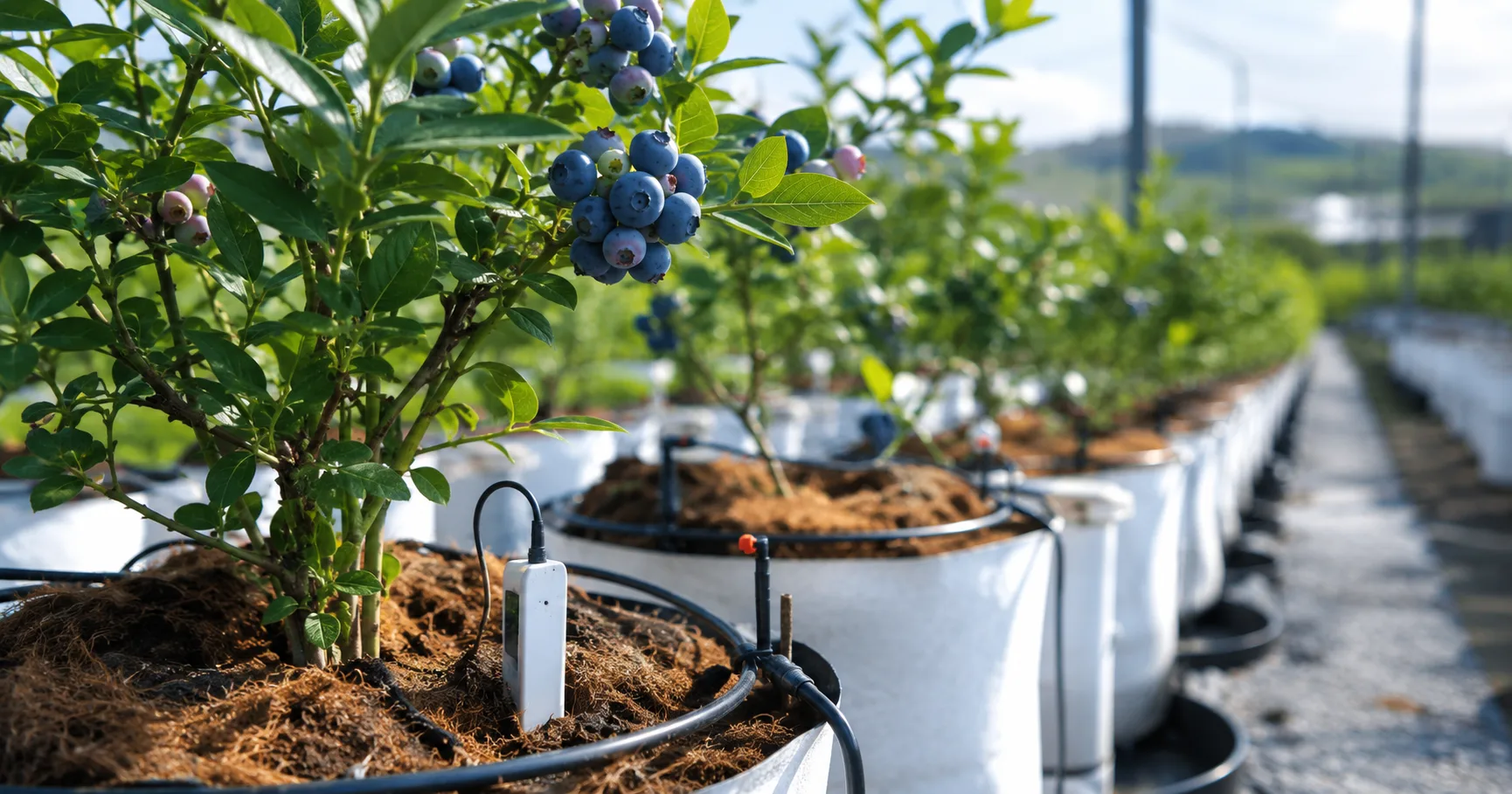
Blueberries are an unforgiving crop to irrigate and feed, and the reason is botanical. Unlike most fruit crops, blueberries evolved in acidic, low-nutrient soils, and they carry two traits that make them demanding: they need a distinctly acidic root zone, and they have shallow, fine roots with low tolerance for salinity. Get either wrong and the plant does not fail dramatically overnight. It quietly underperforms, throws yellowing leaves, and gives you a fraction of the yield the block should produce.
That slow, silent failure mode is exactly why blueberry farms benefit from continuous monitoring. The two numbers that decide a blueberry crop’s fate, root-zone pH and salinity (EC), are invisible from the row and drift gradually. By the time you can see the problem in the canopy, you have already lost weeks of growth. Sensors let you see the drift while it is still a number on a dashboard, not a symptom on a leaf.
The two measurements that make or break blueberries
pH: keep the root zone acidic
Blueberries grow best in an acidic root zone, commonly cited in the range of pH 4.5 to 5.5. This is not a preference, it is a nutrient-availability requirement. Above roughly pH 5.5, iron and several other nutrients become far less available to the plant even when they are present in the soil, and the classic result is interveinal chlorosis (yellow leaves with green veins) and stunted, unproductive bushes.
The trouble is that most irrigation water is not acidic. Hard groundwater and recycled water are often alkaline and carry bicarbonates that steadily push the root zone up out of the range blueberries need. Growers counter this by acidifying irrigation water, but acidification is a moving target that depends on water chemistry and flow, and that is precisely the kind of thing you want measured rather than assumed. Continuous pH monitoring of the feed and, where practical, the root-zone solution tells you whether your acidification is actually holding the root zone where it belongs.
EC: watch salinity relentlessly
Electrical conductivity (EC) is a proxy for the total dissolved salts in a solution, which for a grower means fertilizer concentration plus whatever salinity the water carries. Blueberries have low salt tolerance, so EC management is not a fine-tuning exercise for them, it is a core safety measurement.
Two things drive EC too high: over-fertilization and salt accumulation in the root zone from saline water or insufficient leaching. Because blueberry roots are shallow and fine, they are among the first to be damaged by elevated EC. The plant responds with reduced water uptake, marginal leaf burn, and suppressed growth, symptoms that look like several other problems and are easy to misdiagnose.
Feed EC versus drain EC: the measurement that matters most
For substrate-grown blueberries (containers or beds of pine bark, coir, or similar media, which is how much modern and Israeli blueberry production is set up), the single most informative routine measurement is the comparison between feed EC and drain EC.
- Feed EC is the EC of the nutrient solution you apply. It tells you what is going in.
- Drain EC is the EC of the runoff leaving the container or root zone. It tells you what is actually accumulating around the roots.
When drain EC sits close to feed EC, your salt balance is healthy. When drain EC climbs well above feed EC, salts are building up in the root zone faster than they are leaching out, and you are heading toward salinity damage. The fix (a larger leaching fraction, or correcting the feed) is simple once you can see the gap. Without measurement, you find out when the plants tell you, which is too late.
The same feed-versus-drain logic applies to pH: comparing the pH going in with the pH coming out reveals how the substrate is buffering your acidification.
What Agrinovo sensors measure, honestly
It is worth being precise about what these sensors do, because the wrong mental model leads to wrong decisions. Agrinovo pH and EC probes are inline liquid probes. They measure the nutrient solution and the drain water, not the water content locked inside the substrate solids. That is exactly the right measurement for fertigation management: feed and drain pH and EC are the levers you actually control.
- pH monitoring: the PH-100 digital pH probe (RS485) or the PH-110 industrial pH probe, which is built for continuous inline use in irrigation lines. For a simpler analog installation, the PH-10 in-line pH probe.
- EC monitoring: the EC-100 digital conductivity probe (RS485) on the feed and drain lines, or the analog EC-10. How to pick an EC probe for a fertigation setup is covered in our EC probe selection guide.
- Moisture: for soil-grown or acidified-bed blueberries, the Watermark 200SS granular matrix sensor reads soil water tension so you irrigate on plant demand rather than a timer. For container/substrate blueberries, manage moisture through irrigation frequency and drain behavior rather than a soil tension sensor.
- Root-zone temperature: the DS18B20 soil temperature sensor, useful because root activity and nutrient uptake track soil temperature.
We do not make an in-substrate water-content probe, and we will not pretend a pH or EC probe reads substrate moisture. Framing the measurement correctly is part of getting the agronomy right.
Bringing it together on the farm
A blueberry monitoring station connects these probes to an Omni Genesis controller, which sends readings to a cloud dashboard over cellular. In practice that gives a blueberry grower:
- Live feed and drain pH and EC, so acidification and fertilizer concentration are verified continuously instead of spot-checked with a handheld meter once a day.
- Alerts on drift, for example when feed pH creeps above your acid target or drain EC pulls away from feed EC, so you intervene before roots are damaged.
- A season-long record that ties your pH and EC management to how the crop actually performed, which is how you refine the program year over year.
For farms running several blocks or benches, the Omni Exodus controller handles more probes per unit. The hardware is modular, so a station can start as pH-plus-EC on the feed line and grow to include drain monitoring, root-zone temperature, and soil tension as the operation scales. This is the same precision agriculture approach we apply across crops, adapted to what blueberries specifically demand.
Practical notes
Acidify to a target, then verify. Setting an acid injection rate is not the same as achieving a root-zone pH. Measure the result; water chemistry changes through the season.
Trend the feed-drain gap. A single drain EC reading is a snapshot. The gap between feed and drain EC, tracked over days, is what tells you salts are accumulating.
Mind the shallow roots. Blueberry roots are near the surface and fine. They punish both drought and waterlogging quickly, so consistency matters more than for deep-rooted trees.
Water quality is the starting point. If your source water is alkaline or saline, no downstream tweak fully fixes it. Measure the water going in first, and treat it before it reaches a salt-sensitive, acid-loving crop.
Conclusion
Blueberries reward growers who measure. The crop’s two defining sensitivities, a narrow acid pH range and low salinity tolerance, are precisely the conditions that are invisible from the row and drift slowly out of bounds. Continuous pH and EC monitoring on the feed and drain, plus tension-based moisture monitoring for soil-grown plantings, turns those hidden variables into numbers you can act on before they cost you yield.
Start with feed and drain pH and EC monitoring, the two measurements that most directly protect a blueberry crop, and connect them through a precision agriculture platform so you catch drift early. For the wider fertigation picture, our hydroponic nutrient monitoring guide covers EC and pH management in soilless systems, and the soil sensors guide explains how each measurement fits together.