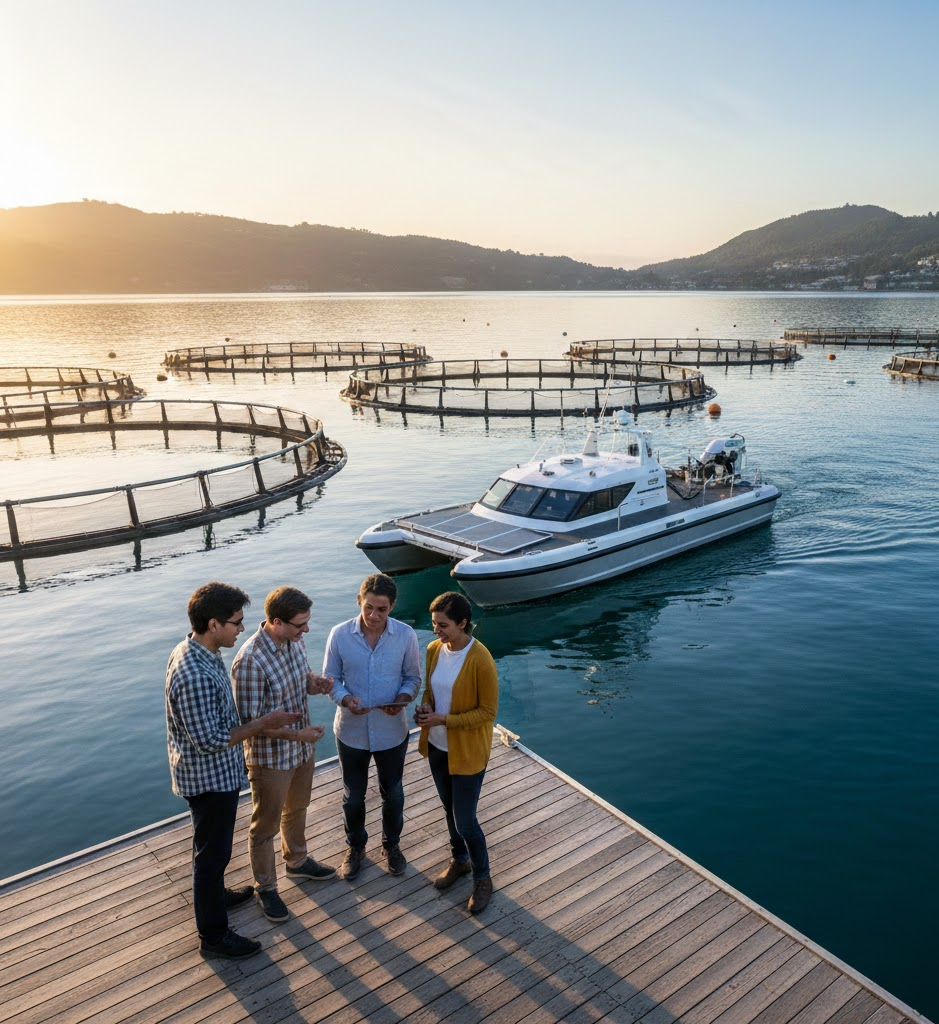
We’ve helped dozens of fish farmers spec out their first aquaculture monitoring system over the past several years, and we keep seeing the same pattern: someone spends $3,000 on equipment that doesn’t fit their operation, realizes six months later they bought the wrong sensors for their water type, and ends up replacing half the system. The worst case we saw was a shrimp farmer who bought freshwater-grade stainless steel probes for saltwater ponds. Corrosion ate through three sensors in under four months. That was $1,200 down the drain, plus the fish losses from unmonitored water quality during the weeks it took to get replacements.
Choosing the best aquaculture monitoring system isn’t complicated once you understand what matters. But there’s a lot of bad advice out there, a lot of vendors selling equipment that looks good on paper but fails in the field, and very little honest information about what you actually need versus what someone wants to sell you. This guide is our attempt to fix that.
Whether you’re running a freshwater tilapia operation, a saltwater shrimp farm, or anything in between, by the end of this article you’ll know exactly what to buy, what to skip, and what red flags to watch for.
The 5 Core Parameters Every Aquaculture Monitoring System Must Cover
Before you look at a single product listing, you need to understand the five water quality parameters that every fish farming monitoring system should track. Miss any of these and you’re flying blind on something that can kill your stock.
Dissolved Oxygen (DO)
This is the single most critical parameter in aquaculture. Fish suffocate when DO drops too low, and it can happen in hours. Most warmwater species need DO above 5 mg/L; coldwater species like trout and salmon need 6-7 mg/L or higher. A sudden DO crash at 3 AM will kill more fish than almost any other water quality event.
Your aquaculture monitoring system needs to measure DO continuously, not just once or twice a day. Manual testing with a handheld meter is fine for spot checks, but it won’t catch the 2 AM oxygen crash caused by a failed aerator or an algae bloom that consumed all the oxygen overnight.
The difference between freshwater and saltwater here matters: oxygen solubility decreases in saltwater, so marine systems run on tighter margins. A saltwater salmon cage at 15 ppt salinity holds roughly 10% less dissolved oxygen than an equivalent freshwater system at the same temperature. Your alarm thresholds need to account for this.
pH
pH affects everything from ammonia toxicity to gill function to feed conversion rates. Most freshwater species thrive between 6.5 and 8.5, while marine species generally prefer 7.8 to 8.3. But the real danger isn’t a slightly off-target pH; it’s rapid swings. A 0.5 pH unit swing in a few hours stresses fish far more than a stable reading that’s slightly outside the ideal range.
In freshwater ponds, pH can swing dramatically between day and night due to photosynthesis and respiration cycles. In saltwater, the natural buffering capacity of seawater keeps pH more stable, but you still need to watch it, especially in recirculating systems where buffering depletes over time.
The critical link most people miss: pH determines how toxic your ammonia is. At pH 7.0, only about 0.5% of total ammonia is in the toxic NH3 form. At pH 8.5, that jumps to roughly 15%. Same ammonia level, completely different toxicity. You cannot manage ammonia without monitoring pH. For a deeper dive into how these parameters interact, see our aquaculture water quality guide.
Electrical Conductivity / Salinity
EC tells you about the total dissolved ions in your water, which for aquaculture primarily means salinity. In freshwater systems, rising EC over time signals salt and mineral buildup from feed inputs and evaporation, a sign you need more water exchange. In brackish and marine systems, EC is how you maintain the precise salinity your species requires.
Freshwater fish generally live in water under 1 mS/cm. Brackish shrimp (like vannamei) can range from 10 to 35 mS/cm depending on grow-out stage. Marine finfish need 45-55 mS/cm. Getting salinity wrong by even a few ppt costs you in growth rates and feed conversion, so continuous EC monitoring pays for itself quickly in any salinity-dependent operation.
The sensor selection here is the biggest freshwater-vs-saltwater decision you’ll make. Freshwater and saltwater require different sensor cell constants, and using the wrong one gives you garbage data. For detailed guidance on selecting the right EC probe for your water type, see our EC probe selection guide. More on that in the sensor technology section below.
Temperature
Temperature affects dissolved oxygen capacity, metabolic rate, feed conversion, ammonia toxicity, and disease susceptibility. It’s the parameter that modifies all other parameters. Every aquaculture monitoring system needs temperature logging, and most modern DO and pH sensors include integrated temperature measurement with automatic compensation.
The good news is that temperature sensors are cheap and reliable. The important thing is having continuous logging so you can see trends and correlate temperature changes with other parameter shifts. A sudden 2-degree drop from a cold front explains a lot of unusual fish behavior.
ORP (Oxidation-Reduction Potential)
ORP is the parameter that separates basic monitoring from a truly comprehensive aquaculture monitoring system. It measures the water’s oxidizing or reducing capacity in millivolts, giving you a single number that reflects overall water quality.
Healthy aquaculture water typically reads 200-400 mV. Below 200 mV means reducing conditions: organic waste is accumulating, bacterial activity is high, and you’re headed for trouble. Above 400 mV is typical of heavily ozonated or chlorinated water.
We think of ORP as the “check engine light” of water quality. It doesn’t tell you exactly what’s wrong, but when it starts trending downward over days, it tells you something is deteriorating before DO or pH show problems. For farms using ozone treatment, ORP is essential for verifying disinfection effectiveness.
Advanced Parameters Worth Adding
The five core parameters will keep your fish alive. These advanced parameters will help you optimize growth, prevent disease, and catch subtle problems early.
Ammonia (NH3) and Ammonium (NH4+)
Ammonia is the primary metabolic waste product from fish. It accumulates in every aquaculture system and is toxic at surprisingly low concentrations. Toxic unionized ammonia (NH3) is dangerous above 0.02 mg/L for long-term exposure in most species, and lethal at 0.2-0.4 mg/L for sensitive fish like trout.
Continuous ammonia monitoring used to be unreliable and expensive. The technology has improved significantly, and modern ion-selective sensors like the NH4-100 (ammonium, 0.1-18,000 mg/L range) and NH3-100 (ammonia, 0.05-1,400 mg/L range) are now viable for commercial operations. They’re still a significant investment, so we recommend them primarily for intensive recirculating systems where ammonia is your constant enemy. For pond-based systems with regular water exchange, weekly lab testing may still be sufficient.
Nitrite and Nitrate (NO2 / NO3)
Nitrite is the intermediate product in the nitrification cycle, and it’s toxic to fish. It binds to hemoglobin and reduces oxygen-carrying capacity (brown blood disease). Nitrate is the end product and is far less toxic, but high levels indicate biofiltration issues or insufficient water exchange.
For recirculating aquaculture systems (RAS), tracking the nitrogen cycle is critical. The NO2-100 (nitrite, 0.5-46,000 mg/L) and NO3-100 (nitrate, 0.6-62,000 mg/L) sensors let you monitor biofiltration performance in real time. For flow-through or pond systems, these are less critical since water exchange dilutes nitrogen compounds naturally.
Chlorophyll
Chlorophyll concentration is a proxy for algae biomass in your water. For pond-based aquaculture, algae management is a constant balancing act: too little algae means no natural food source and poor oxygen production; too much leads to overnight DO crashes when respiration exceeds photosynthesis.
The CHL-100 chlorophyll sensor measures 0-500 ug/L and includes a self-cleaning brush, which matters because algae measurement sensors are particularly prone to biofouling. The 316L stainless steel construction handles both freshwater and moderate salinity environments. We’d call this a specialized tool for pond-based operations rather than a universal requirement, but if algae blooms are your recurring nightmare, continuous chlorophyll data is transformative.
Sensor Technology: What to Look For in Aquaculture Monitoring Equipment
Not all sensors are created equal, and the technology inside matters as much as the parameter being measured. Here’s what to pay attention to when evaluating aquaculture monitoring equipment.
Fluorescent vs. Galvanic DO Sensors
This is the most important sensor technology decision you’ll make. Galvanic DO sensors are cheaper ($200-350 typically) but they consume oxygen at the sensing membrane to generate a measurement signal. This means they need regular membrane replacement (every 1-2 years), they take 5-10 minutes to stabilize after installation, and they drift over time as the membrane degrades.
Fluorescent (optical) DO sensors use a completely different principle: a light source excites a fluorescent material, and dissolved oxygen quenches the fluorescence. No membranes to replace, faster response time, less drift, and longer operational life.
Every dissolved oxygen sensor we’d recommend for a serious aquaculture monitoring system uses fluorescent technology. The DO-100 is the workhorse: fluorescent sensing, 0-20 mg/L range, +-2% full-scale accuracy, 316L stainless steel body, RS485 output, IP68 waterproofing, and a 1-year warranty. That’s the sensor we’d put in a freshwater tilapia or catfish system without hesitation.
For dedicated freshwater operations where budget matters, the DO-P100 uses PE (polyethylene) housing instead of stainless steel, operates in the 0-40 degrees C range, and carries a 1-year warranty. It’s a solid choice for warmer freshwater ponds where corrosion resistance to salt isn’t a concern.
For saltwater, and this is critical, you need the DO-110. It uses titanium alloy construction that handles 0-60 ppt salinity, operates from 0-50 degrees C, and comes with a 1-year warranty. The premium over the DO-100 buys you a sensor that won’t corrode in seawater. Do not put 316L stainless steel in high-salinity environments for extended periods and expect it to last. Titanium is the right material for marine aquaculture, period.
Digital vs. Analog Sensors
Modern aquaculture monitoring equipment comes in digital (RS485/Modbus RTU) and analog (4-20mA or 0-10V) variants. Here’s the practical difference:
Digital sensors (RS485/Modbus) transmit data as digital signals. They’re immune to electrical noise from pumps and aerators, they can send temperature-compensated readings, and you can run multiple sensors on a single cable bus. They also allow two-way communication, so the controller can query the sensor for diagnostics and calibration status.
Analog sensors output a continuous electrical signal (usually 4-20mA) that corresponds to the measured value. They’re simpler, universally compatible with older controllers, and fine for short cable runs in clean electrical environments. But they’re susceptible to noise, can’t self-report errors, and each sensor needs its own dedicated cable run.
For new installations, go digital. RS485/Modbus RTU is the industry standard, and every modern controller supports it. The pH sensors illustrate this nicely: the PH-100 is a digital RS485 probe with automatic temperature compensation, while the PH-10 (analog, PG13.5 thread) is great for in-line installations where analog integration is already set up. Same accuracy (+-0.01 pH, -2 to 16 pH range), different communication methods. Choose based on your controller infrastructure.
Material Considerations: Freshwater vs. Saltwater
This is where we see the most expensive mistakes. Sensor housing material must match your water type:
316L Stainless Steel: Excellent for freshwater, acceptable for low-salinity brackish water (under 15 ppt), but will pit and corrode in full seawater over time. Most standard sensors use this.
Titanium Alloy: The gold standard for marine environments. Handles full seawater salinity indefinitely. Costs more but eliminates corrosion risk entirely. The DO-110 uses titanium for exactly this reason.
PE / PVDF (Plastic Housings): Chemical-resistant plastics work well in both fresh and saltwater because they don’t corrode at all. The trade-off is lower mechanical strength. The DO-P100 uses PE housing and works fine in any water chemistry, but it just doesn’t have the physical ruggedness of metal.
Four-Fluorine + Titanium Composites: Specialized for harsh marine environments. The EC-J100 uses this construction for seawater EC measurement.
For EC sensors specifically, the cell constant (K value) must match your application. The EC-100 (K=1.0, range 1 uS/cm to 20 mS/cm) is designed for freshwater. The EC-120 (K=0.45, range 10 uS/cm to 500 mS/cm) handles high-salinity and seawater. The EC-J10 (PVDF body, K=10, up to 200 mS/cm) and EC-J100 (four-fluorine + titanium, K=10) are heavy-duty options for marine environments. Using a freshwater EC sensor in saltwater doesn’t just corrode; it gives wildly inaccurate readings because the measurement range is wrong. Check out the full EC sensor lineup to match the right cell constant to your water type.
Controllers and Data Infrastructure
Sensors are only half the equation. You need a controller to power them, collect data, and get it to you. Here’s what matters for a fish farming monitoring system.
Sensor Port Count
Count your sensors. Then add two more for future expansion. That’s your minimum port requirement.
A basic freshwater pond setup might need four sensors (DO, pH, EC, temperature/ORP). A comprehensive marine recirculating system might need six or more (DO, pH, EC, ORP, ammonia, nitrite). Don’t buy a controller with exactly the number of ports you need today. You’ll regret it within a year.
The Omni Genesis controller provides 4 sensor ports and supports RS-485, Modbus RTU, SDI-12, I2C, and analog inputs. That’s enough for a single-pond freshwater operation with room for one additional sensor. It’s IP65 rated with a 6-32V DC solar input and a sleep current under 30 microamps, so it runs indefinitely on solar power.
For aquaculture specifically, the Omni Exodus controller is purpose-built with 6 sensor ports and marine-grade connectors. Those connectors matter more than you’d think. Standard connectors in humid, salt-spray environments corrode at the connection point, causing intermittent failures that are maddening to troubleshoot. The Exodus eliminates that problem. Same connectivity options as the Genesis (Wi-Fi, Bluetooth, optional 4G-LTE and LoRa), same protocol support, but optimized for aquaculture environments.
If you’re just starting out and want to test the waters (literally) with a single sensor, the Omni Genesis Lite gives you 1 sensor port with the same protocol support and connectivity. It’s a low-risk way to prove the concept before scaling up. Check current pricing for all controllers.
Connectivity for Remote Farms
Most aquaculture operations aren’t next to a Wi-Fi router. Your monitoring system needs to work where your fish are, which is often remote.
Wi-Fi/Bluetooth: Fine if your ponds or tanks are within range of your farm’s network. Limited to a few hundred meters at best, less with obstructions. Good for indoor RAS facilities.
4G-LTE (optional add-on): The go-to for remote ponds and ocean cages. As long as you have cellular coverage, you get real-time data and instant alerts. Both the Genesis and Exodus support optional 4G-LTE modules. Test cellular coverage at your actual sensor locations before committing.
LoRa (optional add-on): Long-range, low-power radio that reaches 2-5 km in open terrain. Perfect for large pond operations where you need multiple monitoring points spread across a property. Data rates are low, but water quality data is small. LoRa is the most reliable option for multi-pond freshwater farms.
Solar Power and Off-Grid Operation
Aquaculture monitoring systems need to run 24/7, and many farm locations don’t have convenient power outlets. Both the Genesis and Exodus controllers accept 6-32V DC input for solar panels, and their sleep current of less than 30 microamps means a modest solar panel and battery setup keeps them running indefinitely.
This isn’t a luxury feature; it’s essential. A monitoring system that dies when the power goes out is failing you at exactly the moment you need it most (power outages kill aerators, which crashes DO, which kills fish). Solar-powered monitoring with cellular alerts means you know about the power outage at your remote pond even before the utility company does.
Data Logging and Alerts
The best aquaculture monitoring system in the world is useless if you can’t access the data or get alerted to problems. Look for:
- Cloud-based dashboards you can check from your phone
- Configurable alert thresholds for each parameter (SMS and email)
- Historical data export for trend analysis and regulatory compliance
- Rate-of-change alerts, not just absolute thresholds (a rapid drop in DO is an emergency even if the level hasn’t hit the critical threshold yet)
- API access if you want to integrate with your farm management software
Freshwater Farm Setup Example
Let’s get specific. Here’s what we’d recommend for a freshwater tilapia or catfish pond operation as a complete aquaculture monitoring system.
The Scenario
Three one-acre grow-out ponds, no grid power at the pond sites, farmhouse with Wi-Fi 800 meters away. Tilapia production, target harvest weight 500g, year-round in a warm climate.
Recommended Equipment
Controller: Omni Genesis with LoRa module, one per pond, communicating back to a LoRa gateway at the farmhouse.
DO Sensor: DO-100. Fluorescent technology, 316L stainless steel is fine for freshwater, 1-year warranty, RS485 output. One per pond. The DO-P100 (PE housing) is also viable here if you prefer the lighter plastic body.
pH Sensor: PH-100. Digital RS485, automatic temperature compensation, +-0.01 pH accuracy. One per pond.
EC Sensor: EC-100. K=1.0 cell constant, range 1 uS/cm to 20 mS/cm. This is the freshwater-specific model. Tracks salt buildup from feed to tell you when to increase water exchange.
ORP Sensor: ORP-100. Digital, +-1 mV accuracy, automatic temperature compensation. One per pond for early warning of water quality deterioration.
Per-Pond Equipment
| Item | Details |
|---|---|
| Omni Genesis Controller | 4 sensor ports, RS-485/Modbus, LoRa capable |
| DO-100 (dissolved oxygen) | Fluorescent, 316L SS, 0-20 mg/L |
| PH-100 (pH) | Digital RS485, +-0.01 pH |
| EC-100 (conductivity) | K=1.0, freshwater range |
| ORP-100 (ORP) | +-1 mV accuracy, ATC |
Contact us for current pricing on complete freshwater monitoring packages. Budget for additional solar panels, batteries, and mounting hardware for a fully installed system.
That monitors all five core parameters across three ponds continuously, with alerts to your phone and historical data logging. For a tilapia operation producing 15,000-20,000 kg per year, one prevented mortality event pays for the entire system.
Saltwater Farm Setup Example
Saltwater changes everything. Material selection, sensor specifications, and connector types all need to handle corrosive marine environments. Here’s what a marine shrimp or salmon cage operation looks like.
The Scenario
Four shrimp ponds, brackish water at 15-25 ppt salinity. Remote coastal location with 4G coverage but no Wi-Fi. Vannamei shrimp production, two cycles per year.
Recommended Equipment
Controller: Omni Exodus with 4G-LTE module. Marine-grade connectors are non-negotiable in saltwater environments. The standard connectors on the Genesis will corrode in salt air. The Exodus’s 6 sensor ports give you room for the five core parameters plus one advanced sensor per pond.
DO Sensor: DO-110. Titanium alloy construction, 0-60 ppt salinity tolerance, 1-year warranty. Do not use 316L stainless steel sensors in 15+ ppt salinity water for extended deployments. The titanium pays for itself by not needing replacement.
pH Sensor: PH-100. The IP68 rating and digital RS485 communication work well in brackish environments. The electrode itself is glass and unaffected by salinity.
EC Sensor: EC-120. K=0.45, range 10 uS/cm to 500 mS/cm. This is the high-salinity model. For full seawater operations, the EC-J100 (four-fluorine + titanium, K=10) handles the most aggressive marine environments. Match the cell constant to your salinity range.
ORP Sensor: ORP-100. Same unit works in both fresh and saltwater.
Ammonia Sensor: NH3-100. For shrimp, ammonia is the parameter that causes the most chronic production losses. Continuous monitoring catches problems that weekly lab tests miss.
Per-Pond Equipment
| Item | Details |
|---|---|
| Omni Exodus Controller | 6 sensor ports, marine-grade connectors, 4G-LTE |
| DO-110 (titanium, saltwater DO) | Titanium alloy, 0-60 ppt, fluorescent |
| PH-100 (pH) | Digital RS485, +-0.01 pH, IP68 |
| EC-120 (high-salinity EC) | K=0.45, up to 500 mS/cm |
| ORP-100 (ORP) | +-1 mV accuracy, ATC |
| NH3-100 (ammonia) | 0.05-1,400 mg/L range |
Contact us for current pricing on complete marine monitoring packages. Budget for additional 4G data plans, solar power infrastructure, and installation.
This is more expensive than the freshwater setup for good reason: saltwater demands better materials, and shrimp are more sensitive to ammonia than most freshwater fish. The Exodus controller’s 6 ports accommodate all six sensors per pond with no compromises. A single mass shrimp die-off from an undetected ammonia spike or oxygen crash can cost $10,000-30,000 depending on stocking density and shrimp size. The monitoring system is insurance.
Budget Planning: What to Expect to Spend
Let’s be honest about pricing so you can plan properly. Here are realistic budget ranges for a complete aquaculture monitoring system in 2026.
Entry-Level System
One controller (Genesis Lite or Genesis), one or two sensors (DO is mandatory, pH recommended). This covers a single pond or tank with the most critical parameters.
Best for: Hobbyists, small single-pond operations, or proving the concept before scaling up.
What you get: Continuous DO monitoring with alerts. You’ll still need manual testing for other parameters.
Mid-Range System
One full-featured controller (Genesis or Exodus), four to five sensors covering all core parameters. This is the sweet spot for most commercial operations monitoring a single water body.
Best for: Single pond or tank commercial operations, RAS facilities, research installations.
What you get: Comprehensive water quality monitoring with all five core parameters, historical data, and alerts.
Comprehensive System
Multiple controllers with full sensor suites, advanced parameters like ammonia and nitrite, multi-pond coverage with networked connectivity.
Best for: Commercial farms with multiple grow-out units, operations where stock value justifies the investment.
What you get: Complete situational awareness across your entire operation.
The Cost-Per-Fish Perspective
Here’s how we think about it: if you’re running 10,000 fish worth $3 each wholesale, your stock is worth $30,000. A comprehensive multi-pond monitoring system represents a small fraction of your stock value. If it prevents even one 5% mortality event ($1,500 in losses), it pays for itself quickly from loss prevention alone, not counting the growth rate improvements from maintaining optimal water quality.
For shrimp at higher stocking densities, the math is even more compelling. A monitoring system protecting $100,000 worth of shrimp is an insurance premium that actively improves your production.
Red Flags: What to Avoid When Buying Aquaculture Monitoring Equipment
We’ve seen enough bad purchases to compile a reliable list of warning signs. If you spot any of these, keep shopping.
Cheap Sensors That Drift
A sensor that reads correctly on day one but drifts 10% per month is worse than no sensor at all, because it gives you false confidence. Electrochemical DO sensors are the worst offenders, and many budget models drift significantly between calibrations. Insist on fluorescent/optical DO technology for any sensor that will be deployed continuously.
pH sensors drift inherently (it’s the nature of glass electrodes), but good ones drift predictably and slowly. Ask about expected calibration intervals. If the vendor can’t tell you, or claims “calibration-free” for a pH sensor, walk away. No pH sensor is truly calibration-free in an aquaculture environment.
No Calibration Support
Sensors need calibration. Period. Your vendor should provide calibration solutions, clear instructions, and ideally remote calibration verification. If their answer to “how do I calibrate this?” is a shrug, find a different vendor.
Also check: can you calibrate in the field, or does the sensor need to be sent back to the manufacturer? Field-calibratable sensors save you weeks of downtime and shipping costs.
Proprietary Lock-In
This is the biggest trap in aquaculture monitoring. Some vendors sell controllers that only work with their sensors, platforms that only export data in proprietary formats, and systems where adding a third-party sensor is impossible.
Your aquaculture monitoring system should use open industrial standards. RS-485 and Modbus RTU are the lingua franca of industrial sensors. Any controller worth buying supports these protocols, and any sensor communicating over RS485/Modbus will work with any compatible controller. The Omni Genesis and Omni Exodus both support RS-485, Modbus RTU, SDI-12, I2C, and analog inputs, meaning you can mix and match sensors from any manufacturer that uses these standard protocols.
If a vendor’s controller only works with their branded sensors, you’re locked into their pricing, their availability, and their product roadmap. When they discontinue a sensor, you’re stuck replacing your entire system.
No RS485/Modbus Support
In 2026, there is no excuse for an aquaculture monitoring system that doesn’t support RS485/Modbus RTU. This is the standard industrial protocol for water quality sensors, and any controller without it is either outdated or deliberately limiting your options.
Analog-only controllers (4-20mA) still work, but they’re less flexible: one wire pair per sensor, no digital diagnostics, susceptible to electrical noise from pumps and aerators. If you’re building a new system from scratch, go digital.
Unrealistic Battery Life Claims
“5-year battery life” on a controller running four sensors with cellular connectivity? Suspicious. Do the math: how much power do the sensors draw, how often does the modem transmit, what’s the battery capacity? Controllers with sleep currents under 30 microamps (like the Genesis and Exodus) can genuinely run for extended periods on solar, but only if the solar panel is adequately sized and the battery has sufficient capacity for cloudy days.
Ask for real-world battery life data from existing installations, not theoretical maximums calculated with one sensor polling once per hour.
No Warranty or Short Warranty on Submerged Sensors
Sensors that live underwater in harsh conditions will eventually fail. A manufacturer that backs their submerged sensor with a meaningful warranty is telling you they trust their product. A 90-day warranty on an underwater sensor tells you the opposite.
Check what the warranty actually covers. Water ingress into an IP68-rated sensor should be covered. “Normal wear” exclusions that functionally cover corrosion are a red flag.
Making Your Decision: The Aquaculture Monitoring System Checklist
Before you place an order, run through this checklist. If you can check every box, you’re making a sound purchase.
Water Type Compatibility
- Sensor housing materials match your water type (titanium or plastic for saltwater, stainless steel fine for freshwater)
- EC sensor cell constant matches your salinity range
- Connectors rated for your environment (marine-grade for any salt exposure)
Parameter Coverage
- Dissolved oxygen: fluorescent/optical technology, continuous logging
- pH: digital with automatic temperature compensation
- EC/Salinity: correct cell constant for your water type
- Temperature: integrated with other sensors or standalone
- ORP: included for early warning capability
- Advanced parameters (ammonia, nitrite) if running intensive systems
Controller Requirements
- Enough sensor ports for current needs plus 1-2 spare
- Supports RS-485/Modbus RTU at minimum
- Connectivity that works at your actual farm location (test first)
- Solar power input for off-grid operation
- Low sleep current for battery longevity
- IP65 or higher environmental rating
Data and Alerts
- Cloud dashboard accessible from mobile
- SMS and/or email alerts with configurable thresholds
- Historical data with export capability
- Rate-of-change alerting, not just absolute thresholds
Vendor Evaluation
- Open protocols (not proprietary sensor lock-in)
- Clear calibration procedures and supplies available
- Meaningful warranty (1+ years for submerged sensors)
- Technical support that understands aquaculture
- Existing installations you can reference
Budget Reality Check
- Total system cost including installation, solar, and connectivity
- Annual recurring costs (cellular data, calibration solutions, replacement membranes)
- Spare sensor budget (have at least one backup DO sensor on hand)
- Cost justified against stock value at risk
Final Thoughts
The best aquaculture monitoring system is the one that matches your actual operation: your water type, your species, your budget, and your farm’s infrastructure. A $15,000 marine monitoring setup is wasted on a backyard tilapia pond, and a single-sensor entry-level system isn’t protecting a $100,000 shrimp crop.
Start with the five core parameters. Get them right with proper sensors and a reliable controller. Make sure your materials match your water chemistry. Use open standards so you’re never locked into a single vendor. Then expand into advanced parameters as your operation and budget grow.
If there’s one piece of advice we’d leave you with, it’s this: don’t buy the cheapest aquaculture monitoring equipment you can find. Buy the most appropriate equipment for your specific operation. The difference between a cheap sensor that drifts and fails in six months and a quality sensor with a solid warranty and proven accuracy isn’t a few hundred dollars. It’s the cost of every fish you lose while you’re running without reliable monitoring.
Your fish can’t tell you when the water quality is dropping. Your monitoring system can. Invest in one that does the job right.
Frequently Asked Questions
How much does an aquaculture monitoring system cost?
A basic system with DO, pH, and temperature sensors plus one controller runs $1,500-3,000. A comprehensive system covering 5+ parameters with multi-pond controllers costs $5,000-15,000. Budget an additional 10-15% annually for sensor replacement and calibration supplies.
What is the difference between freshwater and saltwater aquaculture sensors?
Saltwater sensors need corrosion-resistant materials - titanium or specialized polymer bodies instead of stainless steel. EC/salinity sensors need higher measurement ranges (up to 50+ mS/cm vs 5 mS/cm for freshwater). DO sensors for saltwater should use optical/fluorescence technology, which requires less maintenance than electrochemical sensors in saline environments.
How many sensors do I need per pond?
For ponds under 0.5 hectares, one sensor station per pond is usually sufficient. For larger ponds (0.5-2 hectares), install two stations - one near the inlet and one near the drain or center. Place DO sensors at the depth where your fish spend most time, typically 60-80% of water depth.
What is the ROI timeline for aquaculture monitoring?
Most farms recover their monitoring investment within 6-12 months through reduced fish mortality, better feed conversion, and lower emergency response costs. A single prevented overnight DO crash can save more than the entire cost of a monitoring system. Ongoing savings come from optimized feeding and earlier disease detection.