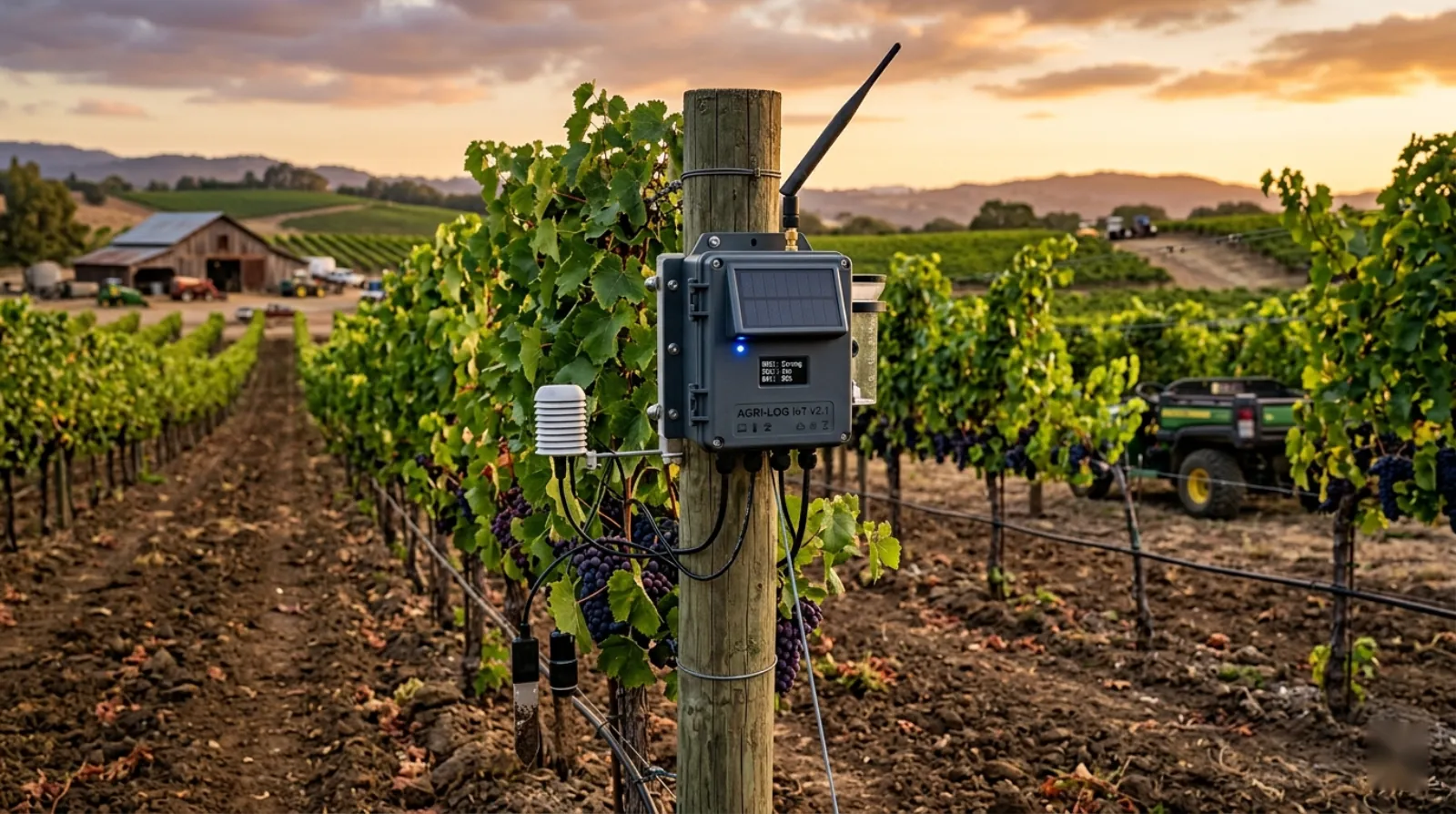
If you farm, you already have a data logger somewhere on your property. It might be a basic weather station feeding a PC in the office, an industrial-grade logger bolted inside a weatherproof cabinet, or a handful of soil moisture probes wired into a controller that a neighbour installed for you three years ago and nobody has logged into since.
What makes a data logger “IoT” is the last link in the chain: instead of you walking out to download the data or waiting for a monthly summary, the device pushes readings to a cloud platform where you, or an algorithm, or a contractor in another country, can see what is happening in close to real time.
That sounds simple. In practice, picking the right IoT data logger for a farm is where most people lose money. Industrial-grade loggers do not survive agricultural conditions. Consumer-grade IoT devices do not talk to the sensors you actually need. And the specs that look similar on paper (“cellular, solar-powered, 8 inputs”) hide differences that show up in month three, in the field, at 3 am.
This guide is for people who have decided they need to monitor something on a farm and want to pick hardware that will still be working in five years. We will cover what makes a logger “agricultural” rather than industrial or consumer, the core specs that actually matter, your connectivity options, when to use a data logger versus a controller, and what drives the cost of a deployment.
What Makes a Data Logger “Agricultural”
There are thousands of data loggers on the market. Most are not suitable for farm use. The ones that are suitable share a specific set of traits driven by what farm conditions actually do to electronics.
Extreme temperature range. A field logger in a continental climate sees -25 °C in January and +55 °C in August inside a sun-baked enclosure. Loggers rated for 0 to 40 °C “industrial office environment” will fail you. Look for -20 to +60 °C operational range at minimum, and check the battery spec separately because lithium batteries behave differently than the electronics do.
High ingress protection. IP67 is the practical minimum. IP68 is better if you might be anywhere near irrigation spray, flood zones, or coastal salt. Rubber gaskets degrade, so the enclosure rating depends as much on the connectors as on the main body. Cable glands rated for outdoor use with strain relief are non-negotiable.
Power tolerance. Farms have dirty power. If your logger is mains-powered, expect voltage dips, surges from motors cycling, and outright losses during storms. A logger with a built-in battery backup and brownout tolerance survives conditions that kill a bench-grade device in its first thunderstorm.
Sensor compatibility. Agricultural sensors use a mix of 4-20 mA, 0-10 V, SDI-12, RS485 Modbus, and sometimes specialty digital protocols. A logger with only analog inputs is useless in a modern precision agriculture stack where half the sensors are digital. For a deeper walkthrough of protocol tradeoffs, see our agricultural sensor protocols guide.
Deep sleep and low-power design. If the logger sleeps poorly between readings, a 20Ah battery lasts a week instead of six months. This is the difference between a device designed for field use and one designed for a lab bench with mains power.
The Specs That Actually Matter
Most datasheets emphasise the wrong specs. Here is what to check, in order of how often it matters in the field.
Sensor Inputs
Count the physical inputs, then divide by two. That is how many sensors you can actually wire without creating a mess. If the datasheet says “8 inputs,” four of them will be analog (shared with another four), the SDI-12 bus will only reliably address three sensors before noise becomes an issue, and the RS485 bus will work for a dozen sensors in theory but needs careful termination and a decent cable in practice.
For a practical farm deployment, you want at least: four analog inputs (4-20 mA and 0-10 V), one SDI-12 bus, one RS485 Modbus RTU bus, and one or two digital inputs for tipping bucket rain gauges or pulse flow meters. If the logger has a dedicated bus for each, you can run more sensors without cross-interference.
Reading Interval
Many loggers advertise “1 second resolution.” In the field, you want readings every 5 to 30 minutes for most agricultural parameters. Soil moisture does not change in seconds. Wind speed peaks do, but you want gust maxima and averages rather than raw 1-Hz data if you are transmitting over cellular. Make sure the logger can average readings between transmissions and buffer data locally when connectivity fails.
Local Storage
Cellular drops happen. A good logger buffers at least 30 days of readings locally and backfills to the cloud when the connection comes back. Without this, any outage is a permanent data gap. Check the datasheet for “offline storage” or “buffer size” and insist on at least 30 days at your planned reading interval.
Time Synchronisation
Every reading needs an accurate timestamp. The logger should sync its internal clock over the cellular or LoRaWAN network automatically. GPS sync is a bonus for stationary installations and a requirement for mobile ones. A logger that drifts ten minutes per year is useless for correlating events across multiple devices.
Firmware Updates
Can the logger update its firmware over the air? If not, every bug fix requires a site visit with a laptop. This matters enormously at scale and does not matter at all for a single installation you plan to forget about.
Connectivity Options
How the logger reaches the cloud is one of the first decisions to get right.
Cellular (4G/LTE or NB-IoT)
Cellular is the proven, shipping connectivity for agricultural loggers, and it is what the Agrinovo Genesis controller uses today. It fits well when:
- You have one to ten devices on a site
- The site is remote with no existing infrastructure
- Reliable coverage exists (check with a handset before you commit)
- A modest monthly data cost per device is acceptable
Cellular gives you independent devices that each have their own internet connection. A single device works anywhere with signal. No gateway, no infrastructure. Each device carries its own data plan, so the recurring cost scales with the number of devices rather than with a shared piece of network hardware.
NB-IoT is a cellular variant for low-data-rate devices. Coverage in agricultural areas is improving but still spotty outside Europe. If NB-IoT works at your site, battery life doubles or triples versus LTE. Test before committing.
LoRaWAN
LoRaWAN is a separate low-power, long-range network technology used in some agricultural deployments. The idea is a private network where one gateway covers several kilometres of rural terrain with line-of-sight and handles many low-data-rate nodes, with no per-device data plan once the gateway is in place. Per-node battery life can be long because the radio transmits very little.
The tradeoff is that you own and run the gateway. If it fails, every node behind it goes silent, so gateway redundancy becomes part of the design.
The Agrinovo Genesis controller is built to be modular and is LoRaWAN-ready as a future add-on. It is not a connectivity option you deploy today. If your operation grows toward a dense, single-property sensor network, LoRaWAN is a reasonable technology to evaluate at that point, but cellular is the connectivity you put in the field now.
WiFi
WiFi is only appropriate for greenhouses, tunnels, barns, or any site with existing wireless coverage. Range and reliability are not suited to open-field deployments. Power draw is higher than cellular for the same duty cycle. Use WiFi when the logger is within 30 m of a reliable access point and nowhere else.
Power: Battery, Solar, and Mains
The lowest-cost logger to own is the one you never have to visit. Power is what determines how often you do.
Battery-Only
Good for low-data-rate nodes with 15-30 minute reading intervals, where a single primary cell can last for years. Good for cellular loggers only if you accept a 3-12 month replacement schedule and limited reading frequency.
Solar with Rechargeable Battery
The practical default for cellular loggers. A 10-20W solar panel with a 7-20Ah LiFePO4 or sealed lead-acid battery runs indefinitely in most climates. LiFePO4 handles cold weather better than lead-acid and lasts 3-5x longer, worth the extra outlay in nearly all cases.
Size the panel for your worst week, not your average. In a temperate climate with three weeks of cloudy winter weather, a system sized for the average will fail in February. Double the panel wattage or the battery capacity, or both, for sites with marginal solar exposure.
Mains with Battery Backup
Use mains only in barns, greenhouses, or packing houses where reliable 120/240 VAC is available. Always specify a logger with built-in battery backup, at minimum for orderly shutdown during outages, ideally for a few hours of continued operation.
When You Need a Controller, Not a Logger
A data logger is a read-only device. It takes sensor readings and transmits them. A controller does that and also triggers outputs: opens valves, starts pumps, sounds alarms, sends SMS notifications.
You need a controller, not a logger, when:
- You want to close an irrigation valve automatically based on soil moisture
- You want to start a pump when a tank drops below a set level
- You want to alert a night shift by SMS when a parameter exceeds a threshold, with a confirmation response loop
- You want local control to keep working when cellular drops
The Agrinovo Omni Genesis and Omni Exodus controllers are both in this category. They read sensors via RS485 Modbus and analog inputs, drive up to six relay or 4-20 mA outputs, run on solar, and transmit over cellular. For deployments where the field device must act, not just observe, a controller is the right starting point.
What Drives the Cost of a Deployment
Rather than chase a single number, it helps to understand which parts of a deployment carry cost and how they scale. Three common scenarios show where the spend goes.
Single-Site Field Crop Monitoring (Cellular)
This is the lowest-cost scenario to stand up. One cellular logger with its solar, battery, and enclosure, a small set of soil moisture probes, and a rain gauge with temperature and humidity cover the hardware. Recurring cost is light: one cellular data plan plus cloud platform access for a single device. Most of the spend is the one-time hardware outlay, and the yearly cost after that is small. Cost-per-monitored-point is highest here simply because the logger and power kit are shared across only a few sensors.
Multi-Field Row Crop Operation
A larger operation spreads sensors across several fields. Hardware cost scales mainly with sensor count, so this is the highest one-time outlay of the three scenarios. Recurring cost depends on the connectivity design: independent cellular loggers carry one data plan each, while a shared-network design concentrates the recurring cost on fewer connections. Cost-per-monitored-point drops as you add sensors, because the supporting hardware is amortised across more readings.
Greenhouse Environmental and Irrigation Control
A greenhouse build centres on a controller with relays rather than a read-only logger, plus environmental and water-quality sensors (SHT30, soil moisture, pH, EC). Connectivity cost is often the lowest here because an existing WiFi network can carry the data, leaving cloud platform access as the main recurring item. The value sits in active control: the system does not just record conditions, it acts on them.
Reading the Cost Picture
Across all three, the pattern is consistent. Expect a one-time hardware and power-kit outlay that scales with sensor and site count, plus a modest recurring cost for connectivity and the cloud dashboard. Spending more on rugged hardware and correctly sized power up front is what keeps the recurring cost (site visits, replacements, lost data) low. For pricing on a specific configuration, contact us.
The Things That Break Year One
A short list of things we have seen fail in the first year of agricultural IoT deployments. Most are avoidable with the right initial hardware choice.
Waterlogged enclosures. Solar panels on top of metal enclosures without drip edges funnel water straight into cable glands. Inspect enclosures after the first major rain event. Anything that looks damp inside will be fully flooded inside a month.
Sensor cable damage from farm equipment. Tractor tyres, harvester drums, and tillage implements find exposed cable runs. Bury or conduit all cable runs that cross vehicle paths.
Cellular signal degradation during growing season. A site that has great cellular reception in March may have nothing by July once the surrounding corn is seven feet tall. Install external directional antennas on a mast, not on the enclosure itself.
Theft. This is real. Visible enclosures in accessible areas get taken. Mount equipment out of casual sight, or in locked cabinets with tamper detection.
Software that required a phone app that the vendor stopped supporting. Ask about long-term platform support before buying. If the answer is “you access readings through the app,” pick a different vendor.
What We Recommend
For a small farm or a first deployment, start with one cellular-connected controller that can expand later. A single Omni Genesis or Exodus controller reads the same sensors as a dedicated data logger would, but gives you the option to add control outputs later without replacing hardware. For larger operations, plan around cellular as the connectivity that ships today, and keep in mind that the Genesis is modular and LoRaWAN-ready if you later grow into a dense single-property sensor network.
Whichever path you choose, specify the hardware for the worst week of the year, not the average week. The day a logger goes down is rarely a sunny day in May.
For the sensor side of the question, our IoT soil monitoring guide walks through how to choose and place the probes that feed the logger.