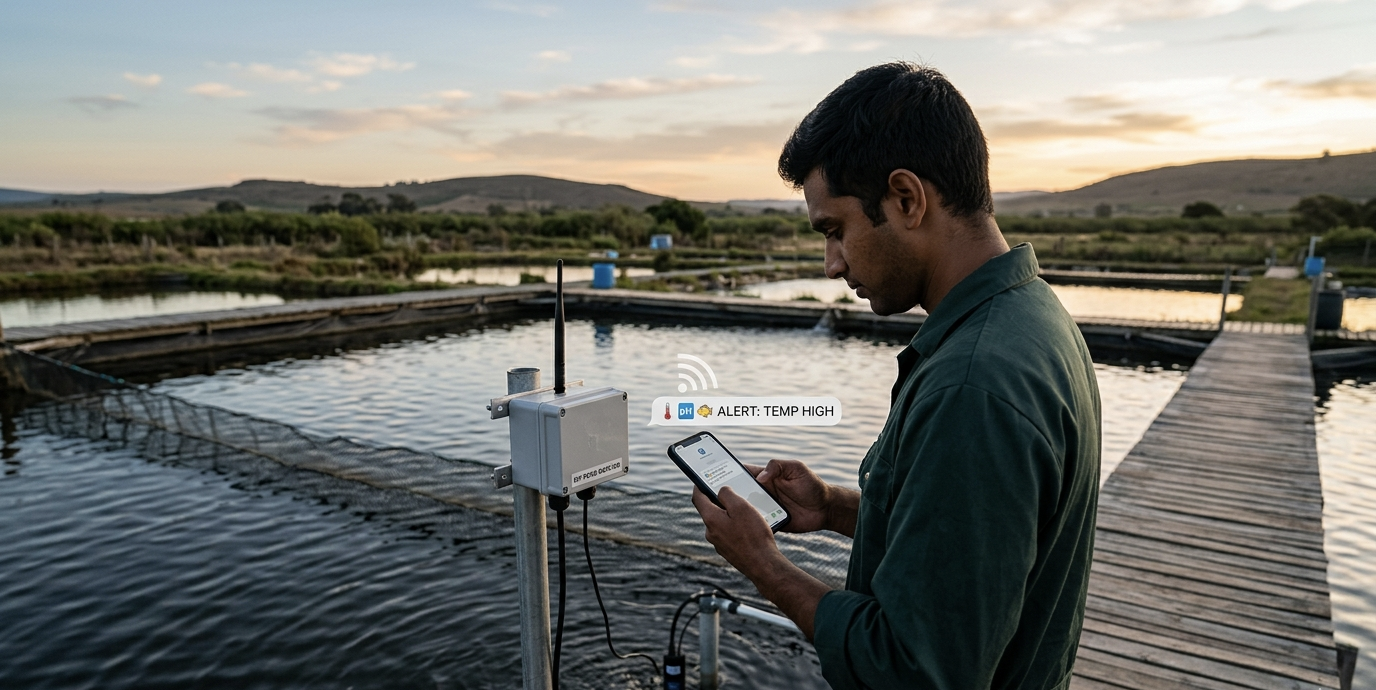
A catfish farmer in Mississippi told us the story of how he lost $22,000 worth of channel catfish in a single night. He had six grow-out ponds on a property 40 minutes from his house. He drove out to check them every morning and evening. On a Thursday in August, he checked the ponds at 6 PM, everything looked fine. Water temperature was 31 degrees C, fish were feeding actively, and the sky was clear. He went home.
What he did not know was that his main aerator on pond 3 had a belt snap at 11 PM. By 1 AM, dissolved oxygen had dropped below 3 mg/L. By 4 AM, it was below 1 mg/L. When he arrived at 6:30 AM Friday, pond 3 was covered in dead fish. The other five ponds were fine. If he had received a text message at 11:30 PM telling him pond 3’s DO was dropping fast, he could have driven out and switched to the backup aerator. Total repair cost: a $40 belt and an hour of his time. Instead, he lost the entire pond.
This is not a story about a farmer who was negligent. He was checking his ponds twice a day, which is more than many small operators manage. The problem is that twice a day is not enough when things can go wrong in hours and the pond is 40 minutes away. You cannot be at the pond 24 hours a day. But a $15-per-month cellular connection and a DO sensor can be.
The perception in the industry is that remote monitoring is complicated and designed for large operations with engineering staff. That was true ten years ago. It is not true now. Modern cellular IoT controllers and optical sensors have made reliable pond monitoring accessible to any size operation. A well-designed system that sends you an SMS when something goes wrong pays for itself the first time it catches a problem. This guide covers exactly what you need, what it costs, and how to set it up.
The Minimum Viable Monitoring System
Let us define what “minimum viable” means. This is not a system that monitors everything. It is a system that monitors the parameter most likely to kill your fish and alerts you before that happens. You can always add more sensors later. Right now, we are building the smallest useful system.
What you need
1. One dissolved oxygen sensor
DO is the parameter that kills fish fastest. Ammonia, pH, and temperature problems develop over days and give you time to respond during your regular visits. A DO crash kills overnight, and it is the one problem you cannot catch without a sensor watching the pond when you are not there.
The DO-100 optical dissolved oxygen probe is our standard recommendation for pond monitoring. Optical (fluorescence) sensors have no membranes to replace, minimal drift over months, and response times under 30 seconds. They read both dissolved oxygen and temperature with a single probe, which gives you two parameters for the cost of one sensor.
2. A cellular IoT controller
The controller is the brain of the system. It reads the sensor, stores the data, checks it against your thresholds, and sends you an alert if something is wrong. For remote pond monitoring, you need a controller that:
- Has cellular connectivity (no WiFi or internet at the pond site required)
- Supports SMS alerts to your phone
- Reads standard sensor protocols (analog 4-20mA, SDI-12, or Modbus RS-485)
- Has low power consumption (so solar power is feasible)
- Has inputs for additional sensors if you want to expand later
The Omni Genesis Lite is designed for exactly this use case. It is a compact cellular controller with multiple sensor inputs, configurable alert thresholds, SMS and push notifications, cloud data logging, and low power consumption for solar deployment. It does not have relay outputs for equipment control, but that is a feature for the next tier of monitoring.
If you want the ability to automatically turn on an aerator when DO drops (which we recommend for any operation where response time matters), the Omni Genesis controller adds relay outputs alongside all the monitoring features. For a detailed comparison of controllers, see our guide to choosing an IoT controller for agriculture.
3. Power supply
For a remote pond without grid power, a small solar panel (10-20W) and a 12V sealed lead-acid battery (7-12Ah) is the standard approach. The solar panel charges the battery during the day. The battery runs the controller and sensor 24/7. A well-sized solar setup can run indefinitely without maintenance beyond occasional panel cleaning.
For ponds with grid power available, a simple 12V adapter and a small backup battery (in case of power outages) is simpler and cheaper.
4. Enclosure and mounting
Your controller and battery go inside a weatherproof NEMA 4X or IP66 enclosure mounted on a post near the pond. The sensor cable runs from the enclosure to the water. The antenna (cellular) mounts on top of the enclosure or on the post. The solar panel mounts above on the same post or a nearby bracket.
5. Cellular SIM card and data plan
The controller needs a SIM card with a data plan. Sensor data uploads are tiny, typically a few kilobytes per reading, so even the most basic IoT data plan is sufficient. Monthly cost is usually $5-$15 depending on the carrier and country. Some controllers support multi-carrier SIMs that automatically select the strongest available network.
What It Actually Costs
Here is an honest cost breakdown for a single-pond monitoring system.
Hardware (one-time)
| Component | Estimated Cost |
|---|---|
| DO-100 optical dissolved oxygen sensor | $300-$500 |
| Omni Genesis Lite controller | $250-$400 |
| Cellular antenna | $15-$30 |
| 20W solar panel | $30-$50 |
| 12V 7Ah sealed battery | $20-$35 |
| Weatherproof enclosure (NEMA 4X) | $40-$80 |
| Mounting post and hardware | $20-$40 |
| Cable, connectors, glands | $20-$40 |
| Total hardware | $695-$1,175 |
Recurring costs (annual)
| Item | Estimated Cost |
|---|---|
| Cellular data plan (12 months) | $60-$180/year |
| Sensor maintenance (cleaning, recalibration) | $50-$100/year |
| Battery replacement (every 2-3 years, amortized) | $10-$15/year |
| Total annual | $120-$295/year |
What this protects
A single grow-out pond of tilapia, catfish, or barramundi at typical stocking densities holds $10,000 to $50,000 worth of fish at harvest. The monitoring system costs 2-10% of one pond’s value and protects it for years.
A modular approach means you invest in exactly the monitoring you need today and expand when your operation grows. There is no need to commit to a $10,000+ platform on day one when a focused system built around the right sensor and controller protects your fish just as effectively.
For a more detailed comparison of monitoring systems at different budget levels, see our aquaculture monitoring system buyer’s guide.
Setting Up SMS Alerts That Work
The monitoring system is only useful if the alerts actually reach you and you actually respond. Here is how to configure alerts that work in practice.
Set the right thresholds
For dissolved oxygen with warmwater species (tilapia, catfish, carp):
- Warning alert: DO below 4.5 mg/L. This is your “heads up, keep an eye on it” notification.
- Critical alert: DO below 3.5 mg/L. This is your “get to the pond now” notification.
- Emergency alert: DO below 2.5 mg/L. This means fish are likely already in distress.
For species-specific thresholds and more detailed guidance, see our overnight fish kill prevention guide.
Configure alert escalation
Send the warning alert to yourself. Send the critical alert to yourself and one backup person (a farm worker, neighbor, or family member) who can get to the pond if you cannot. If your controller supports it, configure a phone call (not just SMS) for the emergency threshold because people sleep through text messages.
Avoid alert fatigue
If your system sends a “low DO” alert every single night because DO naturally dips to 4.4 mg/L at 3 AM, you will start ignoring alerts. This is the most dangerous thing that can happen with a monitoring system.
Set your warning threshold just below the expected nightly minimum. If your ponds normally bottom out at 5 mg/L, set the warning at 4.5 mg/L. That way, an alert means something abnormal is happening, not just the regular overnight cycle. You may need to watch the data for a week or two after installation to learn what “normal” looks like for your ponds before dialing in thresholds.
Test the system monthly
Send yourself a test alert once a month to verify that the cellular connection is working, your phone number is correct, and the SMS actually arrives. A monitoring system that silently failed three weeks ago protects nothing.
How Cellular IoT Controllers Work
If you have not used IoT equipment before, here is a plain explanation of what happens inside the box on the post next to your pond.
The controller has a small computer inside that reads the sensor at a configured interval (every 1 minute, every 5 minutes, every 15 minutes, depending on how you set it up). Each reading gets stored in the controller’s memory. At a configured upload interval, the controller turns on its cellular modem, connects to the cell network, and transmits the stored readings to a cloud server. Then it turns the modem off to save power.
When a sensor reading crosses your alert threshold, the controller wakes the modem immediately and sends an SMS to your configured phone numbers. Most controllers also push the alert to a phone app if you have one installed.
You can also log into a web dashboard or phone app at any time to see current and historical sensor readings from all your ponds, check battery voltage and solar charging status, and adjust alert thresholds remotely.
The data usage is minimal. A controller sending one reading per minute (which is more frequent than most farms need) uses about 10-15 MB of cellular data per month. That is less than loading a single webpage on your phone.
What to Monitor First, Second, and Third
If you are building your monitoring system incrementally, here is the priority order.
Priority 1: Dissolved oxygen (mandatory)
This is your first sensor, every time, no exceptions. DO crashes kill faster than anything else and happen when you are not at the pond. Every other parameter gives you more time to respond. Start here.
Priority 2: Temperature (usually free)
Most DO sensors, including the DO-100, include a built-in temperature measurement. Temperature affects oxygen solubility, fish metabolism, feeding rate, and disease susceptibility. If your DO sensor reports temperature, you get this parameter at no additional cost.
If your DO sensor does not include temperature, an SHT30 temperature and humidity sensor mounted at the pond surface gives you both air temperature and humidity, which are useful for predicting overnight conditions.
Priority 3: pH
pH affects ammonia toxicity (as explained in our ammonia spike guide), influences fish health directly, and indicates water quality trends. A pH sensor is a worthwhile second water quality sensor once your DO monitoring is running smoothly.
Priority 4: Ammonia or ORP
For intensive systems, continuous ammonia monitoring is valuable. For pond systems, ORP is a useful general water quality indicator that correlates with several problems (low DO, high organics, high ammonia) and can serve as an early warning system. See our guide to IoT vs manual water testing for a framework on which parameters justify continuous monitoring.
Priority 5: EC/salinity (if relevant)
For brackish water systems, shrimp ponds, or ponds using well water with variable mineral content, salinity monitoring prevents osmotic stress. For freshwater species in stable water sources, this is lower priority.
Scaling Up: From One Pond to a Full Farm
The advantage of starting with a capable controller is that you can grow the system without replacing the core equipment.
Adding sensors to existing ponds
The Omni Genesis Lite and Omni Genesis controllers support multiple sensor inputs. Adding a pH sensor to a pond that already has a DO sensor is a matter of plugging in the new sensor, configuring the new channel in the controller, and setting alert thresholds. No new controller needed, no new cellular connection.
Adding more ponds
Each pond needs its own sensor(s), but depending on the controller’s input capacity and the distance between ponds, you may be able to run sensors from multiple nearby ponds to a single centrally located controller. For ponds more than 50-100 meters apart, a dedicated controller per pond (or per pond cluster) is more practical.
Moving from alerts to automation
The biggest step up from a monitoring-only system is adding equipment control. This means replacing the Omni Genesis Lite (monitoring only) with the Omni Genesis or Omni Exodus (monitoring plus relay outputs), and connecting aerators, pumps, or feeders to the controller’s relay outputs.
With equipment control, the system can turn on a backup aerator automatically when DO drops, without waiting for you to receive the SMS, wake up, drive to the farm, and flip the switch manually. This automated response can save hours of response time, which at 2 AM in a DO crash is the difference between losing 5% of the fish and losing 80%.
Cost of a scaled system
A full farm monitoring system with DO, pH, and temperature on four ponds, plus automated aerator control on each, runs $4,000-$8,000 depending on sensor selection and the number of relay-controlled devices. Because the system is modular, you have full control over which sensors and features you add and when, scaling from a single pond to full-farm coverage without replacing your core equipment.
Common Mistakes to Avoid
Overcomplicating the initial setup. A single DO sensor that is installed, connected, and sending you alerts is infinitely more valuable than a multi-parameter sonde sitting in a box because the wiring was too complex. Start with one reliable sensor. Get the system working. Expand later.
Setting alert thresholds too tight. If your phone buzzes every night with a “low DO” warning, you will disable alerts within a week. Set thresholds based on what actually represents a problem, not on textbook optimal ranges.
Ignoring sensor maintenance. An optical DO sensor with biofilm on the lens reads low. A pH sensor with a fouled reference junction drifts. Schedule a monthly cleaning visit, even if it is just wiping the sensor with a cloth and checking the readings against a handheld meter.
Not having a response plan. An alert at 3 AM is useless if you do not know what to do. Write down your response plan (who goes, what they do, where the backup aerator is, how to start it) and share it with everyone who might receive an alert. Practice it once.
Relying on a single point of failure. If the cellular network goes down, your alerts stop. If the battery dies, the controller stops. If the sensor fails, the data stops. For critical ponds, consider adding a simple backup alert mechanism: a float switch connected to a separate alarm, a second controller on a different cellular carrier, or at minimum, a manual check routine that continues even when the automated system is running.
Getting Started Today
If you have made it this far, you are probably ready to stop reading and start building. Here is the shortest path from nothing to a working SMS alert system:
- Order a DO sensor and a cellular controller
- Get a SIM card with a basic data plan
- Mount the controller on a post at the pond, connect the sensor, insert the SIM card
- Power it with a solar panel and battery (or 12V adapter if grid power is available)
- Configure your alert thresholds and phone number through the controller’s setup interface
- Watch the data for a week to learn your pond’s normal patterns
- Adjust thresholds so alerts mean something
That is it. You will have better overnight protection than most fish farms in the world, for less than the cost of losing a single net pen of fish.
For more on choosing the right dissolved oxygen sensor for your specific situation, read our dissolved oxygen sensor selection guide. And if you are ready to look at complete monitoring system options beyond the minimum viable setup, our aquaculture monitoring buyer’s guide covers systems at every budget level.