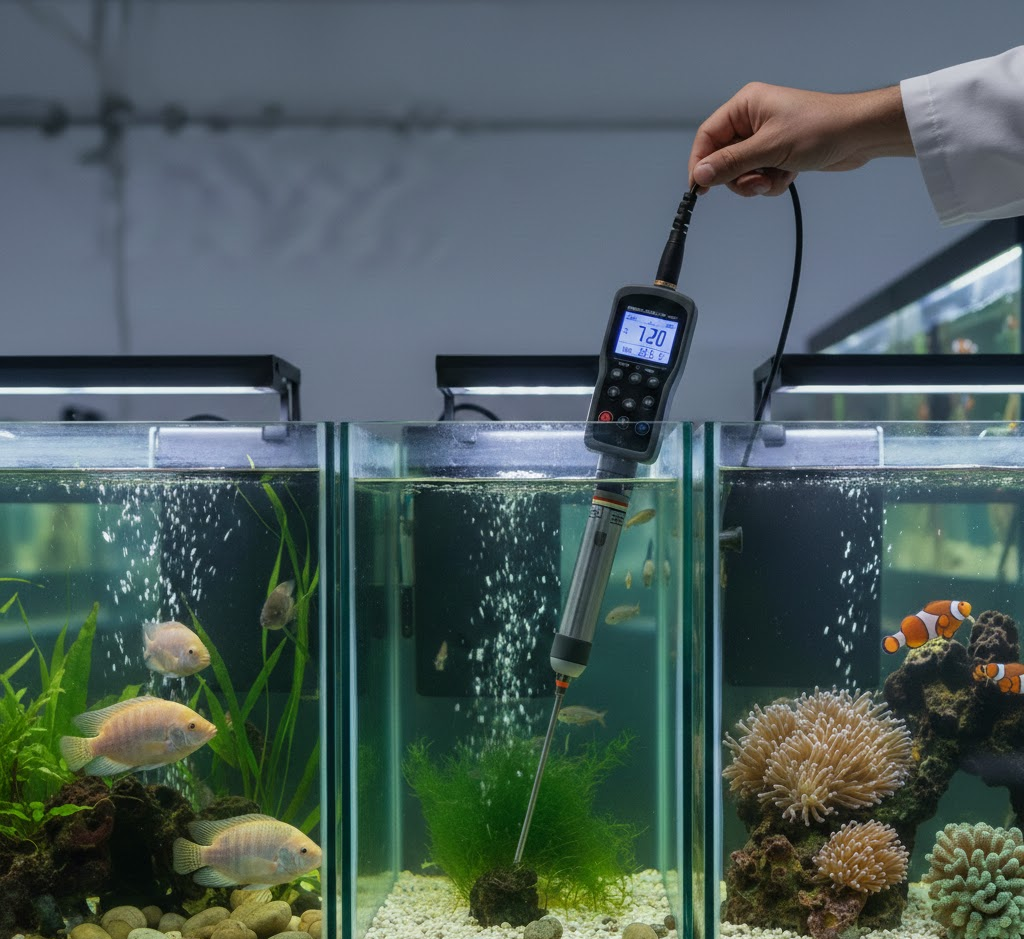
We have watched a farmer lose 4,000 kg of barramundi in a single night because his dissolved oxygen sensor was corroding in saltwater and reading 5.8 mg/L when actual DO had dropped to 1.9 mg/L. The sensor body was 316 stainless steel, which is fine for brackish water, but he was running full-strength seawater at 35 ppt salinity. Pitting corrosion compromised the sensor housing over six months, water intruded into the electronics, and the readings drifted high without anyone noticing. By the time the fish started gulping at the surface, most of them were already past saving.
That story sticks with us because the fix was straightforward: use a titanium-bodied sensor rated for marine environments. The farmer replaced his corroded sensor with a titanium unit, and three years later it is still reading accurately. The cost difference between the two sensors was minimal. The fish he lost were worth over $30,000.
Dissolved oxygen is the single most critical parameter in fish farming. Not pH, not ammonia, not temperature. Those matter, absolutely, but they kill slowly over days and weeks. A dissolved oxygen crash kills in minutes. Your fish are breathing that water, and when the oxygen is gone, they suffocate. There is no buffer, no tolerance window, no waiting until morning to check. If you are going to invest in one sensor for your farm, make it a DO sensor. If you are going to get the selection right on one sensor, make it this one.
This guide covers everything we have learned from deploying dissolved oxygen sensors across freshwater tilapia ponds, saltwater salmon cages, indoor RAS facilities, and shrimp farms. We will walk through the technology, the materials, the specs that actually matter, and the ones that do not. And we will be specific about which sensor fits which application, because “it depends” is not a useful answer when your fish are on the line.
Dissolved Oxygen Basics: What Fish Farmers Actually Need to Know
Before we talk sensors, let us make sure the fundamentals are solid. Understanding how dissolved oxygen behaves in water directly affects how you deploy and interpret your sensors.
How Oxygen Gets Into Water (And Why It Leaves)
Dissolved oxygen enters water through two main pathways: atmospheric diffusion at the surface and photosynthesis by aquatic plants and algae. It leaves through respiration by fish, bacteria, and other organisms, and through chemical oxygen demand from decomposing organic matter.
The amount of oxygen water can hold is governed by Henry’s Law: gas solubility in liquid is proportional to the partial pressure of that gas above the liquid. In practical terms, this means three things matter enormously.
Temperature. Cold water holds more oxygen than warm water. At 10 degrees C, freshwater at sea level saturates at about 11.3 mg/L. At 25 degrees C, that drops to 8.2 mg/L. At 35 degrees C, only 7.0 mg/L. This is why summer is the danger season for DO crashes. Your margin between saturation and lethal levels shrinks dramatically as water warms.
Salinity. This is the one most freshwater farmers do not think about until they move to brackish or marine systems. Salt ions in water reduce the available space for dissolved gas molecules. At 35 ppt salinity (standard seawater) and 25 degrees C, saturation drops from 8.2 mg/L to about 6.7 mg/L. That is an 18% reduction. In warm tropical saltwater, you are working with very thin margins.
Altitude. Lower atmospheric pressure at elevation means less oxygen partial pressure. A farm at 1,500 meters elevation has roughly 15% less oxygen available for dissolution than one at sea level. If you are farming trout in mountain ponds, factor this into your alarm thresholds.
Species-Specific DO Requirements
Not every fish needs the same oxygen level. Here are the established minimum dissolved oxygen thresholds for common aquaculture species:
| Species | Minimum DO (mg/L) | Optimal DO (mg/L) | Notes |
|---|---|---|---|
| Tilapia | 3.0+ | 5.0-7.0 | Hardy, but growth slows below 4 mg/L |
| Catfish | 3.0+ | 5.0-7.0 | Similar tolerance to tilapia |
| Shrimp (L. vannamei) | 4.0+ | 5.0-8.0 | More sensitive than most farmers expect |
| Trout | 6.0+ | 8.0-10.0 | Cold water, high oxygen demand |
| Salmon | 7.0+ | 8.0-11.0 | Highest requirements of common species |
| Barramundi | 4.0+ | 5.0-8.0 | Tropical, but needs decent DO |
| Pangasius | 2.0+ | 4.0-6.0 | Exceptionally hardy air-breather |
These are survival minimums, not targets. We set our alarm thresholds at least 1 mg/L above the species minimum, and our “take action” thresholds 2 mg/L above. For salmon at 7 mg/L minimum, that means alarms at 8 mg/L and emergency response at 9 mg/L. It sounds conservative until the night you get an alarm and have time to respond instead of arriving to a tank of dead fish.
Why Saltwater Farms Face Tougher DO Challenges
If you run a saltwater or brackish operation, the physics are working against you. Lower oxygen saturation at higher salinity, combined with warm tropical temperatures for species like barramundi and shrimp, means you are often operating with only 2-3 mg/L of headroom between saturation and lethal levels. A freshwater tilapia farmer at 25 degrees C has 8.2 mg/L saturation and a 3 mg/L floor, giving 5.2 mg/L of headroom. A marine shrimp farmer at the same temperature has 6.7 mg/L saturation and a 4 mg/L floor, giving just 2.7 mg/L.
This means saltwater operations need more accurate sensors, more frequent monitoring, and faster response systems. It also means sensor reliability is non-negotiable, because a sensor that drifts even 1 mg/L can put you in the danger zone without knowing it.
Sensor Technology: Fluorescent vs Galvanic vs Polarographic
There are three dissolved oxygen sensor technologies you will encounter. Two of them we would not recommend for fish farming anymore, but understanding why helps you evaluate what vendors are selling.
Polarographic (Clark-type) Sensors
The original electrochemical DO sensor. A platinum cathode and a silver/silver chloride anode behind an oxygen-permeable membrane. When voltage is applied, oxygen is consumed at the cathode, generating a current proportional to DO concentration.
Problems for aquaculture: Requires a warm-up period of 15-30 minutes after power-on. Consumes oxygen at the membrane surface, so it needs water flow past the sensor for accurate readings (flow dependency). Membranes foul and need replacement every few months. Electrolyte solution needs periodic refilling. Drifts significantly between calibrations.
We used these for years. They work, but the maintenance burden in an aquaculture environment is considerable. You are cleaning and recalibrating constantly, and every time you pull a sensor for maintenance, you have a monitoring gap.
Galvanic Sensors
Similar electrochemistry to polarographic, but uses a zinc or lead anode and a silver cathode with no external voltage. The galvanic reaction drives itself. Simpler electronics, lower power consumption, no warm-up period.
Better than polarographic, but still problematic: Still consumes oxygen at the membrane (flow dependent). The anode material depletes over time and eventually needs replacement. Membranes still foul and need regular replacement. Drift is lower than polarographic but still requires weekly calibration in aquaculture environments.
Galvanic sensors are cheaper upfront, typically $150-300, which makes them tempting for budget operations. But the total cost of ownership over two years, factoring in membrane replacements, electrolyte, anode replacement, and calibration labor, often exceeds the cost of an optical sensor.
Fluorescent (Optical) Sensors
This is the current standard, and it is what we recommend for any serious aquaculture operation. All three Agrinovo dissolved oxygen sensors use fluorescent technology, and there is a reason for that.
The principle is fluorescence quenching. A sensing element coated with a luminescent dye (typically a platinum porphyrin complex) is excited by a blue LED. The dye fluoresces, emitting red light. When oxygen molecules are present, they collide with the excited dye molecules and quench the fluorescence, reducing either the intensity or the lifetime of the emitted light. More oxygen means more quenching, which means shorter fluorescence lifetime.
Modern fluorescent sensors measure the phase shift of the emitted light rather than intensity, which makes them insensitive to LED aging, optical fouling, and photobleaching of the dye. This is why they hold calibration so well.
Why fluorescent wins for fish farming:
- No oxygen consumption. The sensor does not consume oxygen, so it is completely flow-independent. This means accurate readings in still water, slow-moving ponds, and fast-flowing raceways alike.
- No electrolyte. Nothing to refill or replace (except the sensing cap on some models).
- Minimal drift. Monthly calibration is sufficient for most aquaculture applications, compared to weekly for galvanic sensors.
- No warm-up period. Instant readings on power-up, which matters when you are deploying sensors after maintenance.
- Long-term stability. The sensing element typically lasts 2-3 years before the luminescent dye degrades enough to warrant replacement.
The response time on all three Agrinovo fluorescent DO sensors is under 60 seconds (T90), which means you get 90% of the true reading within one minute of a change. For aquaculture monitoring where you are logging every 5-15 minutes, this is more than adequate.
Freshwater vs Saltwater: Why Material Selection Is Critical
Here is where most farmers make their biggest mistake: choosing a sensor based on specs alone without considering the environment it will live in. A dissolved oxygen sensor for fish farming is going to spend years submerged in water, exposed to biological growth, temperature swings, and in saltwater environments, one of the most corrosive substances on the planet.
PE Housing: The Freshwater Specialist
The DO-P100 uses a polyethylene (PE) housing. PE is chemically inert, lightweight, and completely immune to corrosion. It will never rust, pit, or degrade in freshwater.
The DO-P100 is purpose-built for freshwater aquaculture. It shares the same fluorescent sensing technology and accuracy (plus or minus 2% full scale) as its more expensive siblings, so you are not sacrificing measurement quality. The temperature compensation is actually more precise at plus or minus 0.1 degrees C compared to plus or minus 0.5 degrees C on the metal-bodied sensors, which is a nice bonus for freshwater farmers who want tighter data.
The trade-off is the operating temperature range caps at 40 degrees C instead of 50 degrees C (rarely an issue in aquaculture), and the membrane cap is non-replaceable (meaning you replace the whole sensing head rather than just the cap).
Best for: Freshwater ponds, RAS systems, aquaponics, hydroponics, any application where salinity stays near zero. If you are running tilapia ponds, catfish raceways, or indoor recirculating systems, this is your sensor. The PE body is also lighter, which makes it easier to mount in lightweight PVC pipe installations common in RAS.
316L Stainless Steel: The Versatile Middle Ground
The DO-100 uses 316L stainless steel, the marine-grade standard in the stainless family. The “L” means low carbon, which improves weld corrosion resistance. 316L handles freshwater and brackish water without issue and can survive in saltwater for moderate periods.
The DO-100 gives you a wider temperature range (0-50 degrees C), IP68 plus NEMA 6P ingress protection, a replaceable membrane cap, a 1-year warranty, and cable extendable up to 100 meters. The replaceable membrane cap is a meaningful advantage for long-term cost of ownership. When the luminescent sensing element degrades after 2-3 years, you swap a cap instead of replacing the entire sensor.
Best for: Brackish water aquaculture (5-15 ppt salinity), wastewater treatment ponds, shrimp farms running low to moderate salinity, and any situation where you want industrial-grade durability with the flexibility to handle some salt exposure. We also recommend the DO-100 for farms that might transition from freshwater to brackish in the future.
A word of caution on stainless in seawater: 316L stainless steel has a PREN (Pitting Resistance Equivalent Number) of about 25. The threshold for reliable seawater service is generally considered to be 40+. This means 316L will pit in full-strength seawater (30-40 ppt) over months of continuous immersion. We have seen 316L sensors survive a year in seawater, and we have seen them start pitting in four months. It depends on temperature, flow, chlorination, and biological activity. If there is any chance your water will consistently be above 20 ppt salinity, go with titanium.
Titanium Alloy: The Marine Standard
The DO-110 uses a titanium alloy body and is rated for 0-60 ppt salinity. That covers everything from freshwater to hypersaline environments. Titanium forms a self-healing oxide layer that makes it essentially immune to chloride-induced pitting and crevice corrosion. In 30 years of marine instrumentation, titanium has proven itself as the gold standard for seawater sensors.
The DO-110 is priced at a premium over the other two options. For that premium, you get complete corrosion immunity in any salinity, the same 0-50 degrees C range and IP68/NEMA 6P rating as the DO-100, a replaceable membrane cap, a 1-year warranty, and cable extendable to 100 meters.
Best for: Marine aquaculture (salmon cages, seabass, seabream), coastal shrimp farms running full-strength or near-full-strength seawater, oceanographic monitoring, and any application where salt exposure is guaranteed. If you are spending hundreds of thousands of dollars on marine fish stock, the modest premium for a titanium sensor is the cheapest insurance you will ever buy.
Cost-Benefit Summary
| Sensor | Body | Salinity Range | Membrane Cap | Warranty | Best Environment |
|---|---|---|---|---|---|
| DO-P100 | PE | Freshwater | Non-replaceable | 1 year | Ponds, RAS, aquaponics |
| DO-100 | 316L SS | Fresh-brackish | Replaceable | 1 year | Brackish, industrial, versatile |
| DO-110 | Titanium | 0-60 ppt | Replaceable | 1 year | Marine, high salinity |
Key Specs That Actually Matter (And Ones That Don’t)
When you are comparing dissolved oxygen sensor datasheets, here is what to focus on and what to ignore.
Accuracy: Plus or Minus 2% F.S. Is the Standard
All three Agrinovo DO sensors deliver plus or minus 2% full scale accuracy on a 0-20 mg/L range. That translates to plus or minus 0.4 mg/L across the full range. In practice, accuracy is better in the middle of the range where you are usually operating (4-10 mg/L) and slightly worse at the extremes.
Plus or minus 2% F.S. is the current industry standard for fluorescent DO sensors. If someone is claiming plus or minus 1% at a similar price point, ask how they measured it and at what temperature. Accuracy specs in datasheets are typically stated at 25 degrees C, and real-world accuracy in field conditions is always somewhat wider.
For fish farming, plus or minus 0.4 mg/L is absolutely sufficient. Your alarm thresholds should have at least 1 mg/L of margin above lethal levels anyway.
Response Time: Under 60 Seconds Is Fine
All three sensors have a T90 response time under 60 seconds. T90 means the sensor reaches 90% of the true value within that time window. Some vendors advertise T95 or T98 response times, which are inherently longer numbers for the same sensor, so make sure you are comparing the same metric.
For aquaculture monitoring with 5-15 minute logging intervals, 60 seconds is more than adequate. You are tracking trends, not instantaneous changes. A faster response time (say 10-15 seconds) matters in laboratory respirometry or in-line process control where you are measuring rapid oxygen changes. In a fish pond, the DO at minute zero and minute one are effectively identical.
Temperature Compensation: Non-Negotiable
All DO sensors should have automatic temperature compensation (ATC). Dissolved oxygen saturation is temperature-dependent, and a sensor reading without temperature correction is meaningless. Every Agrinovo DO sensor has an integrated temperature probe for ATC, with the DO-P100 offering the tightest temperature accuracy at plus or minus 0.1 degrees C.
If you encounter a DO sensor without built-in temperature compensation, keep looking. Manual temperature compensation means you have to measure temperature separately and apply a correction factor, which is impractical for continuous monitoring.
Output Protocol: RS485 Modbus RTU
All three sensors output via RS485 Modbus RTU, which is the industrial standard for sensor communication. RS485 is differential signaling, which means it is highly resistant to electrical noise from pumps, aerators, and other equipment on your farm. Cable runs up to 1,200 meters are supported on a single RS485 bus, and you can daisy-chain multiple sensors on the same bus with different Modbus addresses.
If your controller supports Modbus RTU (both the Omni Genesis and Omni Exodus do), this is the protocol you want. Analog 4-20 mA output is simpler but loses resolution, cannot transmit diagnostics, and requires individual cable runs to each sensor.
Cable Length: 5 Meters Standard, But Think Ahead
Standard cable length is 5 meters on all three models. For pond-side installations where the controller is near the water, 5 meters is usually enough. But the DO-100 and DO-110 support cable extensions up to 100 meters, which is critical for two applications.
Cage farming. Open-water net cages may be 50-100 meters from shore infrastructure. You need long cable runs to reach sensors deployed at depth in the cages. The DO-110 with 100-meter cable extension was designed with exactly this scenario in mind.
Large pond systems. If you have a row of 10 earthen ponds with a central monitoring station, some sensors might be 30-50 meters from the controller. Cable extension keeps your architecture clean.
The DO-P100’s 5-meter cable is fixed, which is one reason it is optimized for smaller installations like RAS tanks and individual ponds where the controller is nearby.
Specs That Matter Less Than You Think
Resolution. Most fluorescent sensors resolve to 0.01 mg/L. This sounds impressive but your accuracy is plus or minus 0.4 mg/L, so the extra decimal places are noise, not signal.
Measurement range. 0-20 mg/L covers everything in aquaculture. You will never see 20 mg/L in a fish pond. Sensors with wider ranges (0-40 mg/L or 0-50 mg/L) are designed for industrial oxygen processes, not aquaculture.
Percent saturation output. Nice to have for understanding your system’s oxygenation efficiency, but mg/L is what matters for fish health decisions. All three sensors output both.
Installation Best Practices
A perfectly calibrated sensor in the wrong location gives you wrong data with false confidence. Placement matters.
Sensor Placement in Ponds
Depth. Mid-water column is the standard recommendation. Surface water is supersaturated during the day from photosynthesis and wind mixing, giving falsely high readings. Bottom water near sediment is an oxygen sink, giving falsely low readings. Mid-column represents what your fish are actually experiencing.
Distance from aerators. This is the most common placement mistake we see. Installing a DO sensor 2 meters downstream from a paddle wheel aerator will give you beautiful, reassuring numbers that have nothing to do with the DO in the rest of your pond. Place sensors at least 10 meters from any aeration source, ideally at the point of lowest expected DO, which is typically the far side of the pond from your aerator.
Multiple sensors for large ponds. If your pond is more than 0.5 hectares, a single sensor is not enough. DO can vary by 3-4 mg/L across a large pond at the same time. Two sensors on opposite sides of the pond give you a much more accurate picture.
Sensor Placement in RAS
Recirculating aquaculture systems have defined water flow paths, which makes sensor placement more logical.
After the aeration or oxygenation stage. Confirms your oxygen injection is working and hitting target levels.
In the fish tank itself. This is what the fish are actually breathing. If you can only afford one sensor per tank, put it here.
After the biofilter. Nitrification consumes oxygen. If DO drops significantly across your biofilter, you may need supplemental aeration in the biofilter itself or your biological load is too high.
For RAS, the DO-P100 in PE housing is ideal. RAS are freshwater systems (usually), the tanks are close to the control room (short cable runs), and the PE body resists the sanitizers and cleaning agents used in indoor systems.
Sensor Placement in Net Cages
Marine cage farming is the most demanding environment for DO monitoring. Oxygen levels vary with depth, current, tide, and time of day.
Multiple depths. Minimum two sensors per cage: one at 3-5 meters depth (where most fish swim) and one near the cage bottom (where waste accumulates and oxygen depletes first). Large cages benefit from a third sensor at mid-depth.
Current-facing side. Mount sensors on the upstream (current-facing) side of the cage for incoming water quality, and optionally on the downstream side to measure oxygen depletion across the cage.
Anti-fouling. Marine biofouling is aggressive. Copper-based anti-fouling guards or automated wiper systems are worth the investment. A fouled sensor in a marine cage is worse than no sensor because it gives you false confidence.
For cage farming, the DO-110 titanium sensor is the only sensible choice. The titanium body handles seawater indefinitely, the 100-meter cable extension reaches cages far from shore, and the NEMA 6P rating means it survives the submersion depths typical of cage installations.
Freshwater Setup Example: Tilapia Pond Farm
Let us walk through a real deployment scenario. A tilapia farmer in central Thailand running eight 0.25-hectare earthen ponds, stocking Nile tilapia at moderate density, using paddle wheel aerators.
Sensors: One DO-P100 per pond, eight total. PE housing is perfect for freshwater ponds. Contact us for current pricing.
Controller: Omni Genesis controller with RS485 Modbus input. All eight sensors on a single RS485 bus with different Modbus addresses.
Placement: Sensors mounted on PVC pipe stakes driven into the pond bottom, sensor head at mid-water column (about 0.75 meters deep in 1.5-meter ponds), at least 10 meters from the nearest paddle wheel.
Monitoring configuration: Logging every 5 minutes. Low DO alarm at 4.0 mg/L (species minimum is 3.0, so 1 mg/L buffer). Emergency alarm at 3.5 mg/L triggers automatic aerator activation. Rate-of-change alarm if DO drops more than 1.0 mg/L in 30 minutes.
Why the DO-P100 is the right choice here: Freshwater only, so no corrosion risk. Short cable runs from pond edge to controller housing. The lower cost per sensor means the farmer can afford one sensor per pond instead of sharing sensors between ponds. The tighter temperature compensation (plus or minus 0.1 degrees C) is actually a nice advantage in tropical environments where temperature changes directly affect DO calculations.
The non-replaceable membrane cap means the sensing head gets replaced rather than just the cap when the dye degrades. At the 1-year warranty period, budget for potential sensing head replacement at year 2-3. Even with replacement costs, the total cost of ownership is competitive because you are not paying the titanium premium on eight sensors.
Saltwater Setup Example: Salmon Cage Farm
Now a very different scenario. A salmon farm in Norway operating six 50-meter-diameter net cages in a fjord, stocking Atlantic salmon, dealing with full-strength seawater at 33-35 ppt salinity.
Sensors: Three DO-110 titanium sensors per cage (top, mid, bottom), eighteen total. Contact us for current pricing.
Controller: Omni Exodus controller per cage cluster, designed for marine and distributed installations. RS485 bus with extended cable runs.
Placement: Top sensor at 3 meters depth, mid sensor at 8 meters, bottom sensor at 15 meters. All on the current-facing side of each cage. Cable runs of 40-80 meters from cage to shore-side controller housing, using the DO-110’s cable extension capability.
Monitoring configuration: Logging every 2 minutes (faster than pond farming because the margin is tighter). Low DO alarm at 8.0 mg/L. Emergency alarm at 7.5 mg/L triggers supplemental oxygenation. Depth differential alarm if bottom DO drops more than 2 mg/L below top DO, indicating stratification or excessive waste loading.
Why titanium is non-negotiable here: At 33-35 ppt salinity, stainless steel will corrode. Period. The titanium body on the DO-110 is rated for 0-60 ppt, giving enormous margin for any marine environment including estuaries with variable salinity. The titanium construction reflects the manufacturer confidence in the material’s durability. The replaceable membrane cap means you swap sensing elements without pulling cable runs through the cage structure, which is a significant labor savings in marine installations.
Three sensors per cage at three depths is the minimum we would recommend for salmon. Oxygen stratification in cages can be dramatic, with 3-4 mg/L differences between top and bottom during low-current conditions. A single sensor at one depth can completely miss a hypoxic zone developing below it.
Maintenance and Calibration
Fluorescent DO sensors require far less maintenance than galvanic or polarographic types, but they are not zero maintenance.
Calibration Schedule
Fluorescent sensors (all Agrinovo DO models): Monthly. One-point calibration in water-saturated air is the standard method. Remove the sensor from the water, let it equilibrate in humid air for a few minutes, and calibrate to the known saturation value for your altitude and barometric pressure. This takes about 10 minutes per sensor.
Compare this to galvanic sensors that need weekly calibration, and you understand why fluorescent technology saves enormous labor over the course of a year. Eight sensors calibrated monthly is 96 calibration events per year. Weekly would be 416 events. At 10 minutes each, that is 16 hours versus 69 hours of calibration labor annually.
Cleaning Schedule
Freshwater ponds: Biweekly cleaning. Soft cloth or brush to remove algae and biofilm from the sensor face and optical window. Do not use abrasive materials on the optical components.
Saltwater/marine: Weekly cleaning due to faster biofouling rates. Consider copper-based anti-fouling guards or sensor wiper accessories for unattended marine deployments.
RAS systems: Monthly cleaning. Enclosed recirculating systems generally have less fouling than open ponds, but biofilm still accumulates.
Membrane Cap Replacement
The DO-100 and DO-110 have replaceable membrane caps containing the luminescent sensing element. Typical replacement interval is 2-3 years depending on usage intensity and UV exposure. You will notice the cap needs replacement when calibration no longer brings readings into spec, or when the sensor reports a low signal strength diagnostic.
The DO-P100 has a non-replaceable membrane cap, meaning the sensing head is replaced as a unit. This is a simpler procedure (no risk of improper cap seating) but slightly higher cost per replacement. For freshwater operations where the sensor cost is a smaller fraction of total farm investment, this trade-off is usually acceptable.
Common Mistakes (And How to Avoid Them)
After years of working with DO sensors in aquaculture, these are the errors we see repeatedly.
Using Freshwater Sensors in Saltwater
This is the number one material mistake. A PE-bodied sensor like the DO-P100 will not corrode in saltwater (PE is chemically inert), but it is not rated for marine deployment, and its fixed 5-meter cable limits marine cage installations. More critically, some freshwater-rated sensors from other manufacturers use components and o-ring materials that degrade in salt environments. If your water has more than 15 ppt salinity on a regular basis, use a sensor explicitly rated for marine service.
Placing the Sensor Too Close to an Aerator
We mentioned this above, but it bears repeating because we see it constantly. A DO sensor 3 meters from a paddle wheel aerator reads 7.5 mg/L while the rest of the pond is at 4.2 mg/L. The farmer sees 7.5, feels comfortable, and goes to bed. The fish in the far corner of the pond are gasping. Always place sensors at the point of lowest expected DO, which is typically the farthest point from aeration.
Not Accounting for Biofouling
A clean sensor and a fouled sensor can read 2-3 mg/L apart. Biofilm on the optical window blocks light transmission and creates a micro-environment around the sensor that does not represent bulk water conditions. The most common symptom is readings that gradually drift low over weeks, then jump up after cleaning. If your data shows a slow downward trend that resets every time you clean the sensor, your cleaning interval is too long.
Ignoring Temperature Compensation
This is less common with modern sensors that have built-in ATC, but we still encounter older installations using external temperature probes with manual compensation, or worse, no compensation at all. A DO reading without temperature compensation is meaningless. At 10 degrees C, air-saturated water is at 11.3 mg/L. At 30 degrees C, it is 7.5 mg/L. If your sensor does not know the temperature, it cannot distinguish between oxygen-depleted warm water and well-oxygenated cold water.
Skipping Redundancy
One sensor per critical system is a single point of failure. If that sensor fails, drifts, or fouls, you have no warning. For any tank or pond holding high-value stock, we recommend at least two DO sensors. They serve as a cross-check on each other. If one reads 6.0 mg/L and the other reads 5.8 mg/L, you are fine. If one reads 6.0 mg/L and the other reads 3.5 mg/L, you know something is wrong before the fish tell you.
Not Monitoring at Night
DO crashes almost always happen at night when photosynthesis stops and respiration continues. A farmer who checks DO at noon sees 8 mg/L and feels great. At 4 AM, that same pond might be at 3 mg/L. Continuous automated monitoring is the only way to catch nocturnal DO crashes. If you are still using a handheld meter and checking once or twice during the day, you are flying blind during the most dangerous hours.
Choosing the Right Sensor: Decision Matrix
If you have read this far, you probably know which sensor fits your operation. But let us lay out the decision tree explicitly.
Choose the DO-P100 if:
- Your water is freshwater (less than 5 ppt salinity)
- You are running ponds, RAS, aquaponics, or hydroponics
- Controller is within 5 meters of the sensor location
- Budget priority is maximizing sensor count (more sensors, more data)
- You want the tightest temperature compensation (plus or minus 0.1 degrees C)
Choose the DO-100 if:
- Your water is freshwater to moderately brackish (less than 15-20 ppt)
- You want a replaceable membrane cap for long-term maintenance
- You need cable runs up to 100 meters
- You might transition to brackish water in the future
- You want maximum versatility for a multi-application farm
Choose the DO-110 if:
- Your water is saltwater or high-salinity brackish (above 15 ppt)
- You are operating marine net cages, coastal shrimp farms, or ocean-based systems
- Sensor reliability in corrosive environments is non-negotiable
- You need long cable runs to offshore or remote installations
- The cost of fish stock at risk far exceeds the sensor premium
For a complete overview of all the water quality parameters you should be monitoring beyond dissolved oxygen, including pH, ORP, EC, and ammonia, see our aquaculture water quality monitoring guide. If you are specifically running a recirculating system, our RAS monitoring guide covers the additional considerations for indoor and closed-loop systems. And if you are evaluating pH sensors as well, we have a full lineup of aquaculture-grade probes that integrate on the same RS485 bus as the DO sensors.
The bottom line is simple. Dissolved oxygen is the parameter that kills fish fastest, and a dissolved oxygen sensor for fish farming is your first line of defense. Match the sensor material to your water, place it where problems develop first, keep it clean and calibrated, and make sure it is talking to a controller that can wake you up at 3 AM when things go wrong. The fish cannot wait until morning, and neither should your monitoring system.