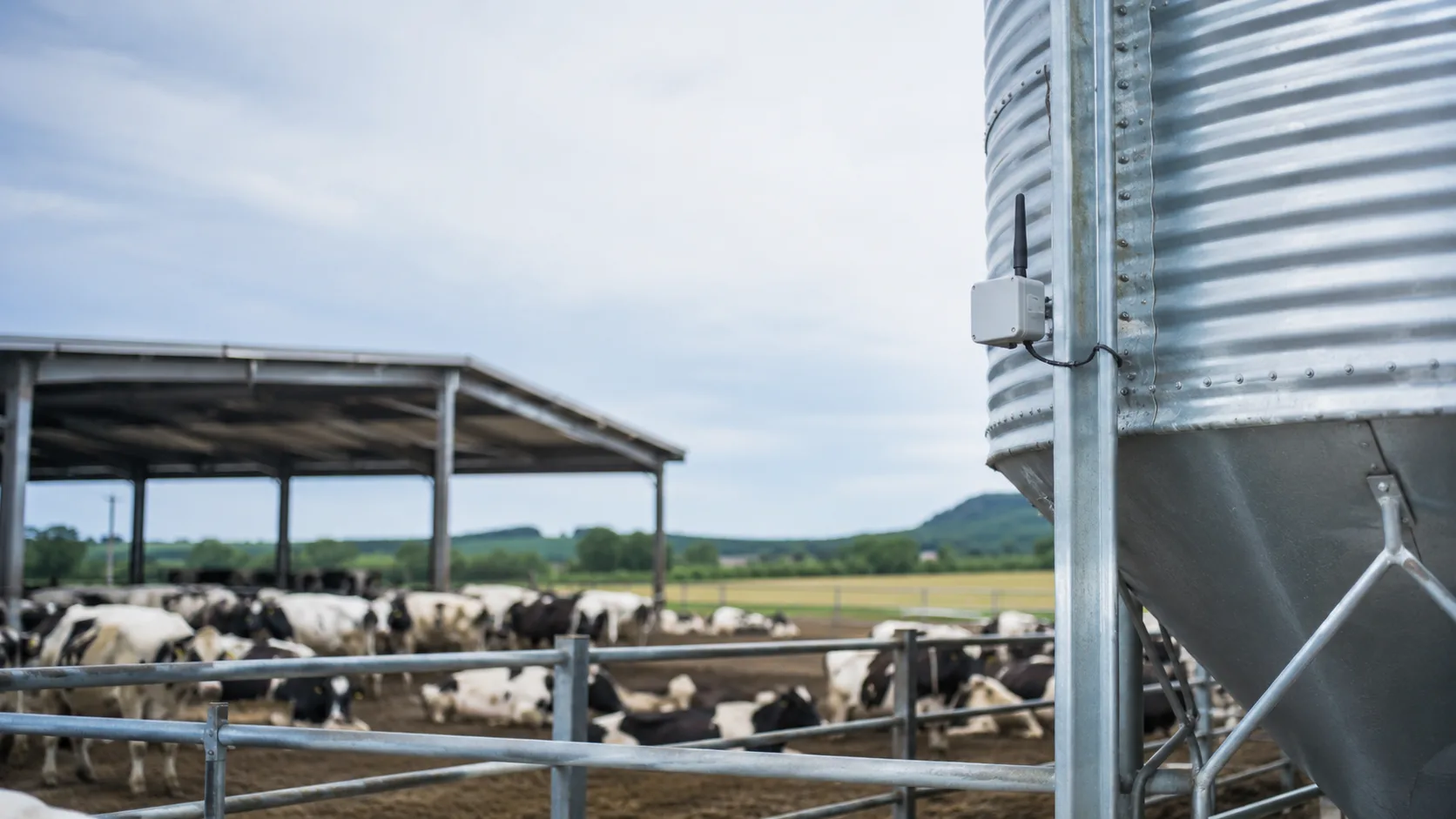
Running out of feed in a dairy silo is the kind of problem that always seems to happen at the worst time: a weekend, a holiday, or the night before a delivery was due. Running the opposite way, ordering too early and topping up a silo that was still half full, quietly ties up cash and risks spoilage. Both problems come from the same root cause, which is that most dairy farms still guess at how much feed is in each silo.
Feed silo monitoring replaces the guess with a continuous, accurate reading of every silo, sent to a dashboard you can check from anywhere. This guide explains how it works, which sensor technology actually holds up on a dairy, and how to choose a system that pays for itself instead of becoming another device to maintain.
Why Manual Feed Silo Checks Fall Short
The traditional ways of checking a feed silo are all variations on a guess. Someone climbs a ladder to look inside, taps the side and listens for where the sound changes, or watches the calendar and reorders on a fixed schedule. Every one of these methods has the same weaknesses.
They are imprecise. A visual estimate through a hatch, or the pitch of a knock on a steel wall, tells you roughly whether a silo is high, medium, or low. That is not enough to plan a delivery or catch a feed-out running ahead of schedule.
They are a safety risk. Climbing silos is one of the more hazardous routine jobs on a dairy, and it tends to happen in a hurry, in poor weather, or in the dark, exactly when accidents occur.
They happen too rarely. A silo checked once a day can empty overnight without anyone knowing until the morning feed. On a dairy, an empty feed bin is not a minor inconvenience. It disrupts rations, stresses the herd, and can cost milk yield that does not come back quickly.
They do not create a record. Manual checks leave no history. You cannot see how fast a silo is actually drawing down, whether a delivery matched the invoice, or how consumption is trending across the season, because none of it is written down in a usable form.
Continuous feed silo monitoring solves all four at once. It measures accurately, it removes the climb, it never stops watching, and it logs everything automatically.
How Feed Silo Monitoring Works
A feed silo monitoring system has three parts: a sensor on each silo, a controller that collects the readings and sends them onward, and a cloud dashboard where you actually use the data.
The sensor sits on top of the silo and measures the distance down to the surface of the feed. As the feed level drops, that distance grows, and the system converts it to a fill level and a quantity based on the silo’s dimensions. The best sensors do this without touching the feed, so there is nothing inside the silo to clog, wear, or get buried.
The controller gathers readings from the sensor and transmits them over cellular to the cloud. On a dairy, where silos often sit away from buildings and mains power, a solar-powered controller with a built-in cellular connection is the practical choice, because it works with no wiring and no local network.
The dashboard is where monitoring turns into money saved. You see every silo’s level in real time, get an alert the moment one crosses your low-stock threshold, and review the history of refills and consumption. Feed silo monitoring is one of the clearest cases where continuous data changes daily decisions rather than just recording them.
Choosing the Right Silo Level Sensor
Not every level sensor survives a feed silo. Feed is dusty, the temperature inside a steel silo swings widely, and the surface of the feed is rarely flat. Here is how the main options compare for dairy feed.
80 GHz Radar (the practical default)
An 80 GHz radar level sensor is the technology we recommend for dairy feed silos. It measures with a focused microwave beam that reflects off the feed surface, and it has three properties that matter on a dairy.
It reads through dust. Filling a feed silo throws up a dense dust cloud that blinds some sensors exactly when a refill is happening. Radar cuts through it.
It ignores temperature. The speed of the radar signal is not affected by the temperature swings inside a steel silo, so readings stay accurate from a cold night to a hot afternoon.
It has a narrow beam and no moving parts. A focused beam avoids false echoes from silo walls and internal structures, and with nothing mechanical inside, there is nothing to service. Radar sensors typically deliver millimeter-level distance accuracy and need no recalibration after commissioning.
Ultrasonic
Ultrasonic sensors are a lower-cost option that work by bouncing a sound pulse off the surface. On a dairy feed silo their weakness is decisive: dust absorbs and scatters the sound, so the sensor tends to lose its reading during filling. They also drift with temperature. Ultrasonic is a reasonable fit for clean liquid tanks, but for dusty feed silos radar is the more dependable tool.
Load cells
Load cells measure weight by sitting under the silo legs, which gives a true mass reading and is excellent for verifying delivery quantities. The catch is cost and installation: retrofitting load cells to existing silos is expensive and disruptive. They make most sense on new silos or where weight-based billing verification is the priority.
For most dairy farms, one radar sensor per silo is the right balance of reliability, accuracy, and cost. Our silo level sensor comparison guide covers the full technology breakdown if you want to go deeper.
What Good Feed Silo Monitoring Delivers
The point of monitoring is not the sensor, it is what the data lets you do.
Low-stock alerts before you run out. Set a threshold per silo, and the system warns you while there is still time to order on a normal schedule rather than paying for an emergency delivery. This is the single feature dairy managers value most.
Automatic refill logging. Every delivery shows up as a step change in the level, logged with date, time, and quantity added. Over a season this becomes a complete record you can check against invoices and use to spot a delivery that came up short.
Consumption trends. Watching draw-down rates tells you how fast each ration is being consumed and flags anything unusual, a silo emptying ahead of schedule can mean a feed-out error, a leak, or simply a change in herd intake worth knowing about.
Less capital tied up in feed. When you can see exactly what is in every silo, you can safely run a leaner buffer instead of keeping every bin topped up “just in case.” That frees working capital without risking a stockout.
One screen for the whole farm. Whether you run two silos or twenty across several sites, they all report to one dashboard. See every level at a glance, compare across bins, and manage alerts in one place.
Building a Dairy Feed Silo System
A practical deployment on a dairy looks like this. Each silo gets a radar sensor on the roof, positioned off-center to read a representative average of the feed surface rather than the peak or the draw-down cone. The sensors connect to an Omni Genesis controller, which is solar powered and reports over 4G-LTE cellular, so no silo needs mains power or a network cable.
The controller streams data to the cloud, where the dashboard shows live levels, sends alerts, and keeps the refill and consumption history. Because the controller is modular and multi-protocol, the same system can later take on other sensors around the dairy, water quality in a trough or reservoir, temperature and humidity in a barn, without adding a second platform. The full picture of how the sensors, controller, and dashboard fit together is on our IoT silo monitoring page.
Two practical tips make the difference between a system that works and one that frustrates. First, plan sensor mounting before installation day: a sensor placed directly over the fill point or hard against a wall will give noisy readings. Second, label each silo in the dashboard the way your team actually refers to it, “Silo 2, milking herd” is useful, an anonymous sensor ID is not.
Is It Worth It for a Dairy Farm?
The return on feed silo monitoring is unusually easy to see, because feed is the largest single cost on most dairy farms and the failure modes are concrete. Avoiding a single emergency delivery, preventing one overfill and spillage event, and trimming the safety buffer across several silos typically covers the system in the first months, and the safety benefit of never sending someone up a ladder to check a bin is hard to put a number on but easy to appreciate.
If you are still climbing silos or knocking on steel to guess your feed levels, the technology to stop doing that is proven, low-maintenance, and available today. Start with your most critical silo, see the value, and expand from there.
Ready to scope a system for your dairy? Get a quote and tell us how many silos you run, or browse the full range of silo level sensors.
Frequently Asked Questions
What is the best sensor for feed silo monitoring on a dairy farm?
An 80 GHz radar level sensor is the most reliable choice for dairy feed silos. It measures without contact, reads through the dust raised when a silo is filled, and is unaffected by temperature swings between a cold morning and a hot afternoon. It has no moving parts and needs no calibration after installation, so it suits the low-maintenance reality of a working dairy. Each silo gets one sensor reporting to a single dashboard.
How do dairy farms monitor feed silos without climbing them?
A radar sensor mounted on the silo roof measures the feed level continuously and sends it to a cloud dashboard over cellular. Instead of climbing a ladder or knocking on the silo wall to guess, staff check a screen. The system logs every refill automatically and sends a low-stock alert before a silo runs empty, so nobody has to physically inspect each bin.
Can feed silo monitoring reduce feed costs and waste?
Yes. Continuous level data lets a farm carry a smaller safety buffer with confidence, freeing up working capital tied in feed. It cuts emergency deliveries that carry a premium, prevents overfilling and spillage, and surfaces consumption trends that support better ordering. The visibility also flags a silo emptying faster than expected, which can indicate a delivery shortfall or a feed-out problem.
Does feed silo monitoring work on remote dairy farms without Wi-Fi?
Yes. A solar-powered, cellular-native controller sends readings over 4G-LTE, so a silo far from the farm office or with no local network is still online. There is no gateway to install and no wiring to run between silos and a building. Alerts reach the manager by app, SMS, or email wherever they are.
How many silos can one system monitor?
There is no practical limit. Each silo carries its own sensor, and all of them report to one dashboard where you see every level at a glance, compare consumption across bins, and manage alerts for the whole farm. A dairy running several feed silos, or multiple sites, manages them all from a single screen.