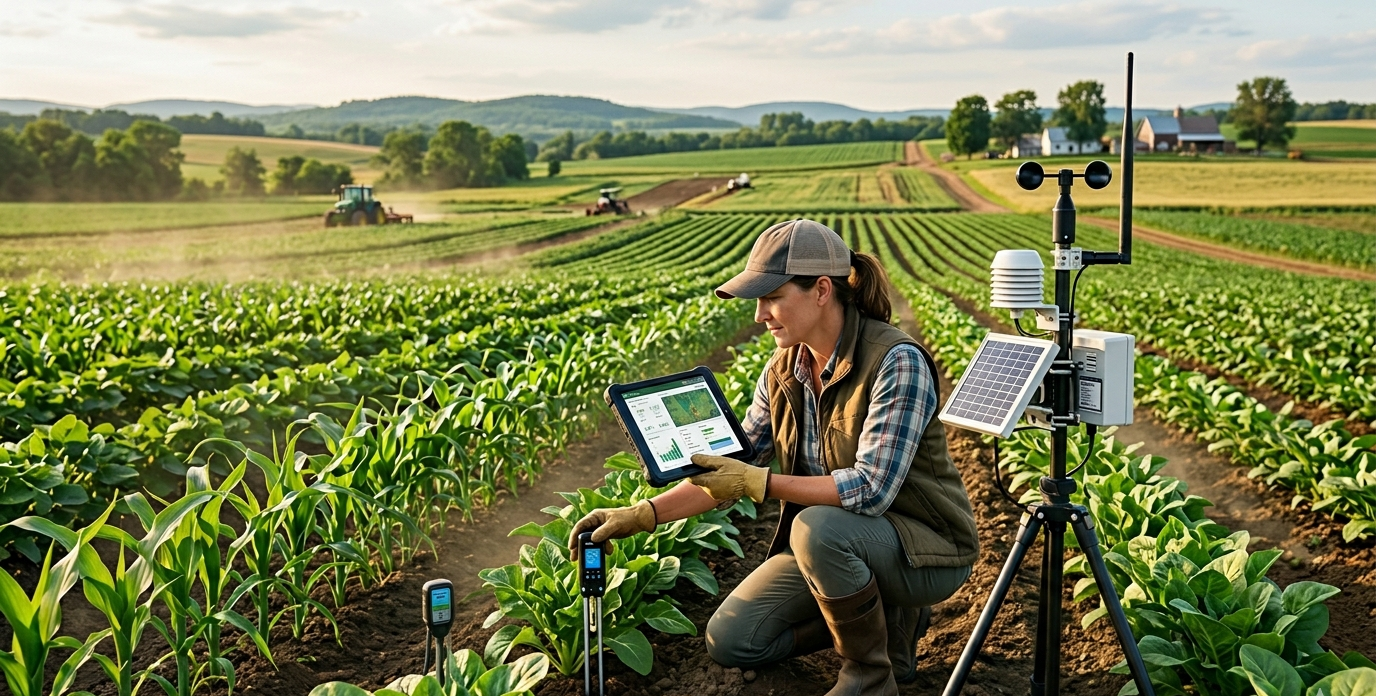
Most farms that invest in sensors start with the wrong ones. They buy what a salesperson recommends, install too many in the wrong places, and end up with dashboards full of data they do not act on.
The better approach: figure out what decision you are trying to make, then pick the minimum sensors that give you the answer.
This guide covers the five sensor categories relevant to agriculture, which ones matter for your specific crop type, and what a realistic starter setup looks like.
The five sensor categories
Every agricultural monitoring system draws from five categories. No farm needs all of them on day one.
1. Soil moisture
This is where most farms should start. Soil moisture sensors answer the most expensive question in agriculture: when to irrigate and how much.
Three technologies compete here:
Granular matrix sensors like the Watermark 200SS measure soil water tension (how hard plant roots have to work to extract water). They cover 0-200 centibars, need zero maintenance, and last 5+ years buried in the field. No recalibration, no refilling, no moving parts. For most field deployments, this is the right starting point.
Tensiometers (LT, MLT, SR) measure the same thing (tension) but with higher accuracy in the wet range (0-80 cb). They are the gold standard for orchards and high-value crops where precision matters. The tradeoff: they need periodic refilling and can air-lock in very dry soil. If you have field staff who check equipment regularly, tensiometers give the best data.
Capacitive sensors (TDR/FDR) measure volumetric water content. They respond faster than tension-based sensors and give you a percentage number that is intuitive. The problem: they are affected by soil salinity, soil type, and temperature. In saline soils above 4 dS/m, readings become unreliable without calibration curves specific to your soil.
For a deeper comparison, see our soil sensors explained guide and the Watermark sensor guide.
2. Soil chemistry — EC and pH
If you fertigate (inject fertilizer through irrigation), EC sensors tell you whether nutrients are reaching the root zone or accumulating as salts. A rising EC trend at 30 cm depth means salts are building up. A dropping EC after irrigation means you are leaching nutrients past the roots.
pH affects nutrient availability. Below 5.5 or above 7.5, certain nutrients lock out regardless of how much fertilizer you apply. If your crop shows deficiency symptoms despite adequate fertilization, pH is usually the culprit.
The EC-100 and PH-100 are digital RS485 sensors that connect to IoT controllers for continuous monitoring. For installations requiring a compact inline form factor, the EC-10 and PH-10 are analog alternatives.
Our soil pH and EC monitoring guide covers interpretation, placement depths, and calibration schedules.
3. Temperature
Soil temperature drives germination timing, root activity, nutrient uptake, and disease pressure. Air temperature and humidity determine evapotranspiration rate, frost risk, and heat stress windows.
The DS18B20 soil temperature sensor is a digital probe accurate to ±0.5°C that chains on a single wire — you can monitor multiple depths with one cable run. For air temperature and humidity, the SHT30 gives you both readings from one sensor.
Temperature is the cheapest sensor to deploy and the easiest to act on. A frost alert at 3 AM that triggers a heater or fan is worth more than every other sensor combined if it saves one crop cycle.
4. Water quality
If your operation includes fish ponds, shrimp tanks, or recirculating aquaculture systems (RAS), water quality sensors are not optional. Dissolved oxygen, pH, ammonia, and temperature determine whether your stock lives or dies.
Even for pure agriculture operations, monitoring irrigation water quality (EC, pH) at the source prevents problems before they reach the field. If you draw from a well or reservoir, seasonal changes in source water chemistry can silently damage a crop.
We cover water quality monitoring extensively in our aquaculture monitoring guide and RAS water quality guide.
5. Storage and silo level
Bulk storage of feed, grain, fertilizer, or other materials benefits from level monitoring. The alternative is climbing silos with a measuring tape or running out of feed on a Friday afternoon.
80GHz radar level sensors measure fill level through dust, humidity, and temperature extremes without contact. One sensor per silo, reporting to the same controller and dashboard as your field sensors.
See our silo monitoring guide for technology comparison and sizing.
Which sensors for your farm type
Open field crops (wheat, corn, cotton, vegetables)
Start with: 2 soil moisture sensors per management zone (one at 15-20 cm, one at 40-50 cm) + 1 soil temperature probe.
Why two depths: The shallow sensor tells you when to irrigate. The deep sensor tells you if water is reaching the full root zone or running past it. If the deep sensor stays dry after irrigation, your run time is too short. If it spikes immediately, water is channeling through cracks.
Add later: EC sensor at 30 cm if you fertigate. Air temperature/humidity sensor for disease prediction models.
Orchards and vineyards
Start with: 2-3 soil moisture sensors at staggered depths (20, 40, 60 cm) per representative tree/vine + 1 soil temperature probe.
Why deeper: Tree roots pull water from much deeper than field crops. Monitoring at 60 cm catches deep drainage that wastes water and leaches nutrients.
Tensiometers are the preferred technology here because orchards justify the maintenance cost and the accuracy in the wet range matters for regulated deficit irrigation.
Add later: EC at two depths for salt leaching management. Weather station for chill hour tracking (deciduous fruit).
Greenhouses and hydroponics
Start with: EC + pH sensors in the irrigation solution + 1-2 substrate moisture sensors + air temperature/humidity.
Why EC and pH first: In controlled environments, the irrigation solution IS the nutrition. Getting EC and pH wrong costs you immediately in growth rate and fruit quality. Substrate moisture matters less because you control the watering schedule precisely.
Add later: CO2 sensor for enrichment control. Additional substrate moisture points if you have mixed crops or zone differences.
Mixed farm with livestock or aquaculture
Start with: Whatever your highest-risk operation needs. If fish die, start with a DO sensor on the most critical pond. If irrigation is your biggest cost, start with soil moisture.
Key advantage: A single Omni Genesis controller handles soil sensors, water quality sensors, and environmental sensors simultaneously. You do not need separate systems for separate operations.
The controller — what connects everything
Sensors without a controller are just probes in the ground. The controller reads sensor data on a schedule (typically every 15-60 minutes), transmits it over cellular or WiFi to the cloud, and triggers alerts or control outputs when values cross thresholds.
The Omni Genesis supports RS485 Modbus, SDI-12, analog 4-20mA, and 1-Wire protocols. This matters because it means any standard sensor connects to it. You are not locked into proprietary sensors. One controller handles 20+ sensors across multiple protocols simultaneously.
For a detailed comparison of sensor protocols, see our SDI-12 vs Modbus vs RS-485 vs Analog guide.
Common mistakes
Installing too many sensors before understanding one. Start with one monitoring station. Learn what the data looks like through a full irrigation cycle. Then expand. Farms that deploy 20 sensors on day one usually abandon the system within a year.
Placing sensors next to drip emitters. The sensor reads the wettest spot in the field, which tells you nothing about the rest of the root zone. Place sensors 15-20 cm from the nearest emitter, between plant rows, at a representative location.
Ignoring soil type variation. One sensor station does not represent a field with three different soil textures. Walk the field, dig a few holes, and identify zones before deciding where to monitor. Two stations in the right places beat ten in the wrong places.
Not acting on the data. A dashboard is not a strategy. Before installing sensors, define the threshold that triggers action. “If moisture at 20 cm drops below 30 cb, irrigate for 45 minutes.” Write it down. Better yet, automate it.
For more on installation mistakes, see our sensor troubleshooting guide.
Getting started — minimum viable setup
The smallest useful system: one Omni Genesis controller, two Watermark 200SS sensors at two depths, and one DS18B20 temperature probe.
This gives you irrigation timing, deep drainage detection, and frost alerts from a single installation point. Data goes to the Omni Cloud dashboard on your phone. Total deployment time: about two hours including wiring.
From there, add sensors based on what questions the data raises. If you see the deep sensor responding too slowly, add an EC sensor to check if salt is blocking infiltration. If you lose a crop section to heat, add an air temperature sensor with SMS alerts.
The system grows with you. That is the point of modular hardware.