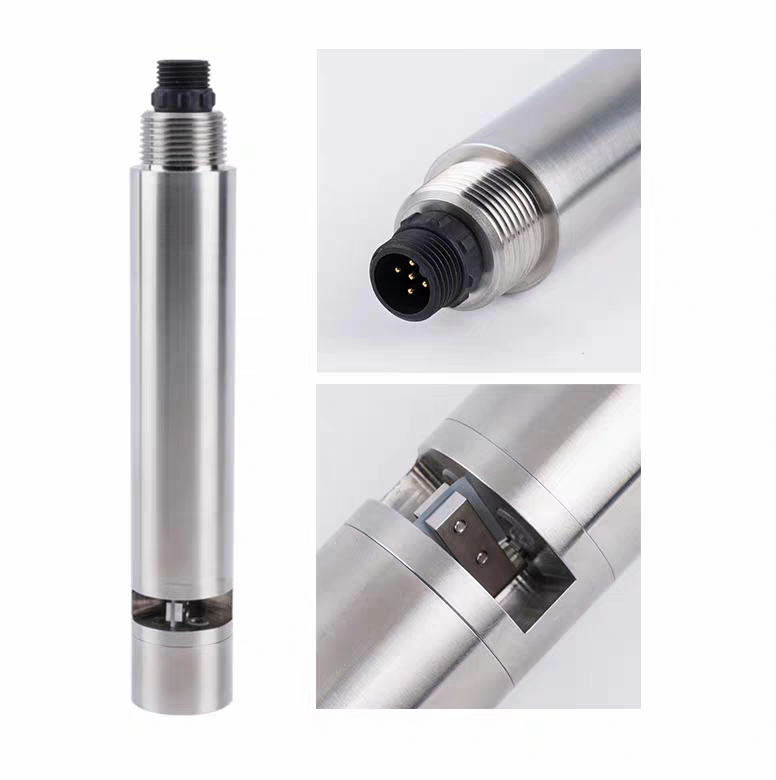
COD-130 UV Absorption COD Sensor with Self-Cleaning Wiper
Self-cleaning UV absorption COD sensor measuring COD, BOD, TOC & turbidity. IP68, RS485 Modbus RTU for wastewater and aquaculture.
Contact for pricing
Product Highlights
View all in Specifications tabOverview
The COD-130 is a digital UV absorption sensor designed for continuous, real-time Chemical Oxygen Demand (COD) monitoring in water and wastewater. By simultaneously measuring absorbance at dual wavelengths — 254nm and 850nm — it derives accurate COD readings while automatically compensating for turbidity interference. Beyond COD, the sensor calculates BOD (Biochemical Oxygen Demand), TOC (Total Organic Carbon), and turbidity from the same optical measurement, delivering four critical water quality parameters from a single compact probe.
A built-in self-cleaning wiper keeps the optical windows free of biofilm and sediment, making the COD-130 well suited for long-term, unattended deployment in harsh environments such as wastewater treatment plants, industrial effluent streams, and aquaculture facilities.
Key Features
- Dual-Wavelength UV Absorption: Simultaneous 254nm and 850nm measurement for accurate COD determination with turbidity compensation
- Multi-Parameter Output: Derives COD, BOD, TOC, and turbidity from a single sensor — reducing hardware costs and installation complexity
- Built-in Self-Cleaning Wiper: Automatic wiper with configurable interval prevents optical fouling and extends maintenance cycles
- Wide COD Range: Selectable 0–300 mg/L or 0–1500 mg/L range to match different application requirements
- Compact Design: Just 32mm diameter and 175mm length for easy installation in tight spaces
- Digital RS485 Output: Modbus RTU protocol for seamless integration with controllers, PLCs, and SCADA systems
- Wide Supply Voltage: 9–36 VDC input accommodates solar-powered and battery-backed installations
- Low Power Consumption: Only 1.5W for energy-efficient continuous monitoring
- Factory Calibrated: Ships ready to deploy with slope and offset field calibration options
Applications
- Wastewater treatment plant influent and effluent COD monitoring
- Industrial effluent discharge compliance and permit reporting
- Aquaculture water quality management and organic load tracking
- Environmental surface water and river quality assessment
- Drinking water source protection and early warning systems
- Process water quality control in food, beverage, and chemical industries
- Stormwater runoff organic pollution monitoring
Technical Specifications
The COD-130 uses UV absorption at 254nm — a wavelength strongly absorbed by dissolved organic compounds — to determine COD concentration. The secondary 850nm channel measures turbidity-induced scattering, allowing the sensor to subtract particulate interference and deliver a corrected COD value. This dual-wavelength approach provides reliable results even in water with moderate suspended solids. For applications where suspended solids are the primary concern, consider pairing the COD-130 with the SS-110 Suspended Solids Sensor for a comprehensive organic and particulate monitoring solution.
The sensor offers two selectable COD measurement ranges — 0–300 mg/L for treated effluent and cleaner water bodies, or 0–1500 mg/L for raw wastewater and industrial streams — with 0.1 mg/L resolution across both ranges.
Understanding COD Monitoring
Chemical Oxygen Demand is one of the most widely used indicators of organic pollution in water. It quantifies the total amount of oxygen required to chemically oxidize organic and inorganic matter in a water sample. Traditional laboratory COD analysis involves hazardous reagents (potassium dichromate, sulfuric acid) and takes hours to produce results. The COD-130 eliminates the need for chemical reagents entirely by using UV light absorption as a proxy for organic content, delivering continuous readings in real time.
Monitoring COD is essential for:
- Wastewater Treatment: Tracking organic load through treatment stages to optimize aeration and chemical dosing
- Regulatory Compliance: Meeting discharge permit limits for COD, BOD, and TOC simultaneously
- Aquaculture: Detecting rising organic loads from uneaten feed and biological waste before water quality degrades
- Industrial Processes: Controlling organic contamination in process and cooling water systems
Because the COD-130 also outputs turbidity, it can complement or partially replace a dedicated turbidity sensor in installations where approximate NTU readings (0–1000 NTU range) are sufficient.
Connectivity and Integration
The COD-130 communicates via RS485 Modbus RTU, making it compatible with a wide range of monitoring infrastructure:
- Agrinovo IoT Controllers: Plug-and-play connectivity with the Omni Genesis and Omni Exodus controllers for cloud-based monitoring and alerting
- Industrial PLCs and SCADA: Standard Modbus integration for plant-wide automation systems
- Data Loggers and Telemetry: Connect to third-party loggers for remote or off-grid deployments
- Custom Systems: Open protocol works with any RS485-capable device or gateway
The 10m standard cable (customizable length) and wide 9–36 VDC power input simplify installation across diverse site conditions, including solar-powered remote monitoring stations.
Installation and Maintenance
The COD-130 installs using a standard submersion bracket. Position the sensor so the optical windows face the flow and remain fully submerged during operation. Avoid locations with excessive air bubbles or direct sunlight on the optical path, as these can affect UV absorption readings.
Self-Cleaning: The built-in automatic wiper runs on a configurable interval to keep the optical windows clear. This dramatically reduces manual cleaning visits, which is especially valuable in wastewater and aquaculture environments where biofouling is rapid.
Calibration: The sensor ships factory-calibrated and ready for deployment. Field recalibration is supported through slope (K) and offset (B) adjustments using known standard solutions, allowing operators to fine-tune readings to match site-specific water chemistry.
Pressure Rating: Rated for 0–3 bar operating pressure, suitable for both open-channel and pressurized pipe installations.
Part of our IoT Aquaculture Monitoring System
See how our aquaculture sensors work together in a complete real-time water quality monitoring system for fish farming.