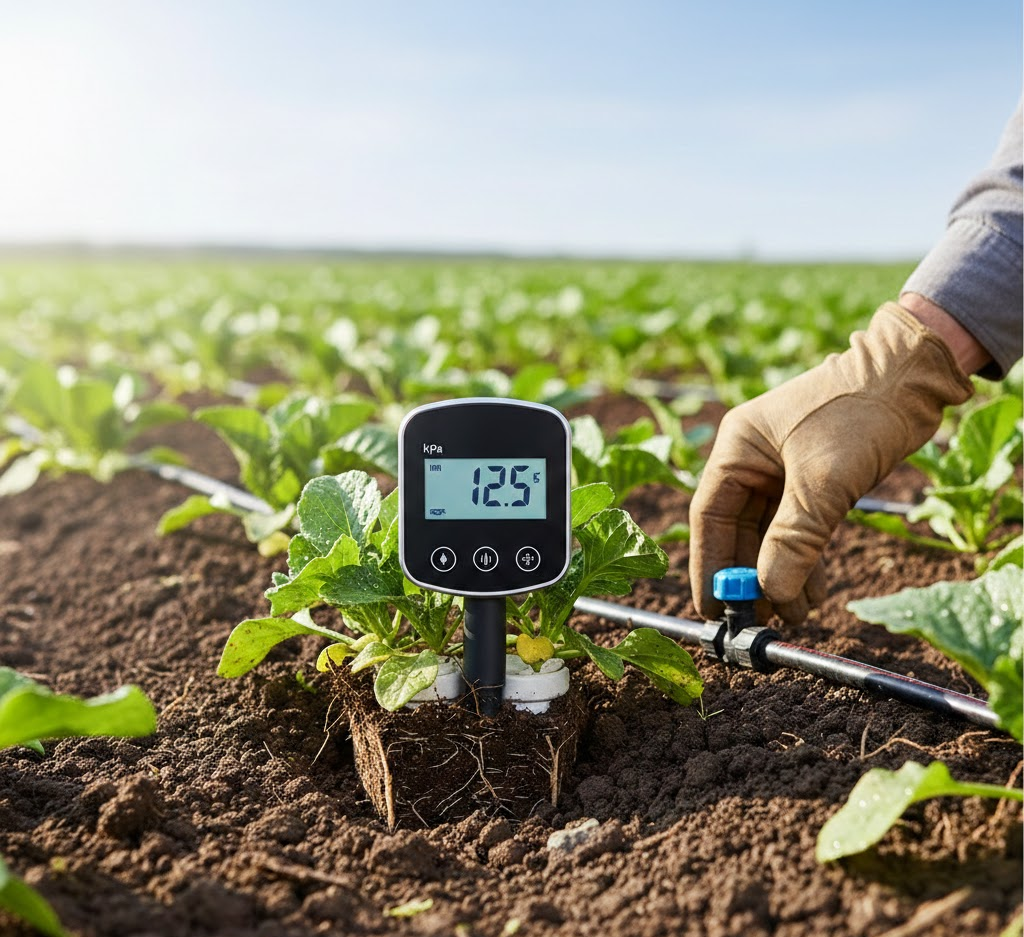
A tomato grower in California’s Central Valley once told me he had 15% volumetric water content in his field. He wanted to know: should he irrigate? The answer is that it depends entirely on his soil type. At 15% VWC, a sandy loam is nearly dry, but a heavy clay still has plenty of available water. He was asking the wrong question. The right question is not “how much water is in my soil?” but “how available is that water to my plants?”
That is exactly what a tensiometer measures. And despite being invented in 1951 by L.A. Richards at the USDA Salinity Laboratory, the tensiometer remains the gold standard for answering the most practical question in irrigation management: is it time to water?
The reason is simple. Tensiometers measure soil water tension - the actual force plants must exert to pull water from soil particles. This reading, expressed in centibars (cb) or kilopascals (kPa), is directly comparable across soil types. A reading of 30 cb means the same thing in sand, loam, or clay: plants are working moderately hard to access water. No calibration curves, no soil-specific lookup tables. Just a number that tells you what your crop is experiencing right now.
How Tensiometers Work
The operating principle of a tensiometer is elegant and entirely physical - no electronics required in its simplest form.
The Components
A tensiometer consists of four main parts:
-
Porous ceramic tip (cup): A fired ceramic cylinder at the bottom of the instrument, with pores small enough to remain saturated with water under normal field conditions but large enough to allow water to move freely through them. Typical pore sizes are 1-3 micrometers.
-
Water-filled tube (body): A sealed plastic or acrylic tube, typically 30-120 cm long depending on the installation depth. This tube is completely filled with de-aired water.
-
Vacuum gauge or pressure transducer: Mounted at the top of the tube. In manual tensiometers, this is an analog vacuum gauge graduated in centibars. In electronic tensiometers, a pressure transducer converts the vacuum into an electrical signal (typically 4-20 mA or 0-2.5V).
-
Seal and fill cap: A rubber stopper or screw cap that seals the top of the tube airtight, with a mechanism for refilling water when needed.
The Physical Principle
When you install a tensiometer in soil, the ceramic tip is in direct hydraulic contact with the surrounding soil water. Water can move freely through the ceramic pores in either direction.
When the soil is moist, water pressure outside the tip is close to atmospheric, and the gauge reads near zero. As the soil dries, the soil matrix pulls water out of the tensiometer through the ceramic tip. Because the tube is sealed at the top, removing water creates a partial vacuum inside the tube. The gauge measures this vacuum.
The key insight is that this vacuum is exactly equal to the soil water tension - the energy per unit volume that a plant root would need to expend to extract water from the soil at that point. That is why tensiometer readings are so directly useful: they measure the same force the plant experiences.
When you irrigate and water returns to the soil around the tip, the process reverses. Water flows back through the ceramic into the tube, the vacuum decreases, and the gauge reading drops.
Response Time and Sensitivity
A well-conditioned tensiometer in good hydraulic contact with the soil typically responds to an irrigation event within 30-60 minutes. The response is not instant because water must physically flow through the ceramic tip, and that flow depends on the hydraulic conductivity of both the ceramic and the surrounding soil.
In sandy soils, response tends to be faster (15-30 minutes). In heavy clays, it can take 1-2 hours. This is important to keep in mind when interpreting readings during or immediately after irrigation.
How to Read a Tensiometer
Tensiometer readings are straightforward once you understand the scale. All readings are in centibars (cb), which are numerically equal to kilopascals (kPa). Zero means the soil is saturated; higher numbers mean drier soil.
Here is a practical reference table:
| Range (cb) | Soil Condition | Action |
|---|---|---|
| 0-10 | Saturated soil | Stop irrigating immediately. Risk of root asphyxiation, root rot, and Phytophthora or Pythium infection. Indicates over-irrigation or poor drainage. |
| 10-25 | Well-watered soil | Ideal range for moisture-sensitive crops like lettuce, strawberries, and seedlings. No irrigation needed for most crops. |
| 25-40 | Moderate tension | Time to irrigate most vegetable and fruit crops. Optimal range for established orchards and field crops. |
| 40-60 | Drying soil | Urgent irrigation needed for vegetables and shallow-rooted crops. Acceptable for deficit-irrigated grapes and some drought-tolerant trees. |
| 60-80 | Very dry soil | Most crops are experiencing significant water stress. Tensiometer is approaching its operational limit. Irrigate immediately. |
| 80+ | Cavitation zone | Air has entered the tube through the ceramic tip. The reading is no longer reliable. Refill and re-condition the tensiometer before trusting further readings. |
Reading Tips from the Field
Read at the same time each day. Soil tension follows a daily cycle - it peaks in late afternoon when transpiration is highest and drops overnight. Morning readings (6-8 AM) give you the most stable baseline for comparing day to day.
Watch the trend, not just the number. A reading of 35 cb that has been stable for three days means something different from 35 cb that was 20 cb yesterday. Rapidly rising tension means the soil is drying fast and you may need to irrigate before you hit your threshold.
Check for air bubbles. If your tensiometer reading jumps erratically or seems stuck at zero despite dry conditions, air may have entered the tube. Hold the tensiometer up to the light and look for bubbles in the water column.
Irrigation Trigger Points by Crop Type
Not all crops need the same soil moisture level. Here are specific irrigation trigger points based on published research and field experience:
Leafy Vegetables (lettuce, spinach, herbs):
- Start irrigating at: 15-20 cb
- Optimal range: 10-20 cb
- These crops have shallow roots and wilt quickly. In sandy soils, drop the trigger to 12-15 cb.
Fruiting Vegetables (tomatoes, peppers, cucumbers):
- Start irrigating at: 25-35 cb
- Optimal range: 15-30 cb
- Consistency matters more than the exact number. Fluctuating tension causes blossom-end rot in tomatoes and fruit cracking in peppers.
Citrus and Avocado:
- Start irrigating at: 30-50 cb
- Optimal range: 20-40 cb
- Avocados are especially sensitive to over-watering. Keep the shallow sensor above 15 cb to avoid Phytophthora root rot.
Grapes and Wine Grapes:
- Start irrigating at: 40-60 cb (varies by growth stage)
- Controlled deficit: 50-70 cb (to concentrate sugars pre-harvest)
- Wine grape quality often improves with moderate water stress. This is one crop where higher tension readings are sometimes the goal.
Deciduous Fruit Trees (apples, peaches, cherries):
- Start irrigating at: 30-50 cb
- Optimal range: 20-40 cb
- Monitor at two depths. These trees have deep roots, and you want to ensure water reaches the full root zone without wasting it below.
Field Crops (corn, cotton, soybeans):
- Start irrigating at: 40-60 cb
- Optimal range: 25-50 cb
- For rainfed field crops, tensiometers are useful as diagnostic tools even if you cannot irrigate on demand. They tell you when yield loss is occurring.
Turf and Lawns:
- Start irrigating at: 20-30 cb
- Optimal range: 10-25 cb
- Sports turf managers often use tensiometers to maintain playing surface consistency.
The Soil Type Factor
These trigger points assume a medium-textured soil (loam to clay loam). In sandy soils, reduce all trigger values by 5-10 cb because sand releases water quickly and plants can go from “fine” to “stressed” fast. In heavy clays, you can sometimes add 5-10 cb because clay holds water more tightly but also releases it more gradually.
Installation Guide
Proper installation is the single biggest factor in getting reliable tensiometer data. A poorly installed tensiometer will give you readings that are either wrong or so noisy they are useless.
Choosing the Right Depth
Install tensiometers in pairs at two depths:
Shallow sensor (active root zone): This is your irrigation trigger. Place it where most of the roots are actively taking up water.
| Crop Type | Shallow Sensor Depth |
|---|---|
| Vegetables | 15-20 cm (6-8 in) |
| Strawberries | 10-15 cm (4-6 in) |
| Field crops | 20-30 cm (8-12 in) |
| Orchards | 30-40 cm (12-16 in) |
| Vineyards | 25-35 cm (10-14 in) |
Deep sensor (below root zone): This tells you if water is draining past the roots (wasted) or if you are under-irrigating and the deep zone is dry.
| Crop Type | Deep Sensor Depth |
|---|---|
| Vegetables | 40-50 cm (16-20 in) |
| Strawberries | 30-40 cm (12-16 in) |
| Field crops | 60-75 cm (24-30 in) |
| Orchards | 80-100 cm (32-40 in) |
| Vineyards | 60-80 cm (24-32 in) |
Interpreting the pair: If the shallow sensor reads high (dry) but the deep sensor reads low (wet), you are under-irrigating - water is not reaching the deep roots. If both read low after irrigation, you are irrigating correctly. If the deep sensor reads lower than the shallow sensor consistently, you may be over-irrigating and pushing water below the root zone.
Step-by-Step Installation
-
Soak the tensiometer. Before installation, submerge the ceramic tip in clean water for at least 24 hours. This saturates the ceramic pores and ensures good hydraulic contact. Some manufacturers recommend 48 hours for new units.
-
Fill the tube. Fill the tube with de-aired water (boiled and cooled water works fine). Tap the sides to dislodge air bubbles. Top off after bubbles rise to the surface. Repeat until no more bubbles appear.
-
Drill the hole. Use a soil auger or a piece of PVC pipe with the same outer diameter as the tensiometer body. The hole must be the same diameter as the tensiometer - a tight fit is essential. In heavy clays, dampen the sides of the hole to prevent the clay from swelling and cracking.
-
Make a mud slurry. Mix some of the excavated soil with water to create a thin slurry. Pour a small amount into the bottom of the hole. This ensures good contact between the ceramic tip and the surrounding soil.
-
Insert the tensiometer. Push it gently into the hole, twisting slightly to ensure the ceramic tip seats into the slurry. The tip must be in firm contact with the undisturbed soil at the bottom.
-
Backfill. Pack the excavated soil tightly around the tube. You want to eliminate air gaps along the tube body. Some installers use bentonite slurry around the tube at the soil surface to prevent preferential water flow down the tube.
-
Top off and seal. Fill the tube one final time, check for bubbles, and seal the cap.
-
Wait 24-48 hours. The tensiometer needs time to equilibrate with the surrounding soil before readings are meaningful.
Maintenance Schedule
Tensiometers are not install-and-forget instruments. Here is a realistic maintenance schedule:
- Weekly: Check gauge readings. Look for sudden jumps that indicate air entry.
- Every 2-4 weeks: Top off with de-aired water. In hot, dry conditions with sandy soils, you may need to refill weekly.
- After cavitation: If the tensiometer has dried past 80 cb and cavitated, pull it out, re-soak the ceramic tip, refill completely, and reinstall.
- Annually: Replace the ceramic tip if it shows signs of clogging (slow response times, algae buildup). Clean the interior with a dilute bleach solution, rinse thoroughly, and re-soak.
Types of Tensiometers
Manual (Gauge) Tensiometers
The classic design. A simple vacuum gauge at the top of the tube, readable by eye. These cost $40-80 each and require no power source. You walk to the field, read the gauge, and write down the number.
Best for: Small operations, educational settings, situations where you visit the field daily anyway.
Limitation: Data only exists when someone reads it. You miss overnight changes, irrigation response curves, and anything that happens when you are not there.
Electronic (Pressure Transducer) Tensiometers
These replace the analog gauge with a pressure transducer that outputs an electrical signal - typically 4-20 mA, 0-2.5V, or RS485/Modbus. The transducer sits in the sealed headspace of the tensiometer and reads the vacuum electronically.
Best for: Automated irrigation systems, data logging, remote monitoring.
Advantages over manual:
- Continuous data logging reveals patterns you would never catch with daily readings
- Signal output can directly trigger irrigation controllers
- Sub-centibar resolution (0.1 cb typical) compared to 2-5 cb for analog gauges
- Data can be transmitted wirelessly to a cloud platform
IoT-Connected Tensiometers
The latest generation combines electronic transducers with wireless communication (cellular, LoRa, or Wi-Fi) and cloud connectivity. These units transmit readings at configurable intervals (typically every 15-60 minutes) to a web dashboard where you can view trends, set alerts, and trigger irrigation remotely.
This is where tensiometers become truly powerful. Instead of a snapshot, you get a continuous film of what is happening in your soil. You can see exactly how your soil responds to irrigation, how quickly it dries between cycles, and whether your irrigation uniformity is consistent across the field.
Tensiometers vs Other Soil Moisture Sensors
Every soil moisture measurement technology has trade-offs. Here is an honest comparison:
Tensiometers vs Capacitance Sensors
Capacitance sensors measure volumetric water content (VWC) using the dielectric properties of soil. They are the most common type of soil moisture sensor in modern agriculture.
| Factor | Tensiometers | Capacitance Sensors |
|---|---|---|
| What they measure | Soil water tension (cb) | Volumetric water content (%) |
| Soil calibration needed | No | Yes (for accurate absolute values) |
| Maintenance | Regular refilling | None (solid-state) |
| Operating range | 0-80 cb | Full range (0-saturation) |
| Response time | 30-60 min | Near-instant |
| Cost per point | $40-200 | $100-400 |
| Best for | Irrigation timing decisions | Water balance calculations |
When tensiometers win: You need to make irrigation decisions across different soil types without calibration. You want a measurement that directly relates to plant water stress. You are growing high-value crops where precise irrigation timing matters.
When capacitance wins: You need maintenance-free sensors for remote or unmanned sites. You need fast response for pulse irrigation systems. You want to calculate exact water application volumes.
Tensiometers vs Granular Matrix Sensors (Watermark)
Granular matrix sensors like the Watermark 200SS measure soil water tension indirectly. A porous block (the granular matrix) equilibrates with the surrounding soil, and embedded electrodes measure the electrical resistance of the block, which correlates with tension.
| Factor | Tensiometers | Granular Matrix (Watermark) |
|---|---|---|
| Measurement principle | Direct (water tension) | Indirect (resistance to tension) |
| Range | 0-80 cb | 0-200+ cb |
| Maintenance | Regular refilling | None |
| Accuracy at 0-40 cb | Excellent | Good |
| Accuracy at 40-80 cb | Good | Good |
| Accuracy above 80 cb | N/A (cavitates) | Fair |
| Lifespan | Years (with maintenance) | 5-10 years |
| Cost | $40-200 | $30-50 |
When tensiometers win: You are managing high-value crops in the 0-40 cb range where precision matters most (vegetables, orchards). You need the highest accuracy at low tensions.
When Watermark wins: You are monitoring dryland or rainfed crops where tension regularly exceeds 80 cb. You want a set-and-forget sensor for remote locations. Budget is a primary concern. For a deeper dive, see our complete guide to granular matrix sensors.
Tensiometers vs TDR (Time Domain Reflectometry)
TDR sensors are the research-grade gold standard for volumetric water content measurement. They send an electromagnetic pulse along a waveguide and measure the travel time, which depends on soil water content.
TDR sensors are extremely accurate but expensive ($300-1000+ per sensor) and overkill for most farm irrigation scheduling. They are primarily used in research, precision viticulture, and situations where you need laboratory-grade VWC data in the field.
Bottom line: For most farmers making irrigation decisions, tensiometers or granular matrix sensors provide the most directly actionable data at a reasonable cost.
IoT Integration and Automation
The real power of tensiometers emerges when you connect them to an automated system. A standalone tensiometer tells you what happened in the past. A connected tensiometer tells you what to do right now.
Electronic Output Options
Modern electronic tensiometers typically offer one or more of these outputs:
- Analog (4-20 mA or 0-2.5V): Simple, reliable, compatible with almost any data logger or irrigation controller. Run two wires from the tensiometer to the controller. The signal is proportional to the tension reading.
- RS485/Modbus: Digital communication allowing multiple sensors on a single bus cable. Each sensor has a unique address. This is the preferred option for systems with many sensors - you can run 20+ tensiometers on a single cable pair.
- SDI-12: A serial protocol common in environmental monitoring. Lower power than Modbus, good for solar-powered installations.
Connecting to Controllers
An electronic tensiometer connected to an irrigation controller enables fully automated irrigation scheduling:
- The tensiometer continuously monitors soil tension
- When tension exceeds your crop-specific threshold (e.g., 30 cb for tomatoes), the controller receives the signal
- The controller opens the appropriate irrigation valve
- The tensiometer detects the moisture increase and tension drops
- When tension falls below a lower threshold (e.g., 15 cb), the controller closes the valve
This closed-loop system adjusts irrigation automatically to weather conditions, crop growth stage, and soil variability - without any manual intervention.
Agrinovo Tensiometer Options
We offer several tensiometer models designed for IoT integration:
- SR Tensiometer: Compact electronic tensiometer with analog output, ideal for greenhouse and nursery applications where space is limited.
- MLT Tensiometer: Mid-length tensiometer with RS485/Modbus output, suitable for field crops and orchards at standard installation depths.
- LT Tensiometer: Long-tube tensiometer for deep root zone monitoring in orchards and vineyards. Available with analog or digital output.
For situations where maintenance-free operation is a priority, the Watermark 200SS granular matrix sensor provides soil tension data without the refilling requirements of a traditional tensiometer.
All of these sensors integrate with our IoT soil monitoring solution, which provides cloud-based dashboards, configurable alerts, and irrigation automation through compatible controllers.
Practical Tips from Real Installations
Place tensiometers in representative locations. Do not put them at the edge of the field, near a leaking emitter, or in a compacted tractor path. Place them in the zone that represents the average condition of the irrigated area.
Use at least two stations per management zone. Soil variability is real. One tensiometer might be in a sandy pocket while another is in a clay lens 50 meters away. Two stations give you confidence; one station gives you a guess.
Protect from physical damage. A tensiometer sticking out of the ground in a field is a target for tractors, workers, and curious animals. Use a protective sleeve or mark the location clearly. In orchards, install on the side away from mowing paths.
Keep records. Even with IoT logging, note when you irrigated, how much you applied, and what the weather was doing. After one season, you will have a dataset that lets you predict your soil’s behavior and fine-tune your thresholds.
Start with published thresholds, then adjust. The crop-specific values in this guide are good starting points, but your soil, climate, and crop variety may need slightly different numbers. Track yield and quality alongside your tension data for a season, and you will find your own optimal range.
Conclusion
Tensiometers have survived 75 years in agriculture for a good reason: they measure what plants actually experience. In an era of complex sensor networks and AI-driven irrigation, the underlying question has not changed. How available is the water to my crop, right now, at root depth?
Whether you use a $50 manual gauge tensiometer or a fully connected IoT system with cloud dashboards, the data these instruments provide is immediately actionable. No calibration curves, no soil-specific algorithms - just a number in centibars that tells you when to irrigate and when to stop.
If you are building out a soil monitoring system, tensiometers are an excellent place to start. Combine them with EC sensors for fertigation management and you have covered the two most impactful measurements in precision irrigation. For a broader overview of all soil sensor types, see our complete guide to soil sensors. And if maintenance-free operation is your priority, our granular matrix sensor guide covers the best alternative.