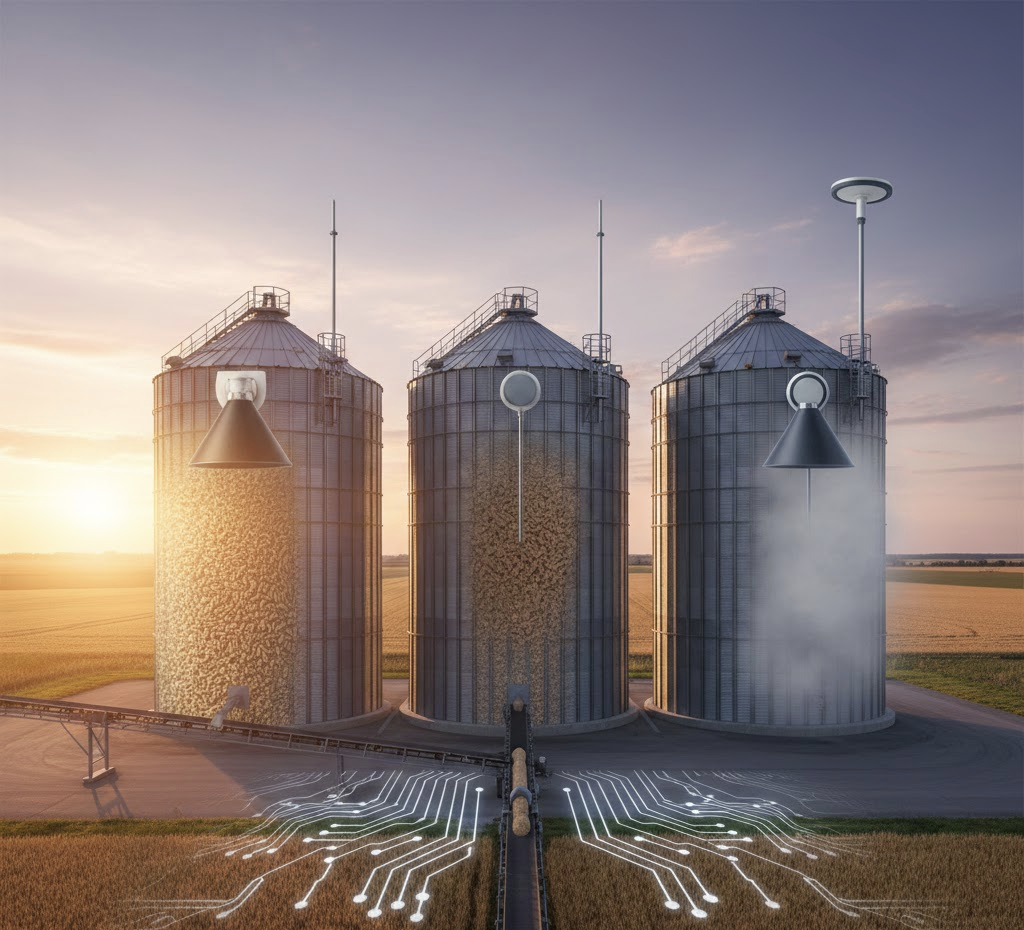
If you manage grain silos, feed bins, or powder storage, you already know the routine. Someone climbs up, knocks on the side, peers through a hatch, and gives a rough estimate: “looks about half full.” That estimate drives purchasing decisions worth thousands of dollars. And when it is wrong - when the silo runs empty on a Friday afternoon or overfills during a delivery - the cost is immediate and painful.
We have spent years deploying silo monitoring systems across farms, feed mills, and industrial storage facilities. In this guide, we break down the four main sensor technologies for continuous silo level measurement, explain which works best for different materials, and show how IoT connectivity turns raw sensor data into actionable inventory intelligence.
The Real Cost of Not Monitoring Silo Levels
Manual silo checks are not just inconvenient - they are a liability. Consider what happens in practice:
Stockouts are the most obvious problem. A dairy farm with 200 cows consuming 25 kg of feed each per day goes through a 20-tonne silo in roughly four days. Misjudge the level by 20%, and you are caught short by a full day. Emergency feed deliveries typically cost 30-50% more than scheduled ones, assuming a supplier can even deliver on short notice.
Overfilling is equally dangerous. When a delivery driver fills a silo beyond capacity, material backs up into the fill pipe, damages pressure relief systems, or in extreme cases compromises the silo structure itself. We have seen corrugated steel bins buckle from overpressure events that started with a simple overfill.
Safety is the factor people underestimate most. Climbing silos for visual inspections accounts for a disproportionate share of farm injuries. Falls, dust inhalation, and engulfment are real risks that a $500-800 sensor eliminates entirely.
Waste from spoilage adds up quietly. Without consumption tracking, it is easy to miss that a silo’s usage pattern has changed - a sign that material is caking, bridging, or degrading. By the time someone notices, tonnes of product may be unsalvageable.
Why Monitor Silo Levels Continuously?
A one-time level check tells you where things stand right now. Continuous monitoring tells you where things are heading. That distinction changes how you manage inventory.
Feed Management Optimization
With continuous level data logged over weeks and months, you can see actual consumption rates per silo, per day, per season. This lets you right-size your ordering. Instead of keeping two weeks of buffer stock “just in case,” you can operate with five days of buffer and know exactly when to reorder. For a facility running ten silos, that reduction in buffer stock frees up significant working capital.
Just-in-Time Ordering
When your monitoring system sends an alert at 30% fill level, your purchasing team has a precise window to order at the best price and schedule delivery at a convenient time. No panic calls, no premium freight charges, no weekend emergencies.
Preventing Overfilling and Structural Damage
A pre-delivery level check - done remotely from a dashboard rather than physically at the silo - confirms there is enough headroom for the incoming load. Some systems can even integrate with delivery scheduling to automatically verify capacity before dispatch.
Compliance and Traceability
In regulated industries like food-grade grain storage and pharmaceutical powder handling, inventory traceability is not optional. Continuous level logging creates an auditable record of material movements, supporting HACCP, GMP, and ISO compliance without additional manual documentation.
Sensor Technologies Compared
There are four main approaches to measuring silo fill level. Each has legitimate use cases, and each has conditions where it fails. Here is what we have learned from deploying all four.
80 GHz Radar (FMCW)
Frequency-Modulated Continuous Wave (FMCW) radar is the technology we recommend most often, and the one we build our 80 GHz radar level sensor around.
How it works: The sensor sits at the top of the silo and emits a continuous microwave signal that sweeps across a frequency range centered at 80 GHz. When the signal hits the material surface, it reflects back. The sensor compares the transmitted and received frequencies - the difference is proportional to distance. This gives a precise measurement of the empty space above the material, which is converted to fill level based on the known silo dimensions.
Why 80 GHz matters: Older radar level sensors operated at 26 GHz, which produced a wide beam angle (around 10-12 degrees). In a narrow silo, that beam bounces off walls, internal ladders, and structural supports, creating false echoes that confuse the measurement. At 80 GHz, the beam angle narrows to just 3-4 degrees. This focused beam hits only the material surface, even in silos as narrow as 1.5 meters in diameter.
Strengths:
- Unaffected by dust, even during active filling
- Unaffected by temperature swings (-40 to +80 degrees Celsius)
- No moving parts, no maintenance schedule
- Works through condensation and steam
- Measures through low-dielectric materials (grain, plastic pellets, wood chips)
- Typical accuracy of ±5 mm distance measurement
Limitations:
- Higher upfront cost than ultrasonic (typically 2-3x)
- Requires correct mounting position to avoid structural obstructions
- Very low-dielectric materials (some dry powders with dielectric constant below 1.5) can weaken the reflected signal
Ultrasonic Sensors
Ultrasonic level sensors use sound waves instead of microwaves. A transducer emits a high-frequency sound pulse (typically 40-70 kHz), which bounces off the material surface and returns. The sensor calculates distance from the time-of-flight.
Strengths:
- Lower cost (typically $150-400 per sensor)
- Simple installation
- Good accuracy under ideal conditions (±1-2%)
- Well-suited for liquid level measurement in clean environments
Limitations:
- Dust is the primary killer. During silo filling, airborne dust absorbs and scatters the sound wave, causing the sensor to lose the return signal entirely. In grain silos that are filled frequently, this means the sensor gives no reading precisely when you most need one.
- Temperature sensitivity. The speed of sound changes with temperature (roughly 0.17% per degree Celsius). A 40-degree temperature swing between winter night and summer afternoon introduces measurement errors of several percent unless the sensor has active temperature compensation.
- Condensation on the transducer face attenuates the signal.
- Foam and light materials (like expanded polystyrene beads) absorb sound and prevent reliable measurement.
We still deploy ultrasonic sensors in specific situations - primarily liquid tanks and silos storing dense, low-dust materials where the environment is temperature-controlled. For outdoor grain or feed silos, we have moved away from them entirely.
Load Cells (Weight-Based Measurement)
Instead of measuring the distance to the material surface, load cell systems measure the total weight of the silo and its contents. Three or four load cells are installed under the silo legs, and the known empty weight of the silo is subtracted to get the net material weight.
Strengths:
- Direct weight measurement, not an inferred level
- Very high accuracy (±0.1-0.5% of full scale)
- Completely independent of material properties, dust, or temperature
- Ideal for batching and blending operations where weight precision matters
- Works with any material type
Limitations:
- Retrofit cost is prohibitive. Installing load cells under an existing silo typically requires lifting the entire structure with a crane, which can cost $5,000-15,000 per silo in labor alone, on top of the load cells themselves ($1,000-3,000 per set).
- Wind loading on tall silos creates lateral forces that introduce measurement noise. Outdoor installations in exposed locations may need wind compensation algorithms.
- Structural modifications are often needed. Older silos may not have discrete legs suitable for load cell mounting.
- Platform scale drift over years requires periodic recalibration.
Load cells make excellent sense for new silo installations where they can be designed in from the start. For retrofitting existing silos, radar is almost always more practical.
Capacitive / Admittance Sensors
Capacitive sensors measure the dielectric properties of the material in contact with a probe. As material level rises around the probe, the capacitance changes proportionally. Admittance sensors are a refined version that compensate for material buildup on the probe.
Strengths:
- Low cost for point-level detection (high/low alarms)
- Rugged, no electronics exposed to the silo interior
- Good for detecting material presence at a specific height
Limitations:
- Continuous measurement requires a probe the full height of the silo. A rod or cable probe in a 15-meter silo is subject to bending, material bridging, and mechanical stress during filling and discharge.
- Material-dependent calibration. Dielectric properties change with moisture content, temperature, and material density. A probe calibrated for dry wheat will read incorrectly if the moisture content increases by a few percent.
- Buildup and rat-holing around the probe skew readings.
- Not suitable for materials that cake, bridge, or have inconsistent density.
We use capacitive sensors primarily as point-level switches - a high-level alarm near the top of the silo to prevent overfilling, or a low-level alarm to trigger reorder notifications. For continuous level measurement, they are outperformed by radar in almost every scenario.
Comparison Table
| Feature | 80 GHz Radar | Ultrasonic | Load Cells | Capacitive |
|---|---|---|---|---|
| Measurement type | Non-contact, continuous | Non-contact, continuous | Contact (silo base), continuous | Contact (probe), continuous or point |
| Typical accuracy | ±5 mm | ±1-2% (ideal) | ±0.1-0.5% | ±2-5% |
| Dust tolerance | Excellent | Poor | N/A | Moderate |
| Temperature range | -40 to +80 C | -20 to +60 C | -30 to +70 C | -40 to +80 C |
| Moving parts | None | None | None | None |
| Installation difficulty | Easy (top mount) | Easy (top mount) | Difficult (silo base) | Moderate (probe insertion) |
| Retrofit suitability | Excellent | Good | Poor | Moderate |
| Cost per silo | $400-800 | $150-400 | $2,000-5,000+ | $100-300 (point) / $500-1,500 (continuous) |
| Best for | Grain, feed, powder, pellets | Liquids, clean environments | New builds, precision batching | Point-level alarms |
Choosing by Material Type
The material stored in your silo is the single biggest factor in sensor selection. Here is what we have found works in practice.
Grain (Wheat, Corn, Barley, Rice)
Grain is a relatively well-behaved material for radar sensors. It has a moderate dielectric constant (3-5), produces a strong radar reflection, and forms a reasonably flat surface. The main challenge is dust during filling, which rules out ultrasonic sensors. Grain also has a natural angle of repose (20-30 degrees), meaning the surface is not perfectly flat - it peaks under the fill point and slopes toward the walls. An 80 GHz radar sensor mounted off-center (about one-third of the radius from the wall) reads the average level more accurately than one mounted dead center.
Recommended: 80 GHz radar, mounted off-center from fill point.
Animal Feed (Pellets and Mash)
Pelleted feed is similar to grain in radar behavior, but mash feed creates significantly more dust and tends to have a steeper angle of repose. Mash also bridges more readily, creating void spaces inside the silo that no top-mounted sensor can detect. For mash feed silos, we recommend combining a radar sensor for continuous level measurement with a low-level capacitive switch as a backup alarm.
Recommended: 80 GHz radar + capacitive low-level switch.
Powder (Flour, Cement, Calcium Carbonate, Mineral Supplements)
Fine powders are the most challenging materials for level measurement. They generate extreme dust during filling (cement dust can take 30+ minutes to settle), have low dielectric constants (cement is around 2.5-3.0), and can have very flat or very uneven surfaces depending on the fill method.
Radar works, but you need to ensure the sensor has sufficient signal strength for low-dielectric materials. Our 80 GHz radar level sensor is rated for materials with a dielectric constant as low as 1.5, which covers virtually all industrial powders.
Ultrasonic sensors are essentially unusable in powder silos due to dust. Load cells work well if you are building new, but the retrofit argument stands.
Recommended: 80 GHz radar with high-sensitivity mode for low-dielectric powders.
Plastic Pellets and Granules
Plastic pellets have very low dielectric constants (often 2.0-3.0), which means weaker radar reflections. The narrow beam of an 80 GHz sensor is critical here - in a narrow plastics silo, a 26 GHz sensor’s wide beam would bounce off walls and overpower the weak surface reflection. An 80 GHz sensor with a 3-degree beam angle avoids this problem.
Recommended: 80 GHz radar, ensure narrow beam and adequate sensitivity.
Liquids (Water, Liquid Feed, Molasses)
Liquids are the one case where ultrasonic sensors genuinely compete. Liquid surfaces are flat, there is no dust, and the strong acoustic reflection from a liquid surface gives reliable readings. If the tank is indoors and temperature-stable, ultrasonic can be the most cost-effective option.
For outdoor liquid tanks or tanks with vapor/foam, radar remains the safer choice.
Recommended: Ultrasonic for clean indoor tanks; radar for outdoor or challenging conditions.
Installation Best Practices
Even the best sensor gives poor results if installed incorrectly. Here are the mounting guidelines we follow on every installation.
Mounting Position
For non-contact sensors (radar and ultrasonic), the sensor should be mounted at the top of the silo, looking straight down. Key considerations:
- Avoid the center fill point. Material falling directly onto the sensor during filling can damage it or create false readings. Mount the sensor at least 200 mm from the fill stream.
- Avoid the silo wall. The sensor beam should not intersect the wall at any point along its path. For an 80 GHz sensor with a 3-degree beam angle, this means mounting at least 150 mm from the wall for every meter of silo height.
- The sweet spot is typically one-third of the silo radius from the center, offset from the fill pipe. This reads a representative surface level that accounts for the material’s angle of repose.
Nozzle and Process Connection
Most radar sensors mount via a threaded or flanged nozzle. The nozzle length matters - if the nozzle is too long, the sensor beam can clip the nozzle edge and create a permanent false echo. As a rule, the nozzle inner diameter should be at least 40 mm larger than the sensor’s antenna diameter, and the nozzle length should not exceed 150 mm for a standard installation.
Avoiding False Echoes
Internal silo structures - ladders, level switches, support beams, stiffener rings - can reflect the radar signal and produce false readings. Modern 80 GHz sensors have built-in false echo suppression: during commissioning, you teach the sensor which echoes are structural (by running a “learn” cycle with the silo empty or at a known level), and the sensor ignores those echoes in future measurements.
Wiring
Most silo level sensors output either a 4-20 mA analog signal or RS485 Modbus RTU digital signal. For runs under 100 meters, shielded twisted-pair cable is sufficient for either protocol. For longer distances or electrically noisy environments (near VFDs, welding equipment, or heavy motors), RS485 is more robust than 4-20 mA because it uses differential signaling.
Route cables away from power lines, use cable glands with IP67 or better rating at the sensor junction box, and provide a drip loop at any outdoor cable entry point to prevent water ingress.
IoT Integration for Remote Monitoring
A sensor mounted on a silo is useful. A sensor connected to the cloud is transformative. Here is how the integration works in a typical deployment.
From Sensor to Cloud
The data path is straightforward:
- Sensor measures distance to material surface, outputs RS485 Modbus RTU or 4-20 mA signal
- IoT controller reads the sensor data on a configurable interval (typically every 5-15 minutes), converts distance to fill level percentage and estimated volume/weight
- Cellular or LoRaWAN backhaul transmits the data to a cloud platform
- Cloud dashboard displays current levels, historical trends, and consumption rates
Our Omni Exodus Controller handles steps 2 and 3. It supports up to 8 RS485 sensors and 4 analog inputs on a single controller, making it practical to monitor multiple silos from one device. It connects via 4G LTE cellular and pushes data to the cloud platform at configurable intervals.
For large sites with 10+ silos spread across a wide area, LoRaWAN connectivity reduces per-silo cost by using a single gateway to aggregate data from multiple sensor nodes across a 2-5 km range.
Dashboard and Alerts
The cloud platform turns raw level data into operational intelligence:
- Current fill levels displayed as simple gauges for each silo
- Consumption trend graphs showing daily, weekly, and monthly usage
- Predictive empty date calculated from the current consumption rate
- Low-level alerts via SMS, email, or webhook when a silo drops below a configurable threshold (e.g., 25%)
- High-level alerts to prevent overfilling during deliveries
- Delivery logging - sudden level increases are automatically flagged as deliveries, creating a receipt record
For a complete walk-through of our silo monitoring deployment architecture, see our silo monitoring solution page.
Integration with Existing Systems
Many feed mills and grain facilities already run ERP or inventory management software. The cloud platform provides an API that feeds level data into these systems, closing the loop between physical inventory and digital records. We have integrated with systems ranging from simple spreadsheet exports to full SAP and Microsoft Dynamics connections.
ROI and Practical Considerations
Silo monitoring is one of the few IoT investments where the payback calculation is unambiguous.
The Math
Consider a mid-sized poultry farm running 6 feed silos, each holding 20 tonnes. Without monitoring, the farm keeps an average of 60% fill across all silos as a safety buffer - that is 72 tonnes of feed on hand at any time. Feed costs around $350 per tonne.
With monitoring and predictive ordering, the farm can safely reduce the average buffer to 35% - about 42 tonnes on hand. That frees up 30 tonnes of working capital, worth $10,500 in feed alone. Add in the elimination of two emergency deliveries per year ($500 premium each) and one overfill incident ($2,000 in wasted product and cleanup), and the first-year savings reach approximately $13,500.
The cost of monitoring 6 silos with radar sensors and a shared IoT controller runs approximately $4,000-5,000 installed, plus roughly $150/year for connectivity. The system pays for itself in under five months.
Maintenance
80 GHz radar sensors have no moving parts and no consumables. In our experience, the typical maintenance requirement is zero for the first 5-7 years. The only periodic check we recommend is a visual inspection of the antenna face for material buildup once a year - and even this is rarely an issue because the antenna is mounted at the top of the silo, away from the material.
IoT controllers should have their firmware updated annually (done remotely over-the-air in most cases) and the cellular SIM or LoRaWAN subscription renewed.
Common Pitfalls to Avoid
- Do not cheap out on the sensor and overspend on the platform. A $150 ultrasonic sensor feeding a $50/month cloud platform is a poor investment if the sensor cannot read through dust. Spend the money on a reliable radar sensor and use a simple, affordable cloud service.
- Do not install sensors during active filling and then wonder why the readings are off. Commission the sensor when the silo is either empty or stable at a known level.
- Do plan for cable routing before the sensor arrives. Running RS485 cable across a silo farm after the fact is awkward and expensive. Include cable conduit in the installation plan.
- Do label your silos in the dashboard exactly as your team refers to them. “Silo 3 - Layer Feed” is useful. “Sensor_node_0x4A3F” is not.
Conclusion
Silo level monitoring has matured from an expensive industrial luxury to a practical, affordable technology that pays for itself within months. The 80 GHz radar level sensor has emerged as the clear winner for the vast majority of applications - grain, feed, powder, pellets, and cement - because it handles dust, temperature variation, and condensation without flinching.
The sensor is only half the equation. Connecting it to an IoT controller like the Omni Exodus Controller and pushing data to a cloud dashboard transforms a point measurement into a continuous inventory management system. You get alerts before you run out, confirmation before deliveries arrive, and consumption data that drives smarter purchasing decisions.
If you are still climbing silos or knocking on walls, the technology to stop doing that is proven, affordable, and available today. Start with your most critical silo, prove the value, and expand from there.