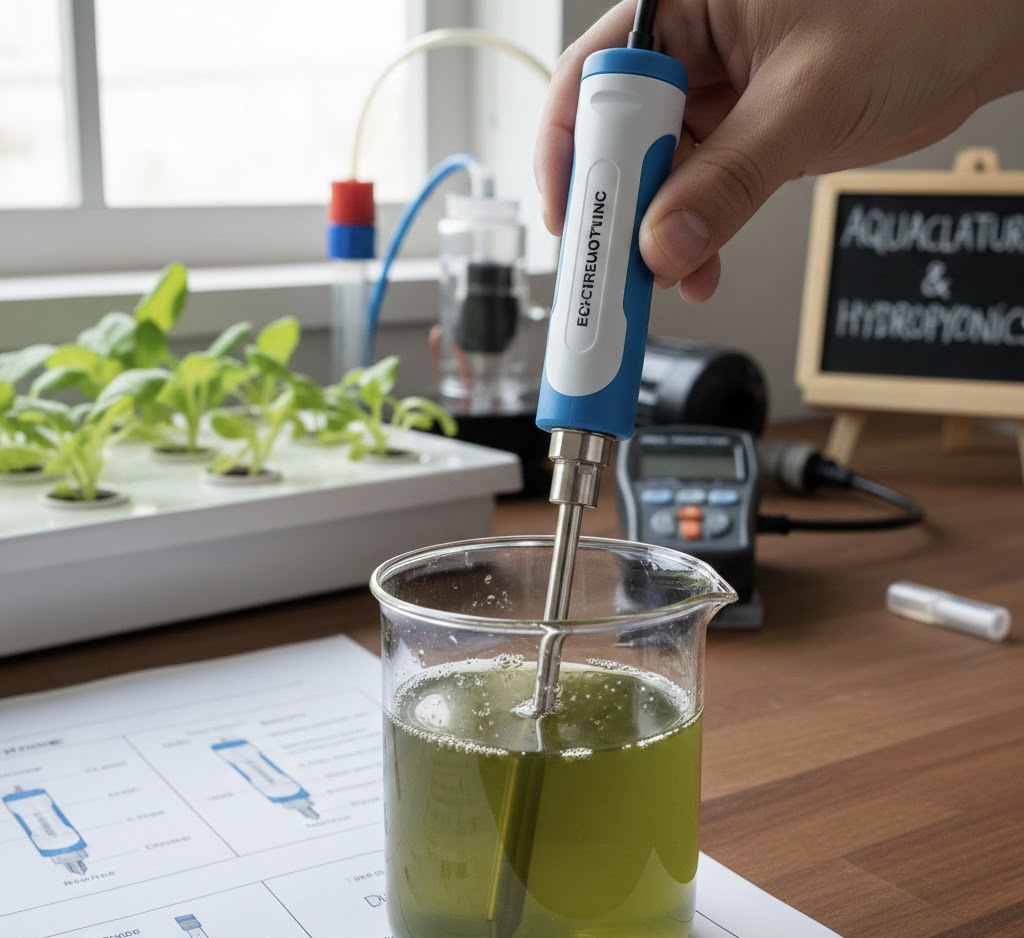
A hydroponic grower we work with in the Netherlands was running lettuce at what his meter read as 1.4 mS/cm. Perfect range for butterhead. Except his EC probe had a cell constant of K=10, which is designed for high-conductivity water like seawater. At the low end of its range, it was wildly inaccurate. The actual EC in his nutrient solution was closer to 0.6 mS/cm. His lettuce was starving. Growth had stalled for weeks, leaves were pale, and he was blaming his nutrient concentrate supplier before someone finally checked the probe specs.
On the other end of the spectrum, a shrimp farmer in Thailand was using a K=0.1 probe in full-strength brackish water at 18 mS/cm. The probe was pegged at its maximum, reading a flat 2.0 mS/cm all day regardless of what was actually happening. He had no visibility into salinity swings during water exchanges, and his shrimp were showing signs of osmotic stress that nobody could explain.
Both of these are real situations, and both came down to the same problem: choosing the wrong EC probe for the application. It sounds like a minor detail. It is not. Electrical conductivity is the single measurement that tells you how much dissolved material is in your water, whether that is nutrients in a hydroponic system, salt in a marine tank, or minerals in a freshwater pond. Get it wrong and you are flying blind on everything from feed management to water exchange scheduling.
This guide walks through how to choose the right EC probe based on what you are actually measuring, in what kind of water, and under what conditions. We will cover the technical details that matter and skip the ones that do not.
What EC Measures and Why It Matters
Electrical conductivity is a measurement of how easily electric current passes through water. Pure water is actually a poor conductor. It is the dissolved ions in the water, things like sodium, chloride, calcium, potassium, nitrate, and phosphate, that carry the current. The more dissolved ions, the higher the conductivity.
EC is reported in two common units: millisiemens per centimeter (mS/cm) and microsiemens per centimeter (uS/cm). The conversion is simple: 1 mS/cm equals 1,000 uS/cm. Freshwater systems typically operate in the hundreds of uS/cm range, while seawater sits around 53 mS/cm.
EC, TDS, and Salinity: Same Probe, Different Numbers
This causes more confusion than it should. All three measurements come from the same EC probe. The difference is purely mathematical.
EC (electrical conductivity) is the raw measurement. The probe applies a voltage between two electrodes and measures the resulting current. That gives you conductivity in mS/cm or uS/cm.
TDS (total dissolved solids) is EC multiplied by a conversion factor, typically between 0.5 and 0.7, depending on the dominant ions in your water. For most freshwater aquaculture, 0.5 is standard. For nutrient solutions in hydroponics, 0.64-0.70 is more accurate. The result is reported in ppm or mg/L. It is an estimate, not a direct measurement. If someone tells you their probe “measures TDS,” it is measuring EC and doing the multiplication internally.
Salinity is another derived value, typically using a more complex algorithm that accounts for temperature and pressure. It is reported in parts per thousand (ppt) or practical salinity units (PSU). For marine and brackish aquaculture, salinity is the number that matters operationally because it directly relates to the osmotic environment your animals live in.
The important takeaway: you do not need three different probes. You need one good EC probe and a controller or monitoring system that can apply the correct conversions for your application.
Why EC Matters in Aquaculture
In aquaculture, EC is your window into the dissolved mineral content of the water. Sudden EC changes can indicate problems: a spike might mean a salt intrusion event or fertilizer runoff into a pond. A drop might mean dilution from rainwater or a failing water source. In RAS systems, rising EC over time signals accumulating dissolved waste that water changes need to address.
For marine and brackish systems, EC (as salinity) is a primary welfare parameter. Most aquatic species tolerate only a narrow salinity range. Litopenaeus vannamei shrimp, for example, grow best at 15-25 ppt but can survive 0.5-45 ppt. The key word is “survive.” Outside the optimal range, they spend energy on osmoregulation instead of growth. A 5 ppt salinity swing that your probe missed because it was out of range or poorly calibrated can cost you weeks of growth performance.
Why EC Matters in Hydroponics
In hydroponics, EC is your primary tool for managing plant nutrition. The nutrient solution is everything. Unlike soil, which buffers and stores nutrients, a hydroponic system delivers dissolved minerals directly to the roots in real time. EC tells you the total concentration of dissolved nutrients in solution.
Too low, and the plants starve. Too high, and you get salt stress: leaf tip burn, stunted growth, and in extreme cases, reverse osmosis that pulls water out of the roots. The window between “not enough” and “too much” is surprisingly narrow for many crops. Lettuce wants 0.8-1.5 mS/cm. Go to 2.5 mS/cm and you will see tip burn within days. Tomatoes can handle 2.0-3.5 mS/cm, but seedlings of the same plant need 0.5-1.0 mS/cm or they will wilt.
EC does not tell you which nutrients are present, only the total ionic strength. You can have perfect EC with a completely unbalanced nutrient profile. But without accurate EC, you cannot even begin to manage nutrients effectively.
Understanding Cell Constants: The Most Misunderstood Spec
The cell constant, expressed as K, is the single most important specification on an EC probe, and the one most people choose wrong. It determines the measurement range and accuracy of the probe.
What the Cell Constant Actually Is
A conductivity probe has two or more electrodes separated by a defined distance. The cell constant is the ratio of the distance between electrodes to the area of the electrodes: K = distance / area. It is expressed in cm^-1.
A small cell constant (K=0.1) means the electrodes are close together and/or have large surface area. This creates high sensitivity at low conductivity levels but saturates quickly in conductive water.
A large cell constant (K=10) means the electrodes are far apart and/or have small surface area. This works in highly conductive water but lacks resolution at low levels.
Think of it like choosing a measuring tape. A tape marked in millimeters is great for measuring a circuit board but useless for surveying a field. A tape marked in meters is perfect for the field but cannot measure a circuit board. The cell constant is your measuring tape for conductivity.
Cell Constant Selection Table
| Cell Constant | Effective Range | Best For | Not Suitable For |
|---|---|---|---|
| K=0.1 | 0.5 uS/cm - 500 uS/cm | Ultra-pure water, deionized water, boiler condensate | Anything above tap water |
| K=0.5 | 10 uS/cm - 5 mS/cm | Drinking water, freshwater aquaculture, low-EC hydroponics | Brackish or saltwater |
| K=1.0 | 10 uS/cm - 20 mS/cm | General purpose: hydroponics, freshwater aquaculture, brackish water | Full-strength seawater |
| K=10 | 1 mS/cm - 200 mS/cm | Marine aquaculture, saltwater, brine, high-concentration solutions | Freshwater, low-EC hydroponics |
The most common mistake we see is farmers buying a K=10 probe because it has the widest range and assuming it covers everything. It does not. A K=10 probe reading 1.2 mS/cm in a hydroponic nutrient solution is operating at the very bottom of its range, where the signal-to-noise ratio is poor and accuracy degrades significantly. You might get readings that bounce between 0.9 and 1.5 mS/cm when the actual value is stable at 1.2 mS/cm.
For most hydroponic and freshwater aquaculture operations, K=1.0 is the correct choice. It covers the practical range you need with good resolution. For marine operations, K=10. If you run both freshwater and saltwater systems on the same site, buy one of each. Do not compromise on a single probe for both.
EC Ranges by Application
Here are the specific EC ranges you should expect for common applications. Use these to guide your probe selection.
| Application | Typical EC Range | Recommended K | Notes |
|---|---|---|---|
| Freshwater aquaculture (tilapia, catfish) | 0.2 - 1.5 mS/cm | K=1.0 | Low EC; monitor for changes, not absolute value |
| Freshwater RAS | 0.5 - 3.0 mS/cm | K=1.0 | Rising EC indicates dissolved waste accumulation |
| Brackish shrimp farming | 5 - 30 mS/cm | K=1.0 or K=10 | Wide swings during water exchange and rain events |
| Marine aquaculture (salmon, sea bass) | 45 - 55 mS/cm | K=10 | Narrow range but high absolute value |
| Hydroponic lettuce/herbs | 0.8 - 1.5 mS/cm | K=1.0 | Sensitive crops, need tight control |
| Hydroponic tomatoes/peppers | 2.0 - 3.5 mS/cm | K=1.0 | Higher EC tolerance, varies by growth stage |
| Hydroponic strawberries | 1.0 - 1.8 mS/cm | K=1.0 | Moderately sensitive |
| Aquaponics | 0.3 - 1.0 mS/cm | K=0.5 or K=1.0 | Lower than pure hydroponics; fish waste provides nutrients |
| Irrigation water quality | 0.1 - 3.0 mS/cm | K=1.0 | Above 2.5 mS/cm indicates salinity risk for most crops |
A note on brackish systems: if your operation spans the range of 5-30 mS/cm, you are in the overlap zone between K=1.0 and K=10. A quality K=1.0 probe rated up to 20 mS/cm will cover the lower end. If you regularly exceed 20 mS/cm during high-salinity periods, go with K=10 and accept slightly less resolution at the low end. Or better yet, deploy both and use the reading from whichever probe is in its optimal range.
Probe Materials and Construction
The material your probe is made from matters more than most spec sheets suggest, especially in harsh aquaculture environments where the probe sits submerged 24/7 in water that is often warm, salty, and biologically active.
Electrode Materials
Graphite electrodes are the workhorse of aquaculture EC probes. Graphite is chemically inert in both fresh and saltwater, resists biofouling better than metals, and is inexpensive. It does not corrode and does not polarize at the voltages used in EC measurement. The downside is that graphite is mechanically soft. Aggressive cleaning with metal brushes can damage the electrode surface and shift the cell constant. Use soft nylon brushes only.
Platinum electrodes offer the highest accuracy and stability. Platinum is virtually inert in any water chemistry and maintains a consistent surface over years. Platinum-plated electrodes are common in laboratory-grade probes, and some industrial probes use solid platinum rings. The cost is higher, but for critical applications where calibration drift is unacceptable, platinum justifies the premium.
Stainless steel electrodes are common in low-cost probes and handheld meters. They work adequately in freshwater and hydroponic applications. In saltwater, however, stainless steel corrodes. Even 316L stainless, which handles mild chloride exposure, will pit and degrade in full-strength seawater over months. If you see a stainless steel EC probe marketed for marine use, be skeptical.
Titanium electrodes appear in some specialized marine probes. Titanium forms a self-healing oxide layer that resists saltwater corrosion indefinitely. It is an excellent material for marine EC probes, though less common than graphite.
Body Materials
The probe housing matters as much as the electrodes. Common options:
| Body Material | Freshwater | Brackish | Marine | Chemical Resistance | Cost |
|---|---|---|---|---|---|
| PVC/PVDF | Excellent | Excellent | Excellent | Good | Low |
| PEEK | Excellent | Excellent | Excellent | Excellent | High |
| 316 Stainless Steel | Excellent | Good (limited lifespan) | Poor | Moderate | Medium |
| Titanium | Excellent | Excellent | Excellent | Excellent | High |
| Epoxy/Resin | Good | Good | Moderate | Moderate | Low |
For most aquaculture and hydroponic installations, a PVC or PVDF body with graphite or platinum electrodes is the practical choice. It handles any water chemistry, is easy to clean, and costs less than metal housings. Reserve titanium and PEEK bodies for demanding marine environments or installations where probe replacement is difficult and expensive.
Cable and Connector Considerations
This is where many people overlook details that cause field failures. The cable gland where the wire exits the probe body is the most common point of water ingress. Look for probes with IP68-rated cable exits and strain relief. In marine environments, the cable jacket itself must resist UV and saltwater degradation. PUR (polyurethane) jackets outperform PVC jackets in saltwater by a wide margin.
Connector type matters if you plan to disconnect probes for calibration or replacement. Threaded M12 or potted cable connections are standard. Avoid probes with exposed pin connectors in wet environments; they will corrode and introduce noise.
Choosing the Right EC Probe: A Decision Guide
Based on your application, here is how to narrow down your selection from the Agrinovo EC probe lineup.
For Hydroponics and Freshwater Aquaculture
The EC-100 is designed for this range. With a K=1.0 cell constant and an operating range of 0-20 mS/cm, it covers hydroponic nutrient solutions and freshwater systems with excellent resolution. Graphite electrodes mean no corrosion concerns in nutrient solutions that might be acidic (pH 5.5-6.5 is typical in hydroponics). If you are running lettuce, herbs, tomatoes, strawberries, or any standard hydroponic crop, this is the probe to start with.
For Brackish Water and Mixed Operations
The EC-120 bridges the gap between freshwater and marine with an extended range that handles brackish shrimp farming and systems where salinity varies widely. If your operation sees water that ranges from 5 mS/cm to 40+ mS/cm depending on the season or water exchange schedule, the EC-120 gives you one probe that stays accurate across that span.
For Marine and High-Salinity Applications
The EC-J100 is built for full-strength seawater and high-conductivity environments. With a K=10 cell constant, it reads accurately in the 45-55 mS/cm range typical of marine aquaculture and handles brine solutions well above that. Marine-rated materials throughout mean it withstands continuous immersion in saltwater without degradation.
For Inline Process Monitoring
The EC-10 is a compact inline probe designed for installation in pipes and flow cells. If you are monitoring EC in a hydroponic feed line, a RAS water treatment loop, or any pressurized plumbing system, this probe integrates without requiring an open tank or sump installation. Its form factor and connection type are optimized for inline mounting.
Quick Selection Matrix
| Application | Primary Probe | Alternative |
|---|---|---|
| Hydroponic nutrient tank | EC-100 | EC-10 (inline) |
| Freshwater fish pond | EC-100 | - |
| Freshwater RAS | EC-100 | EC-10 (inline) |
| Brackish shrimp farm | EC-120 | EC-J100 |
| Marine fish cages | EC-J100 | - |
| Aquaponics | EC-100 | - |
| Feed line monitoring | EC-10 | - |
Calibration and Maintenance
EC probes are less maintenance-intensive than pH probes or dissolved oxygen sensors, but they are not set-and-forget. Neglect calibration and you will get readings that drift slowly enough to seem plausible but inaccurately enough to cause real problems.
How to Calibrate
EC calibration is straightforward compared to most water quality sensors. You need calibration standard solutions at known conductivity values.
Single-point calibration uses one standard solution, typically 1.413 mS/cm or 12.88 mS/cm. This adjusts the probe’s reading to match the known value at one point. It is adequate for applications where you only care about a narrow range.
Two-point calibration uses two standards that bracket your operating range. For hydroponics at 1.0-2.5 mS/cm, use 0.447 mS/cm and 2.764 mS/cm standards. For brackish water at 10-30 mS/cm, use 1.413 mS/cm and 12.88 mS/cm. Two-point calibration corrects both slope and offset errors, giving better accuracy across the full range.
Common calibration standards: 0.147 mS/cm, 0.447 mS/cm, 1.413 mS/cm, 2.764 mS/cm, 6.668 mS/cm, 12.88 mS/cm, 80.0 mS/cm, 111.8 mS/cm. Pick the two that bracket your operating range.
Calibration Frequency
| Environment | Recommended Interval | Why |
|---|---|---|
| Hydroponics (indoor, clean water) | Every 4 weeks | Low fouling, stable conditions |
| Freshwater aquaculture | Every 2-4 weeks | Moderate organic loading |
| Brackish aquaculture | Every 2 weeks | Higher fouling, salt crystal formation |
| Marine aquaculture | Every 2 weeks | Biofouling, mineral deposits |
| Inline process monitoring | Monthly, with regular flow | Flow reduces fouling |
Cleaning
The number one cause of EC probe drift is fouling on the electrode surfaces. Organic films, mineral scale, and biofilm all create an insulating layer that makes the probe read lower than actual conductivity.
Routine cleaning (weekly to biweekly): Remove the probe from the water. Rinse with clean fresh water. Use a soft nylon brush to gently clean the electrode surfaces. Rinse again. Reinstall.
Deep cleaning (monthly or when readings drift): Soak the electrode end in 10% hydrochloric acid (HCl) for 15-30 minutes to dissolve mineral deposits. For organic fouling, use a 5% bleach solution for 10 minutes, then rinse thoroughly. Never use both acid and bleach without thorough rinsing between; the chemical reaction produces chlorine gas.
Do not use abrasive materials on graphite electrodes. No steel wool, no scouring pads, no metal brushes. You will scratch the surface, change the effective electrode area, and shift the cell constant permanently.
Common Calibration Mistakes
Using expired calibration solutions. Conductivity standards have a shelf life. Once opened, most are good for 3-6 months. If the bottle has been sitting on your shelf for a year, buy a fresh one.
Not accounting for temperature. EC varies significantly with temperature, roughly 2% per degree Celsius. Quality probes have built-in temperature compensation (ATC), but the calibration standard bottle lists its conductivity at a reference temperature (usually 25 degrees C). If you are calibrating at 15 degrees C, the actual conductivity of a “12.88 mS/cm” standard is about 9.3 mS/cm. Let the probe and standard reach ambient temperature before calibrating, or use a probe with ATC and make sure it is enabled.
Cross-contaminating standards. Always rinse the probe with deionized or distilled water between calibration standards. Dipping a probe from a 12.88 mS/cm standard directly into a 1.413 mS/cm standard contaminates the low standard and shifts your calibration.
IoT Integration: Making EC Data Actionable
A standalone EC reading is useful. A continuous EC trend with automated alerts is transformative. The difference between checking EC manually twice a day and having a probe feeding data to a monitoring system every 60 seconds is the difference between reacting to problems and preventing them.
What Continuous EC Monitoring Reveals
In hydroponics, trending EC over time shows you nutrient uptake patterns. When plants are actively growing and taking up nutrients, EC drops. When transpiration exceeds nutrient uptake (hot days, high light), EC rises as water leaves but salts stay. These patterns tell you when to top off with fresh water versus nutrient solution and help you optimize feed schedules. A sudden EC spike can indicate a dosing pump malfunction. A gradual rise over days indicates the solution needs a partial change.
In aquaculture, EC trends reveal water exchange effectiveness, salinity intrusion events, and the gradual accumulation of dissolved waste in recirculating systems. In a shrimp pond, EC data overlaid with rainfall data tells you exactly how much freshwater dilution occurred during a storm and how quickly salinity is recovering. That information drives water management decisions that directly affect growth rates.
Setting Alerts
Effective EC alerts need both high and low thresholds. For a hydroponic lettuce system at target 1.2 mS/cm:
- Low warning: 0.8 mS/cm (nutrient depletion, needs dosing)
- Low critical: 0.5 mS/cm (plants will suffer, immediate attention)
- High warning: 1.8 mS/cm (concentration rising, dilute or check dosing)
- High critical: 2.5 mS/cm (tip burn risk, flush system)
For a brackish shrimp farm at target 15 ppt salinity (approximately 25 mS/cm):
- Low warning: 10 ppt (rain dilution event, check pond level)
- Low critical: 5 ppt (significant osmotic stress, emergency salt addition)
- High warning: 25 ppt (evaporation concentration, add fresh water)
- High critical: 35 ppt (approaching marine strength, urgent dilution needed)
Rate-of-change alerts are equally important. An EC drop of 5 mS/cm in one hour in a shrimp pond is abnormal and likely indicates a dike leak or sudden freshwater influx. A change of that magnitude would not trigger a static threshold alert until it had already moved well into the danger zone, but a rate-of-change alert catches it immediately.
Integration Architecture
Modern EC probes output analog (4-20 mA), RS-485 (Modbus RTU), or SDI-12 signals. For IoT integration, digital protocols (RS-485 or SDI-12) are strongly preferred over analog. They are less susceptible to electrical noise over long cable runs, carry temperature data alongside EC data, and allow multiple sensors on a single cable bus.
A typical deployment connects the EC probe to a field controller that reads the sensor data, applies temperature compensation, handles calibration offsets, and transmits data to a cloud platform via cellular or Wi-Fi. The cloud platform handles storage, visualization, alert logic, and integration with other sensor data (pH, DO, temperature) for a complete water quality picture.
If you are building out a monitoring system from scratch, our aquaculture monitoring system buyer’s guide covers the full architecture from sensors to cloud, including how to select controllers, communication protocols, and software platforms.
Conclusion
Choosing an EC probe comes down to three decisions: the right cell constant for your conductivity range, the right materials for your water chemistry, and the right output for your monitoring system. Get those three right and the probe will give you reliable, accurate data for years. Get any one of them wrong and you will spend time troubleshooting readings that never quite make sense.
For freshwater and hydroponic applications, a K=1.0 probe with graphite electrodes covers the vast majority of use cases. For marine and high-salinity operations, step up to K=10 with materials rated for continuous saltwater immersion. For inline monitoring in pipes and process loops, choose a probe form factor designed for that installation.
Do not overthink the selection, but do not underthink it either. The cost difference between probes is small relative to the cost of inaccurate data driving bad decisions in a system full of living organisms, whether those are fish, shrimp, or plants. Match the probe to the water, calibrate it regularly, keep the electrodes clean, and connect it to a system that turns raw numbers into actionable insights. That is the entire job.